

KP-155 · Water & Climate
PQNK Advisory Note: Frost, Cold Weather & Irrigation Management
Directly answers a farmer's question about whether irrigation should be increased during frost and cold spells, explaining why added water cannot protect plants from cold stress and can actively harm soil biology, with a supplementary protocol for mild-weather transitional-season crops.
Read or listen to the full paper ↓Abstract
Answering a farmer's question about whether irrigation, especially warm tube-well water applied at midnight, protects crops from frost, this advisory's short answer is no: increasing irrigation during cold or frost conditions does not protect plants and can actively harm soil life, aeration, and plant vigor. It explains cold stress as primarily an air-temperature and leaf-surface phenomenon rather than a soil-water problem, since frost damages plants by forming ice crystals on or inside leaf tissue that block gas exchange, a process water applied to roots cannot reverse.
The physiological reason irrigation fails is detailed through the plant's vacuum-pull water uptake mechanism: water is drawn upward only because leaf transpiration creates suction, and in cold weather transpiration is minimal and stomata are often closed, so no pull exists to draw applied water into the plant. Both candidate water sources are examined and rejected: canal water is already at cold ambient winter temperature and simply lowers soil temperature further while displacing air from pores, while groundwater, despite emerging at a relatively warm 18-22°C, spreads into a thin layer and loses that heat within minutes once applied, so its warming effect is described as temporary and biologically inconsequential while its aeration damage is lasting.
Instead, the paper argues PQNK prepares crops before cold arrives rather than reacting after: well-aggregated, crumbly, biologically active soil under permanent mulch moderates temperature swings, keeps roots oxygenated, and sustains microbial nutrient supply through cold snaps, producing plants with denser sap, stronger cell walls, and better stress signaling. It also distinguishes cold-tolerant crops (wheat, barley, mustard, rapeseed, which contain natural antifreeze proteins and higher soluble sugars, and for which cold can actually improve performance) from dormant or perennial crops that shed leaves or otherwise conserve energy as a survival strategy rather than exhibiting damage.
A dedicated section addresses transitional-season crops (potato, maize, early/late vegetables) planted during the Punjab plains' short spring and autumn windows, where rapid temperature swings, not water shortage, are the actual stressor. For these crops specifically, the paper recommends a 1-2% ethanol foliar spray every 8-10 days as a biologically compatible cryo-protectant that lowers cellular freezing stress, stabilizes membranes, and improves enzymatic activity during fluctuation, explicitly framed as temporary adaptive support rather than a fertilizer, pesticide, or stimulant.
The paper closes by directly debunking midnight tube-well irrigation as a frost-control tactic: while groundwater's modest warmth may delay frost by a few hours, the net effect in most cases is negative, since roots become oxygen-starved and soil temperature drops again before sunrise regardless, making mulch-driven soil insulation and pre-built plant immunity the superior strategy over water flooding.
Revision R1 (28 September 2026): the ethanol foliar-spray strength has been standardised across Pedaver material at 1-2% food-grade ethanol in clean water (about 10-20 ml per litre), used against ambient heat or cold stress and sprayed in the cooler part of the day; stronger solutions can scorch leaves. The PDF opens with a revision note; the original text follows unchanged.
Full Paper
If you use “Listen”, the text of the page may be sent to your browser or operating system’s speech provider, such as Apple, Google or Microsoft, depending on the voice your device uses. Pedaver does not process, transmit or store any audio.
(PQNK پقنک – pronounced “picnic” | Paedar Qudratti Nizam Kashatqari: the regenerative & sustainable Pristine Organic Farming System)
The Farmer’s Question (Summary)
During cold and frost conditions (کورا), should irrigation be increased—especially in the morning after frost—as commonly advised in conventional farming? Does water help plants resist frost damage?
PQNK’s Clear Answer (In Short)
No. Increasing irrigation during cold or frost conditions does not protect plants. In fact, unnecessary irrigation during cold periods can harm soil life, reduce aeration, and weaken plants, whether water comes from canals or tube-wells.
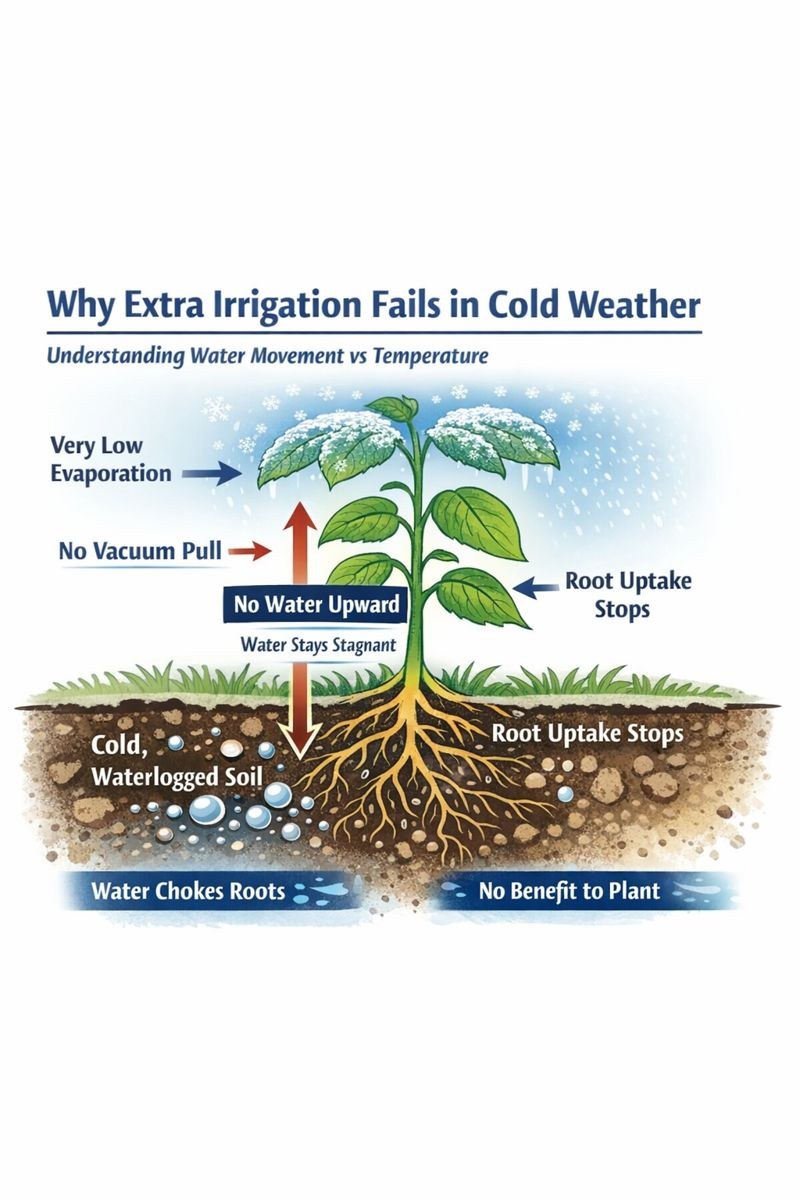
PQNK relies on soil moisture regulation, soil aeration, organic mulch, and plant immunity, not emergency watering.
1. Understanding Cold Stress in Plants (Scientific + Practical)
Cold stress is primarily an air-temperature and leaf-surface phenomenon, not a soil-water problem.
Frost damages plants when ice crystals form on or inside leaf tissues, blocking gas exchange.
Water on or around roots cannot reverse this process.
Plants do not absorb water on demand; they absorb water only when leaves are actively transpiring.
In cold conditions:
Transpiration is very low
Evaporation from leaves is minimal
Water movement inside plants is naturally slow
So adding more water does not push water into the plant.
2. Two Water Sources – Why Neither Helps During Frost
Farmers often believe warm tube-well water can “save” crops. Let’s examine both sources logically.
(a) Canal Water
Canal water is at ambient air temperature
During winter, this water is already cold
Applying it:
Lowers soil temperature further
Fills soil pores with water
Displaces air, reducing oxygen
(b) Tube-Well (Groundwater)
Groundwater temperature is usually 18–22°C (varies by depth & region)
But once applied:
It spreads in a thin layer
Loses heat rapidly
Reaches soil temperature within minutes
Result: The warmth is temporary and meaningless, but the damage is lasting:
Soil aeration collapses
Roots suffocate
Soil microbes slow down or die
Anaerobic conditions develop
👉 There is no lasting thermal benefit, only biological harm.
3. Why Extra Irrigation Fails – The Core Plant Physiology
Plants uptake water through a vacuum pull mechanism:
Water evaporates from leaves (transpiration)
This creates a suction force
Water is pulled upward against gravity
In cold weather:
Evaporation is extremely low
Leaves are often stomata-closed
No vacuum pull exists
So:
Water applied to soil cannot enter plants
Excess water stays stagnant
Roots and microbes suffocate
This is true in both conventional and organic systems—but PQNK avoids this trap.
4. What PQNK Does Differently (Why It Works)
PQNK prepares crops before cold arrives, not after.
PQNK Soil Conditions:
Well-aggregated soil (crumbly, porous)
Balanced moisture—not wet, not dry
High organic matter
Active soil biology
Permanent organic mulch cover
Results:
Soil temperature remains moderated
Sudden temperature shocks are reduced
Roots stay oxygenated
Microbial nutrient supply continues
Plants remain metabolically stable
5. Cold Tolerance of Different Crops (Natural Design)
Not all crops react the same way to cold.
Cold-Tolerant Crops:
Wheat
Barley
Mustard
Rapeseed
These crops contain:
Natural antifreeze proteins
Higher soluble sugars
Strong cell membrane stability
Cold actually improves their performance.
Perennial & Tree Crops:
Citrus can tolerate cold when healthy
Thick cuticle, dense sap, strong roots protect tissues
Dormant Crops & Trees:
Many species shed leaves
Enter dormancy
Conserve energy until temperatures rise
This is survival, not damage.
6. PQNK-Created Immunity: The Missing Factor
Under PQNK, plants develop systemic immunity, not chemical dependency.
This immunity comes from:
Balanced mineral nutrition (not excess nitrogen)
On-demand nutrients supplied by microbes
Strong root systems
Stable soil moisture
Aerated soil
Mulch-regulated temperature
Such plants:
Have denser sap (less freezing injury)
Stronger cell walls
Better stress signaling
Faster recovery after cold events
Cold becomes a filter that strengthens plants, not a threat.
7. Final PQNK Recommendation (Clear & Practical)
✅ Do NOT increase irrigation during frost or cold spells ✅ Maintain mulch cover ✅ Trust soil moisture already present ✅ Allow soil to breathe ✅ Let plants self-regulate
One Line to Remember:
Cold damages weak systems, not strong ones. PQNK builds strength before stress arrives.
Special PQNK Advisory for Mild-Weather & Transitional-Season Crops
(Early Spring & Late Autumn Conditions)
In regions like the Punjab plains of the Indian subcontinent, spring and autumn are very short transition periods. Crops planted during these windows—such as potato, maize (corn), early vegetables, and late vegetables—often face physiological stress due to rapid temperature swings rather than true water shortage.
1. The Core Problem in Transitional Seasons
Early spring:
Low night temperatures delay germination
Soil moisture may be present, but metabolic activity is slow
Late autumn:
Soil remains warm while air temperature drops rapidly
This creates root–shoot imbalance and stress in conventional systems
In both cases, extra irrigation does not solve the problem, because:
Water uptake depends on leaf evaporation (transpiration)
In cool or unstable temperatures, evaporation is minimal
Excess water only reduces soil aeration and stresses roots
2. PQNK Recommendation: 1% Ethanol Spray (Biologically Compatible Intervention)
For mild-weather crops and early/late season vegetables, PQNK recommends:
Spraying a 1% ethanol solution every 8–10 days
Why ethanol works (PQNK scientific rationale):
Ethanol acts as a natural cryo-protectant, similar to compounds plants produce internally
It:
Lowers cellular freezing stress
Stabilizes cell membranes
Improves enzymatic activity during temperature fluctuations
It enhances stress tolerance without disturbing soil life
It mimics natural antifreeze behavior seen in cold-tolerant plants
PQNK avoids chemical inputs but accepts biologically compatible tools when they align with natural plant physiology.
This practice is not a fertilizer, not a pesticide, and not a stimulant—it is a temporary adaptive support during climatic transitions.
3. About Midnight Tube-Well Irrigation & Frost
A common question is whether applying tube-well water at midnight helps protect crops from frost.
Scientific clarification:
Groundwater usually emerges slightly warmer (≈18–22°C depending on depth)
However:
Once applied, water rapidly cools to ambient temperature
It fills soil pores, displacing air
This reduces soil respiration and harms roots and soil life
While temporary surface warmth may slightly delay frost for a few hours, the net effect is negative in most cases:
Roots become oxygen-starved
Soil temperature drops again before sunrise
Plant stress increases rather than decreases
PQNK position:
Do not rely on midnight irrigation as a frost-control strategy
A mulched, aerated, biologically active soil provides far better frost buffering
Soil insulation + plant immunity is superior to water flooding
4. The PQNK Bottom Line for Transitional Crops
Frost and cold stress are energy and physiology problems, not water problems
PQNK solves these through:
Regulated soil moisture (never saturation)
Organic mulch for temperature buffering
Active soil biology
Plant-level immunity
Ethanol spray is recommended only where:
Crops are outside their ideal season
Temperature fluctuations are unavoidable
Natural immunity needs temporary support
Final Farmer Takeaway (Simple Logic)
🌱 Cold slows evaporation → no water pull → irrigation fails 🌱 Healthy soil + mulch + biology = natural protection 🌱 Ethanol helps plants adapt, not depend
This approach keeps crops alive, balanced, and productive—without breaking natural laws.
—————————
Footnote: PQNK (pronounced 'picnic')—the regenerative & sustainable Pristine Organic Farming System—is grounded in Natural Ecosystem Science. This science employs perennial biodiversity, protects soil with organic mulch, and avoids practices like water inundation, tillage disturbance, and leaving soil bare.
It is the process that matters most. PQNK is a pristine production system designed not merely for yield, but for optimal, balanced output—where quality, sustainability, and ecological harmony emerge from a self-regulated, zero-external-input methodology.
www.Facebook.Com/Pedaver
https://www.youtube.com/@pedaverpqnk3167/videos
http://www.youtube.com/@aasifsharif
PDF Knowledge papers: https://drive.google.com/drive/folders/1iadwV6mdUPyrUIpB3oRfNv6DLiackaUL?usp=sharing
pedaver@gmail.com
WhatsApp +92 320 677 6666
About This Paper
- Crop
- Wheat · Barley · Mustard · Rapeseed · Potato · Maize (Corn)
- Problem
- Cold / Frost Damage
- Science
- Climate · Plants · Water · Soil
- Evidence
- Scientific Mechanism
- Authority
- Current / Approved PQNK Knowledge
Related PQNK Science
Key Takeaways
- Do not increase irrigation during frost or cold spells; cold stress is an air-temperature/leaf-surface phenomenon, not a soil-water deficit, and added water cannot be pulled into the plant when transpiration is minimal.
- Neither canal water (already cold) nor groundwater (18-22°C but cooling to ambient within minutes of application) provides meaningful lasting warmth; both risk displacing soil air and harming root/microbial oxygenation.
- PQNK's cold-weather strategy is preparation, not reaction: well-aggregated, mulched, biologically active soil moderates temperature swings and keeps roots oxygenated through cold events.
- Cold-tolerant crops (wheat, barley, mustard, rapeseed) contain natural antifreeze proteins and higher soluble sugars and can actually perform better under cold; dormancy in perennials/trees is a survival strategy, not damage.
- For transitional-season crops facing rapid temperature swings, a 1-2% ethanol foliar spray every 8-10 days is recommended as a temporary, biologically compatible cryo-protectant, not a fertilizer or pesticide.
- Midnight tube-well irrigation as a frost-prevention tactic is explicitly discouraged: any brief warming effect is outweighed by oxygen starvation and soil temperature dropping again before sunrise.
Related Knowledge
same problem
Temperature-Induced Vascular Failure in Plants: Cold, Heat, Survival Mechanisms, and PQNK-Based Natural Interventions
Reframes both frost and heat damage as failures of hydraulic continuity in a plant's xylem rather than temperature alone, explaining the physics of freezing-induced embolism and heat-induced cavitation, and detailing PQNK's 1-2% ethanol foliar spray as a biologically compatible corrective signal.
same problem
PQNK Advisory Paper: Tomato (Solanum lycopersicum)
Tomato is naturally perennial in its tropical highland origin, and this advisory shows how PQNK's stable microclimate, mulch, living companion canopy, and a low-dose ethanol spray, can restore that perennial behavior in open-field cultivation, alongside a full sucker-pruning and harvest protocol.
same crop
Channeling Plant Energy: A PQNK Guide to Managing Vegetative Growth for Regenerative Production
With no grazing animals left to signal plants that their surplus foliage is being used, PQNK farmers must manually replicate that missing pressure. This guide sets out four directives, stamping, grazing, pruning and pinching, and bruising, with a crop-by-crop protocol for redirecting a plant's vegetative surplus into reproductive yield.
same problem
Rapeseed, Frost and the Sowing Window
Rapeseed survives winter cold; the danger is frost on its flowers and young pods. For central Punjab, PQNK sows between 1 and 15 October with a suitable variety so that the crop flowers after the main frost period, tops the leader shoot at about 12 inches for a shorter, branchier crop, and sprays a 2% solution of food-grade ethanol when flowering meets frost. Mulched living soil keeps roots active through winter; irrigation is never increased to fight frost.