

KP-081 · PQNK Philosophy, Framework & Economics
Supplemental Knowledge Paper: Quantifying the Abundance
A data supplement to 'The Perpetual Abundance Principle' that extends its phosphorus, potassium, and nitrogen soil-bank-versus-crop-uptake ratios across six major subcontinental crops, wheat, rice, corn, potato, cotton, and sugarcane, showing the 'undeniable disparity' holds even for the heaviest feeders.
Read or listen to the full paper ↓Abstract
The paper positions itself explicitly as the empirical backbone to the main 'Perpetual Abundance Principle' paper, aiming to remove any remaining abstraction from that paper's central claim by extending its wheat-only example into a full crop-by-crop dataset. Its centerpiece is Annex A, a table of nutrient removal for wheat, rice, corn, potato, cotton, and sugarcane at typical subcontinental yields, set against a constant topsoil reserve baseline of roughly 800 kg phosphorus, 14,000 kg potassium, and 2,000 kg nitrogen per acre.
The table shows phosphorus uptake ranging from about 4.2 kg (rice) to 24 kg (sugarcane) per acre, potassium uptake from 10 kg (wheat) to 144 kg (sugarcane), and nitrogen uptake from 35 kg (cotton) to 112 kg (corn), all measured against the same fixed soil bank. The paper adds footnotes clarifying that the phosphorus and potassium figures represent only the topsoil's mineral structure, itself continuously replenished by deeper geological weathering, and that the nitrogen figure represents only soil organic matter, with the true ultimate reserve being the atmosphere's 78% nitrogen content, continuously drawn down by nitrogen-fixing microbes.
Working through wheat as the illustrative case, the paper restates the ratios from the main paper (roughly 182:1 for phosphorus, 1,167:1 for potassium, 50:1 for nitrogen) and then extends the same logic to the heaviest feeder in the dataset, sugarcane, showing that even though sugarcane removes 24 kg of phosphorus per acre, roughly five times wheat's removal, the fixed 800 kg reserve is still 33 times larger than that substantially heavier withdrawal.
From this the paper draws two conclusions it calls inescapable: that mineral deficiency in agriculture is a problem of access, not scarcity, since the data shows soil is not 'poor' so much as poorly managed, and that input-based agriculture's standard prescriptions, such as applying 50 kg of P₂O₅ fertilizer to meet a crop's actual need of roughly 4-24 kg of elemental phosphorus, are revealed as a chemical brute-force overcorrection to what is fundamentally a biological access problem, one that further damages the very soil biology needed to solve it.
The paper closes by describing the soil bank not as a static pile of minerals but as a dynamic interface connected to effectively infinite reserves, bedrock and atmosphere, arguing the data should shift farmers from fearing scarcity and procuring external inputs to nurturing the internal biological key, the soil's own microbial workforce, that unlocks the reserve already present.
Full Paper
If you use “Listen”, the text of the page may be sent to your browser or operating system’s speech provider, such as Apple, Google or Microsoft, depending on the voice your device uses. Pedaver does not process, transmit or store any audio.

Subtitle: Empirical Data on Crop Uptake Versus Soil Bank Reserves Date: November 28, 2025 Authoring Body: PQNK Knowledge Initiative Reference: Supplemental to "Knowledge Paper: The Perpetual Abundance Principle"
`1.0 Preamble
This supplemental document provides the empirical backbone to the philosophical and scientific arguments presented in the main PQNK knowledge paper, "The Perpetual Abundance Principle." The following data and analysis translate the principle of abundance into tangible, quantifiable terms, using region-specific yields for the subcontinent. It serves to remove any abstraction, making the "undeniable disparity" between soil reserves and crop demand irrefutably clear.
2.0 The Core Data: Annex A - Crop Uptake vs. Soil Bank Reserves
The following table is the cornerstone of this supplement. It details the nutrient removal of major crops at typical subcontinental yields against the immutable background of the soil bank's total reserves.
Annex A: Crop Nutrient Uptake vs. Soil Bank Reserves per Acre
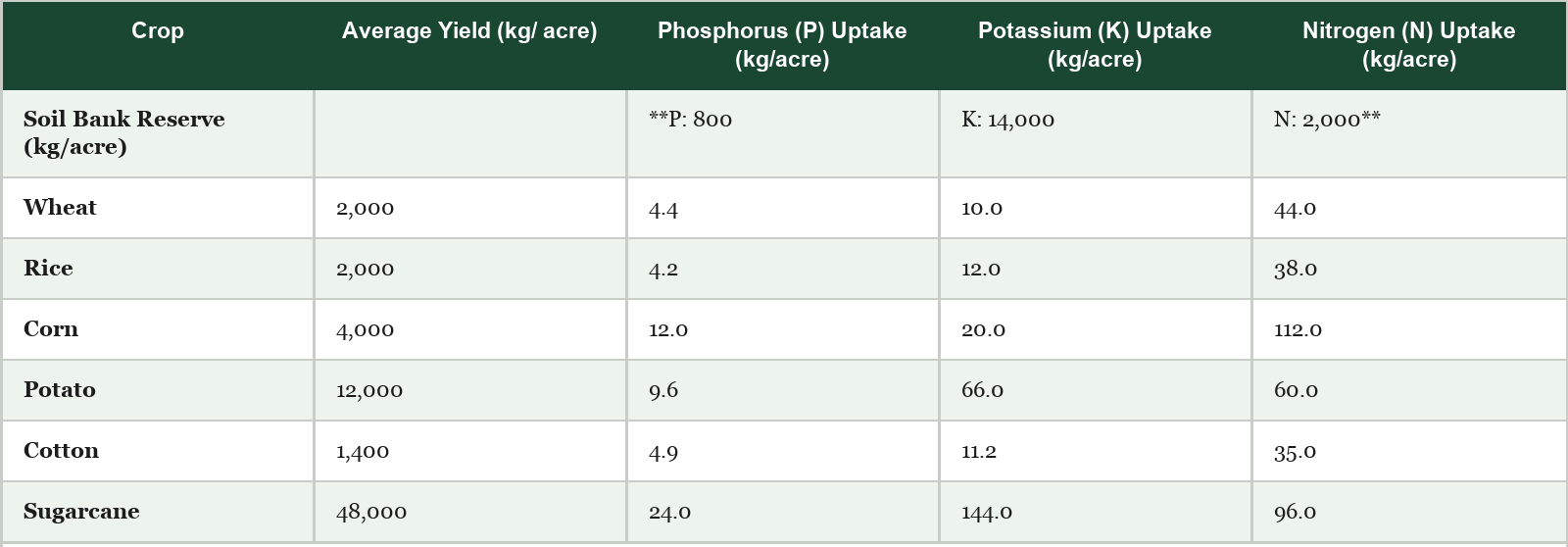
| Crop | Average Yield (kg/ acre) | Phosphorus (P) Uptake (kg/acre) | Potassium (K) Uptake (kg/acre) | Nitrogen (N) Uptake (kg/acre) |
|---|---|---|---|---|
| Soil Bank Reserve (kg/acre) | **P: 800 | K: 14,000 | N: 2,000** | |
| Wheat | 2,000 | 4.4 | 10.0 | 44.0 |
| Rice | 2,000 | 4.2 | 12.0 | 38.0 |
| Corn | 4,000 | 12.0 | 20.0 | 112.0 |
| Potato | 12,000 | 9.6 | 66.0 | 60.0 |
| Cotton | 1,400 | 4.9 | 11.2 | 35.0 |
| Sugarcane | 48,000 | 24.0 | 144.0 | 96.0 |
Source: Crop uptake data calculated from standard agronomic removal values. Soil Bank Reserve based on median global soil composition data (Sparks, 2003) for the plow layer.
Footnotes on Soil Bank Reserves:
• Phosphorus (P: 800*): The 800 kg represents the total elemental phosphorus in the topsoil. The ultimate "geological bank" is the parent rock and deep sediments, a reserve of thousands of tonnes per acre that is continuously weathered by the microbial assembly line, making the P cycle truly perpetual.
• Nitrogen (N: 2,000*): The 2,000 kg represents the total nitrogen in soil organic matter. The ultimate, infinite bank is the Earth's atmosphere, which is 78% nitrogen gas (N₂). This atmospheric reserve is continuously replenished into the soil by nitrogen-fixing microbes (diazotrophs).
• Potassium (K: 14,000): The immense reserve in the soil's mineral structure alone demonstrates overwhelming abundance, and it is also continuously weathered from an even larger geological reserve.
3.0 Analysis: Interpreting the "Undeniable Disparity"
The data in Annex A reveals a consistent and staggering reality across all crops: The ratio of the Soil Bank Reserve to the annual Nutrient Uptake is overwhelmingly large.
To illustrate this, let us take the example of Wheat:
The Topsoil "Current Account" vs. Crop Demand - Wheat

| Element | Total in Topsoil/ Acre (kg) | Crop Uptake/ Acre (kg) | Ratio (Bank:Withdrawal) |
|---|---|---|---|
| Phosphorus (P) | ~800 kg | ~4.4 kg | ~182 : 1 |
| Potassium (K) | ~14,000 kg | ~12 kg | ~1,167 : 1 |
| Nitrogen (N) | ~2,000 kg | ~40 kg | ~50 : 1 |
This means:
• For every 1 kg of Phosphorus the wheat crop removes, the soil bank holds 180 kg in reserve.
• For every 1 kg of Potassium removed, the bank holds a staggering 1,400 kg.
• Even for Nitrogen, which has a smaller total reserve and higher plant uptake, the bank holds 45 times the annual withdrawal.
This pattern holds true even for the heaviest feeder, Sugarcane. While it removes 24 kg of Phosphorus, the 800 kg reserve is still 33 times larger than this substantial withdrawal.
4.0 Implications for the PQNK System
This quantitative analysis leads to two inescapable conclusions:
I. The Problem is Access, Not Scarcity: The data proves conclusively that mineral deficiency in agriculture is a management failure, not a resource shortage. The soil is not "poor"; our methods are. The crisis is one of liquidity, not capital. II. The Folly of Input-Based Agriculture: The practice of applying, for example, 50 kg of P₂O₅ fertilizer to meet a wheat crop's need for ~4.4 kg of P is revealed as fundamentally illogical. It is an attempt to solve a biological access problem with a chemical brute-force approach that further damages the very biological system required for the solution.
5.0 Conclusion: Data as a Testament to Natural Design
This supplement provides the numerical proof that validates the PQNK paradigm. The "Perpetual Abundance" is not a philosophical concept but a quantifiable reality. The figures in Annex A should liberate the farmer from the fear of scarcity and redirect their focus from procuring external inputs to nurturing the internal, biological key—the microbial assembly line. The annotated reserves for P and N further strengthen this argument, revealing that the soil bank is not a static pile of minerals but a dynamic interface connected to infinite reserves— the bedrock and the atmosphere. By adopting the PQNK principles, we shift from being miners of a finite resource to wise managers of an infinite, self-replenishing system. The data shows us unequivocally that the path to sustainable, prosperous agriculture lies not in the fertilizer bag, but in the life within the soil.
Footnote: Any Production Process That Inundates Soil With Water, Disturbs Soil Through Tillage, Or Leaves Soil Bare Without Organic Mulch Cover Does Not Qualify As Natural Ecosystem Science For Production Agriculture.
PQNK, to be pronounced as 'picnic', which stands for Paedar Qudratti Nizam Kashatqari, and means: the regenerative & sustainable Pristine Organic Farming System.
About This Paper
- Crop
- Wheat · Rice · Maize (Corn) · Potato · Cotton · Sugarcane
- Problem
- Preventive/Prophylactic Over-Application of Inputs (Fertilizer/Nitrogen)
- Science
- Soil · Plants
- Evidence
- Scientific Mechanism
- Authority
- Current / Approved PQNK Knowledge
Related PQNK Science
Key Takeaways
- Extends the 'Perpetual Abundance Principle' soil-bank-versus-crop-uptake analysis from wheat alone to six major crops: wheat, rice, corn, potato, cotton, and sugarcane.
- Shows phosphorus uptake ranging from ~4.2 kg/acre (rice) to ~24 kg/acre (sugarcane), all measured against a constant topsoil reserve of roughly 800 kg/acre.
- Demonstrates the 'undeniable disparity' holds even for the heaviest feeder in the dataset: sugarcane's phosphorus removal is still 33 times smaller than the topsoil reserve.
- Clarifies that the tabulated phosphorus/potassium figures represent only the topsoil layer (continuously replenished by deeper geological weathering) and the nitrogen figure represents only soil organic matter (replenished from the atmosphere's 78% nitrogen content).
- Concludes that standard fertilizer prescriptions (e.g., 50 kg P₂O₅/acre against an actual crop need of 4-24 kg elemental P) represent a chemical overcorrection to what is fundamentally a biological access problem.
- Reframes the soil mineral bank as a dynamic interface to near-infinite geological and atmospheric reserves, not a finite pile to be mined and refilled.
Related Crops
Related Knowledge
same crop
Can High-TDS Water Be Used to Rehabilitate Saline Soils?
Conventional guidelines flag groundwater above 1,000-1,500 ppm TDS as unsuitable for irrigation, pushing farmers to abandon productive land. This paper argues the real determinant isn't the water's salt concentration but the soil's physical and biological capacity to keep those salts moving instead of accumulating in the root zone, backed by a crop-by-crop salt-load data table.
same crop
Five Decades of Agricultural Innovation: Interventions and Achievements in Chronological Order, 1973–2023
Asif Sharif's own year-by-year record of fifty years of hands-on agricultural intervention in Pakistan, from early machinery and seed distribution through the 2008 development of PQNK and its crop-by-crop expansion since, presented as the primary evidentiary record behind PQNK: a ground-up, farmer-verified track record rather than a journal citation.
same crop
PQNK Knowledge Paper: The Twofold Art of Pruning as Compensatory Grazing
With grazing animals absent, plants read the lack of browsing pressure as a sign their foliage isn't wanted and pour energy into ever more vegetative growth instead of fruit. This paper sets out a two-phase pruning protocol, formative and reproductive, standing in for that missing herd, with a detailed crop-by-crop benchmark table and a full sugarcane case study covering two distinct harvest strategies.
same crop
Pakistan's Agricultural Biotechnology Policy 2025: The Right Intention, The Wrong Diagnosis
A formal PQNK response to Pakistan's Federal Cabinet-approved National Agricultural Biotechnology Policy 2025, arguing the BT cotton experiment already proved that engineering the plant to compensate for a damaged environment fails within years, and that the real intervention point is restoring the soil biology and water systems the policy leaves untouched.