

KP-133 · Crop-Specific Guides
PQNK: The Pristine Organic Production System for Onion and Garlic Cultivation
A propagation-focused guide to onion and garlic under PQNK, comparing seeds, large bulbs, and offsets as planting material before laying out the full 10-step PQNK transition sequence, from hardpan-breaking through raised-bed formation to harvest timed by leaf yellowing.
Read or listen to the full paper ↓Abstract
This guide is distinct from PQNK's yield-and-economics literature on garlic and onion in that its focus is propagation method and system transition rather than cost modeling. It opens by comparing the three planting materials available for alliums: seeds, which take 4-6 months to mature but offer the broadest genetic base and let growers select for traits like disease resistance; large bulbs planted as 'sets,' which establish in 2-3 months with good uniformity but can carry disease if not properly selected or stored; and small bulbs or offsets, genetic clones of the parent plant that combine the speed of bulb propagation with the highest uniformity of the three methods.
Offsets are presented as generally optimal for commercial production: they are cheaper than both seeds and large bulbs, multiply rapidly, and reduce crop-management variability because every plant is genetically identical to its parent. The guide details their full handling chain: collect after the main crop matures and begins to die back, dig carefully and separate with clean tools to prevent disease transmission, air-dry for a few days in a cool ventilated space, then store at 4-10°C in breathable mesh containers if not planting immediately. Planting guidelines specify a 1-inch depth with the pointed end up, 4-inch spacing between plants and between rows, and consistent low moisture maintained through mulch rather than frequent irrigation.
The second half of the guide lays out a 10-step conventional-to-PQNK transition sequence that applies identically to both onion and garlic: laser-level the plot, break the hardpan (the compacted layer 8-22 inches deep) to restore water and air infiltration, flood-irrigate once to leach salts and chemicals and reconnect soil layers, form 42-inch raised beds with 18-inch furrows sized for 60-inch tractor tracks, establish and then mulch a cover crop in place without disturbing the soil or its root systems, plant propagules at 4-inch spacing for a target density of roughly 235,224 bulbs per acre, and eliminate all purchased fertilizer, pesticide, and herbicide inputs. Irrigation under this system is reduced to whatever is needed to hold soil pore water content at roughly 35%, and harvest timing is read directly off the crop, triggered once 60% of plant leaves have turned yellow rather than by calendar date.
Because the same 10-step sequence and the same offset-propagation logic apply to both crops, the guide treats onion and garlic as functionally interchangeable within the PQNK system, differing only in variety-specific detail rather than in method.
Full Paper
If you use “Listen”, the text of the page may be sent to your browser or operating system’s speech provider, such as Apple, Google or Microsoft, depending on the voice your device uses. Pedaver does not process, transmit or store any audio.
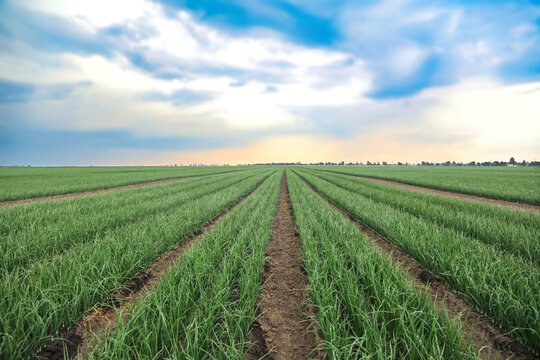
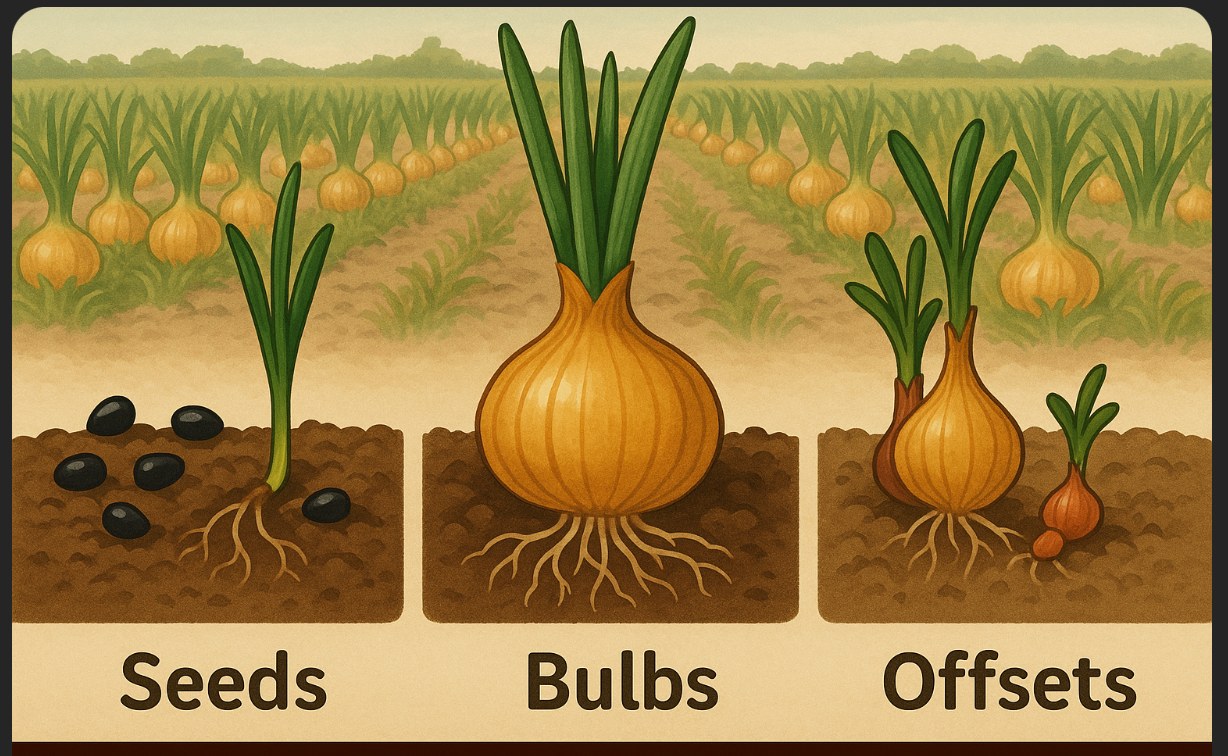
Seeds, Bulbs and Offsets
PQNK: Cultivating Sustainable Tomorrow Through Regenerative Agriculture
Onion Propagation Methods... Understanding Onion Propagation Methods
Welcome to this presentation on sustainable approaches to onion and garlic cultivation. We'll explore various propagation methods and PQNK the Pristine Organic farming system that optimize production of these important allium crops while enhancing soil health and sustainability.
Overview Of Planting Materials Types Of Planting Materials For Alliums
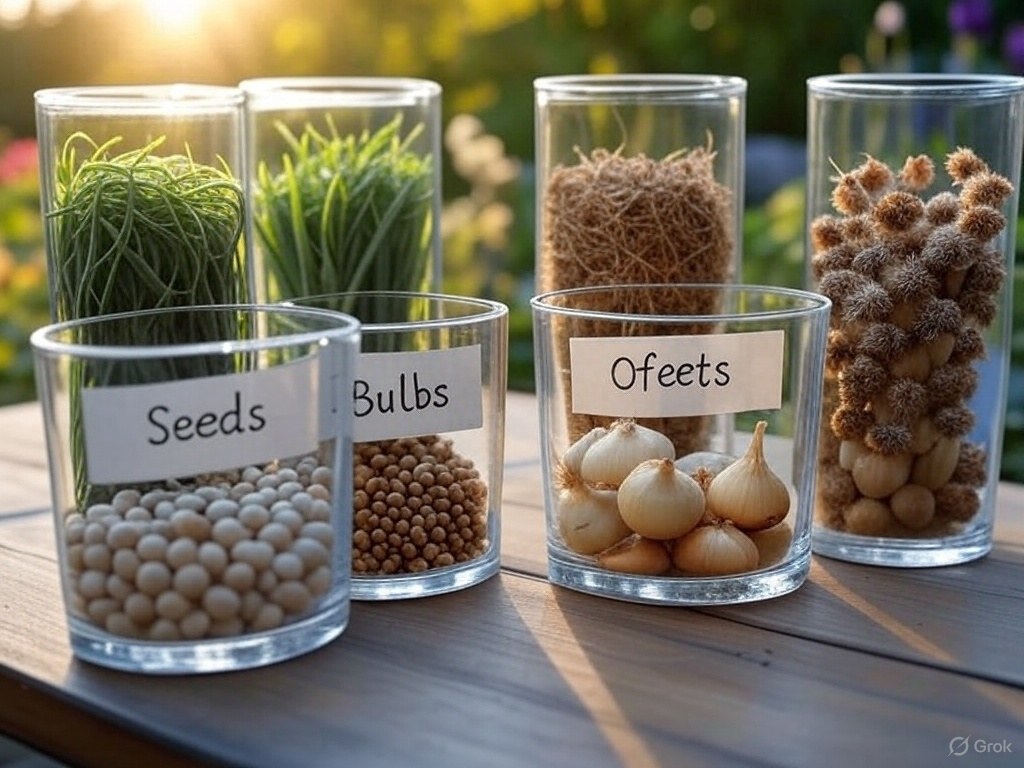
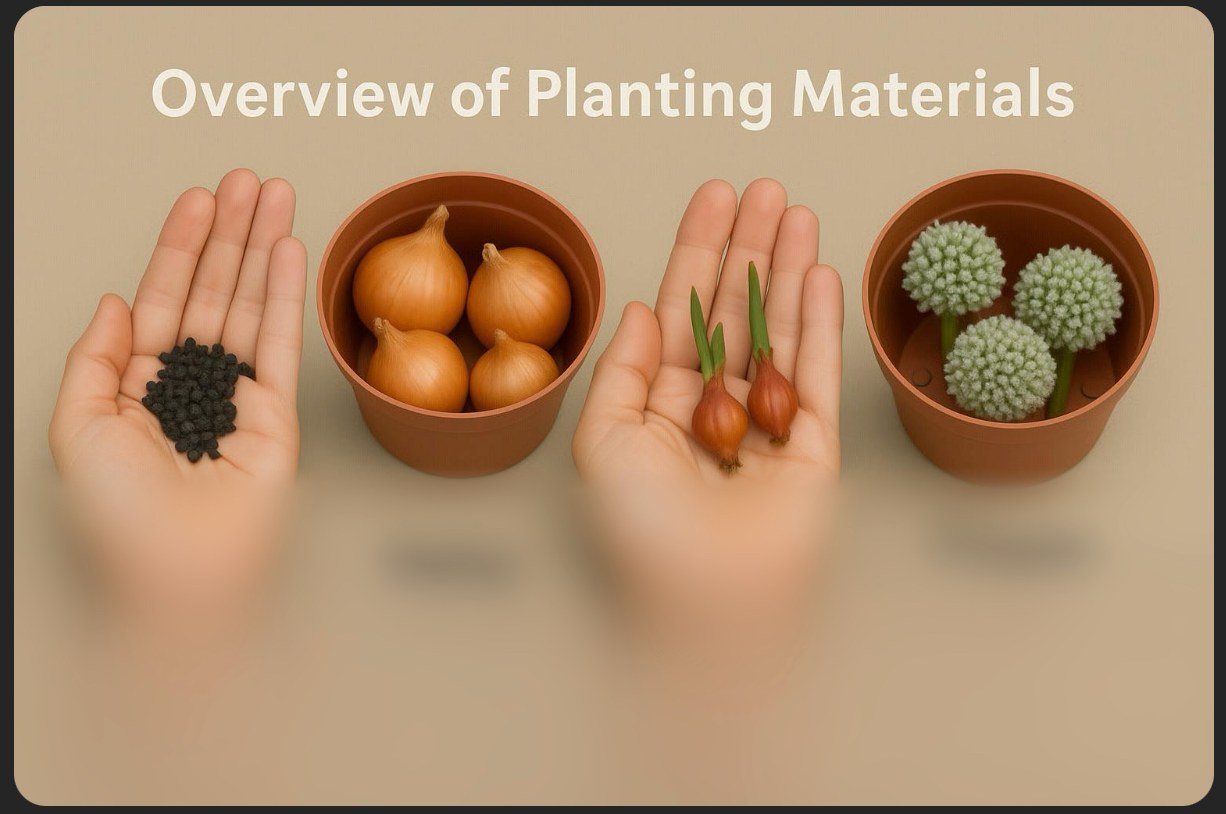
Both onions and garlic can be propagated using several main types of planting materials. Each has distinct characteristics that make them suitable for different growing situations.
Seeds
Seeds:
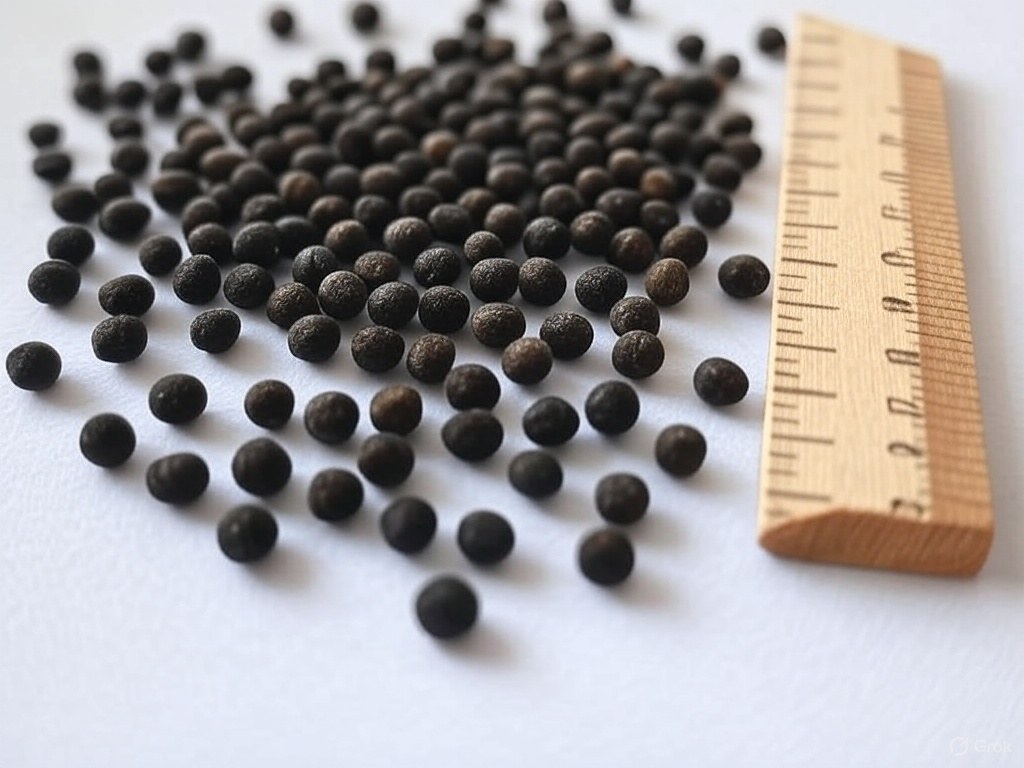
• Tiny, elongated, dark-colored
• Used primarily for large-scale
commercial cultivation
• Allow selection for specific traits (disease
resistance, size, shape)
• Broader genetic base improves
adaptability
• Take longer to grow and may produce
variable bulb sizes
• Growth period: 4-6 months
First, let's look at seeds. These tiny, dark-colored propagules are the foundation of
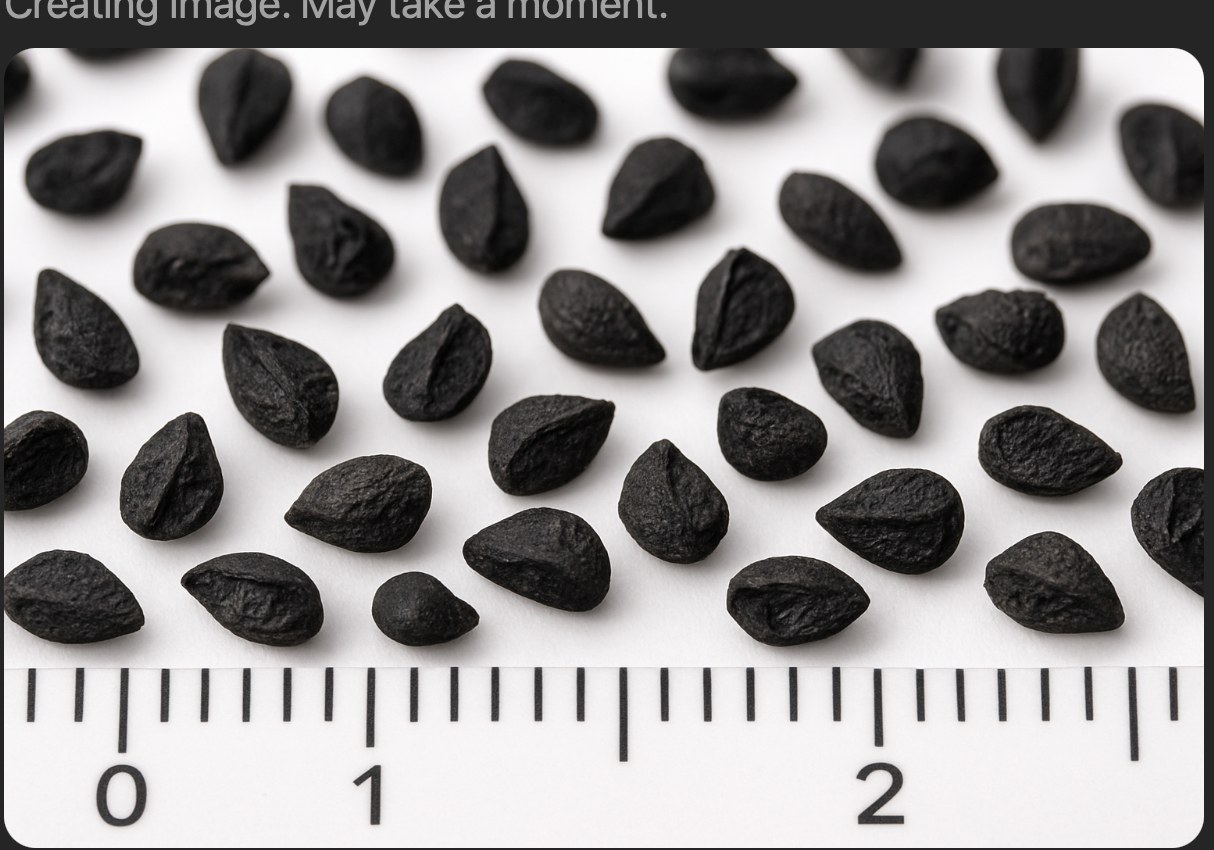
large-scale commercial onion cultivation. They offer genetic diversity, allowing growers to select for desirable traits like disease resistance and bulb characteristics. While seeds take longer to mature—typically 4 to 6 months—they provide greater adaptability to changing conditions, though with some variability in the final product.
Bulbs (Main Or Storage Bulbs)
Bulbs (Main or Storage Bulbs):
• Mature, enlarged underground parts for
consumption or planting
• Can be planted directly as "sets" for new plants
• Advantages: quick establishment and uniformity
• May carry diseases if not properly selected or stored
• Growth period: 2-3 months
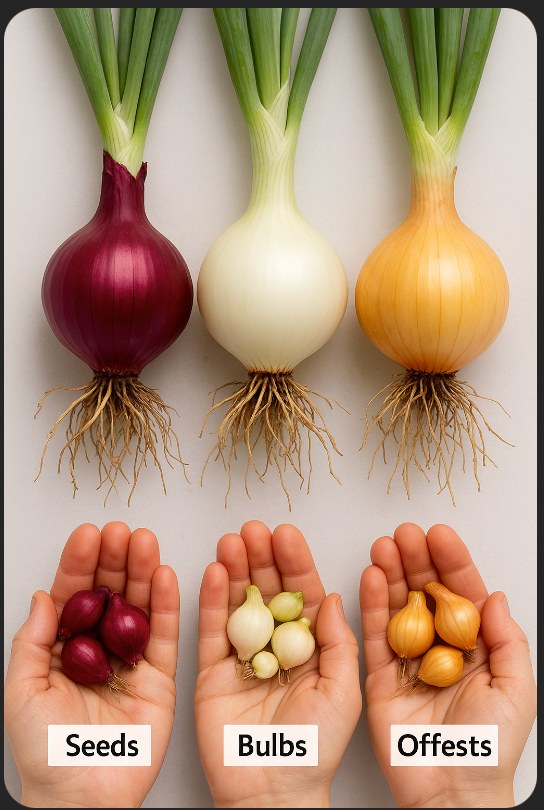
Next are mature bulbs, which serve dual purposes as both food and planting material. When planted as "sets," these bulbs establish quickly and produce uniform crops in just 2 to 3 months— significantly faster than seeds. However, careful selection and storage are essential, as these bulbs can potentially carry diseases from one generation to the next.
Small Bulbs (Offsets or Bulbils)
• Tiny bulbs formed in the leaf axils
• Used for vegetative propagation true to
parent type
• Faster than seed propagation with high
uniformity
• Popular for home gardening and rapid
multiplication Small bulbs, also called offsets or bulbils, are miniature versions of the main bulb that form in the leaf axils. These are particularly valuable for vegetative propagation because they remain genetically identical to the parent plant. Offsets combine the speed advantages of bulb propagation with exceptional uniformity, making them ideal for both home gardeners and commercial growers seeking consistent results.
Flower Heads
Flower Heads:
• Flowering parts that produce
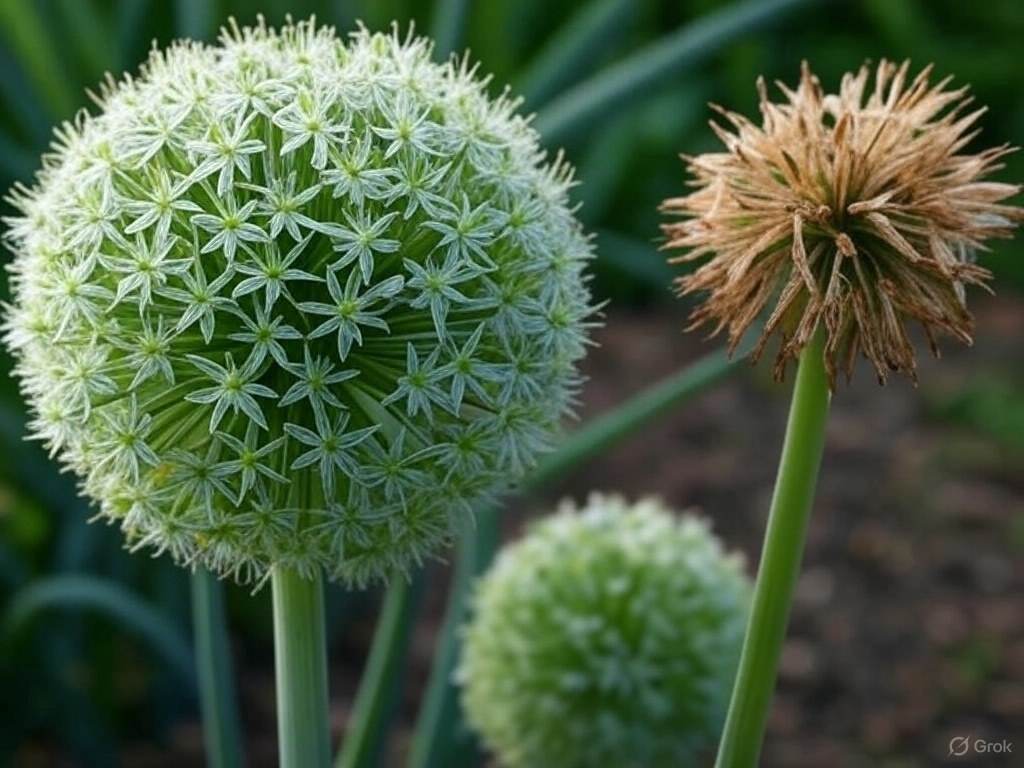
seeds after pollination
• Used for seed production and
breeding
• Often removed in cultivation to
encourage bulb growth Finally, flower heads represent the reproductive stage of the onion plant. While essential for seed production and breeding programs, they're frequently removed in commercial cultivation to redirect the plant's energy toward bulb development. Understanding when to allow flowering versus when to prevent it is a key management decision for onion growers.
Large Bulb Propagation
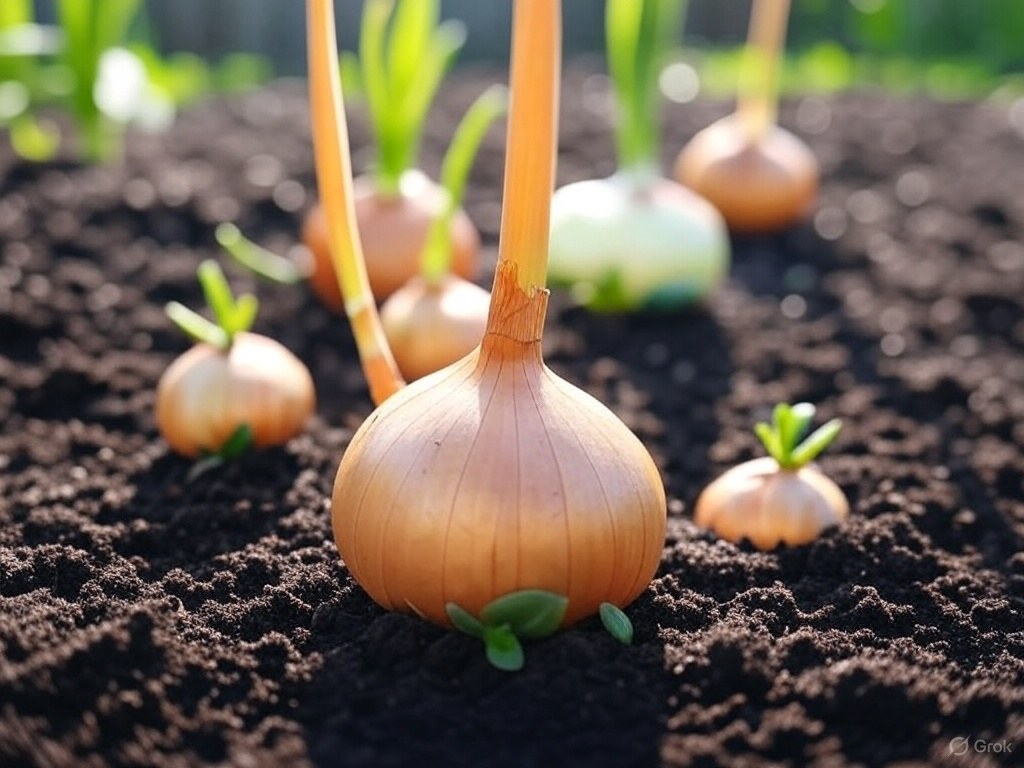
Using Large Bulbs for Propagation Let's examine how large bulbs can be used for propagation, which is a common practice in many growing regions.
Large Bulb Process
Large Bulb Process:
• Large bulbs have lateral buds or "eyes" that
grow into new shoots
• Shoots develop into new plants with their
own root systems
• Original bulb acts as a starter for the new
plant The large bulb contains lateral buds or "eyes" that sprout into new shoots when planted. These shoots quickly develop their own root systems, with the original bulb serving essentially as a nutrient reserve to jump-start growth—like a built-in starter package for the new plant.
Large Bulb Advantages
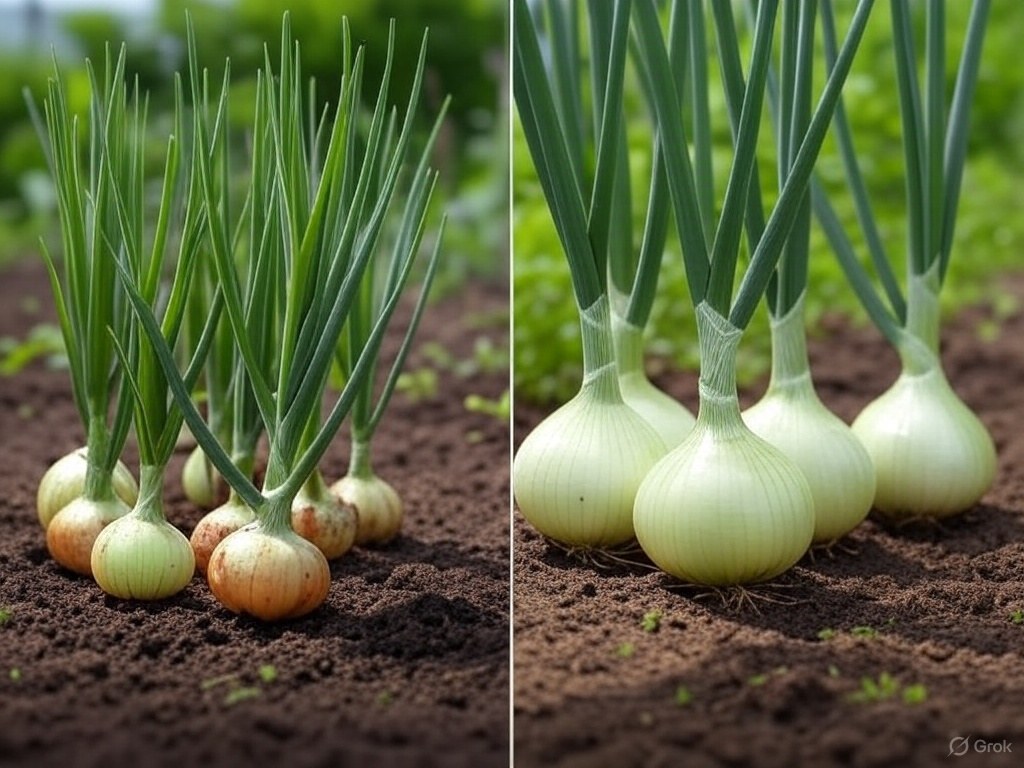
Large Bulb Advantages:
• Faster establishment with more uniform crops
• Quicker harvest time compared to seed propagation
• More predictable bulb sizes
• Higher total productivity per season due to shorter growth cycle
Plants established from bulbs develop more rapidly and uniformly than those grown from seed. The predictable bulb sizes and shorter growth cycle translate directly to higher seasonal productivity, making this method particularly attractive for commercial operations with time constraints or multiple cropping seasons.
Offset Production
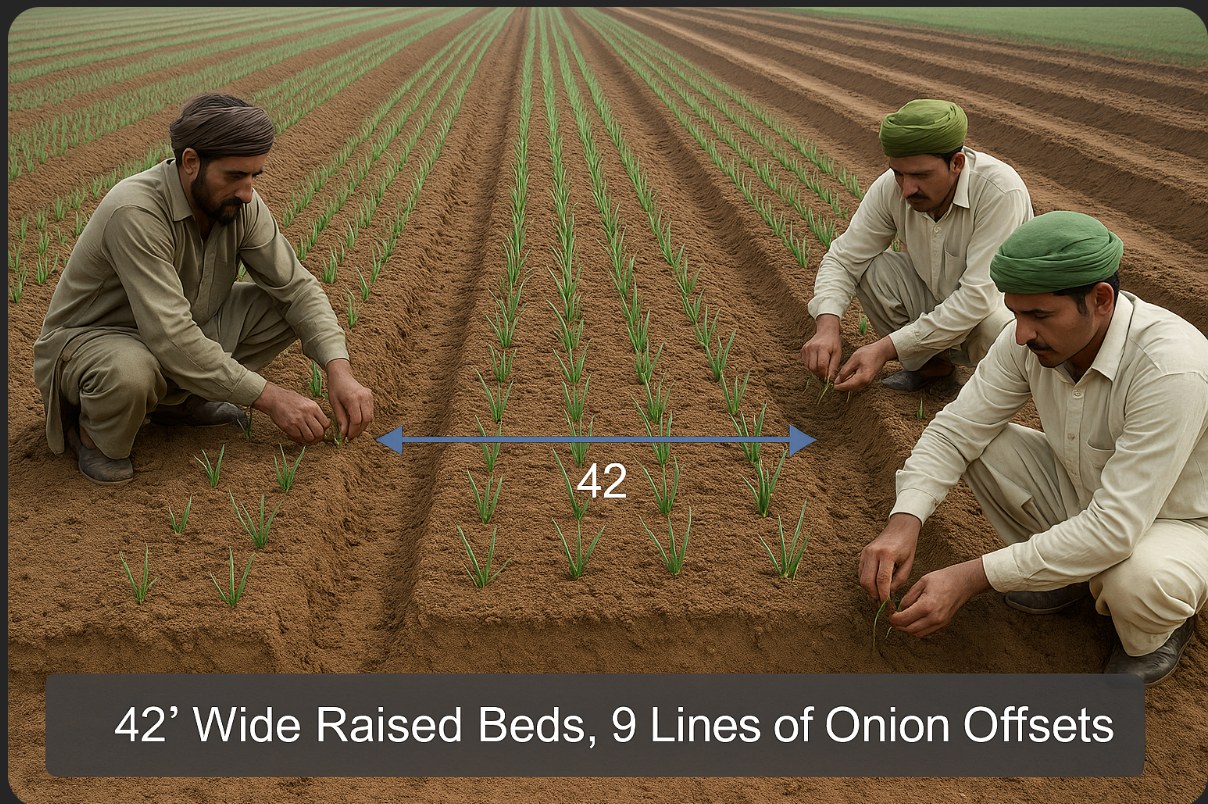
Offset Production: Using Small Bulbs (Offsets) for Commercial Production Now let's focus on what many consider the optimal propagation method for commercial production: using small bulbs or offsets.
Offset Advantages
Offset Advantages:
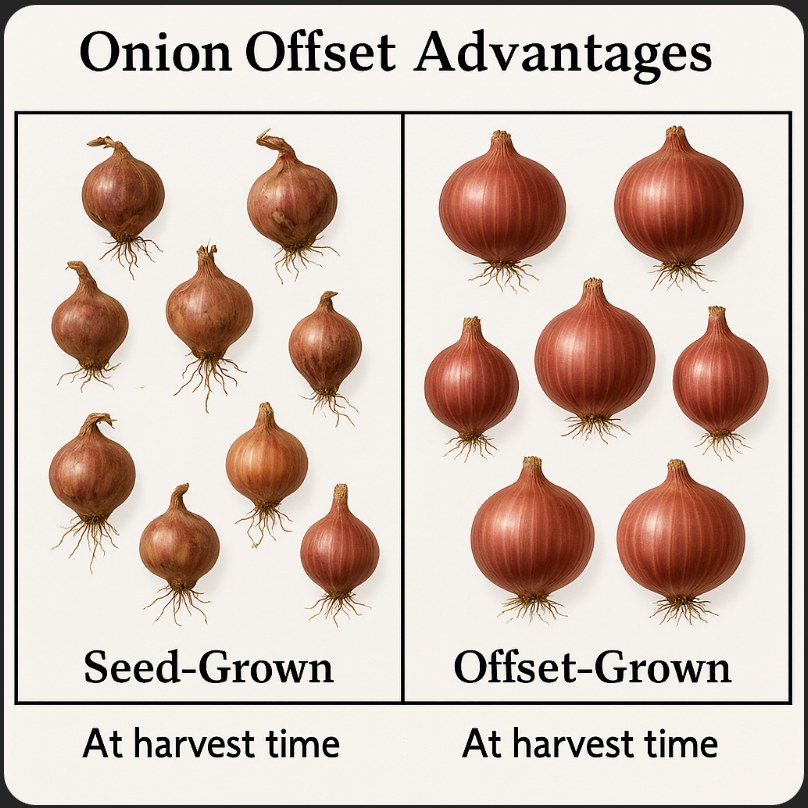
• Genetically identical to parent plant
ensuring uniform crops
• Cost-effective compared to large
bulbs or seeds
• Rapid multiplication capability
• Reliable with less variability for
easier crop management As clones of the parent plant, offsets produce exceptionally uniform crops with predictable characteristics. They're more cost-effective than both seeds and large bulbs, while offering rapid multiplication potential. The reliability and reduced variability simplify crop management decisions, reducing risk and labor costs.
Offset Collection Process
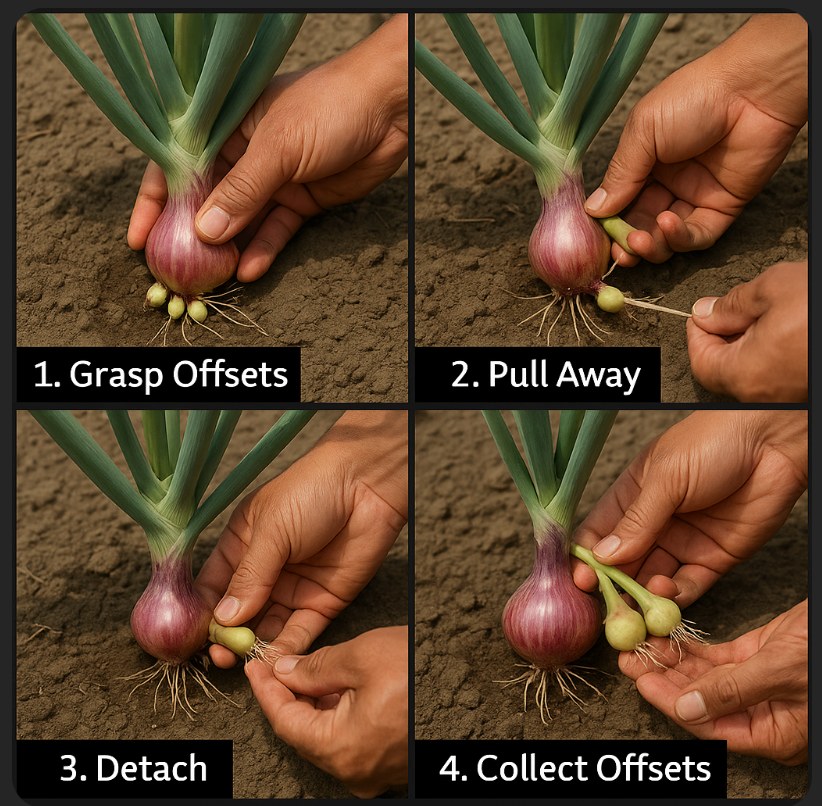
1.Collect after main crop matures and begins to die back 2.Carefully dig around main bulb 3.Gently separate offsets using clean tools 4.Remove soil and debris; trim roots if necessary
Timing is crucial—harvest offsets when the main crop has matured and begun to die back. Use careful digging techniques to avoid damage, and gently separate the offsets with clean tools to prevent disease transmission. Final preparation involves cleaning away soil and debris, with minimal root trimming if necessary.
Offset Storage
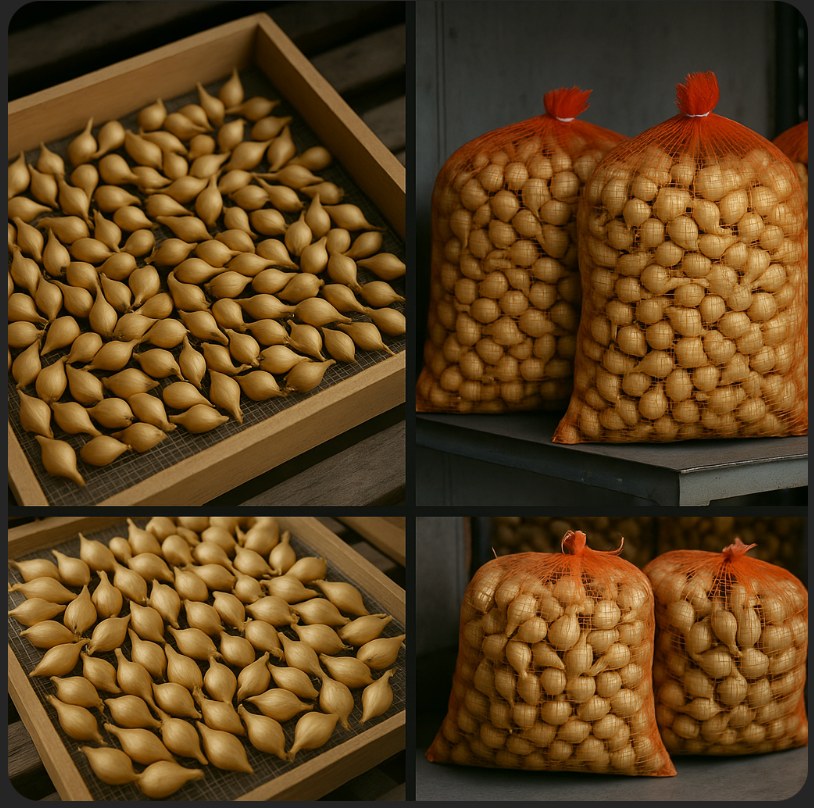
1. Air-dry for a few days in a cool, ventilated place 2. Store at 4-10°C (39-50°F) in mesh bags or containers with good airflow 3. Best planted soon after harvesting for maximum viability After collection, allow offsets to air-dry for several days in a cool, well-ventilated environment to reduce moisture content and prevent rot. For longer storage, maintain temperatures between 4 and 10 degrees Celsius in breathable containers to ensure proper airflow. However, for best results, plant offsets as soon as possible after harvesting and processing.
Offset Planting Guidelines
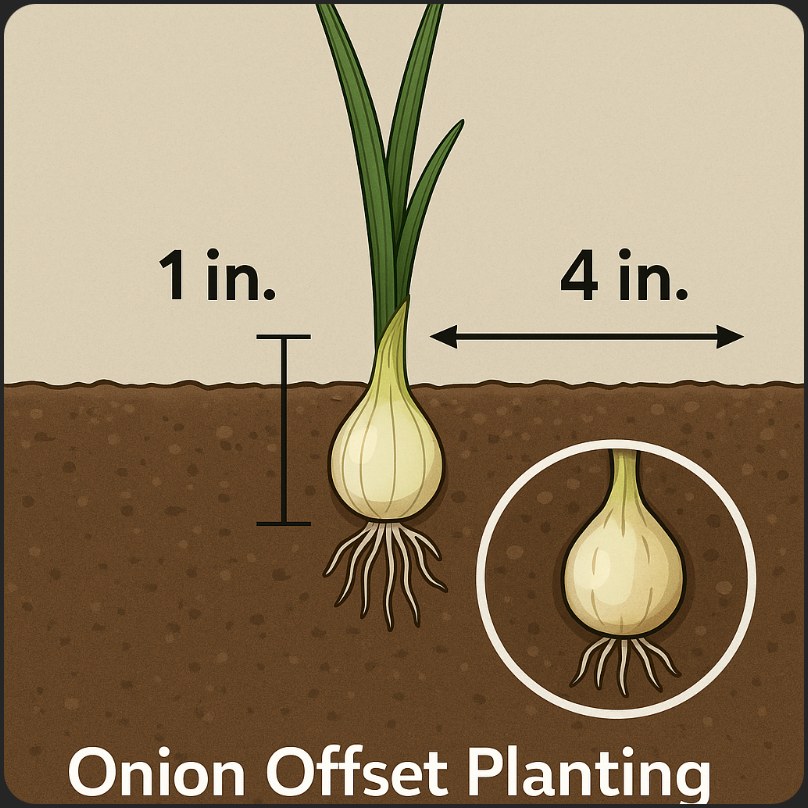
Offset Planting Guidelines:
1. Timing: Early spring or late fall depending on climate.
2. Soil: Loose, fertile soil with organic matter.
3. Depth: 1 inch deep, pointed end up.
4. Spacing: 4 inches apart rows and plant to plant in rows.
5. Maintenance: Consistent low moisture managed by mulching. Planting should be timed according to your local climate—typically early spring or late fall. Prepare loose, fertile soil enhanced with organic matter. Plant offsets at a depth of 1 inch with the pointed end facing upward. Maintain proper spacing of 4 inches between plants in rows that are 4 inches apart. After planting, ensure consistent moisture, diligent weed control by maintaining organic mulch to conserve water and suppress weed growth.
Comparison Propagation Method
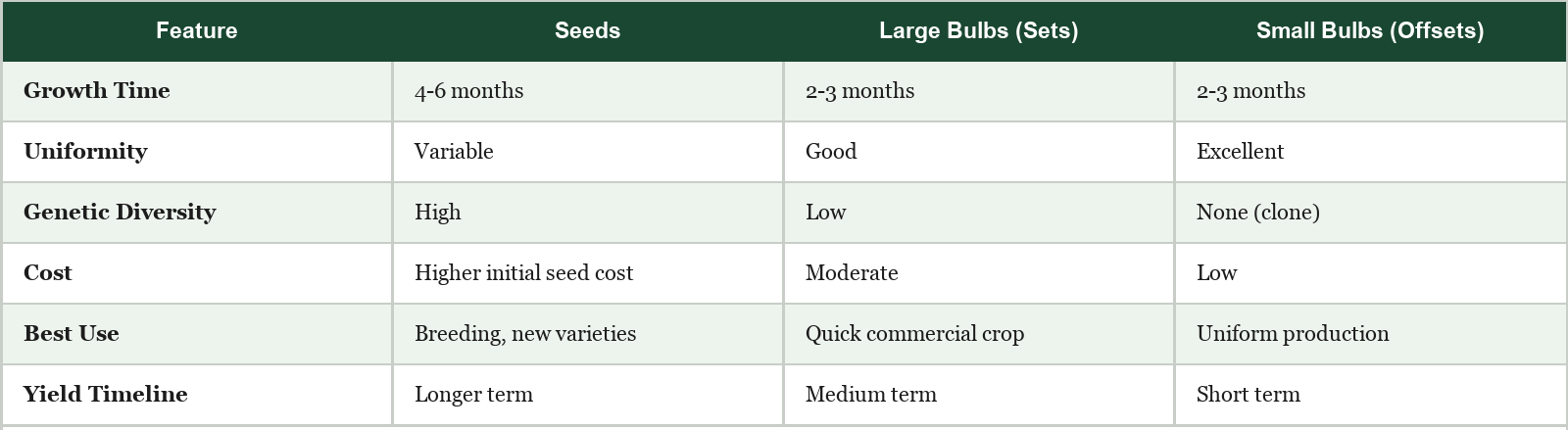
| Feature | Seeds | Large Bulbs (Sets) | Small Bulbs (Offsets) |
|---|---|---|---|
| Growth Time | 4-6 months | 2-3 months | 2-3 months |
| Uniformity | Variable | Good | Excellent |
| Genetic Diversity | High | Low | None (clone) |
| Cost | Higher initial seed cost | Moderate | Low |
| Best Use | Breeding, new varieties | Quick commercial crop | Uniform production |
| Yield Timeline | Longer term | Medium term | Short term |
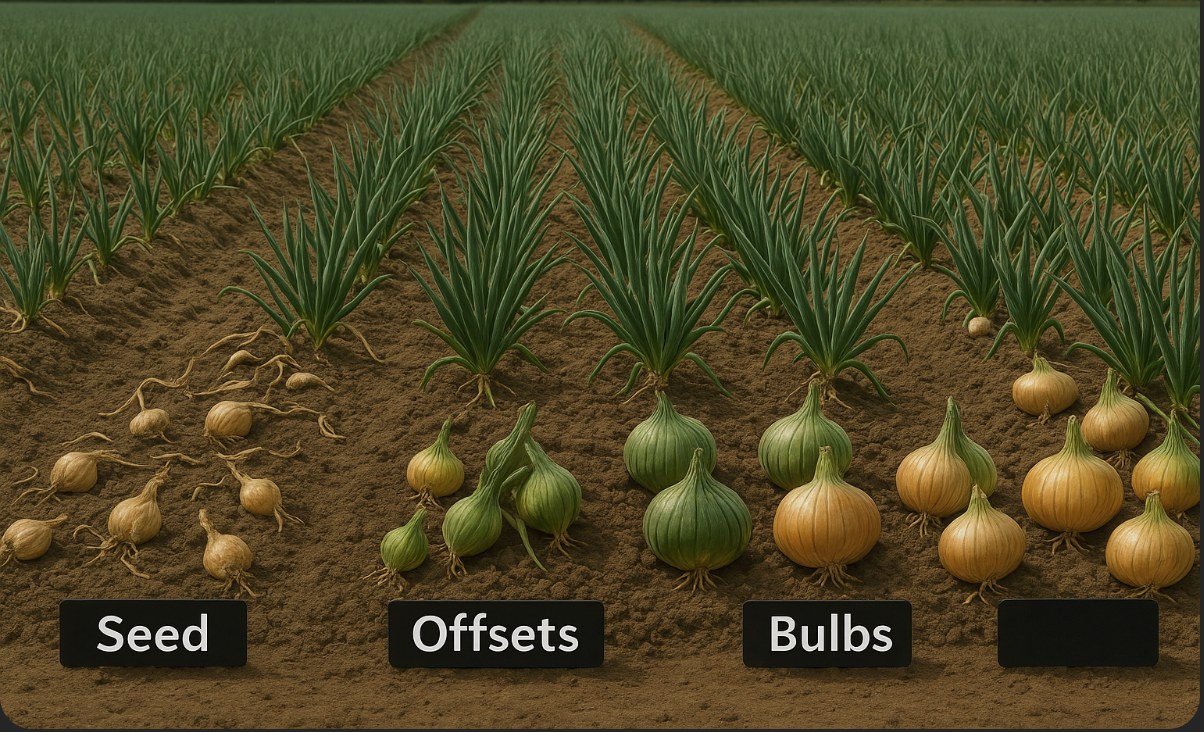
As we can see in this comparison, each propagation method offers distinct advantages. Seeds provide genetic diversity ideal for breeding programs but require longer growing periods. Large bulbs offer a good balance of speed and uniformity for commercial production. Small bulbs or offsets excel in producing highly uniform crops at the lowest cost, though without genetic diversity. The choice ultimately depends on your specific growing objectives, timeline constraints, and available resources.
PQNK System for Allium Production
Applying PQNK System in Onion and Garlic Production Steps for Conventional to PQNK Transition:
1. Create laser-levelled plots in flatland areas for efficient machinery operation
2. Break the hardpan (compacted soil layer 8-22" deep) to improve water/air infiltration
3. Flood irrigate to leach salts/chemicals and reconnect soil layers for expanded root networks
4. Make 42" wide raised beds with 18" furrows (for 60" tractor tracks) for controlled traffic
5. Plant cover crops to improve soil porosity, temperature regulation, and microbial activity
6. Mulch mature cover crops without disturbing soil and root systems
7. Plant onion/garlic propagules at 4" spacing (row-to-row and within rows) yielding 235,224 bulbs/acre
8. Eliminate fertilizers, pesticides, and herbicides—no purchased inputs required
9. Minimal irrigation needed with proper mulch; maintain only 35% water-filled soil pores
10. Harvest when 60% of plant leaves turn yellow
Note: This system works identically for both onion and garlic cultivation, making it versatile for all allium crops.
This slide introduces the PQNK Pristine Organic farming system for onion and garlic production. Both crops respond exceptionally well to this identical approach. This regenerative system begins with laser-levelling and breaking the hardpan—that compacted layer restricting water and air movement. After flood irrigating to leach unwanted chemicals, raised beds are created with specific dimensions to accommodate machinery while minimizing soil compaction. Cover crops play a crucial role in improving soil structure before being mulched in place. Allium crops are then planted at precise spacings to maximize yield without overcrowding. One of the most remarkable aspects of this system is the elimination of purchased inputs like fertilizers and pesticides. With proper mulching, irrigation requirements are dramatically reduced, and harvest timing is guided by observing the natural yellowing of plant leaves. This system represents a complete paradigm shift from conventional cultivation to regenerative practices for all allium family crops.
Conclusion
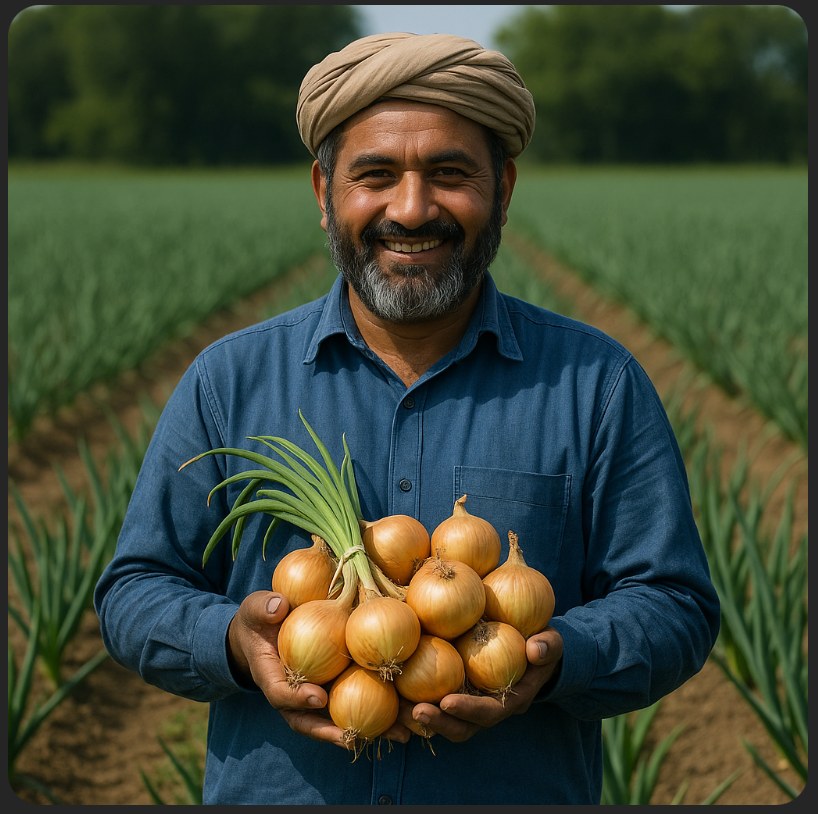
Thank you for joining this presentation on PQNK, the Pristine Organic to onion and garlic cultivation. Understanding these different propagation methods allows growers to select the most appropriate technique for their specific circumstances, whether prioritizing genetic diversity, speed to harvest, or uniformity of production. By applying these principles alongside the PQNK farming system, both commercial and home growers can optimize their allium cultivation for improved yields, sustainability, and soil health. This integrated approach to allium production represents farming that works with nature rather than against it—benefiting both growers and the environment.
Images
About This Paper
- Crop
- Onion · Garlic
- Problem
- Fungal / Bacterial Disease · Hardpan · High Input / Production Cost · Inconsistent / Uneven Crop Uniformity
- Science
- Soil · Water · Production Architecture · Transition
- Evidence
- Scientific Mechanism
- Authority
- Current / Approved PQNK Knowledge
Related PQNK Science
Key Takeaways
- Three propagation options compared: seeds (4-6 months, high genetic diversity), large bulb sets (2-3 months, good uniformity, disease-carry risk), and offsets (2-3 months, clonal, highest uniformity, lowest cost).
- Offset handling chain: collect at die-back, separate with clean tools, air-dry a few days, store at 4-10°C in breathable containers if not planting immediately; plant 1 inch deep, pointed end up, at 4-inch spacing.
- The 10-step PQNK transition applies identically to onion and garlic: laser-level, break the 8-22 inch hardpan, flood-irrigate once to leach salts, form 42-inch raised beds with 18-inch furrows, mulch a cover crop in place, then plant.
- Target planting density is roughly 235,224 bulbs per acre at 4-inch spacing, with all purchased fertilizer, pesticide, and herbicide inputs eliminated.
- Irrigation is calibrated to hold soil pore water content near 35% rather than run on a fixed schedule, and harvest is triggered once 60% of plant leaves turn yellow.
Related Crops
Related Knowledge
same problem
Transforming Garlic and Onion Cultivation through the PQNK Regenerative System
Garlic and onion farming has been squeezed by rising labour costs and heavy agrochemical reliance, pushing countries toward import dependence. This paper shows how PQNK's raised-bed geometry and mulch management quadruple planting density and let farmers reach up to 300 maunds per acre without synthetic inputs.
same problem
The Farm You Only Have to Build Once: How PQNK Converts a Conventional Field into a Permanent, No-Till System
Most fields across Pakistan and northern India's irrigated plains are still laid out for nineteenth-century bullock-and-plough flood irrigation. This paper walks through the one-time engineering project, topography survey, field redesign, hardpan fracture, laser levelling, and permanent bed shaping, that converts such a field into a permanent PQNK system, citing published water-savings and yield data specific to Pakistani Punjab.
same problem
A Farmer's Guide to Establishing a Prosperous Olive Orchard
A practical planting guide for olive growers in Mediterranean-equivalent climates, laying out two distinct PQNK establishment paths, high-density irrigated beds versus a low-cost curved-furrow-and-borehole system for rain-fed sloping land, plus a year-by-year yield projection showing how consistent soil biology breaks the crop's typical biennial-bearing cycle.
same problem
Potato Planting Depth vs Mulch-Based No-Till Planting: A Production, Economics, and Quality Analysis under the PQNK System
A scientific and economic comparison of conventional 6-inch deep seed burial against PQNK's surface-placement-plus-mulch method, showing that mulch delivers the same tuber-zone temperature control as deep burial while also enabling earlier sowing, denser planting, and a roughly 90% cut in per-acre production cost.