

KP-134 · Crop-Specific Guides
A Farmer's Guide to Establishing a Prosperous Olive Orchard
A practical planting guide for olive growers in Mediterranean-equivalent climates, laying out two distinct PQNK establishment paths, high-density irrigated beds versus a low-cost curved-furrow-and-borehole system for rain-fed sloping land, plus a year-by-year yield projection showing how consistent soil biology breaks the crop's typical biennial-bearing cycle.
Read or listen to the full paper ↓Abstract
Olive trees are naturally suited to Mediterranean-equivalent climates, hot dry summers and mild rainy winters, and this guide sets out two PQNK establishment paths depending on whether a farm has an existing irrigation source. For irrigated land, the sequence follows the standard PQNK conversion: level the ground, break the hardpan, wash down accumulated salts with a heavy irrigation, then form permanent 42-inch raised beds with 18-inch furrows sized to the local tractor track, and grow a cover crop on the beds before transplanting. Trees are spaced 10 feet between rows and 8 feet within the row, a high-density layout giving roughly 545 plants per acre, with irrigation applied sparingly through the furrows since a tree only needs water equal to what it loses through transpiration.
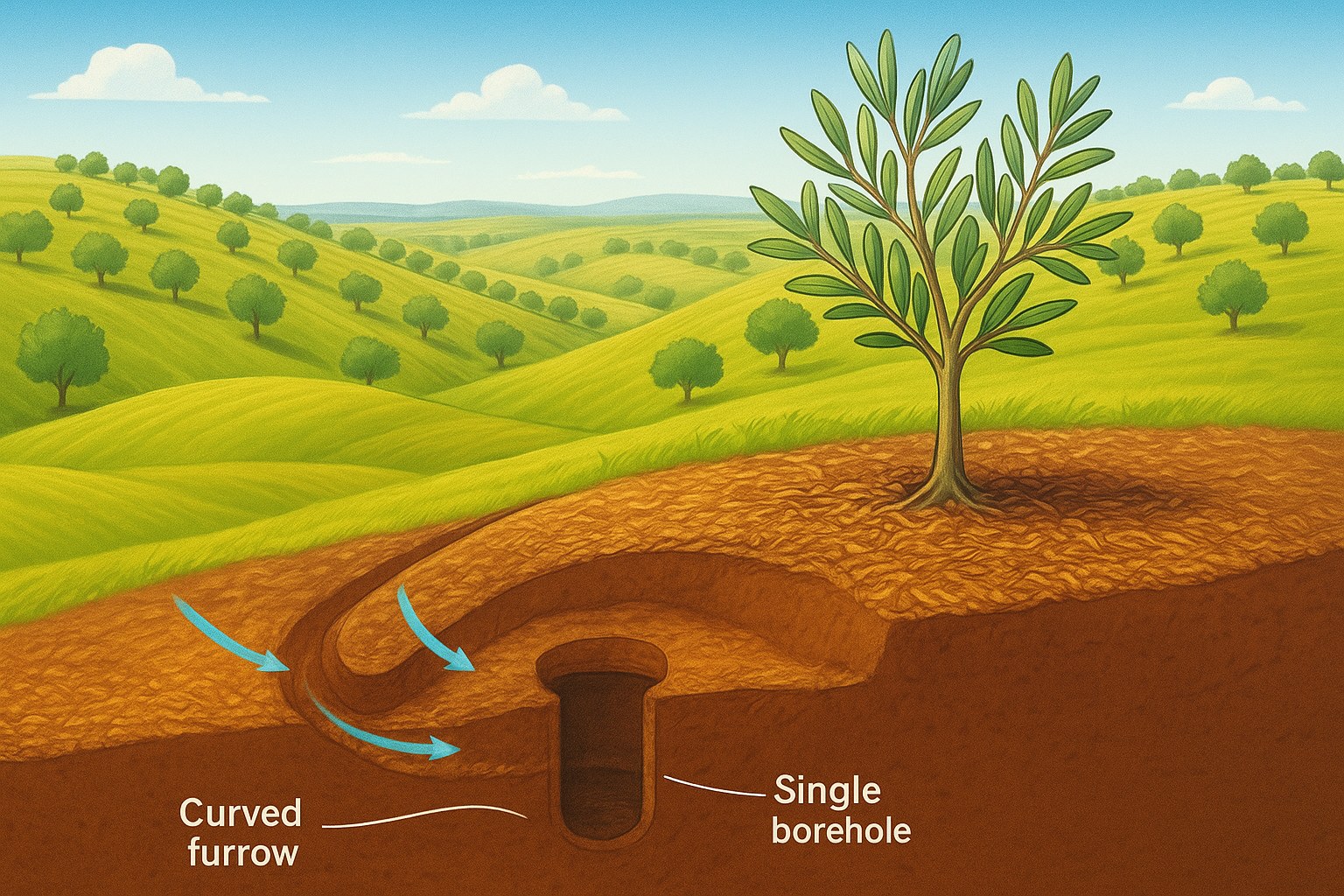
For rain-fed, sloping land with no irrigation system, the guide details an 'optimized curved furrow and borehole' method built around a single strategically placed borehole per tree, 1 foot in diameter and 4 feet deep, dug on the downhill side inside a shallow curved furrow that intercepts and channels rainwater into it. A separate planting hole, 1 foot in diameter and 2 feet deep, is dug at least 2 feet away on the uphill side and backfilled with the same loose soil for root establishment. The entire area, planted spot, open borehole, and furrow, is then covered in thick organic mulch, which absorbs rain, dew, and humidity and keeps the underground reservoir charged through the dry season; strawberries or other low-height crops can be intercropped in the mulched zone around each young tree for additional early income.
Once established, orchard management is reduced to two tasks, harvesting and pruning, and the guide recommends combining them into a single operation: removing dead, diseased, or inward-growing branches while picking fruit. The paper argues this consistent, stress-free nutrient and water supply from the soil ecosystem breaks 'biennial bearing,' the on-off fruiting cycle common in conventionally managed olives, because the tree is never forced to exhaust its energy reserves in a heavy year and rest the next.
A year-by-year yield table projects output per tree rising from 0-5 kg in years 1-2 (establishment, light formative pruning), to 10-20 kg in years 3-4 (canopy management as yield ramps up), 25-40 kg in years 5-7 (sustained productivity), and 45-60+ kg from year 8 through 15-plus (full genetic potential, minimal management beyond harvest and light annual pruning). The guide frames this trajectory as evidence that the PQNK soil system lets the tree grow and fruit simultaneously rather than trading one for the other.
Full Paper
If you use “Listen”, the text of the page may be sent to your browser or operating system’s speech provider, such as Apple, Google or Microsoft, depending on the voice your device uses. Pedaver does not process, transmit or store any audio.
Introduction
Olive trees thrive in specific climates known as "Mediterranean-equivalent" zones, characterized by hot, dry summers and mild, rainy winters. This guide is for farmers everywhere who have such a climate. Whether you have access to irrigation or farm on rain-fed sloping lands, the PQNK system provides a path to a profitable and sustainable orchard. This paper provides a simple guide to establishing an olive orchard using the PQNK (Paedar Qudratti Nizam Kashatqari) system. PQNK is a pristine organic farming system that works with nature, not against it. It regenerates the soil to provide all the water and nutrients your plants need, sustainably and at a low cost.
Why Olives Are a Smart Choice
• Climate Match: They are perfectly adapted to the climatic conditions for which they are named.
• Low Water Needs: Olive leaves are small, meaning the plant loses very little water through transpiration.
• Rain-fed Potential: With sufficient annual rainfall (typically over 400 mm), these lands receive more than enough water for olives. The key is capturing it in the soil.
Two Paths to a Successful Orchard
Choose the option that fits your land and resources. Option 1: For Irrigated Land (With a Water Pond & Drip System, Sprinkler or Furrow Irrigation sourcing Canal or Tube-Well Water) If you have already invested in a water source and irrigation system, this plan maximizes your water efficiency and land use.
Steps to Transition to PQNK Raised Beds:
1. Level the Land: Ensure the land is properly leveled.
2. Break the Hardpan: Use a subsoiler to break the hard layer beneath the soil. This is crucial for water to seep deep down and for roots to grow freely.
3. Water Wash: Apply a good amount of water to wash down and leach away accumulated salts and agrochemicals from the soil.
4. Make Raised Beds: Form permanent raised beds that are 42 inches wide, with furrows that are 18 inches wide. This geometry perfectly matches a tractor available in the region, whose wheels will always run in the furrows, never compacting your growing area.
5. Grow Cover Crops: Before transplanting your olive trees, grow cover crops on the beds. These plants open up pores in the soil, improving water absorption, retention, and aeration. After this, you simply grow crop after crop on the same permanent beds and orchards sustainably.
Water Wisdom for Irrigated Land:
Remember, water is primarily a nutrient carrier. A plant only drinks water equal to what it loses through transpiration. Any extra water is wasted; it drowns soil microbes and brings salts to the surface. With good rainfall, you will need very few irrigations, and only in extreme dry conditions. Water should be applied only through the furrows.
Olive Plantation Plan for Irrigated Land:
• Layout: High-density planting.
• Spacing: 10 feet from row to row, and 8 feet from plant to plant within the row.
• Plant Count: This will give you about 545 plants per acre.
• Intercropping: If you wish to grow other crops between the olive trees, you can increase the space between the rows as needed.
Option 2: For Rain-fed Rolling Land (No Irrigation System)
This is for farmers on sloping land where irrigation is not accessible. We will use simple, low-cost techniques to trap rainwater and make your orchard self-sufficient. The Optimized "Curved Furrow & Borehole" System:
The Science of a Single Borehole:
Strategically placed boreholes are sufficient to store the annual water requirement for an olive tree. A borehole measuring 1 foot (30 cm) in diameter and 4 feet (120 cm) deep has a large enough capacity to capture infiltrating water in the surrounding area to meet plant needs, year-round. The volume of water will sustain the tree throughout the year when combined with dew and humidity.
Step-by-Step Guide:
1. Timing is Key: Execute this land preparation just before the start of the rainy season. Planting the olive trees soon after gives the young plants the maximum amount of natural water to establish their roots, ensuring minimal plant mortality.
2. Identify the Slope: For each plant location, identify the downhill side.
3. Dig a Curved Furrow: On the downhill side of where you will plant the tree, dig a shallow, curved furrow (like a smile or a crescent moon). This furrow will act as a barrier to trap rainwater.
4. Create the Water-Soaking Borehole:
• Using a posthole digger, create one primary borehole within the curved furrow. Its dimensions should be 1 foot in diameter and 4 feet deep. Leave this hole open; it is the dedicated, high-capacity water-infiltration bore.
5. Prepare the Planting Hole:
• Dig a second hole for the tree itself. This planting hole should be 1 foot in diameter and 2 feet deep, located at least 2 feet away from the furrow, towards the UPHILL side.
• Refill this planting hole with the same soil you extracted. This loose, aerated soil is perfect for the young olive tree, providing excellent conditions for root establishment and growth.
• Plant your olive tree in this refilled hole.
6. Apply Thick Mulch:
• Immediately after planting, cover the entire area—the planted spot, the open borehole, and the furrow—with a thick layer of organic mulch (like straw, leaves, or crop residue).
• This mulch is critical. It absorbs water from rain, dew, and humidity, stores it, and keeps the soil moist. Over time, a live mulch (cover crop) will grow, providing year-round cover.
7. No Additives: Do not apply any chemical fertilizer or agrochemicals. The PQNK system prepares a soil that is naturally rich and self-sufficient. Adding chemicals will harm the soil microbes and disrupt the natural balance we are building.
How This Optimized System Works:
When it rains, the curved furrow stops the water from running downhill. The water pools and is channeled directly into the single, large-capacity borehole, which acts like a vertical reservoir, rapidly charging the underground soil profile with water. The thick mulch prevents evaporation. This stored water is more than enough to meet the yearly needs of a healthy olive tree.
Additional Income:
In the mulched area around your young olive tree, you can grow other high-value, low-height crops like strawberries for extra income.
Uncovering the Secrets of Natural Water Supply
In nature, plants don't need drip irrigation. They rely on a perfect system that we have broken with our tillage. The PQNK system helps restore it. Here’s how nature waters your plants:
• Rain, Dew, and Humidity: Organic mulch absorbs moisture from all three, acting like a sponge.
• Infiltration: The deep borehole allows water to bypass surface compaction and seep deep into the subsoil, creating a lasting water reserve.
• Capillary Action & Roots: The water is drawn up by the plant's roots. The tree's roots will naturally grow towards this moisture zone.
• Soil Microbes: A healthy, untilled soil is full of microbes and fungi that help plants absorb water and nutrients efficiently.
Long-Term Orchard Management: Only Two Tasks
Once your orchard is established, your work becomes very simple.
1. Harvesting: You will harvest the fruit when it is ready.
2. Pruning: This is the only other main task.
Simplifying Your Work: Combine Pruning with Harvesting We recommend making pruning a part of the harvesting operation. As you harvest, you can simultaneously remove unwanted branches—those that are dead, diseased, or growing inwards. This "one-operation" approach saves time and labour. The best time for this is when the fruit is being picked.
Projected Yield and Growth Timeline
Understanding how your olive orchard will grow and produce over the years is crucial for planning. In the PQNK system, the soil is a continuous source of energy and health for the plant from day one. A common issue in other farming methods is "Biennial Bearing" or
"On-Off Years," where a tree fruits heavily one year and takes a rest the next. This is a sign of a stressed tree that has exhausted its energy reserves.
In the PQNK framework, this cycle is broken. Because the soil ecosystem provides consistent, balanced nutrition and water directly to the plant's roots without stress, the olive tree maintains robust health and energy year after year. This allows it to demonstrate its full fruiting potential consistently, without needing a "rest year."
Olive Orchard Yield Projection (Per Plant)
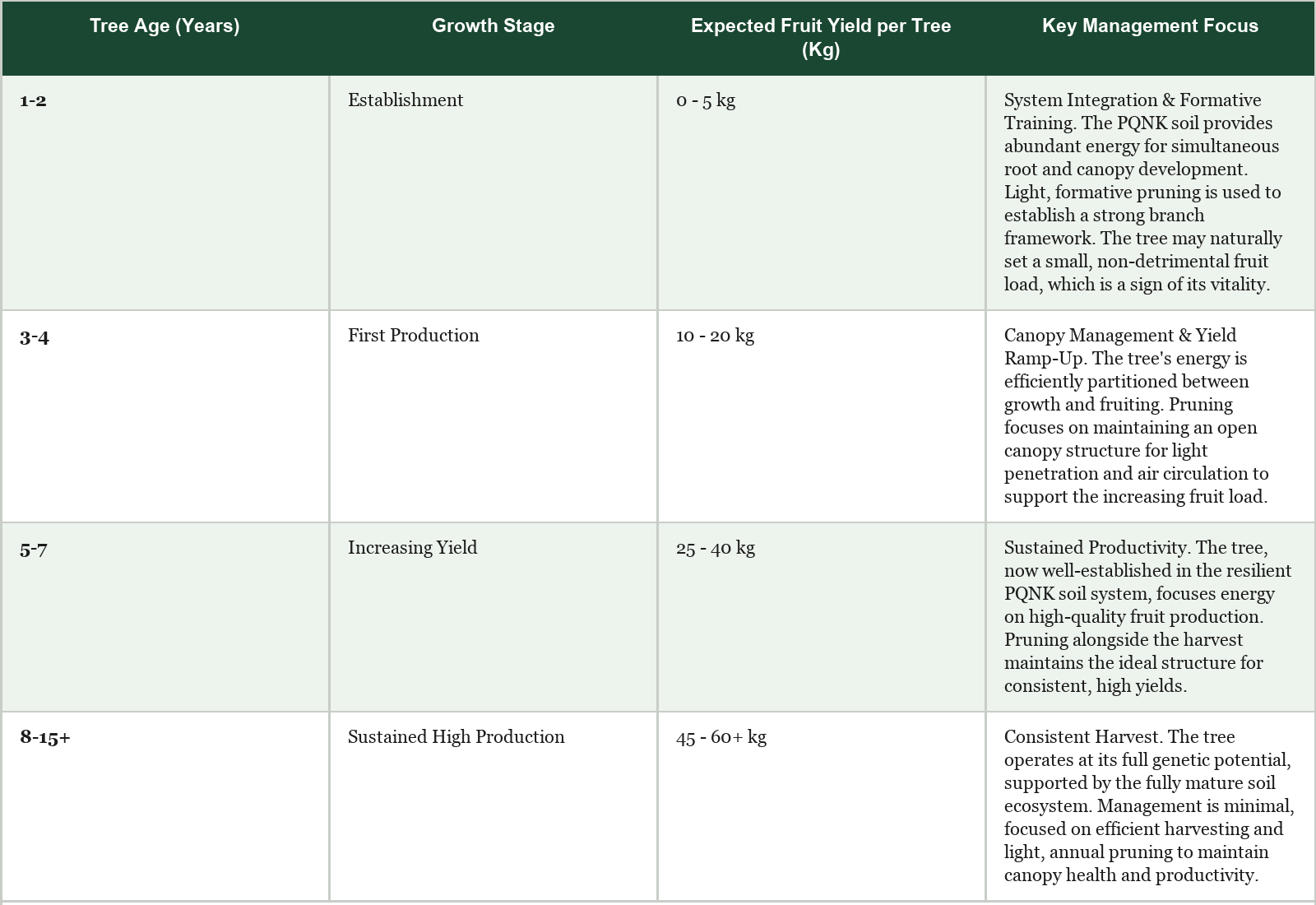
| Tree Age (Years) | Growth Stage | Expected Fruit Yield per Tree (Kg) | Key Management Focus |
|---|---|---|---|
| 1-2 | Establishment | 0 - 5 kg | System Integration & Formative Training. The PQNK soil provides abundant energy for simultaneous root and canopy development. Light, formative pruning is used to establish a strong branch framework. The tree may naturally set a small, non-detrimental fruit load, which is a sign of its vitality. |
| 3-4 | First Production | 10 - 20 kg | Canopy Management & Yield Ramp-Up. The tree's energy is efficiently partitioned between growth and fruiting. Pruning focuses on maintaining an open canopy structure for light penetration and air circulation to support the increasing fruit load. |
| 5-7 | Increasing Yield | 25 - 40 kg | Sustained Productivity. The tree, now well-established in the resilient PQNK soil system, focuses energy on high-quality fruit production. Pruning alongside the harvest maintains the ideal structure for consistent, high yields. |
| 8-15+ | Sustained High Production | 45 - 60+ kg | Consistent Harvest. The tree operates at its full genetic potential, supported by the fully mature soil ecosystem. Management is minimal, focused on efficient harvesting and light, annual pruning to maintain canopy health and productivity. |
What This Means for Your Farm:
This projection shows the significant economic potential of converting to olive cultivation using the PQNK system. It requires patience in the first few years, but the long-term rewards are substantial and consistent. The PQNK system ensures the plant is never forced to choose between growing and fruiting; it has the energy to do both effectively.
Conclusion
The opportunity is here for farmers in suitable climates worldwide. By adopting the PQNK system, you can work with nature to create a prosperous, low-maintenance, and sustainable orchard. This method helps you capture your greatest resource—rainwater—and can turn even marginal sloping lands into a source of wealth and health. Let your orchard be showcase training farm for others.
Footnote: Any Production Process That Inundates Soil With Water, Disturbs Soil Through Tillage, Or Leaves Soil Bare Without Organic Mulch Cover Does Not Qualify As Natural Ecosystem Science For Production Agriculture.
PQNK, to be pronounced as 'picnic', which stands for Paedar Qudratti Nizam Kashatqari, and means: the regenerative & sustainable Pristine Organic Farming System.
About This Paper
- Crop
- Olive
- Problem
- Drought / Water Scarcity · Poor Flowering / Fruit Set · High Input / Production Cost
- Science
- Soil · Water · Plants · Production Architecture
- Evidence
- Economic Model/Projection
- Authority
- Current / Approved PQNK Knowledge
Related PQNK Science
Key Takeaways
- Two establishment paths: irrigated high-density planting at 10ft x 8ft spacing (~545 plants/acre) on 42-inch raised beds, or a rain-fed 'curved furrow and borehole' system for sloping, non-irrigated land.
- The rain-fed borehole is 1 foot in diameter and 4 feet deep, positioned within a curved furrow on the downhill side of each tree; the separate planting hole is 1 foot in diameter and 2 feet deep on the uphill side.
- Projected per-tree yield rises from 0-5 kg (years 1-2) to 10-20 kg (years 3-4), 25-40 kg (years 5-7), and 45-60+ kg from year 8 onward.
- Consistent soil-driven nutrition is presented as the mechanism that eliminates 'biennial bearing,' the heavy-year/rest-year cycle typical of conventionally managed olive trees.
- Long-term management reduces to two combined tasks: harvesting and pruning performed as a single pass, removing dead, diseased, or inward branches while picking fruit.
- No chemical fertilizer or agrochemicals are used at any stage; the mulched borehole system alone is sized to meet a tree's annual water requirement from rain, dew, and humidity.
Related Crops
Related Knowledge
same problem
Knowledge Paper: Olive Under PQNK — Pakistan's Underdeveloped Potential
Pakistan imports all of its olive oil, roughly 15,000–20,000 tonnes a year, despite holding climate-suitable land in the Potohar plateau, the KP hills, and the Balochistan highlands. This paper sets out PQNK's curved furrow and borehole system for rainfed olive establishment, and the biological management that growers report cuts establishment cost by 40–50% versus conventional orchards.
same problem
PQNK: The Pristine Organic Production System for Onion and Garlic Cultivation
A propagation-focused guide to onion and garlic under PQNK, comparing seeds, large bulbs, and offsets as planting material before laying out the full 10-step PQNK transition sequence, from hardpan-breaking through raised-bed formation to harvest timed by leaf yellowing.
same problem
Unlocking the Secrets of the Soil: Understanding Deep Topsoil and Nature's Partnership
Answering a farmer's questions about topsoil and the plant-air-soil nutrient split, this paper explains how PQNK builds 'deep topsoil' many inches below the surface through a plant-microbe carbon pump, and unpacks why nature evolved a system where over 95% of a plant's mass comes from air and water while a mere 0.083% mineral fraction from soil governs everything.
same problem
NARC/PNARD Wheat Field Trials: Regenerative Agri-Production System Results (2021-22)
Results from the second year of joint NARC-PNARD wheat trials in Pakistan comparing the standardized RAS/PQNK package against conventional drill and broadcast farmer practice, plus World Bank survey findings on farmer awareness gaps.