

KP-104 · Workforce & Practice Advisories
The Farm You Only Have to Build Once: How PQNK Converts a Conventional Field into a Permanent, No-Till System
Most fields across Pakistan and northern India's irrigated plains are still laid out for nineteenth-century bullock-and-plough flood irrigation. This paper walks through the one-time engineering project, topography survey, field redesign, hardpan fracture, laser levelling, and permanent bed shaping, that converts such a field into a permanent PQNK system, citing published water-savings and yield data specific to Pakistani Punjab.
Read or listen to the full paper ↓External Knowledge — this paper is sourced from outside Pedaver/PQNK. It is presented as supporting evidence, not as PQNK's own approved doctrine.
Abstract
The paper's premise is that converting to PQNK is not simply a change in what goes into the soil; in most cases the field itself was never designed for the system being adopted. Across the irrigated plains of Pakistan and northern India, most field boundaries and watercourses trace to a canal-colonisation era beginning with the Upper Bari Doab Canal's 1859 opening, shaped by manual labour and draft animals for gravity-fed flood irrigation under the bunna-kiarri system, a layout well suited to its era but poorly matched to mechanised, permanent no-till farming. Converting a field is therefore a distinct, sequenced engineering project that must happen before any of PQNK's biological principles can function.
The conversion begins with a topography survey: a grid of elevation readings that reveals unevenness invisible to the eye, a representative PQNK farm survey found a 4-foot elevation spread across ground that looked essentially flat on foot. With that map in hand, field redesign consolidates small, watercourse-fragmented plots into the longest practical fields in a single consistent orientation (a representative redesigned field ran roughly ten acres and 2,000 feet long), removing most internal watercourses and, wherever intercropping is planned, preferring north-south bed orientation so no single bed sits in shade all day from a taller neighboring crop.
Hardpan correction is sequenced precisely around the earthmoving: wherever more than roughly eight inches of fill is needed, the hardpan must be broken before fill is applied, or a buried, invisible impermeable layer forms beneath the new surface, and it must be broken a second time after grading, since the grading equipment's own wheel traffic recompacts what it just leveled. A bulk soil shifter performs the coarse relocation, then laser levelling brings the whole field to a single uniform grade to within a few centimeters, a precision the paper backs with published Pakistani Punjab data: roughly 22% average irrigation water savings across the rice-wheat rotation, yield gains of 7-9%, and a roughly 27% increase in net farm income.
Water delivery gets equal engineering attention: roughly twenty 2-inch siphon tubes draw from a 6-8 inch main channel at a deliberately conservative ~50% of theoretical maximum flow to keep discharge even along the whole channel, and furrow flow speed is tuned to a 'Goldilocks' advance rate of 50-100 feet per hour, fast enough to reach the tail of the furrow, slow enough to let water seep sideways into the bed rather than scour past it, with soil-type-specific starting flow rates given for sandy, loamy, and clay beds.
The paper closes by describing bed shaping as the point of no return: a bed shaper forms the field's permanent raised beds and furrows in a single pass, after which all future wheel traffic is permanently confined to roughly 15-20% of the field (the furrows), leaving 70-80% of the productive area permanently free of machine-induced compaction, citing research that uncontrolled traffic otherwise compacts an entire field within two seasons. From that point forward, the only operation the farm repeats is no-till precision planting through mulch, crop after crop, on a geometry that never has to be rebuilt again.
Full Paper
If you use “Listen”, the text of the page may be sent to your browser or operating system’s speech provider, such as Apple, Google or Microsoft, depending on the voice your device uses. Pedaver does not process, transmit or store any audio.
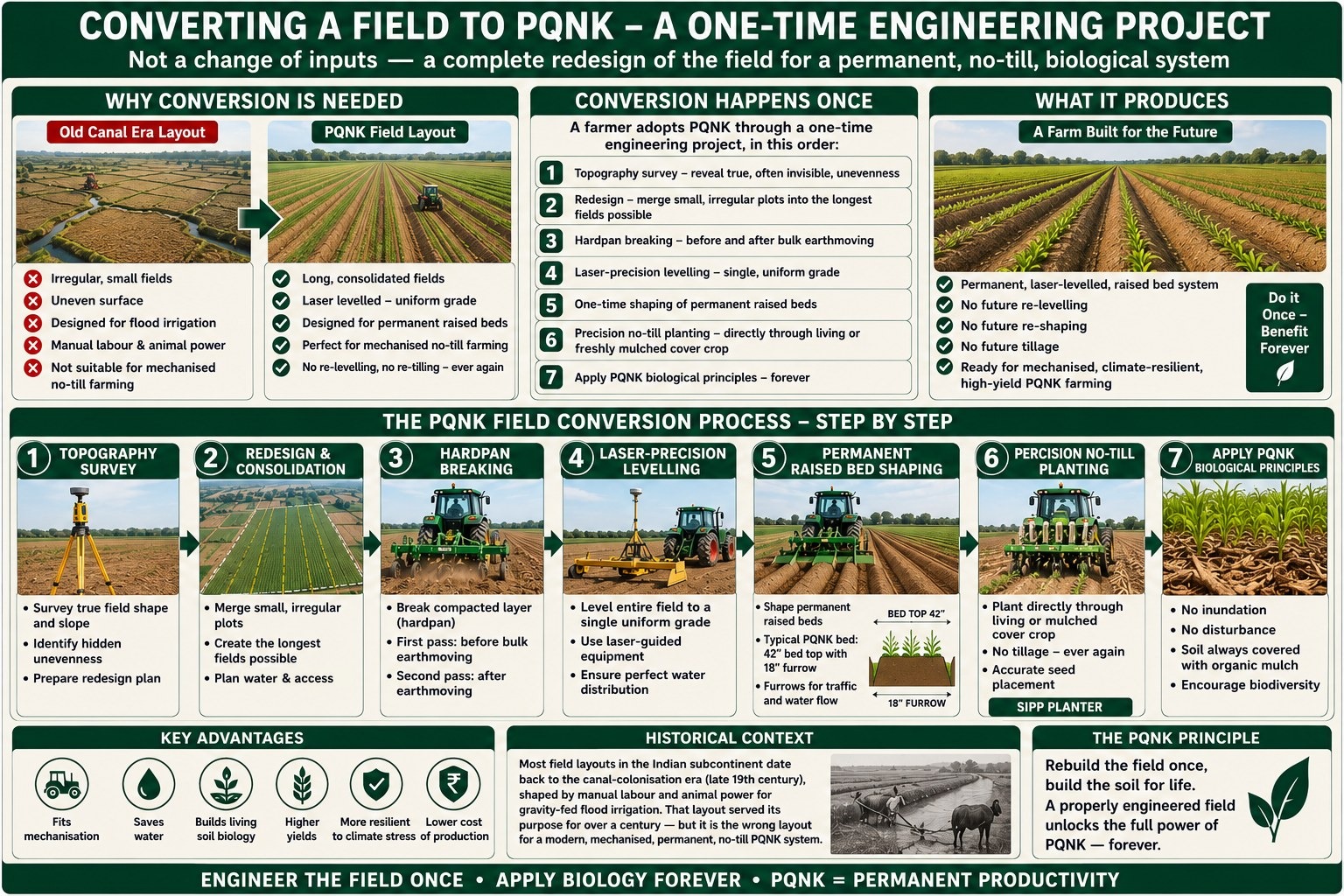
How PQNK Converts a Conventional Field Into a Permanent, No-Till System
Topography, Hardpan, and Bed Geometry, Solved Once, So the Soil Is Never Disturbed Again
From land laid out for a bullock and a plough to a farm engineered for zero tillage, permanently.
Author: PQNK Team
Founder: Asif Sharif, Paedar Qudratti Nizam Kashatqari (PQNK)
Date: July 2026
ABSTRACT
A farmer who wants to convert to PQNK is not simply changing what goes into the soil. In most cases, the field itself, its shape, its slope, and the compacted layer sitting beneath it, was never designed for the system being adopted. Across the irrigated plains of the Indian subcontinent, most existing field boundaries and watercourses trace their layout to a canal-colonisation era that began in the second half of the nineteenth century, when there was no earthmoving machinery and no tractor, and fields were shaped by manual labour and draft animals to the land's natural contour and to the requirements of gravity-fed flood irrigation. That layout served its purpose for over a century. It is the wrong layout for a mechanised, permanent, no-till farming system, and converting a field from one to the other is a distinct, one-time engineering project that has to happen before any of PQNK's biological principles can be applied at all.
This paper sets out that conversion project in the order it actually happens on a PQNK farm: a topography survey that reveals a field's true, often invisible unevenness; a redesign that consolidates small, irregularly bordered plots into the longest fields the land will allow; the deliberate sequencing of hardpan-breaking before and after bulk earthmoving; laser-precision levelling to a single uniform grade; the one-time shaping of permanent raised beds; and, finally, precision no-till planting directly through living or freshly mulched cover crop, the operation that, once the conversion is complete, replaces tillage permanently. Every step described here happens once. What it produces is a farm that never needs to be re-levelled, re-shaped, or re-tilled again.
1. WHY THE LAND ITSELF HAS TO CHANGE FIRST
A farmer new to PQNK naturally focuses first on the biological principles: no tillage, permanent mulch cover, no synthetic inputs, maximum diversity. Those principles describe how a PQNK field is farmed once it exists. They say nothing about how to get from a conventional field, uneven, criss-crossed with small watercourses, compacted beneath the surface by generations of shallow tillage, to a field capable of supporting those principles at all. That gap is a physical and engineering problem, not a biological one, and it has to be solved before the biology can do its work.
This is the gap this paper addresses: the farm-design and conversion process that turns a conventional field into a permanent PQNK system. It is, deliberately, a one-time process. Every operation described in the sections that follow, the survey, the earthmoving, the hardpan fracture, the levelling, the bed shaping, is a capital investment made once and then maintained, not an operation repeated every season the way conventional tillage is. Understanding why each step exists, and why the sequence matters, is what allows a farmer or a farm-design team to convert a field correctly the first time.
2. A FIELD SHAPE BUILT FOR A WORLD THAT NO LONGER EXISTS
Land demarcation across most of the irrigated plains of Pakistan and northern India dates substantially to the canal-construction era that began in the mid-nineteenth century. The region's first major perennial canal, the Upper Bari Doab Canal, opened in 1859, and the wider network of canal colonies that followed was surveyed, allotted, and settled in stages from roughly 1860 through the early twentieth century. The gravity-fed distribution and field-watering scheme introduced alongside that canal network, known locally as the bunna-kiarri system, borders and small check-basins marked out to guide flood water across a bordered plot by gravity alone, is the direct ancestor of the field shape a PQNK conversion has to undo. None of that original layout work was mechanised. Fields were marked out and marginally levelled by manual labour assisted by draft animals, in an era with no tractors, no earthmoving equipment, and no laser levels, and they were shaped to two constraints only: the land's existing, unaltered contour, and the practical requirement of getting flood irrigation water from a watercourse to a bordered plot by gravity alone.
That layout was a reasonable, even ingenious, solution to the constraints of its time. It is a poor fit for the constraints of the present one. A field system built around small, individually bordered plots and a dense internal network of minor watercourses forces any tractor-drawn implement, a plough, a planter, a sprayer, into frequent turns, and every turn is unproductive time and unplanted headland. Machinery efficiency scales directly with the length of an uninterrupted pass; a field system inherited from an age of manual labour was never designed with that variable in mind, because it did not need to be.
The starting objective of a PQNK farm conversion is therefore a direct inversion of the original design logic. Where the nineteenth-century layout prioritised minimal earthmoving within a fixed, contour-following field shape, a PQNK redesign prioritises the longest field length the land and its irrigation source can support, while still moving the minimum practical volume of soil to achieve it, because shifting soil is both expensive and, handled carelessly, damaging to the soil structure the rest of the PQNK system depends on. Reconciling those two goals, long fields and minimal earthmoving, is what the topography survey described in the next section makes possible.
3. READING THE LAND BEFORE MOVING IT: THE TOPOGRAPHY SURVEY
A field can look level to the eye and still vary by several feet in true elevation across its length. A topography survey removes the guesswork: a grid of elevation readings is taken across the entire farm, typically recorded in feet relative to a fixed benchmark, using a level and staff or an equivalent surveying instrument, and the results are plotted onto a map of the farm showing the precise elevation of every surveyed point.
In a representative PQNK farm survey, elevations across a single contiguous block ranged from roughly 13.2 feet at the highest surveyed point down to 8.8 feet at the lowest, a spread of more than four feet across a farm that, walked on foot, would have looked essentially flat. That invisible unevenness is precisely the information a farm-design team cannot work without. It shows exactly which zones require heavy fill, which need only a light finishing pass, and which are already at or near the elevation the rest of the design will be built around. Without this map, any subsequent earthmoving is guesswork; with it, every cubic metre of soil that gets moved is moved for a specific, calculated reason.
4. DESIGNING THE FIELD: LONGEST BEDS, ONE DIRECTION, MINIMUM SOIL MOVEMENT
With the topography map in hand, the farm design itself follows a small number of consistent rules. Beds and crop rows are laid out in the longest practical direction the farm's shape allows, held to a single, consistent orientation across as much of the property as possible, so that a tractor completes the longest possible uninterrupted pass before it has to turn. Most of the small internal watercourses inherited from the original, pre-mechanised field layout are removed from the design entirely, consolidating what were previously several small, individually bordered plots into a single long field, irrigated from a main channel along one side and served by an access road along the other, rather than threaded through with minor channels that break up the field and consume space that could otherwise be cropped.
A representative example illustrates the scale this achieves: a single redesigned field roughly ten acres in size and approximately two thousand feet, around six hundred and ten metres, long, irrigated along one side and bordered by a road on the other. A field of this length reduces the number of headland turns a tractor makes per unit area worked to a small fraction of what the original, subdivided layout required, and every turn eliminated is time, fuel, and compacted headland soil that a shorter, more fragmented field design would have spent instead.
None of this is a fixed template applied identically to every farm. The specific balance between field length and the volume of soil that has to move to achieve it is a site-specific engineering decision, constrained by the farm's actual topography, its irrigation source, and its boundaries. What is constant across every PQNK conversion is the underlying rule: design for the longest field the land will support, while moving the least soil necessary to get there, and remove the internal infrastructure that a manual, animal-drawn era needed but a mechanised, permanent-bed system does not.
Bed-furrow direction is a second design decision within this same step, and it matters most wherever the farm plans to multi-crop rather than run a single crop edge to edge. Wherever intercropping is intended, beds should preferably run north–south rather than east–west. The sun's apparent path moves east to west through the day, and a tall-canopy crop grown in an east–west bed casts its shadow onto the same neighbouring bed for hours at a stretch, since that shadow falls consistently to one side (north, in the northern hemisphere) rather than sweeping across the field. A north–south bed avoids this: the shadow of any tall plant instead sweeps from one side of the field to the other as the sun crosses the sky, so no single neighbouring bed sits in shade for the whole day, and every bed, tall crop or short, receives a comparable share of direct sunlight. This becomes especially important once crops of differing canopy height and size are planted in adjacent beds, since a shorter crop boxed in behind a taller one on an east–west orientation can lose a meaningful share of its daily light to shading, with a corresponding yield cost. Where slope, wind exposure, or an existing canal alignment forces a different orientation, north–south remains the default to return to whenever the field's own layout allows it.
Where the field's own constraints, slope, prevailing wind, or an existing canal alignment, make a north–south bed impossible, the two effects above do not have to be accepted together. Orchard trees are planted as individually spaced points rather than as a continuous row crop, so their planting line can still be laid out north–south for shade management even while the field's own bed-furrow direction runs east–west; the two orientations are independent decisions and do not need to match. The east–west shading this section describes as a drawback for row crops can, in the same field, be turned into a deliberate advantage: shade-tolerant crops, or crops that otherwise suffer from scorching summer heat, can be assigned specifically to the shaded side of a taller neighbouring bed or tree line, using the shadow the taller planting already casts rather than fighting it.
5. PLANT SPACING: EQUAL SPACE AROUND EVERY PLANT, NOT WIDER ROWS
Bed and furrow layout answers one design question; how far individual plants sit from each other within that layout answers a second, separate one, and the conventional answer to it, wide row spacing with plants set close together within the row, is itself a historical accident rather than an agronomic optimum. Before mechanisation, seed was broadcast by hand or planted at best semi-randomly using a simple seed-opener drawn behind draft animals, and weeds were suppressed by hand-hoeing, by crop rotation, or by leaving ploughed soil bare and irrigating it deliberately to trigger weed germination before the cash crop was ever planted. A refinement of that same stale-seedbed logic went a step further: because a seed is, in a real sense, a cautious creature, most of a given weed seed bank will not germinate from a single irrigation alone, so farmers broadcast a small amount of cash-crop seed first, specifically to trick and encourage the weed seed bank into germinating, then irrigated the field a second time and planted the actual cash crop into it once that flush of weeds had been dealt with. Under this entire regime, row-to-row and plant-to-plant spacing were more or less the same in every direction, because nothing about the method required otherwise.
Wider row spacing arrived only with mechanisation, and it arrived to solve a machinery problem, not a plant one: tractors needed a wide enough gap between rows to pass through for weeding, fertiliser application, and pest spraying, all mid-season operations carried out from within the standing crop. Row spacing widened to accommodate the tractor, and plant-to-plant spacing within the row tightened to compensate and hold population per acre roughly constant, producing the crowded-in-row, wide-between-row pattern now treated as standard practice, a pattern that was never actually chosen for the plant's own benefit.
PQNK's recommendation reverses this by removing the reason for it. Once mulch cover suppresses weeds and permanent furrows confine all machine traffic outside the bed, mid-season tractor passes between individual crop rows are no longer needed the way they were under tillage-based, bare-soil farming, and the original justification for wide row gaps with crowded in-row spacing disappears with them. PQNK instead recommends equal space in every direction around each plant, a square or grid spacing rather than a rectangular one, so that every plant draws on a roughly equal, unshared share of light, root volume, and nutrients, optimising the use of the bed's available space rather than trading space between directions for a machinery clearance the permanent-bed system no longer requires.
6. FIXING WHAT IS UNDERNEATH BEFORE FIXING WHAT IS ON TOP
Beneath most conventionally farmed fields sits a hardpan, a dense, compacted layer produced by generations of tillage repeated at the same shallow depth, combined with decades of heavy machinery and animal traffic and the compressive effect of repeated flood irrigation. A hardpan is functionally a false floor: it blocks root penetration below it, and it blocks the downward movement of water into the soil profile beneath it, leaving both roots and water confined to a shallow zone above the pan, precisely the condition that makes a crop simultaneously vulnerable to short-term drought, because there is no deep soil moisture reserve to draw on, and to waterlogging, because excess water has nowhere to go.
This is why hardpan-breaking is not an optional add-on to the earthmoving process; it has to be sequenced correctly around it. Wherever a section of field requires more than roughly eight inches of fill to reach the design elevation, the hardpan beneath that section must be broken before the fill is applied, not after. Burying an intact hardpan under new fill material creates a hidden impermeable layer at depth, one that can trap water beneath the new surface and produce waterlogged pockets invisible from above, defeating the purpose of levelling before the first crop is even planted. Once filling, coarse levelling, and fine levelling are complete, the hardpan is broken a second time, because the grading equipment's own wheel traffic during that earthmoving work recompacts the surface it has just finished shaping.
The tool for this work is a subsoiler, a shank-based implement pulled through the soil at depth to physically shatter the compacted layer rather than simply cutting a narrow slot through it. The distinction matters: subsoiling shatters a compacted layer effectively only when the soil is dry. If the same operation is carried out on wet or moist soil, the shatter lines close again as the soil rehydrates and swells, in much the same way a drought crack in dry clay reseals itself once it rains, and the structural benefit is lost within one wet season. Carried out correctly, in dry soil, at a depth calibrated to the actual thickness of the compacted layer, a subsoiling pass fractures the hardpan permanently, opening a permeable channel for both roots and water that the following bed-shaping and planting operations then build on.
7. BULK EARTHMOVING AND LASER PRECISION: TWO TOOLS FOR TWO DIFFERENT JOBS
Two distinct pieces of equipment carry out the physical earthmoving the topography survey calls for, and they are not interchangeable. Where the survey shows a substantial volume of soil needs to move from a naturally high zone to a naturally low one, a bulk soil shifter, a hydraulic-bucket drag scraper pulled behind a tractor, carries out the coarse, high-volume pass, physically relocating the largest quantities of soil across the farm.
Laser levelling then carries out the precision finishing pass that no amount of operator skill with a plain grader blade can match. A laser transmitter set at a fixed reference point projects a continuously rotating beam across the field at a precisely known height; a receiver mounted on a drag bucket or blade reads its own height relative to that beam in real time and automatically raises or lowers the blade to cut soil from anywhere above the target grade and deposit it anywhere below it, until the entire field, regardless of its size, sits at a single, uniform elevation or a single, uniform planned slope, to a precision of a few centimetres.
The published evidence for what this precision is worth is substantial and specific to this region's own farming systems. Empirical studies of laser-land-levelling adoption in the rice-wheat systems of Pakistan's Punjab have measured irrigation water savings of roughly twenty-two percent across the rotation as a whole, with reductions in the range of twenty-five to thirty percent for rice alone and ten to thirteen percent for wheat; studies focused specifically on precision levelling have recorded water savings as high as forty-seven percent. Yield responses have been measured alongside those water savings: laser-levelled paddy fields in the Indo-Gangetic Plains have shown yield gains of roughly seven percent over conventionally levelled fields, wheat yields have improved by seven to nine percent, and comparisons against completely unlevelled fields have recorded yield increases of up to thirty-five percent. The net effect on farm income has been estimated at an increase of roughly twenty-seven percent for both rice and wheat in Pakistan's Punjab specifically.
The mechanism behind these figures is straightforward. A field with even minor unevenness delivers irrigation water unevenly within a single event: water pools in low spots, creating waterlogging, nutrient leaching, and disease pressure, while high spots receive too little, producing drought stress and poor, patchy germination, within the same field, from the same irrigation turn. A precisely levelled field removes that variability entirely: every part of the field experiences the same water depth and the same infiltration time in the same pass. This is also why a long, slow levelling run across a freshly filled and fractured section of field serves a second purpose beyond achieving grade: watching how quickly water advances and infiltrates along that run is itself a direct, practical test of whether the newly broken and filled soil is actually accepting and conducting water the way the design intends, before a single bed is shaped or a single seed is committed to the ground.
8. DELIVERING WATER EVENLY: THE SIPHON TUBE SYSTEM
A precisely levelled field, described in the previous section, only pays off if the water reaching it is introduced just as evenly. PQNK delivers that water through a bank of siphon tubes rather than through a single cut or breach in the channel bank: roughly twenty tubes of about two inches in diameter draw simultaneously from a six-to-eight-inch main delivery channel running along one side of the field, each tube primed to siphon water over the channel bank and release it into its own furrow at a controlled, individual rate, rather than letting the whole field's water arrive through one uncontrolled opening.
The velocity of that release is deliberately kept slow, and this is a design choice rather than a limitation of the equipment. Water moving gently out of each siphon tube has time to seep laterally into the raised bed on either side of the furrow as it travels, which is the actual mechanism that moistens the bed itself rather than only wetting the furrow floor; water discharged quickly instead rushes down the furrow with too little time in contact with the bed shoulder to seep sideways, and it scours and erodes the furrow and bed edges it passes over instead of soaking into them.
Getting this right depends on maintaining a consistent water head, the depth of water standing in the main channel, across the tube's full working length, because a siphon tube's discharge rate is a direct function of that head pressure. PQNK's own operating practice targets roughly fifty percent of a tube's theoretical maximum flow rate through each outlet, a deliberately conservative figure that keeps the channel's water level, and therefore every tube's discharge, consistent along the whole row of outlets; running tubes closer to their theoretical maximum lets the channel level, and with it the flow rate, fall away toward the far end of the field, so that furrows nearest the inlet are over-watered while furrows furthest from it run short from the same irrigation turn.
9. FINDING THE RIGHT FLOW SPEED: THE GOLDILOCKS PRINCIPLE
Once water is released into a furrow at a controlled rate, a second variable still has to be tuned correctly: how fast that water is allowed to travel down the furrow's length. This is not a detail left to chance. Water moving too fast rushes to the tail end of the furrow before it has had time to soak into the bed at all, leaving the centre of every bed along that furrow dry and wasting the water that runs past the field's end unused. Water moving too slowly does the opposite: it barely advances down the furrow, waterlogging the beds nearest the inlet while the tail end of the same furrow never receives water at all, and whatever does infiltrate near the inlet is lost to deep percolation well below the root zone rather than being held where a crop can use it.
The correct pace sits between these two failures, and PQNK describes it deliberately in plain, physical terms: water should move down the furrow at about the speed of a slow walk, not a run and not a crawl. In concrete, measurable terms, that means an advance rate of roughly fifty to one hundred feet per hour; soil at the centre of the bed should be moist to about two inches below the surface within twenty-four hours of irrigation; no standing water should remain visible in the furrow four to six hours after the irrigation turn ends; and the crop should grow evenly across the entire bed rather than showing a vigorous strip near the inlet and stunted growth toward the tail. The four-to-six-hour standing-water check is itself a direct, practical confirmation that the hardpan fracture described earlier in this paper actually succeeded: water that still sits on the surface well past that window is water the fractured layer beneath it is not actually accepting, exactly the false-floor condition hardpan-breaking exists to eliminate.
PQNK's own field-tested flow rates for its standard forty-two-inch bed with an eighteen-inch furrow give this a concrete starting point by soil type: sandy soil, which lets water through fastest and needs the most water moving through to hold the target advance rate, takes roughly two to two and a half litres per second per furrow; loamy soil takes roughly one and a half to two litres per second; and clay soil, which drains slowest and would waterlog easily at a higher rate, takes roughly one to one and a half litres per second. These figures are a starting point to calibrate from on a given field, not a fixed universal constant, since actual soil texture, slope, and furrow condition all shift the rate needed to hold the same fifty-to-one-hundred-foot-per-hour advance.
This calibration matters most, and needs the closest attention, during the transition phase immediately after conversion, while the soil's internal structure is still developing. As the beds mature, years of undisturbed root channels and biological activity steadily increase soil porosity, giving the soil a far greater capacity to draw in water and hold it for an extended period from a greater lateral distance than a freshly converted bed can manage; a flow rate that has to be followed closely in the first seasons after conversion becomes progressively more forgiving as the bed system matures.
10. FROM FLAT FIELD TO PERMANENT GEOMETRY: SHAPING THE RAISED BEDS
Once a section of field has been surveyed, filled where necessary, fractured below the surface, and brought to a precise, uniform grade, a bed shaper forms the field's permanent raised beds and furrows in a single pass, converting a flat, undifferentiated surface into a fixed geometry of alternating high ground and low ground that the farm will keep, unchanged, indefinitely. The raised sections, the "up" land, become the permanent crop zone, seeded and re-seeded for every subsequent crop without ever being re-tilled or re-shaped. The furrows, the "low" land, become the farm's permanent traffic lanes and its permanent irrigation channels, carrying every tractor pass and every irrigation turn for as long as the farm operates on this design.
This single step is what converts the farm from a system in which wheel traffic goes anywhere the operator drives it, to a system in which it goes nowhere else but the furrows, ever again. Research on controlled traffic farming has documented what happens under the conventional alternative: uncontrolled field traffic compacts roughly three-quarters of a field's total area within a single cropping season, and the entire field area by the second season, as successive operations track over ground the previous pass had already compressed. A permanent bed-and-furrow geometry inverts that outcome directly, confining compaction to the fixed furrow lanes, typically on the order of fifteen to twenty percent of total field area, and leaving the raised bed zone, seventy to eighty percent of the farm's productive area, permanently free of machine-induced compaction, because no wheel ever crosses it again after the beds are first shaped.
This is the point in the conversion process where the distinction between a one-time investment and a recurring cost becomes concrete. Everything from the topography survey through bed shaping happens once. Everything after this point, described in the next section, is maintenance carried out on a fixed, permanent structure, not a re-creation of it.
11. PLANTING WITHOUT EVER TILLING AGAIN
Once a farm's permanent beds are shaped, the operation that establishes every subsequent crop is precision no-till planting: a machine equipped with spring-loaded, disc-coultered planting units that open a narrow slot through whatever is on the bed surface, standing residue, crimped or mulched cover crop, or the stubble of the previous harvest, and place each seed individually at a precise depth and spacing in the undisturbed soil beneath, without ever inverting, loosening, or otherwise disturbing the bed's internal structure. This is the machine operation that makes the entire conversion described in this paper worth carrying out: it is what allows a PQNK bed, once shaped, to grow a new crop after every harvest without the soil ever being tilled again.
A field demonstration of this system in active use shows a specific and instructive configuration: the planter fitted with a front-mounted rotary mulching head, working through a dense, standing hedge of Jantar, Sesbania, a leguminous green-manure cover crop still fully green and actively growing. The mulching head shreds the standing Jantar into fine mulch fragments immediately ahead of the planting units, in the same tractor pass in which those units seed the following cash crop directly into the freshly cut material. This differs in one important respect from the roller-crimper method used elsewhere in the PQNK system for terminating a more mature, drier cover crop: a roller-crimper flattens and physically stresses standing residue to kill it without cutting it, a method that works reliably once a cover crop has begun to dry down and lignify, but is less reliable against a fully green, moisture-rich, actively growing stand, which a roller alone may simply bend rather than kill. A rotary mulching head solves that specific problem by cutting the green material into short fragments small enough to lie flat against the bed surface and begin decomposing quickly, while reliably terminating the standing crop in the same motion.
The practical result, visible directly in this field demonstration, is that the entire transition from one crop to the next, on a farm that has completed the conversion process this paper describes, is a single tractor pass: the outgoing cover crop is terminated and mulched, and the incoming cash crop is seeded, in one operation, with no separate tillage step, no separate cover-crop-kill operation, and no period in which the bed surface is left bare. This is the maintenance operation that a one-time farm conversion exists to make possible.
12. THE COMPLETE SEQUENCE: FOUR STEPS, ONE TIME
Reduced to its practical essentials, the conversion this paper describes proceeds in four steps. First, prepare the field for the type of irrigation it will use, guided by the topography survey, the redesigned field boundaries, and the plant-spacing plan described in Sections 2 through 5. Second, break the hardpan, sequenced correctly around the bulk earthmoving and laser levelling described in Sections 6 and 7, so that the compacted layer is fractured both before heavy fill is applied and again after grading equipment has finished its work. Third, make the permanent raised beds, the single bed-shaping pass described in Section 10 that fixes the farm's geometry for good, delivering water to it through the siphon-tube system and at the calibrated flow speed described in Sections 8 and 9. Fourth, plant crop after crop on those same permanent beds, using the no-till precision planting described in Section 11, indefinitely, without ever tilling, re-shaping, or re-levelling the land again.
The defining feature of this sequence, and the reason it is worth setting out as a distinct engineering process rather than treating it as an implicit prerequisite to PQNK's biological principles, is that every one of the first three steps is a one-time capital investment, made once and amortised over the entire remaining productive life of the farm. Conventional agriculture, by contrast, repeats a version of soil disturbance every single season: every tillage pass re-loosens, and every subsequent traffic pass re-compacts, in a cycle that never converges on a stable, permanent structure. A farm that has completed this four-step conversion has exited that cycle permanently. The only operation it performs from this point forward is the fourth step, repeated for every crop, for as long as the farm operates.
13. THE CONVERSION AT A GLANCE
The table below summarises each stage of the conversion process, what it accomplishes, and whether it is a one-time investment or an operation repeated with every crop.
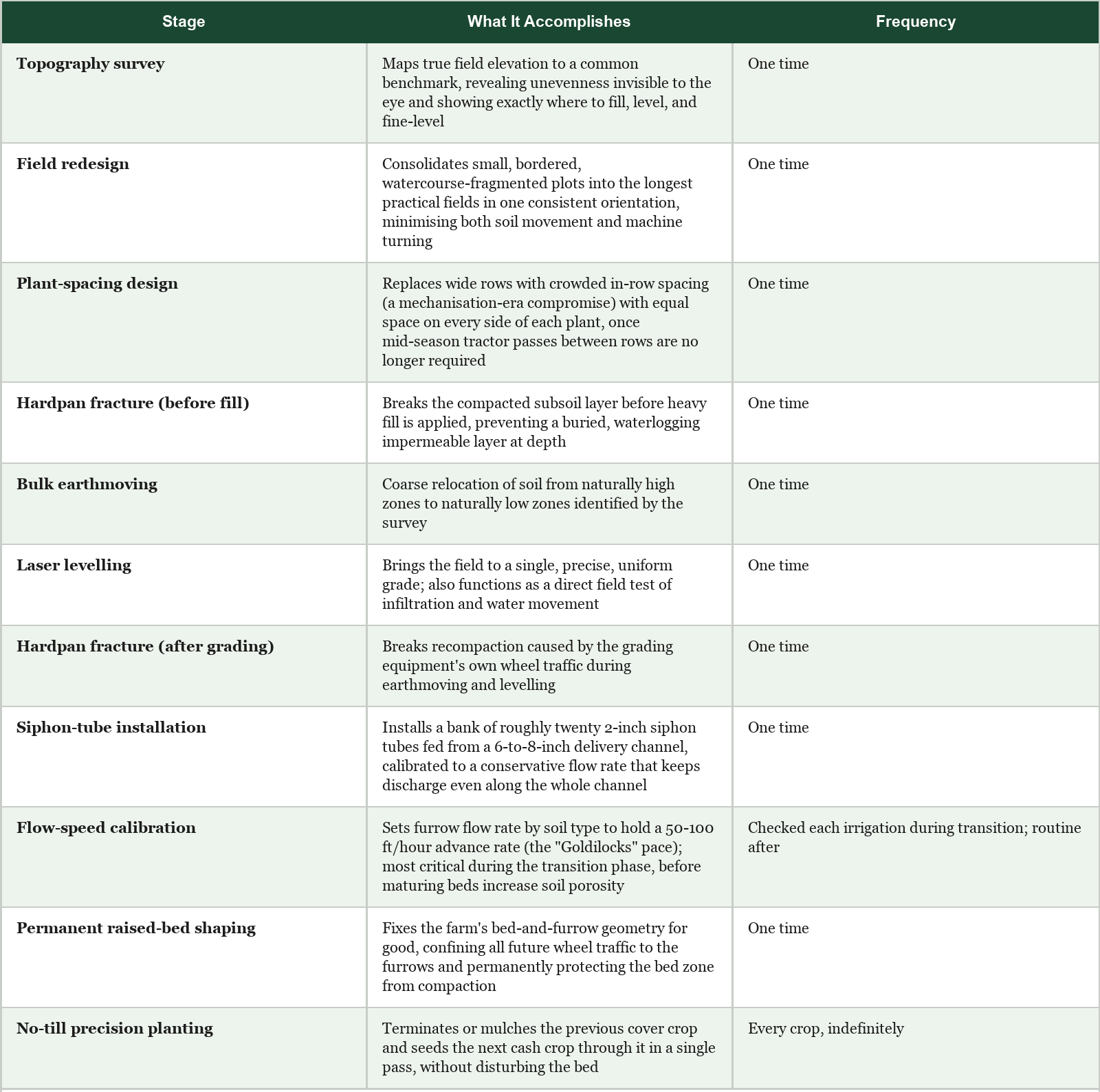
| Stage | What It Accomplishes | Frequency |
|---|---|---|
| Topography survey | Maps true field elevation to a common benchmark, revealing unevenness invisible to the eye and showing exactly where to fill, level, and fine-level | One time |
| Field redesign | Consolidates small, bordered, watercourse-fragmented plots into the longest practical fields in one consistent orientation, minimising both soil movement and machine turning | One time |
| Plant-spacing design | Replaces wide rows with crowded in-row spacing (a mechanisation-era compromise) with equal space on every side of each plant, once mid-season tractor passes between rows are no longer required | One time |
| Hardpan fracture (before fill) | Breaks the compacted subsoil layer before heavy fill is applied, preventing a buried, waterlogging impermeable layer at depth | One time |
| Bulk earthmoving | Coarse relocation of soil from naturally high zones to naturally low zones identified by the survey | One time |
| Laser levelling | Brings the field to a single, precise, uniform grade; also functions as a direct field test of infiltration and water movement | One time |
| Hardpan fracture (after grading) | Breaks recompaction caused by the grading equipment's own wheel traffic during earthmoving and levelling | One time |
| Siphon-tube installation | Installs a bank of roughly twenty 2-inch siphon tubes fed from a 6-to-8-inch delivery channel, calibrated to a conservative flow rate that keeps discharge even along the whole channel | One time |
| Flow-speed calibration | Sets furrow flow rate by soil type to hold a 50-100 ft/hour advance rate (the "Goldilocks" pace); most critical during the transition phase, before maturing beds increase soil porosity | Checked each irrigation during transition; routine after |
| Permanent raised-bed shaping | Fixes the farm's bed-and-furrow geometry for good, confining all future wheel traffic to the furrows and permanently protecting the bed zone from compaction | One time |
| No-till precision planting | Terminates or mulches the previous cover crop and seeds the next cash crop through it in a single pass, without disturbing the bed | Every crop, indefinitely |
CONCLUSION
Most conventional fields across the irrigated plains of Pakistan and northern India carry a layout inherited from a nineteenth-century canal-colonisation era that had no tractors, no earthmoving equipment, and no laser levels, and that shaped fields accordingly, to the land's raw contour and to the minimum requirements of gravity-fed flood irrigation. Converting such a field to a permanent PQNK system is not a matter of simply changing farming practice on the existing ground. It is a distinct, sequenced engineering project, survey, redesign, hardpan fracture, earthmoving, precision levelling, and permanent bed shaping, that has to be completed correctly, and largely in the order set out in this paper, before the biological principles PQNK is built on can actually function.
What that project buys the farmer is not a better version of the same annual cycle. It is an exit from that cycle. Every step described in this paper happens once. What follows it, crop after crop planted directly through mulch into undisturbed, permanently structured soil, is maintenance on a system that no longer needs to be rebuilt every season.
A field's shape is not a fact of nature. It is a decision, made once, usually a very long time ago, for reasons that no longer apply. Redesigning that decision is the one investment a PQNK farm makes only once, and never has to make again.
KEY TAKEAWAYS
Most Existing Field Layouts Predate Mechanisation Entirely: field boundaries and watercourses across much of the region's irrigated plains trace to a canal-colonisation era beginning in 1859, shaped by manual labour and draft animals for gravity-fed flood irrigation, not for tractors or precision machinery.
The Modern Design Objective Is the Reverse of the Original One: PQNK field design prioritises the longest practical field length in a single consistent orientation, removing most internal watercourses, while still minimising the total volume of soil moved to achieve it.
A Field Can Vary by Several Feet Without Looking Uneven: a representative farm topography survey recorded an elevation spread of more than four feet across a single block that appeared flat on the ground; the survey, not the eye, drives the design.
Wide Row Spacing Was a Machinery Fix, Not a Plant Requirement: wide gaps between rows exist to let tractors pass through for mid-season weeding, fertilising, and spraying; PQNK's permanent mulch and confined furrow traffic remove that need, allowing equal space on every side of each plant instead.
Hardpan Sequencing Is Not Optional: wherever fill exceeds roughly eight inches, the hardpan must be broken before filling, not after, or the buried, intact hardpan creates a hidden, waterlogging impermeable layer beneath the new surface.
Subsoiling Only Works in Dry Soil: shattering a compacted layer in wet or moist soil fails; the fracture lines reseal on rehydration the same way a drought crack reseals when it rains. Correct timing, not just correct equipment, determines whether hardpan-breaking succeeds.
Laser Levelling's Water and Yield Benefits Are Documented, Not Theoretical: published studies from Pakistan's Punjab and India's Indo-Gangetic Plains report 22-47% irrigation water savings, 7-35% yield gains, and roughly 27% higher net farm income following laser-precision levelling.
Slow Water Delivery Is Deliberate, Not Inefficient: PQNK's siphon-tube system runs at roughly half a tube's theoretical maximum flow, trading speed for even discharge along the whole channel and giving water time to seep sideways into the bed rather than rushing down the furrow and eroding it.
Furrow Flow Speed Has a Goldilocks Zone: too fast wastes water past the field's end and leaves bed centres dry; too slow waterlogs the inlet end while the tail stays dry; the right pace, roughly 50-100 ft/hour, moistens the whole bed evenly and is confirmed by no standing water 4-6 hours after irrigation.
Flow-Speed Calibration Matters Most Early On: sandy, loamy, and clay soils need different flow rates (roughly 2-2.5, 1.5-2, and 1-1.5 litres per second per furrow respectively, for a 42-inch bed) to hold the target advance rate; as beds mature and soil porosity increases, the system becomes progressively more forgiving of small variations.
Bed Shaping Is the Point of No Return, in a Good Way: once permanent raised beds and furrows are formed, the farm's geometry is fixed for good; every subsequent operation is maintenance on that fixed structure, not a re-creation of it.
Permanent Beds Convert Compaction From Universal to Confined: uncontrolled field traffic compacts roughly 75% of a field within one season and the whole field by the second; a permanent bed-and-furrow system confines that compaction to the furrows alone, leaving 70-80% of the field permanently uncompacted.
No-Till Planting Can Mulch and Seed in the Same Pass: a front-mounted rotary mulching head can shred a standing, actively growing green-manure cover crop into fine mulch immediately ahead of the planting units, which seed the following cash crop through it in the same tractor pass, terminating one crop and establishing the next without a bare-soil period.
A Mulching Head and a Roller-Crimper Solve Different Problems: a roller-crimper reliably terminates a mature, drying cover crop by physical stress alone; a fully green, moisture-rich stand is more reliably terminated by cutting it into mulch, which a rotary mulching head accomplishes in the same pass as planting.
The Whole Conversion Is a One-Time Investment: the survey, redesign, hardpan fracture, earthmoving, levelling, and bed shaping happen once and are amortised over the farm's entire remaining productive life; only the final step, no-till planting, repeats, once per crop, indefinitely.
REFERENCES
Ali, Imran et al. Laser-land leveling adoption and its impact on water use, crop yields and household income: Empirical evidence from the rice-wheat system of Pakistan Punjab. Agricultural Water Management, ScienceDirect.
The adoption of laser land leveler technology and its impact on groundwater use by irrigated farmland in Punjab, Pakistan. Land Degradation & Development, Wiley Online Library.
Water Conservation by Laser Land Leveling in District Mirpurkhas, Sindh, Pakistan.
Impact of laser land leveler for enhancing water productivity in Western Uttar Pradesh.
Tekeste, M. Z. et al. Soil Drying Effects on Soil Strength and Depth of Hardpan Layers. USDA Agricultural Research Service.
Subsoiler: mechanism, function, and typical operating depth. General agricultural engineering reference.
Controlled Traffic Farming. Fact Sheet, Soil Quality (soilquality.org.au).
Tullberg, J. N. et al. Controlled traffic farming, from research to adoption in Australia. Soil and Tillage Research, ScienceDirect.
The Dynamics of Canal Colonies: Agricultural Development in Punjab under British Rule. Pakistan Journal of History (pjh.wum.edu.pk).
Punjab Canal Colonies: history of the Upper Bari Doab Canal (opened 1859) and subsequent canal-colony settlement, 1860s-1930s, including the bunna-kiarri gravity-fed field-watering scheme introduced alongside it.
FAO Irrigation and Drainage Paper: Surface Irrigation Design (fao.org). Advance rate and intake opportunity time as core design variables in furrow and border irrigation.
Wide row spacing as a mechanisation-era accommodation, and PQNK's own siphon-tube discharge rates, flow-speed targets, and equal-spacing recommendation: PQNK field practice and operating parameters, documented internally rather than drawn from third-party literature.
PQNK — Paedar Qudratti Nizam Kashatqari
Connect & Resources
Facebook: www.Facebook.Com/Pedaver
YouTube (PQNK): https://www.youtube.com/@pedaverpqnk3167/videos
YouTube: http://www.youtube.com/@aasifsharif
PDF Knowledge Papers: https://drive.google.com/drive/folders/1iadwV6mdUPyrUIpB3oRfNv6DLiackaUL?usp=sharing
Email: pedaver@gmail.com
WhatsApp: +92 320 677 6666
About This Paper
- Crop
- Rice · Wheat
- Problem
- Inconsistent / Uneven Crop Uniformity · Hardpan · Soil Compaction (General) · Macro / Policy-Level Externalities
- Science
- Production Architecture · Water · Soil · Economics
- Evidence
- Measured Field Result
- Authority
- External Knowledge / Evidence
Related PQNK Science
Key Takeaways
- Most existing field layouts across Pakistan and northern India predate mechanisation entirely, tracing to an 1859-era canal-colonisation layout built for gravity-fed flood irrigation, not tractors or precision machinery.
- A topography survey can reveal several feet of elevation variation across ground that looks flat on foot; a representative PQNK farm survey found a 4-foot spread across a single block.
- Hardpan must be broken before heavy fill is applied (wherever fill exceeds ~8 inches) and again after grading, since grading equipment's own wheel traffic recompacts the surface it just leveled.
- Cites published Pakistani Punjab data on laser levelling: ~22% average irrigation water savings across the rice-wheat rotation, 7-9% yield gains, and roughly 27% higher net farm income.
- Furrow flow speed is tuned to a 50-100 ft/hour 'Goldilocks' advance rate via siphon tubes run at roughly 50% of theoretical maximum flow, with specific starting rates given for sandy, loamy, and clay soils.
- Permanent bed shaping is the point of no return: it confines all future compaction to the furrows (15-20% of the field), leaving 70-80% of the productive area permanently uncompacted, versus uncontrolled traffic compacting an entire field within two seasons.
Related Knowledge
same problem
Production Architecture: Engineering the Farm So the Living System Never Has to Be Rebuilt
Explains the physical engineering behind the four PQNK principles: permanent raised beds and furrows that separate destructive tractor traffic and irrigation from a protected biological zone, so a field accumulates biological function crop after crop instead of being torn down and rebuilt every season.
same problem
PQNK: The Pristine Organic Production System for Onion and Garlic Cultivation
A propagation-focused guide to onion and garlic under PQNK, comparing seeds, large bulbs, and offsets as planting material before laying out the full 10-step PQNK transition sequence, from hardpan-breaking through raised-bed formation to harvest timed by leaf yellowing.
same problem
When 13 Inches of Rain Falls in Eight Hours
After 13 inches of rain in eight hours, the PQNK orchard beds of Jaskaran Singh in Fazilka district, Indian Punjab, had taken the water into the soil and could be walked on in slippers, while neighbouring conventional orchards and fields stood under water, and so did a strip of his own orchard where the hardpan had not been broken. The paper explains why hardpan is a water barrier as well as a root barrier, and why the soil is the first reservoir.
same problem
Contour Line Farming through the PQNK (PICNIC) Lens
Large tracts of sloping, rainfed farmland already receive twice the water crops need, yet fail from runoff and erosion rather than drought. This paper applies PQNK's hardpan-breaking and mulch principles specifically to undulating terrain, using contour-aligned furrows as micro check-dams and citing practitioners who have farmed 7-8 consecutive years on rainfall alone.