

KP-068 · Soil Science & PQNK System
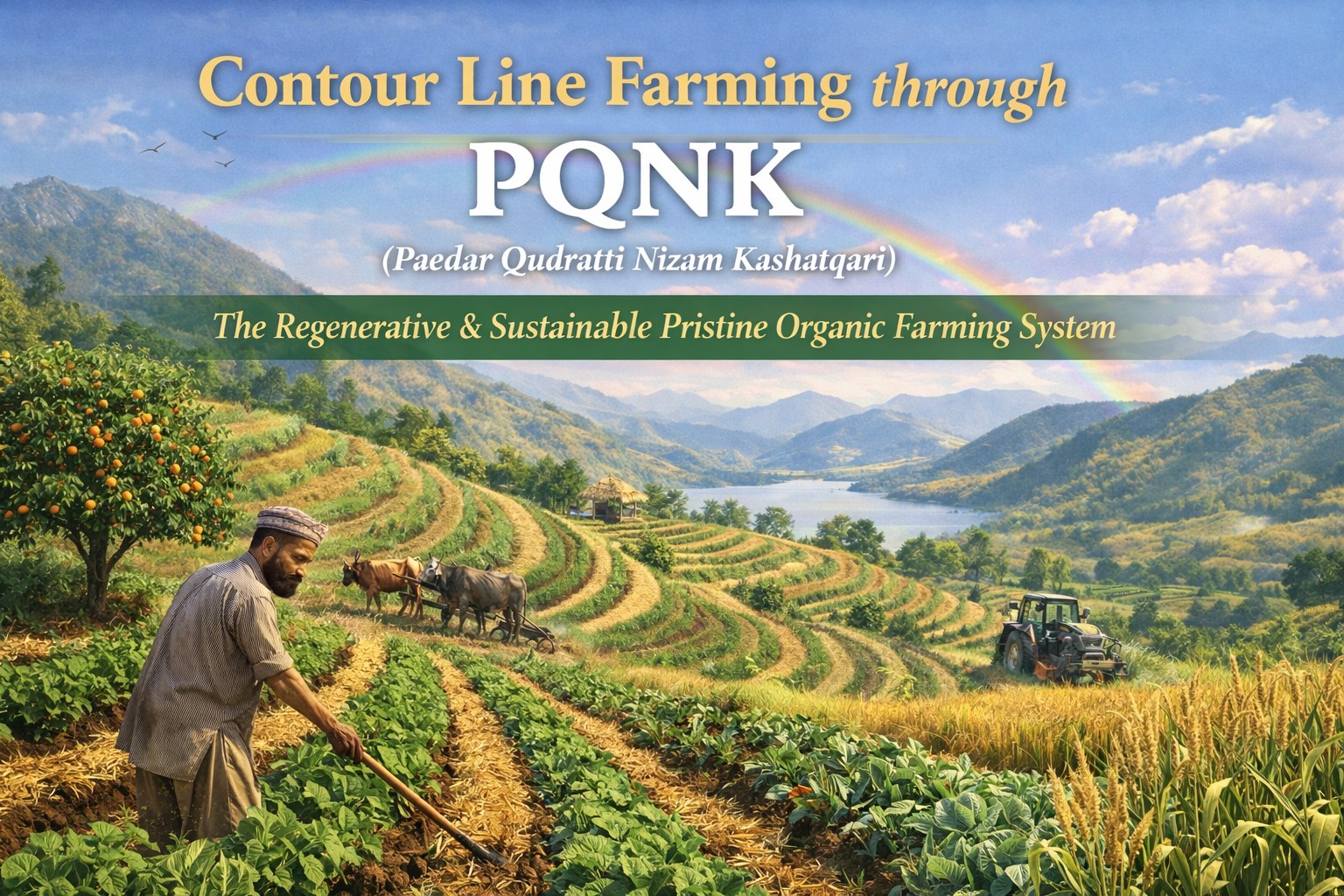
Contour Line Farming through the PQNK (PICNIC) Lens
Large tracts of sloping, rainfed farmland already receive twice the water crops need, yet fail from runoff and erosion rather than drought. This paper applies PQNK's hardpan-breaking and mulch principles specifically to undulating terrain, using contour-aligned furrows as micro check-dams and citing practitioners who have farmed 7-8 consecutive years on rainfall alone.
Read or listen to the full paper ↓Abstract
The paper targets a specific, globally common category of marginal land: sloped or undulating, rainfed, and prone to runoff and erosion. Its opening claim is that many such landscapes receive over 400mm of annual rainfall, roughly twice the biological water requirement of PQNK's year-round crop cycle, meaning the failure is rainfall mismanagement, not rainfall scarcity, a soil that cannot receive, store, or regulate the water that already falls on it.
The first and non-negotiable intervention is identical to PQNK's flat-land protocol, fracturing the hardpan with a subsoiler without inverting soil layers, restoring the macropores that let rain infiltrate rather than run off a compacted, restrictive layer. What is specific to sloped terrain is the second step: furrows cut strictly along contour lines, perpendicular to the slope, functioning as a continuous series of micro check-dams across the whole field, dropping surface runoff velocity to near zero so water is trapped exactly where it falls rather than carrying topsoil downhill.
This produces a deliberate upland-lowland architecture, raised beds as uplands where crops grow, contour furrows as lowlands that collect water, guide it to infiltrate, and double as tractor and machinery pathways, keeping vehicle traffic confined to the lowlands so growing beds stay uncompacted. A deep-rooted cover crop is the first biological operation on this architecture, its roots further fracturing the soil profile and beginning the same chop-and-drop, roots-retained mulch cycle used elsewhere in PQNK, while its above-ground biomass becomes surface mulch that seals capillaries against evaporation and absorbs dew and atmospheric humidity as a second water source.
Once established, the paper describes farm operations reducing to just two: planting and harvesting, with no tillage, fertilizer, pesticide, or irrigation required, and highlights alley cropping as a natural extension for contour systems, fruit trees planted at fixed intervals across the contours with wheat, barley, oilseeds, legumes, or vegetables grown as intercrops between rows, stabilizing the slope while adding a second productive layer.
The paper closes by citing field validation rather than theory alone: practitioners sustaining crop and fruit tree production for 7-8 consecutive years on rainfall alone, exceeding roughly 400mm annually, with zero irrigation and zero agrochemical dependency, and frames the whole approach around a single governing principle: all water that falls on a field must enter the soil and stay there, achieved through only two physical interventions, hardpan-breaking and contour-aligned furrows, with everything else left to biological self-organization.
Full Paper
If you use “Listen”, the text of the page may be sent to your browser or operating system’s speech provider, such as Apple, Google or Microsoft, depending on the voice your device uses. Pedaver does not process, transmit or store any audio.
1. Introduction: The Problem of Sloping and Undulated Lands
Globally, a significant proportion of marginal and unproductive lands share three characteristics:
• They are sloped or rolling
• They are rainfed
• They suffer from runoff, erosion, and shallow effective soil moisture
Ironically, many of these landscapes receive more than 400 mm of annual rainfall, which is twice the biological water requirement of crops grown year‑round under PQNK conditions. The failure is not rainfall scarcity, but rainfall mismanagement.
PQNK reframes the challenge: The problem is not lack of water, but the inability of soil to receive, store, and regulate it.
2. PQNK Philosophy Applied to Contour Line Farming
PQNK is a closed-loop production system designed to mimic nature’s operating principles. Under PQNK:
• Water is absorbed, not harvested
• Soil is activated, not exploited
• Roots are retained, not removed
• Biology replaces chemistry
• Stability replaces intervention
Contour line farming, when practiced through this lens, becomes a hydrological and biological restoration process, not merely a soil conservation technique.
3. Step One: Eliminating the Subsurface Barrier (Hardpan Fracturing)
The first and non-negotiable step in PQNK contour farming is breaking the hardpan without soil inversion.
3.1 Why Hardpans Are the Real Cause of Runoff
• Decades of tillage and machinery traffic create restrictive layers
• These layers block vertical water infiltration
• Roots remain shallow and crops become irrigation-dependent
3.2 PQNK Intervention
• A subsoiler is used to fracture the soil profile
• Soil layers are not turned or mixed
• Continuous macropores are restored for:
◦ Water infiltration
◦ Root penetration
◦ Air exchange
Once the restrictive layer is removed, rainfall no longer has a reason to run off.
4. Step Two: Contour-Aligned Furrows – Forcing Water to Infiltrate
4.1 Design Principle
Furrows are made:
• At regular intervals
• Strictly aligned to contour lines
• Perpendicular to slope direction
These furrows function as micro‑check dams across the entire field.
4.2 Hydrological Outcome
• Surface runoff velocity drops to near zero
• Water is trapped where it falls
• With no hardpan beneath, infiltration becomes inevitable
4.3 Mechanization Compatibility
Where mechanized planting or harvesting is required:
• Furrows double as tractor and machinery pathways
• Traffic is confined to lowlands
• Growing beds remain uncompacted uplands
This preserves soil structure while enabling modern operations.
5. Upland–Lowland Architecture: Nature’s Original Design
PQNK contour farming deliberately creates:
• Uplands: Raised beds where crops grow
• Lowlands: Furrows that collect and guide water
This architecture ensures:
• No waterlogging in crop root zones
• Continuous recharge of deeper soil moisture
• Aerobic conditions for soil life
Nature has used this pattern for millions of years to grow diverse ecosystems on slopes.
6. Step Three: Permanent Soil Cover through Living Roots and Organic Mulch
6.1 Cover Crop as the First Crop
The first biological operation is planting a deep‑rooted cover crop.
Functions of the cover crop:
• Further shattering of the soil profile
• Creation of long‑lasting root channels
• Feeding soil biology through root exudates
6.2 Roots Are Never Uprooted
Under PQNK:
• Plants are cut, not pulled
• Roots are retained permanently
• Decaying roots become:
◦ Carbon pipelines
◦ Nutrient reservoirs
◦ Microbial habitats
6.3 Organic Mulch Formation
The above‑ground biomass:
• Is chopped and spread as thick organic mulch
• Seals soil capillaries
• Eliminates evaporative losses
7. Atmospheric Water Capture: Dew and Humidity Harvesting
Organic mulch performs a function ignored by conventional agriculture:
• It absorbs dew and atmospheric humidity
• Gradually transfers moisture to soil
• Acts as a buffer against dry spells
Thus, PQNK soils are hydrated not only by rainfall, but also by the atmosphere.
8. Cash Crop Production without Inputs
Once the system is established:
• Soil remains continuously moist beneath mulch
• Seeds are placed using no‑till or dribbler planters
• Germination occurs without irrigation
8.1 Operational Simplicity
Only two field operations remain:
1. Planting
2. Harvesting
No:
• Tillage
• Fertilizers
• Pesticides
• Irrigation
The soil ecosystem assumes full responsibility for crop nutrition and protection.
9. Alley Cropping Model under PQNK
PQNK strongly promotes alley cropping in contour systems:
• Fruit trees planted at fixed intervals across contours
• Annual and short‑season crops grown between tree rows
Typical intercrops include:
• Wheat and barley
• Oilseeds and rapeseed
• Peanuts and legumes
• Vegetables
Trees stabilize slopes, deepen biological activity, and increase total system productivity.
10. Outcomes: From Marginal Lands to Dignified Livelihoods
10.1 Land Transformation
• Rolling and sloping lands become productive
• Erosion is eliminated
• Water scarcity disappears
10.2 Human Impact
• Farmers escape dependency and poverty
• Families achieve food security with dignity
• Input costs drop to near zero
10.3 Nutritional Outcomes
• Produce is nutrient‑dense, not calorie‑dense
• Food contains complete natural compounds
• Diets align with biological needs of dependent species
11. Proven Field Validation
This PQNK contour line farming model is not theoretical.
• Practiced continuously for decades
• Multiple practitioners producing crops and fruit trees
• No irrigation for 7–8 consecutive years
• Zero agrochemical dependency
Rainfall alone, when properly infiltrated, retained, and biologically regulated, is sufficient.
12. Conclusion: Water Must Enter the Soil—or Agriculture Fails
The central principle of PQNK contour line farming is simple and absolute:
All water that falls on a field must enter the soil and stay there.
This is achieved through only two physical interventions:
1. Breaking the hardpan
2. Creating contour-aligned furrows
Everything else is biological self‑organization.
When soil life is restored and protected under permanent organic cover, it takes over its assigned role—maintaining fertility, regulating moisture, and defending plants. Agriculture then returns to what it was always meant to be: a stable, self‑sustaining partnership with nature.
PQNK (PICNIC) offers a scalable, low‑cost, climate‑resilient pathway to regenerate sloping and undulated lands worldwide—without inputs, without exploitation, and without scarcity.
Footnote: PQNK (pronounced 'picnic')—the regenerative & sustainable Pristine Organic Farming System—is grounded in Natural Ecosystem Science. This science employs perennial biodiversity, protects soil with organic mulch, and avoids practices like water inundation, tillage disturbance, and leaving soil bare.
About This Paper
- Crop
- Wheat · Barley · Oilseeds (crop group) · Pulses (crop group) · Vegetables (crop group) · Fruit Trees (crop group)
- Problem
- Runoff · Soil Erosion · Poor Water Infiltration · Farmer Income Instability / Debt · Hardpan
- Science
- Soil · Water · Production Architecture · Climate
- Evidence
- Field Observation
- Authority
- Current / Approved PQNK Knowledge
Related PQNK Science
Key Takeaways
- Targets sloped, rainfed, marginal land specifically, arguing it often receives roughly twice the water crops need but fails from runoff and erosion, not drought.
- Contour-aligned furrows are engineered to function as continuous micro check-dams across the field, dropping surface runoff velocity to near zero.
- Establishes a deliberate upland (raised bed)/lowland (furrow) architecture where furrows both harvest water and double as confined tractor pathways, keeping crop beds uncompacted.
- Once established, the system is reported reducing to just two field operations, planting and harvesting, with no tillage, fertilizer, pesticide, or irrigation.
- Cites practitioners sustaining crop and fruit tree production for 7-8 consecutive years on rainfall alone (over ~400mm annually) with zero irrigation.
- Recommends alley cropping, fruit trees at fixed contour intervals with wheat, barley, oilseed, or legume intercrops between rows, as a natural extension of the contour system.
Related Crops
Related Knowledge
same problem
When 13 Inches of Rain Falls in Eight Hours
After 13 inches of rain in eight hours, the PQNK orchard beds of Jaskaran Singh in Fazilka district, Indian Punjab, had taken the water into the soil and could be walked on in slippers, while neighbouring conventional orchards and fields stood under water, and so did a strip of his own orchard where the hardpan had not been broken. The paper explains why hardpan is a water barrier as well as a root barrier, and why the soil is the first reservoir.
same problem
Rain Where It Falls: Restoring the Soil Before Building More Water Storage
Rajendra Singh’s Rajasthan story shows that slowing runoff lets water enter the ground and restore wells and rivers. PQNK moves that principle upstream into the field itself: correct the hardpan, stop disturbing the soil, keep the surface covered, and let every acre receive and hold the rain where it falls, so that agricultural water demand stays within what the landscape renews.
same problem
The Weeds as Soil Physicians: A PQNK Diagnostic Guide to Soil Health in the Punjab Region
This regional diagnostic guide teaches Punjab farmers to read specific weed combinations, not single species, as a whole-field soil diagnosis, then prescribes a 'principle of substitution': replacing each wild pioneer weed with a cultivated crop that performs the identical remediation function while also producing a yield.
same problem
PQNK: The Wholesale Four-Step System to Reconnect the Water Cycle and End Water Scarcity
Iran's collapsing rivers, sinking cities, and vanishing aquifers are presented as a preview of what awaits any nation that keeps farming on hardpan-sealed, bare soil. This paper argues the crisis is not a rainfall shortage but a blocked water cycle, and lays out PQNK's four-step protocol for reopening it.