

KP-049 · Soil Science & PQNK System
The Weeds as Soil Physicians: A PQNK Diagnostic Guide to Soil Health in the Punjab Region
This regional diagnostic guide teaches Punjab farmers to read specific weed combinations, not single species, as a whole-field soil diagnosis, then prescribes a 'principle of substitution': replacing each wild pioneer weed with a cultivated crop that performs the identical remediation function while also producing a yield.
Read or listen to the full paper ↓Abstract
The guide opens with a paradigm shift: rather than enemies to be eradicated, weeds are framed as pioneer plants, the land's self-healing mechanism, emerging as symptoms with a built-in prescription. The underlying degradation is traced to tillage, which collapses soil pores and kills soil life, and flood irrigation, which drives compaction, evaporation, and salt accumulation, creating a vicious cycle of bare, hard, overheated soil hostile to microbes and earthworms. Weeds are said to counter this directly, opening compacted pores with their roots, shielding soil from radiation as living mulch, and building the conditions that let water and biology return.
Beyond identifying single indicator species, the guide's central diagnostic method is reading weed communities together as a whole-field diagnosis. A 'multi-layer compaction' field showing Deeela alongside Khabbal Grass signals problems at multiple depths at once, deep hardpan and topsoil erosion simultaneously, requiring a combined no-till, deep-rooted-cover, and organic-matter response. A 'barren and hungry' field combining Leh and Piazi indicates sandy, dry, physically and nutritionally impoverished soil, prescribed drought-tolerant covers like Bajra and heavy mulch. Most notably, a field where Bathu grows alongside Maina (Burr Clover) is read as a positive sign: Bathu points to a nitrogen-rich zone and Maina appears as the soil's biology recovers, an early sign that nitrogen availability is improving as free-living nitrogen-fixing bacteria work in a living, covered soil, so the correct response is to keep the surface mulched and support the recovery rather than eliminate it.
The guide provides a simple diagnostic flowchart built on three branches: deep taproot dominance (Deeela, Kandyali, Jangli Palak) points to subsoil compaction requiring a subsoiler and deep-rooted covers; mat-forming grasses and weeds (Khabbal, Maina, Itsit) point to topsoil degradation and erosion risk requiring mulch and mat-forming cover crops; and poor-soil indicators (Leh, Piazi) point to severely depleted fertility requiring the full PQNK restoration sequence.
The core management move is what the guide calls the 'principle of substitution': never eradicate a weed and leave bare soil behind, but replace the 'weedy doctor' with a 'cultivated doctor' that performs the same soil-healing function while also providing yield, fodder, or further enhancement. Concrete substitutions are given by function: Raya, Alsi, or Safflower succeed deep-taprooted compaction weeds as living chisels; Javi, Gehun, or Bajra succeed mat-forming erosion weeds as living mulch and soil armor; Jantar, grown for its deep roots, succeeds weeds like Maina, with nitrogen supplied by free-living nitrogen-fixing bacteria; and a polyculture of Javi or Bajra with Jantar succeeds carbon-poor-soil weeds by feeding the soil food web.
The guide closes by pairing this substitution protocol with four cultural practices, eliminating tillage, eliminating flood irrigation in favor of supplementary furrow irrigation on permanent raised beds, maintaining permanent mulch cover, and diversifying crops, trees, and animals, and reframes the farmer's role entirely: from a combatant fighting nature to a skilled soil health manager who reads the silent language weeds speak and acts on their prescriptions rather than simply removing the messenger.
Revision R1 (28 September 2026): the irrigation advice has been updated to the PQNK book (Chapters 26 and 27). PQNK irrigates only through the furrows of permanent raised beds, at no more than a 4-inch head in the 18-inch furrow and only when the soil-ball test shows need; there are no drip lines, sprinklers, pipes or emitters. Where a farm already has drip, as in an established orchard, it is run deeper and less often during transition. The PDF opens with a revision note; the original text follows unchanged.
Full Paper
If you use “Listen”, the text of the page may be sent to your browser or operating system’s speech provider, such as Apple, Google or Microsoft, depending on the voice your device uses. Pedaver does not process, transmit or store any audio.
Publication: PQNK Knowledge Series - Volume 1
Date: October 8, 2025 Authoring Philosophy: Paedar Qudratti Nizam Kashatqari (The Regenerative & Sustainable Pristine Organic Farming System)
1. Introduction: A Paradigm Shift in Perception
Welcome to the PQNK way, the Pristine Organic Farming System. This is not merely a set of techniques; it is a philosophy that recognizes the innate intelligence of nature. For generations, we have waged war on our fields, viewing weeds as enemies to be eradicated. This has led us down a path of dependency on chemicals and relentless tillage, resulting in the very problem we sought to solve: weak, lifeless soil.
The core problem is soil degradation caused by two primary practices:
Tillage: Which collapses soil pores, destroys organic matter, and kills soil life.
Flood Irrigation: Which inundates the soil, leading to compaction, evaporation, and salt accumulation.
This creates a vicious cycle: bare, hard soil that heats up under the regional sun, "burning" its precious organic matter and becoming inhospitable to the microbes and earthworms that make soil live.
PQNK offers a revolutionary perspective: Weeds are not the problem; they are the solution. They are pioneer plants, the land's self-healing mechanism. They emerge as symptoms with a built-in prescription. They come to:
Open Soil Pores: Their roots break up compaction.
Protect the Soil: Their canopy acts as a living mulch, shielding the soil from direct radiation and reducing temperature.
Build Life: They create an environment that absorbs water, retains moisture, and provides habitat for soil organisms.
This guide will teach you to read your fields like a book, using the most common weeds of this region (Punjab in particular) as your guide to diagnose and cure your soil's health issues.
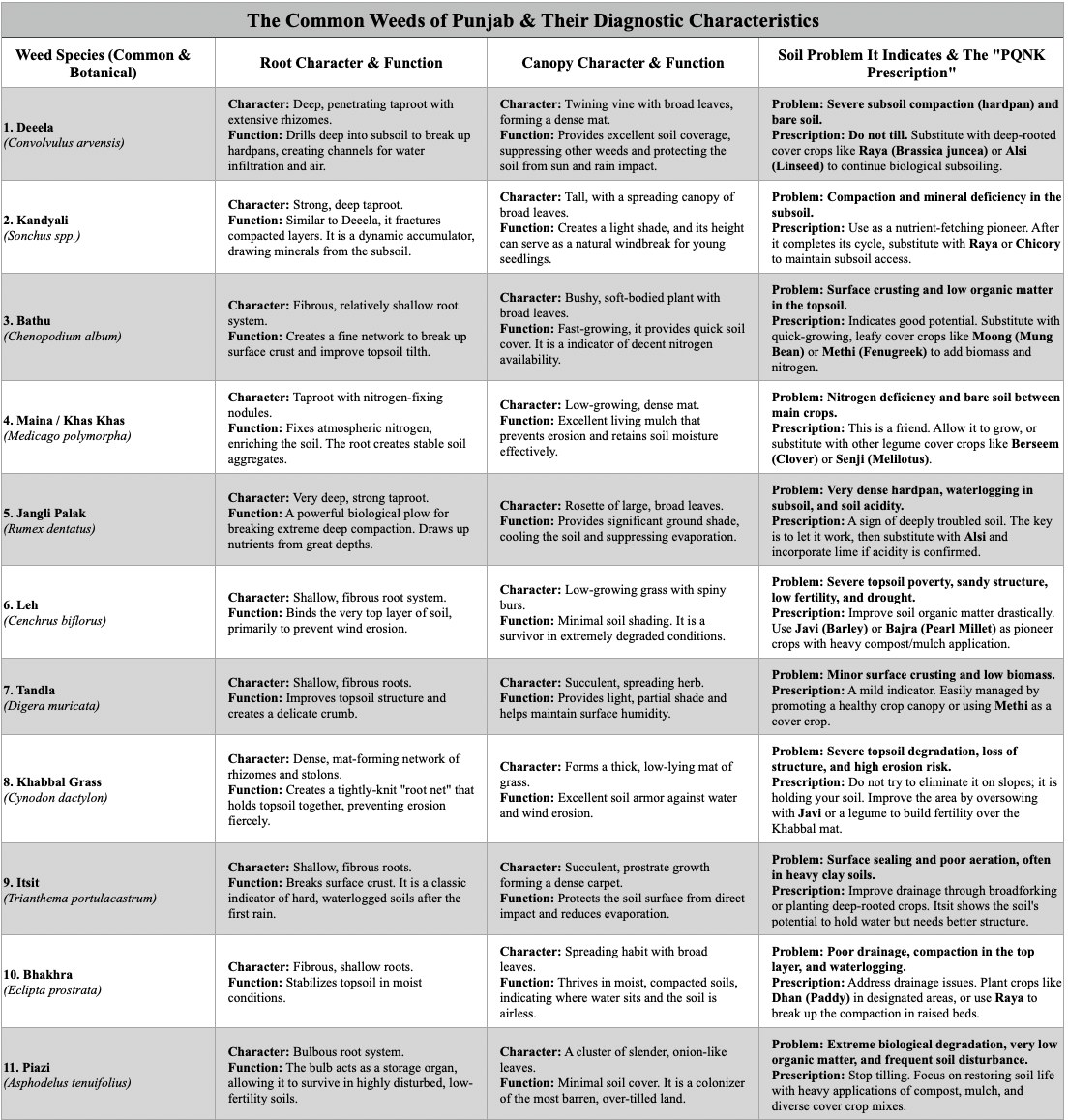
2. The Common Weeds of Punjab & Their Diagnostic Characteristics
| Weed Species (Common & Botanical) | Root Character & Function | Canopy Character & Function | Soil Problem It Indicates & The "PQNK Prescription" |
|---|---|---|---|
| 1. Deeela (Convolvulus arvensis) | Character: Deep, penetrating taproot with extensive rhizomes. Function: Drills deep into subsoil to break up hardpans, creating channels for water infiltration and air. | Character: Twining vine with broad leaves, forming a dense mat. Function: Provides excellent soil coverage, suppressing other weeds and protecting the soil from sun and rain impact. | Problem: Severe subsoil compaction (hardpan) and bare soil. Prescription: Do not till. Substitute with deep-rooted cover crops like Raya (Brassica juncea) or Alsi (Linseed) to continue biological subsoiling. |
| 2. Kandyali (Sonchus spp.) | Character: Strong, deep taproot. Function: Similar to Deeela, it fractures compacted layers. It is a dynamic accumulator, drawing minerals from the subsoil. | Character: Tall, with a spreading canopy of broad leaves. Function: Creates a light shade, and its height can serve as a natural windbreak for young seedlings. | Problem: Compaction and mineral deficiency in the subsoil. Prescription: Use as a nutrient-fetching pioneer. After it completes its cycle, substitute with Raya or Chicory to maintain subsoil access. |
| 3. Bathu (Chenopodium album) | Character: Fibrous, relatively shallow root system. Function: Creates a fine network to break up surface crust and improve topsoil tilth. | Character: Bushy, soft-bodied plant with broad leaves. Function: Fast-growing, it provides quick soil cover. It is a indicator of decent nitrogen availability. | Problem: Surface crusting and low organic matter in the topsoil. Prescription: Indicates good potential. Substitute with quick-growing, leafy cover crops like Moong (Mung Bean) or Methi (Fenugreek) to add biomass and nitrogen. |
| 4. Maina / Khas Khas (Medicago polymorpha) | Character: Taproot with nitrogen-fixing nodules. Function: Fixes atmospheric nitrogen, enriching the soil. The root creates stable soil aggregates. | Character: Low-growing, dense mat. Function: Excellent living mulch that prevents erosion and retains soil moisture effectively. | Problem: Nitrogen deficiency and bare soil between main crops. Prescription: This is a friend. Allow it to grow, or substitute with other legume cover crops like Berseem (Clover) or Senji (Melilotus). |
| 5. Jangli Palak (Rumex dentatus) | Character: Very deep, strong taproot. Function: A powerful biological plow for breaking extreme deep compaction. Draws up nutrients from great depths. | Character: Rosette of large, broad leaves. Function: Provides significant ground shade, cooling the soil and suppressing evaporation. | Problem: Very dense hardpan, waterlogging in subsoil, and soil acidity. Prescription: A sign of deeply troubled soil. The key is to let it work, then substitute with Alsi and incorporate lime if acidity is confirmed. |
| 6. Leh (Cenchrus biflorus) | Character: Shallow, fibrous root system. Function: Binds the very top layer of soil, primarily to prevent wind erosion. | Character: Low-growing grass with spiny burs. Function: Minimal soil shading. It is a survivor in extremely degraded conditions. | Problem: Severe topsoil poverty, sandy structure, low fertility, and drought. Prescription: Improve soil organic matter drastically. Use Javi (Barley) or Bajra (Pearl Millet) as pioneer crops with heavy compost/mulch application. |
| 7. Tandla (Digera muricata) | Character: Shallow, fibrous roots. Function: Improves topsoil structure and creates a delicate crumb. | Character: Succulent, spreading herb. Function: Provides light, partial shade and helps maintain surface humidity. | Problem: Minor surface crusting and low biomass. Prescription: A mild indicator. Easily managed by promoting a healthy crop canopy or using Methi as a cover crop. |
| 8. Khabbal Grass (Cynodon dactylon) | Character: Dense, mat-forming network of rhizomes and stolons. Function: Creates a tightly-knit "root net" that holds topsoil together, preventing erosion fiercely. | Character: Forms a thick, low-lying mat of grass. Function: Excellent soil armor against water and wind erosion. | Problem: Severe topsoil degradation, loss of structure, and high erosion risk. Prescription: Do not try to eliminate it on slopes; it is holding your soil. Improve the area by oversowing with Javi or a legume to build fertility over the Khabbal mat. |
| 9. Itsit (Trianthema portulacastrum) | Character: Shallow, fibrous roots. Function: Breaks surface crust. It is a classic indicator of hard, waterlogged soils after the first rain. | Character: Succulent, prostrate growth forming a dense carpet. Function: Protects the soil surface from direct impact and reduces evaporation. | Problem: Surface sealing and poor aeration, often in heavy clay soils. Prescription: Improve drainage through broadforking or planting deep-rooted crops. Itsit shows the soil's potential to hold water but needs better structure. |
| 10. Bhakhra (Eclipta prostrata) | Character: Fibrous, shallow roots. Function: Stabilizes topsoil in moist conditions. | Character: Spreading habit with broad leaves. Function: Thrives in moist, compacted soils, indicating where water sits and the soil is airless. | Problem: Poor drainage, compaction in the top layer, and waterlogging. Prescription: Address drainage issues. Plant crops like Dhan (Paddy) in designated areas, or use Raya to break up the compaction in raised beds. |
| 11. Piazi (Asphodelus tenuifolius) | Character: Bulbous root system. Function: The bulb acts as a storage organ, allowing it to survive in highly disturbed, low-fertility soils. | Character: A cluster of slender, onion-like leaves. Function: Minimal soil cover. It is a colonizer of the most barren, over-tilled land. | Problem: Extreme biological degradation, very low organic matter, and frequent soil disturbance. Prescription: Stop tilling. Focus on restoring soil life with heavy applications of compost, mulch, and diverse cover crop mixes. |
The following table details the character and function of common weeds, transforming them from pests into soil physicians.
3. Synthesis: The Weed Community as a Whole-Soil Diagnosis
A single weed tells a story, but a community of weeds writes a full diagnosis. The key to advanced soil reading is observing combinations.
The "Multi-Layer Compaction" Field: If you see Deeela and Khabbal Grass together, your soil is crying for help on multiple levels. The Deeela is trying to fix the deep hardpan, while the Khabbal is desperately holding onto what little topsoil you have left. The integrated solution requires a no-till system, deep-rooted covers, and massive organic matter addition.
The "Barren and Hungry" Field: A combination of Leh and Piazi indicates a field that is both physically and nutritionally impoverished. The soil is sandy, dry, and lifeless. The prescription starts with drought-tolerant cover crops like Bajra, and copious amounts of mulch.
The "Nitrogen-Building Pioneer" Field:
Bathu and Maina growing together is a positive sign of initial ecological succession. Bathu points to a nitrogen-rich zone. Maina appears as the soil’s biology recovers. Together they are an early sign that nitrogen availability is improving: in a living, covered soil, the free-living nitrogen-fixing bacteria supply what the crop needs. The soil is not just "recovering"; it is being actively fertilized by nature’s genius.
The PQNK Prescription: Celebrate and support this recovery. Keep the surface mulched, and avoid any tillage or chemical use that would destroy the delicate microbial network in the soil, setting back this vital, life-driven process. Where a deep-rooted cover is wanted, plant Jantar: it is valued for its strong root system, which opens the soil to air and water, not for nitrogen fixation.
Simple Diagnostic Flowchart:
Is your field dominated by deep taproots (Deeela, Kandyali, Jangli Palak)?
YES -> You have subsoil compaction. Action: Stop tillage. Break the hardpan with subsoiler and grow deep-rooted cover crops.
Is your field dominated by mat-forming grasses/weeds (Khabbal, Maina, Itsit)?
YES -> You have topsoil degradation and erosion risk. Action: Protect the soil with mulch and substitute with beneficial cover crops that form mats (e.g., clover).
Is your field dominated by poor-soil indicators (Leh, Piazi)?
YES -> You have severely depleted fertility and organic matter. Action: Focus on restoring soil by adopting PQNK steps.
4. The PQNK Management Protocol: From Diagnosis to Cure
Step 1: Observation & Identification Walk your field after the first rains and before each planting. Take notes. Draw a simple map. Identify the dominant weeds in different areas. Soil problems are often not uniform.
Step 2: Interpretation Use the table and synthesis section above to diagnose the primary constraints. Is it compaction? Erosion? Low nitrogen? Your weeds will tell you.
Step 3: The Regenerative Transition - The Core of PQNK This is the most critical step. The goal is not to create bare soil. Bare soil is sick soil.
The Principle of Substitution: Do not eradicate the "weedy doctor." Substitute it with a "cultivated doctor" (a cover crop or main crop) that performs the same function but also provides you with a yield, fodder, or soil enhancement.
Example: If you remove Deeela, immediately plant Raya or Safflower to continue the subsoiling work.
Example: If you remove Bathu, plant Jantar to continue building topsoil tilth with its deep roots; nitrogen comes from the free-living nitrogen-fixing bacteria of a living, covered soil.
The PQNK Protocol: Succeeding the Weed Physicians with Cultivated Healers
The goal is not to remove a weed and leave the soil bare. The goal is to consciously transition the healing process from a wild pioneer to a cultivated successor that completes the remediation and provides a yield. Choose your cover crops based on the function they perform, just as you diagnosed the weeds.
For Compaction & Hardpan (The Biological Drillers): To succeed weeds like Deeela and Kandyali, plant Raya, Alsi, or Safflower. These powerful taproots act as living chisels, driven by soil life, to continue fracturing compacted layers, creating deep pores for water and air, and restoring the soil's vertical architecture.
For Soil Armor & Structure (The Living Mulch): To succeed weeds like Khabbal Grass and Maina, plant Javi, Gehun, or Bajra. Their dense, fibrous root systems weave a net that holds the soil tight against erosion, while their canopies form a protective layer that conserves moisture, moderates temperature, and feeds the soil food web as they decompose.
For Activating the Nitrogen Life Cycle (The Root Builders): To succeed weeds like Maina, plant Jantar, valued for its deep, strong root system that opens the soil to air and water. Nitrogen does not need to be planted: in a living soil kept covered with organic mulch, free-living nitrogen-fixing bacteria convert atmospheric nitrogen into a living form, shifting the soil from a state of deficiency to a state of vibrant, self-generating fertility.
For Fuelling the Soil Food Web (The Carbon & Life Builders): To address the poverty indicated by weeds like Leh and Piazi, plant a polyculture of Javi or Bajra, with Jantar for its deep roots. The cereals provide the robust carbon skeleton for organic matter, while the free-living nitrogen-fixing bacteria of the living soil provide the nitrogen balance. Together, they create a perfect feast for the soil’s microorganisms, building the humus that is the foundation of all life and fertility in the PQNK system.
Cultural Practices to Address the Root Cause:
Eliminate Tillage: Shift to no-till or minimal tillage.
Eliminate Flood Irrigation: Move to drip or sprinkler systems to avoid compaction.
Mulch: Always keep the soil covered with crop residues or other organic mulch.
Diversify: Integrate crops, trees, and animals to create a resilient ecosystem.
5. Conclusion: Becoming a Soil Health Manager
In the PQNK system, the farmer undergoes a profound transformation: from a combatant fighting against nature to a skilled manager partnering with it. This guide empowers you to understand the silent language of your soil, spoken through the plants we once called weeds.
By reading these signs and acting with the prescriptions offered, you stop treating symptoms and start curing the disease. You will rebuild your soil's pores, its organic matter, and its life. You will save water, reduce costs, and ultimately, cultivate not just a crop, but a thriving, resilient, and pristine ecosystem for generations to come. This is the promise of PQNK.
Footnote: Any Production Process That Inundates Soil With Water, Disturbs Soil Through Tillage, Or Leaves Soil Bare Without Organic Mulch Cover Does Not Qualify As Natural Ecosystem Science For Production Agriculture.
PQNK, to be pronounced as 'picnic', which stands for Paedar Qudratti Nizam Kashatqari, and means: the regenerative & sustainable Pristine Organic Farming System.
www.Facebook.Com/Pedaver
https://www.youtube.com/@pedaverpqnk3167/videos
pedaver@gmail.com
WhatsApp +92 320 677 6666
About This Paper
- Crop
- Mustard · Alsi (Flaxseed) · Safflower · Oats · Wheat · Bajra (Pearl Millet) · Senji (Sweet Clover) · Berseem (Clover) · Mung Bean · Black Gram · Cowpea
- Problem
- Soil Compaction (General) · Soil Erosion · Hardpan · Poor Water Infiltration · General Soil Fertility / Land Degradation · Bare / Exposed Soil
- Science
- Soil · Biodiversity
- Evidence
- Philosophical/Framework Argument
- Authority
- Current / Approved PQNK Knowledge
Related PQNK Science
Key Takeaways
- Reframes weeds as the land's built-in diagnostic and self-healing mechanism rather than competitors to eradicate outright.
- Teaches whole-field diagnosis through weed combinations, not single species: Deeela plus Khabbal Grass signals compaction at multiple depths at once, while Bathu growing with Maina (Burr Clover) is read as a positive sign that nitrogen availability is improving as the soil's biology recovers.
- The 'principle of substitution' is the guide's core management move: never leave bare soil after removing a weed, always replace it with a cultivated crop performing the identical remediation function.
- Specific substitution list: Raya, Alsi, or Safflower succeed deep-taprooted compaction weeds; Javi, Gehun, or Bajra succeed mat-forming erosion-control weeds; Jantar, grown for its deep roots, succeeds Maina.
- Provides a simple three-branch diagnostic flowchart based on whether a field is dominated by deep taproots, mat-forming grasses, or poor-soil indicator species.
- Closing argument reframes the farmer's role entirely: from a combatant fighting weeds to a soil health manager reading and acting on the signals they provide.
Related Crops
Related Knowledge
same problem
Rain Where It Falls: Restoring the Soil Before Building More Water Storage
Rajendra Singh’s Rajasthan story shows that slowing runoff lets water enter the ground and restore wells and rivers. PQNK moves that principle upstream into the field itself: correct the hardpan, stop disturbing the soil, keep the surface covered, and let every acre receive and hold the rain where it falls, so that agricultural water demand stays within what the landscape renews.
same problem
PQNK: The Wholesale Four-Step System to Reconnect the Water Cycle and End Water Scarcity
Iran's collapsing rivers, sinking cities, and vanishing aquifers are presented as a preview of what awaits any nation that keeps farming on hardpan-sealed, bare soil. This paper argues the crisis is not a rainfall shortage but a blocked water cycle, and lays out PQNK's four-step protocol for reopening it.
same problem
Contour Line Farming through the PQNK (PICNIC) Lens
Large tracts of sloping, rainfed farmland already receive twice the water crops need, yet fail from runoff and erosion rather than drought. This paper applies PQNK's hardpan-breaking and mulch principles specifically to undulating terrain, using contour-aligned furrows as micro check-dams and citing practitioners who have farmed 7-8 consecutive years on rainfall alone.
same problem
When 13 Inches of Rain Falls in Eight Hours
After 13 inches of rain in eight hours, the PQNK orchard beds of Jaskaran Singh in Fazilka district, Indian Punjab, had taken the water into the soil and could be walked on in slippers, while neighbouring conventional orchards and fields stood under water, and so did a strip of his own orchard where the hardpan had not been broken. The paper explains why hardpan is a water barrier as well as a root barrier, and why the soil is the first reservoir.