

KP-011 · Crop-Specific Guides
The Future of Potato Cultivation: A Scientific and Economic Comparison of ACI, Global Best Practices, and the PQNK Framework
Conventional potato farming traps growers in a cycle of high input costs, a hard yield ceiling near 14 tonnes per acre, and boom-bust pricing. This paper compares conventional (ACI), Global Best Practice, and PQNK potato systems on plant physiology, economics, and risk, and lays out a year-by-year transition pathway for farmers.
Read or listen to the full paper ↓Abstract
The paper opens with a diagnostic image: soil that feels dead, lifeless, and inert in the hand is the signature of a collapsed system. Conventional 'Ancient Conventional Industrial' (ACI) potato farming produces exactly this, through compacted earth that repels water rather than absorbing it, plants left susceptible to disease, chemical runoff, and tubers that are often tasteless, less nutritious, carry chemical residues, and store poorly. PQNK's founding premise is the opposite: that soil is a living, breathing organism whose original design — teeming with microbial life, rich in organic matter, properly moist and aerated, buffered against temperature extremes — must be restored before the plant can reach its genetic potential.
The paper grounds its argument in potato physiology. Tuber initiation and bulking depend on soil temperature in the 13°C-26°C range, consistent moisture, and day length; under vigorous PQNK growth, farmers use a technique called 'vine pressing' 25-30 days after germination, gently pressing vines with a plank or roller to signal the plant to stop vegetative expansion and begin tuber bulking. Potatoes also need a well-aerated root zone for tuber expansion (compacted soil stunts growth) and a steady nutrient supply rather than the boom-and-bust dosing typical of synthetic fertilizer. The paper describes a healthy source-sink relationship, where photosynthesizing vines (the source) fuel tuber development (the sink), a flow easily disrupted by heat, frost, or drought stress. It also details the soil microbiology underpinning all of this: mycorrhizal fungi extending root uptake of water and phosphorus, and beneficial bacteria fixing nitrogen and solubilizing minerals — biology that ACI practices destroy and PQNK actively cultivates.
On economics, ACI potato production carries heavy recurring costs: roughly 1,500 kg of seed per acre, 3-6 bags of fertilizer, 10-15 cultivation passes, and ongoing chemical spend, capping yield near 14 tonnes per acre. PQNK shifts the cost structure toward one-time or periodic investment in organic mulch and bed establishment rather than annual chemical purchases, while a denser stand of roughly 50,000 healthier plants, a longer growing window, and better growing conditions push past the ACI yield ceiling with tubers that are more flavorful, chemical-residue-free, and longer-storing due to mineral density and stronger skins. The paper frames PQNK's biggest economic advantage as risk reduction: buffering against heat, cold, and drought de-risks farming from climate variability, and freedom from volatile fertilizer and pesticide markets further stabilizes farm income, while PQNK's stable soil environment even opens the door to near-perennial, staggered production that lets farmers sell fresh potatoes year-round at off-season premium prices.
A year-by-year transition pathway is laid out for farmers moving off ACI. In year one: level the field with minimal disturbance while breaking the ACI-era hardpan for deep root growth and infiltration; form permanent 42-inch-wide raised beds; grow cover crops (legumes for nitrogen, deep-rooted species to break compaction) to restore organic matter and kickstart microbial life; plant the first potato crop under a thick organic mulch layer; and monitor closely, supplementing inputs only if an extreme situation demands it. From year one onward, the soil becomes a self-sustaining, largely closed-loop ecosystem, with management shifting to maintaining mulch, rotating crops on the permanent beds, and observing the natural balance as yields stabilize high and costs stay low.
The paper concludes that ACI agriculture is a high-risk, degenerative dead end, that Global Best Practices offer real but incomplete improvement while remaining input-dependent, and that PQNK represents the necessary evolution toward a resilient, profitable, ecologically sound system — a shift from dominating nature to collaborating with it. It urges farmers, extension officers, and policymakers to start the transition on a small portion of land and let the results speak for themselves.
Full Paper
If you use “Listen”, the text of the page may be sent to your browser or operating system’s speech provider, such as Apple, Google or Microsoft, depending on the voice your device uses. Pedaver does not process, transmit or store any audio.
1. Executive Summary
The Ancient Conventional Industrial (ACI) model of potato farming is in a state of crisis. Characterized by exorbitant input costs, declining yields, and severe soil degradation, it traps farmers in a cycle of debt and uncertainty. The produce is often tasteless, less nutritious, carries traces of harmful chemicals, and has a shorter shelf-life, while market volatility ensures that profitability is a gamble.
This paper presents the PQNK framework as a proven, regenerative alternative. PQNK transforms the soil into a living ecosystem, leading to a substantial decrease in the cost of production and a significant increase in yield and quality. By creating resilient growing conditions, PQNK mitigates weather risks and opens the possibility of circular, near-perennial production, allowing farmers to supply the market year-round and escape the boom-bust price cycle.
While Global Best Practices offer an improvement over ACI by focusing on soil health and efficiency, they often still rely on external inputs. PQNK represents the holistic solution—a fundamental shift towards working with nature's own provision and protection systems to create a profitable, sustainable, and resilient agricultural system for future generations.
2. Introduction: The State of the Soil – The Foundation of All Growth
When soil held in the hand feels dead, lifeless, and inert, it is a sign of a collapsed system. The degenerative practices of ACI agriculture have led to this reality, with consequences felt across the entire farm: compacted earth that repels water, plants susceptible to disease, atmosphere-impacting runoff, and produce that lacks vitality and flavour.
The PQNK framework is founded on a different principle: that soil is a living, breathing organism. Its objective is to restore the soil to its original design - teeming with microbial activity, rich with organic matter, adequately moist, perfectly aerated, and buffered against temperature extremes. Plants growing in such an environment are not merely surviving; they are thriving, reaching their full genetic potential. This knowledge paper analyses potato production through the lenses of the problematic ACI past, the improved Global Best Practices present, and the transformative PQNK future.
3. Scientific Principles of Potato Plant Physiology
To understand the failures of ACI and the success of PQNK, one must first understand the potato plant's needs.
Tuber Initiation and Bulking: The formation and growth of tubers are critically dependent on soil temperature, with an ideal range of 13°C to 26°C. Consistent moisture and specific day lengths are also crucial. In an optimally managed environment like PQNK, vine growth can be extremely vigorous. To ensure energy is directed towards tuber formation rather than excessive foliage, a technique of "vine pressing" is employed 25-30 days after germination. Using a wooden plank or roller to gently press the vines stresses the plant slightly, signalling it to cease vine expansion and commence tuber initiation and bulking.
Root Zone Requirements: Potatoes require a well-aerated root zone for respiration and unimpeded tuber expansion. Compacted soil stunts growth. They also need a steady, balanced supply of nutrients, not the violent surges and famines caused by synthetic fertilizers.
Source-Sink Relationship: The healthy vines (the "source") through photosynthesis produce the carbohydrates that fuel tuber development (the "sink"). Any stress - be it heat, frost, or drought - disrupts this flow, reducing yield and quality.
The Role of Soil Microbiology: A gram of healthy soil contains billions of microorganisms. Mycorrhizal fungi extend the root system, vastly improving the uptake of water and immobile nutrients like phosphorus. Beneficial bacteria fix nitrogen, solubilize minerals, and produce compounds that help plants resist diseases. ACI practices destroy this life, while PQNK actively cultivates it.
4. Comparative Analysis: ACI vs. Global Best Practices vs. PQNK Framework
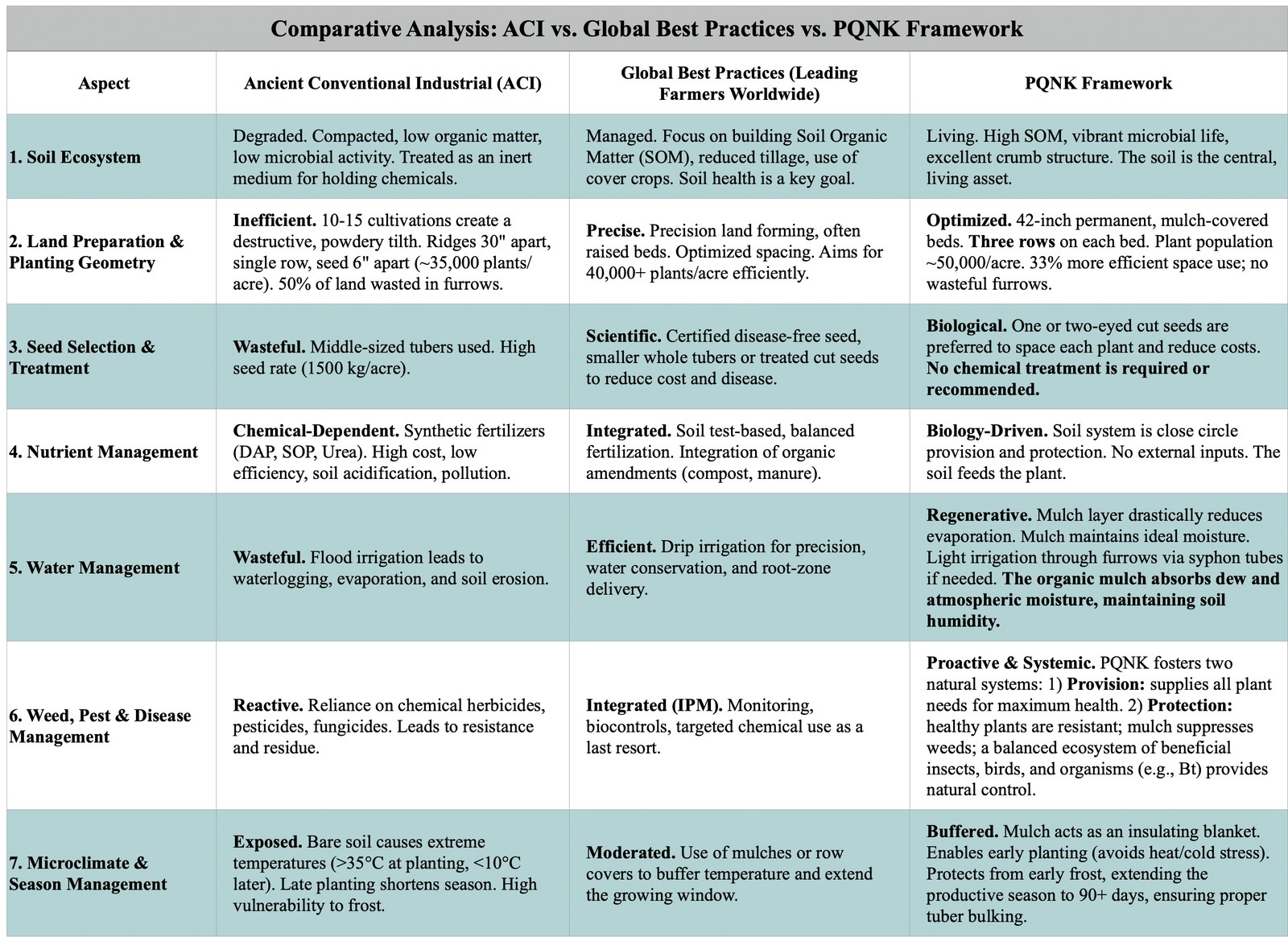
| Aspect | Ancient Conventional Industrial (ACI) | Global Best Practices (Leading Farmers Worldwide) | PQNK Framework |
|---|---|---|---|
| 1. Soil Ecosystem | Degraded. Compacted, low organic matter, low microbial activity. Treated as an inert medium for holding chemicals. | Managed. Focus on building Soil Organic Matter (SOM), reduced tillage, use of cover crops. Soil health is a key goal. | Living. High SOM, vibrant microbial life, excellent crumb structure. The soil is the central, living asset. |
| 2. Land Preparation & Planting Geometry | Inefficient. 10-15 cultivations create a destructive, powdery tilth. Ridges 30" apart, single row, seed 6" apart (~35,000 plants/acre). 50% of land wasted in furrows. | Precise. Precision land forming, often raised beds. Optimized spacing. Aims for 40,000+ plants/acre efficiently. | Optimized. 42-inch permanent, mulch-covered beds. Three rows on each bed. Plant population ~50,000/acre. 33% more efficient space use; no wasteful furrows. |
| 3. Seed Selection & Treatment | Wasteful. Middle-sized tubers used. High seed rate (1500 kg/acre). | Scientific. Certified disease-free seed, smaller whole tubers or treated cut seeds to reduce cost and disease. | Biological. One or two-eyed cut seeds are preferred to space each plant and reduce costs. No chemical treatment is required or recommended. |
| 4. Nutrient Management | Chemical-Dependent. Synthetic fertilizers (DAP, SOP, Urea). High cost, low efficiency, soil acidification, pollution. | Integrated. Soil test-based, balanced fertilization. Integration of organic amendments (compost, manure). | Biology-Driven. Soil system is close circle provision and protection. No external inputs. The soil feeds the plant. |
| 5. Water Management | Wasteful. Flood irrigation leads to waterlogging, evaporation, and soil erosion. | Efficient. Drip irrigation for precision, water conservation, and root-zone delivery. | Regenerative. Mulch layer drastically reduces evaporation. Mulch maintains ideal moisture. Light irrigation through furrows via syphon tubes if needed. The organic mulch absorbs dew and atmospheric moisture, maintaining soil humidity. |
| 6. Weed, Pest & Disease Management | Reactive. Reliance on chemical herbicides, pesticides, fungicides. Leads to resistance and residue. | Integrated (IPM). Monitoring, biocontrols, targeted chemical use as a last resort. | Proactive & Systemic. PQNK fosters two natural systems: 1) Provision: supplies all plant needs for maximum health. 2) Protection: healthy plants are resistant; mulch suppresses weeds; a balanced ecosystem of beneficial insects, birds, and organisms (e.g., Bt) provides natural control. |
| 7. Microclimate & Season Management | Exposed. Bare soil causes extreme temperatures (>35°C at planting, <10°C later). Late planting shortens season. High vulnerability to frost. | Moderated. Use of mulches or row covers to buffer temperature and extend the growing window. | Buffered. Mulch acts as an insulating blanket. Enables early planting (avoids heat/cold stress). Protects from early frost, extending the productive season to 90+ days, ensuring proper tuber bulking. |
5. Economic and Risk Analysis
Cost of Production: ACI costs are perilously high: 1500 kg/acre of seed, 3-6 bags of fertilizer, 10-15 cultivations, and recurring chemical costs. PQNK slashes these inputs. The major investment shifts to organic mulch and bed establishment, which are one-time or periodic, not annual. The cost of production plummets.
Yield and Quality: The ACI yield ceiling of 14 tonnes/acre is a result of plant stress and a shortened season. PQNK, with 50,000 healthier plants, a longer growing window, and ideal conditions, shatters this ceiling. The tubers are more nutritious, flavourful, free of chemical residues, and have a longer shelf-life due to their mineral density and robust skin.
Risk Mitigation: PQNK's greatest economic benefit is resilience. By buffering against heat, cold, and drought, it de-risks farming from climate variability. Freedom from volatile fertilizer and pesticide markets further stabilizes the farmer's economy.
Profitability: The equation is simple: Dramatically Lower Costs + Higher, Premium-Quality Yields = Consistent Profitability. This breaks the destructive cycle of boom and bust.
The Perennial Opportunity: PQNK's stable soil environment opens the door for circular (near-perennial) production. With staggered planting on mature beds, farmers can harvest fresh potatoes year-round, fetching premium prices off-season and eliminating the high cost and loss associated with long-term storage.
6. The PQNK Transition Pathway: A Step-by-Step Guide for Farmers
Year 1 (The Transition Phase):
Land Preparation: Level the field properly with minimal soil disturbance. The key is to break the hardpan created by years of ACI to allow for deep root growth and water infiltration.
Bed Formation: Create permanent, raised beds that are 42 inches wide on top.
Soil Restoration: Grow cover crops (e.g., deep-rooted plants for breaking compaction) to restore organic matter, open soil pores, and kickstart microbial life.
First Potato Crop: Plant potato seeds under a thick layer of organic mulch. This mulch is the cornerstone of the system.
Vigilance: When all PQNK steps are followed, the need for external inputs is eliminated. However, during the first crop, farmers should monitor closely and be prepared to supplement inputs only if an extreme situation arises.
Year 1+ (The Maturity Phase): The soil is now a self-sustaining ecosystem. The beds are permanent. The focus shifts to management: maintaining mulch layers, rotating crops on the beds, and observing the natural balance. Nutrient and water cycles become largely closed-loop, managed by the soil's biological activity and the protective mulch. Yields stabilize at a high level, and costs remain low.
7. Conclusion and Call to Action
The evidence is clear: Ancient Conventional Industrial agriculture is a high-risk, degenerative dead end that compromises our land, our food, and our farmers' futures. Global Best Practices offer valuable improvements but often remain within the same input-dependent paradigm.
The PQNK framework is not merely an alternative practice; it is the necessary evolution towards a resilient, profitable, and ecologically sound agricultural future. It represents a shift from dominating nature to collaborating with it.
The transition requires a change in mindset, but the path is well-defined. We urge farmers, extension officers, and policymakers to embrace this change. Start with a small portion of your land. Observe the life returning to your soil. Witness the vigour of the plants and the quality of the harvest. Let your own experience be the final proof. The time to begin the transition to PQNK is now, for the benefit of generations to come.
*This advisory is based on proven PQNK principles and field observations. Adapt timing and practices to your local conditions for optimal results.
Footnote: Any Production Process That Inundates Soil With Water, Disturbs Soil Through Tillage, Or Leaves Soil Bare Without Organic Mulch Cover Does Not Qualify As Natural Ecosystem Science For Production Agriculture.
PQNK, to be pronounced as 'picnic', which stands for Paedar Qudratti Nizam Kashatqari, and means: the regenerative & sustainable Pristine Organic Farming System.
www.Facebook.Com/Pedaver
https://www.youtube.com/@pedaverpqnk3167/videos
pedaver@gmail.com
WhatsApp +92 320 677 6666
About This Paper
- Crop
- Potato
- Problem
- Soil Compaction (General) · Yield Stagnation / Decline · Contamination / Residue / Food Safety Risk · High Input / Production Cost
- Science
- Soil · Plants · Economics · Transition
- Evidence
- Economic Model/Projection
- Authority
- Current / Approved PQNK Knowledge
Related PQNK Science
Key Takeaways
- ACI potato farming caps out near a 14 tonne/acre yield ceiling; PQNK is positioned to break through it via roughly 50,000 healthier plants per acre and a longer growing window.
- 'Vine pressing' 25-30 days after germination — gently pressing vines with a plank or roller — signals the plant to shift energy from vegetative growth into tuber bulking.
- PQNK shifts costs from recurring annual chemical inputs (1,500 kg seed, 3-6 fertilizer bags, 10-15 cultivations under ACI) to one-time or periodic mulch and bed investment.
- PQNK's stable soil environment opens the door to near-perennial, staggered production, letting farmers sell fresh potatoes year-round at off-season premium prices.
- PQNK-grown tubers are described as more flavorful, chemical-residue-free, and longer-storing due to mineral density and stronger skins.
- A defined year-one transition sequence covers hardpan-breaking, permanent 42-inch bed formation, cover cropping, and mulch-covered planting.
Related Crops
Related Knowledge
same problem
Potato Planting Depth vs Mulch-Based No-Till Planting: A Production, Economics, and Quality Analysis under the PQNK System
A scientific and economic comparison of conventional 6-inch deep seed burial against PQNK's surface-placement-plus-mulch method, showing that mulch delivers the same tuber-zone temperature control as deep burial while also enabling earlier sowing, denser planting, and a roughly 90% cut in per-acre production cost.
same problem
Sugarcane: The Bamboo Principle
Sugarcane is conventionally treated like wheat, sown, harvested, and replanted every few years, but this paper uses bamboo as an analogy for a rhizome-forming perennial that can be harvested repeatedly from a protected living base. It lays out the wide-spacing planting geometry and selective-cut discipline behind PQNK field cases of eight harvest cycles from one planting, with recorded yields of over two thousand maunds per acre, with documented fields reaching 2,800 maunds (about 112 tonnes) (revised R1, per the PQNK book).
same problem
Chemical Fertiliser Dependency Through the PQNK Lens
An evidence-qualified review of the article “Chemical Fertilizer Industry”. It keeps the article's warning about soil degradation, nutrient pollution and biological decline, disciplines its headline numbers, and argues that fertiliser dependency is a symptom of a damaged production system (tillage, flooding, bare soil and simplified biology) that PQNK removes by restoring aerated, covered, living soil, reaching zero purchased fertiliser and pesticide at maturity.
same problem
Why the World Needs PQNK
A case for large-scale PQNK adoption addressed to five constituencies: farmers, governments, environmentalists, health professionals and poverty-alleviation institutions. Because agriculture sits where soil, water, biodiversity, food, farm economics and human health meet, restoring the farm as a living ecosystem benefits all of them at once.