

KP-059 · Plant Physiology & Production Systems
Channeling Plant Energy: A PQNK Guide to Managing Vegetative Growth for Regenerative Production
With no grazing animals left to signal plants that their surplus foliage is being used, PQNK farmers must manually replicate that missing pressure. This guide sets out four directives, stamping, grazing, pruning and pinching, and bruising, with a crop-by-crop protocol for redirecting a plant's vegetative surplus into reproductive yield.
Read or listen to the full paper ↓Abstract
The paper's starting premise is that nature designs plants to overproduce vegetative growth deliberately, to feed soil life through root exudates, to feed insects and animals through foliage, and to ensure propagation through fruit and seed, a system-wide role that isolates plants from the grazing and browsing animals that once provided constant feedback. Conventional farming, by removing animals and applying chemical stress instead, works against this design; PQNK's response is not to suppress vegetative vigor but to consciously manage it by reintroducing the missing signals.
Four directives are defined precisely. Stamping (treading) is controlled soil compression and mild root disturbance applied during tuber or bulb initiation, functioning as a form of root pruning that shifts the plant's priority from leaves to storage organs; it is explicitly unsuitable for legumes, whose nitrogen-fixing roots it would damage. Grazing is the removal of above-ground biomass, timed strictly to developmental stage rather than height, since a cereal tiller that has begun stem elongation will not regrow if grazed, with intensity capped at 50% biomass removal. Pruning and pinching remove apical dominance to redirect energy into lateral growth, with pinching singled out as a minimally invasive technique well suited to basil, mint, chili peppers, indeterminate tomatoes, marigolds, and rapeseed. Bruising is superficial, non-breaking injury applied to vegetatively vigorous but flowering-reluctant plants to trigger a stress-driven reproductive response.
A separate, more advanced section covers stalk 'topping' in corn: once pollen shed is 100% complete, cutting the stalk just above the topmost ear eliminates the tassel and stalk tip as competing energy sinks, redirecting all remaining photosynthetic output into grain fill. The paper reports this produces larger, denser kernels, reduces lodging through a shorter stouter stalk, and improves canopy light penetration, but stresses the technique only performs well in a mature PQNK system with a cooperative root zone able to supply water and nutrients through the following grain-fill period.
The paper's practical core is a four-way crop classification matching directive to species: stamping for potato, sweet potato, garlic, onion, peanut, ginger, and turmeric; grazing and pruning for wheat, rice, oats, and barley; pruning and bruising for citrus, mango, peach, okra, tomato, pepper, melon, cucumber, and grape; and a distinct protocol for green peas, where the primary directive is not pruning at all but a careful two-handed 'clipping' harvest technique that avoids the stress of ripping pods from the vine.
It closes with explicit cautions: over-application causes shock and setback in any of the four directives, grazing cereals after node formation is called out as a critical, yield-reducing error, and pruning or stamping the wrong crop type (determinate peas, legumes generally) causes harm rather than benefit, reinforcing that PQNK is a framework of observation-driven principles rather than a fixed set of mechanical rules.
Full Paper
If you use “Listen”, the text of the page may be sent to your browser or operating system’s speech provider, such as Apple, Google or Microsoft, depending on the voice your device uses. Pedaver does not process, transmit or store any audio.
Stamping, Grazing, Pruning, Pinching and Bruising
Published by: PQNK team lead by Mr. Asif Sharif
PQNK - The Regenerative & Sustainable Pristine Organic Farming System
Date: Sunday, 5 October 2025
Executive Summary
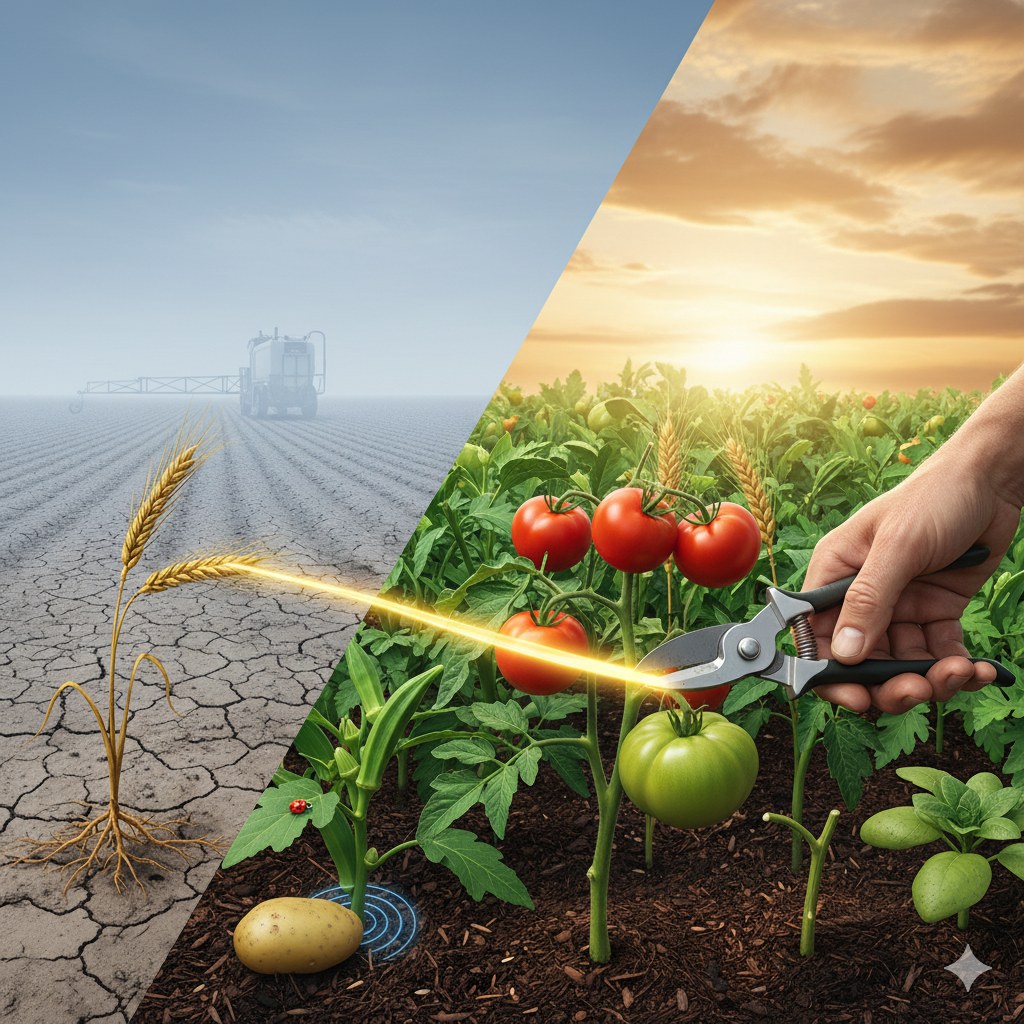
Nature designs plants for abundant vegetative growth to sustain the entire ecosystem—feeding soil life, animals, and humans. Modern farming ignores this symbiotic design. This paper presents the PQNK framework based on four natural directives—Stamping, Grazing, Pruning, and Bruising—which mimic the role of animals in a pristine ecosystem. By applying these principles, farmers intelligently manage a plant's surplus energy, channeling it towards robust reproduction (yield). This system works in harmony with nature's wisdom, eliminating reliance on chemical forcing agents and building a resilient, self-sustaining farm organism. This guide provides a practical classification of crops and specific protocols for applying these principles, emphasizing observation and adaptation to your farm's unique conditions.
1. Introduction: The Philosophy of Abundance and Management
In nature, a plant is a fountain of life for the entire food web. Its roots exude sugars to feed soil microbiology; its foliage supports insects and animals; its fruits and seeds ensure its propagation by nourishing countless species. Nature deliberately encourages plants to perform excess vegetative growth to fulfill this vital, system-wide role.
Conventional production, by isolating plants from animals and applying chemical stress, works against this elegant design. PQNK recognizes that the path to sustainable abundance is not to suppress this vegetative vigor, but to manage it consciously.
The absence of grazing and browsing animals has left plants without the natural signals that direct their energy. This paper details how the farmer, as a mindful steward, can reintroduce these signals through four key directives, turning from a mere extractor into a partner in nature's abundance.
2. The Four Directives: Principles and Physiology
2.1 Stamping (Treading)
Definition & Mechanism: Controlled soil compression and mild root disturbance. This acts as a form of "root pruning," creating mild stress that signals the plant to shift priority from leaf production to energy storage in reproductive organs like tubers and bulbs.
Timing & Intensity: Applied during the critical initiation phase of the tuber or bulb. Must be light to moderate to avoid stem damage or harmful soil compaction.
2.2 Grazing
Definition & Mechanism: The removal of above-ground biomass. Reducing the photosynthetic surface forces a strategic plant response. Before the reproductive shift, it can stimulate tillering; after, it can be fatal.
Timing & Intensity: The critical factor is developmental stage, not height. Grazing must occur before the plant begins forming straw and nodes (e.g., in cereals). A tiller committed to stem elongation will not regrow. Intensity should not exceed 50% biomass removal.
2.3 Pruning and Pinching
Definition & Mechanism: The deliberate removal of plant parts to shape and direct energy. It removes apical dominance, stimulates lateral growth, and opens the canopy.
Timing & Frequency: Dormant pruning (for structure), summer pruning (for vigor control). Frequency can be once, twice, or more for vigorous plants.
The Art of Pinching: A Subtle Directive for Precise Energy Channeling: Beyond the broader actions of pruning and bruising lies the more refined practice of pinching. This involves the manual removal of the terminal bud (the apical shoot) using the fingernails and thumb. Where standard pruning may be too severe—such as with delicate annuals like chickpeas grown in resource-limited, rain-fed, or sandy soils—pinching serves as a minimally invasive surgical strike. Its primary mechanism is the swift elimination of apical dominance. By removing the main source of auxin hormone from the tip, the plant immediately redirects energy to dormant lateral buds, forcing the development of a bushier, more branched architecture. This results in a greater number of flowering and podding sites. Pinching is exceptionally appropriate for enhancing production in a wide range of crops, including: Basil and Mint, where it prevents flowering and encourages continuous leafy harvests; Chili Peppers, to create a sturdier plant with more nodes for fruit set; ** indeterminate Tomatoes,** to halt top growth and direct all energy into ripening the existing fruit cluster; Marigolds and Chrysanthemums, where it is essential for creating a profuse display of blooms; and Rapeseed (Canola), where pinching the main stem before the bolting stage can stimulate the growth of multiple, robust side branches, each bearing a podded inflorescence, thereby significantly increasing seed yield.
2.4 Bruising
Definition & Mechanism: Superficial injury to stems or branches without breaking them. This controlled stress mimics natural damage, often triggering a survival response that results in flowering and fruiting.
Timing & Technique: Applied to vegetatively vigorous plants reluctant to flower. Techniques include gentle twisting or bending of stems to injure internal fibers without snapping the branch.
Advanced Canopy Management - Plant "Topping" for Energy Diversion
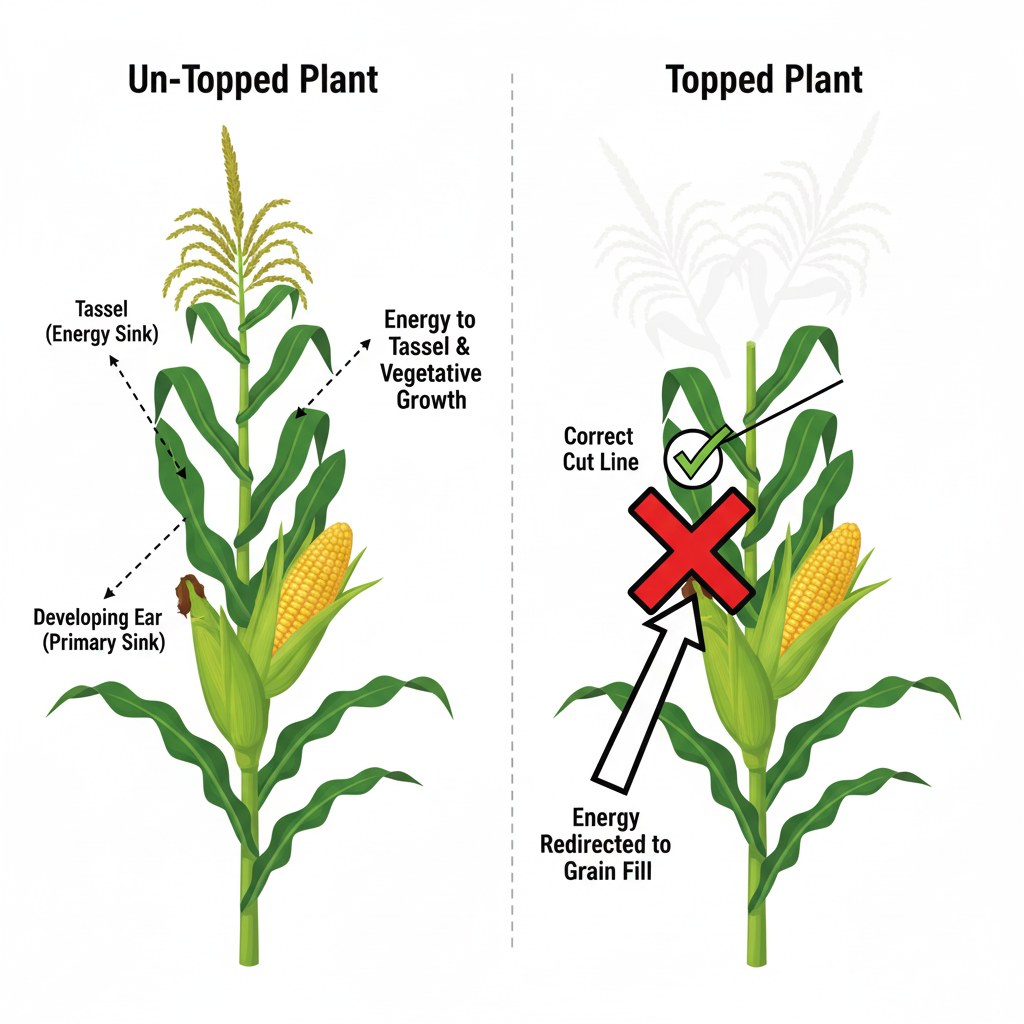
Beyond pruning leaves and side shoots, the PQNK system embraces a more profound intervention: stalk pruning, or "topping." This practice directly manipulates the plant's energy flow to force a shift from vegetative growth to reproductive investment, aligning with our core principle of managing the canopy for yield.
The Principle: In a corn plant, the tassel and the stalk tip are powerful sinks for photosynthetic energy, even after pollination. By removing this top section, we eliminate a major, non-essential sink. The plant's entire energy production is then redirected to the primary sink: the developing ear.
Documented Benefits in a PQNK Context:
Enhanced Grain Fill: Results in larger, denser, and heavier kernels due to improved source-to-sink flow.
Reduced Lodging: A shorter, stouter stalk provides better support for the heavier ear.
Improved Canopy Light Distribution: Opens the plant canopy, allowing sunlight to penetrate more effectively.
PQNK Advisory for Topping Corn:
Timing is Critical: Perform topping only after pollen shed is 100% complete. A visual sign is when the anthers on the tassel have turned brown and stopped shedding yellow pollen. This is typically 2-3 days after the main pollen shed.
Precise Technique: Using sharp, clean shears, make a clean cut just above the node of the topmost ear. Preserve all leaves.
Ideal Conditions: Conduct this operation on a dry, sunny day to promote rapid healing of the wound.
System Dependency: This practice yields the best results in a mature PQNK system where plants are healthy, unstressed, and supported by a cooperative root zone that can supply ample water and nutrients during the critical grain-fill period that follows.
Conclusion: Topping is a high-skill, high-reward practice that exemplifies the PQNK approach of active, intelligent stewardship. It is not merely about cutting the plant, but about strategically guiding its biological processes to achieve our goal of maximum, high-quality production.
3. The PQNK Plant Classification & Practical Protocol
Classification 1: Plants for Stamping (Treading)
Goal: Initiate and boost tuber/bulb formation.
Species: Potato, Sweet Potato, Garlic, Onion, Peanut, Ginger, Turmeric.
PQNK Protocol: Perform light stamping around the plant base at the onset of tuber/bulb initiation.
Note: Not suitable for legumes like peas or beans, as it damages their delicate, nitrogen-fixing root systems.
Classification 2: Plants for Grazing & Pruning (Cereals and Grasses)
Goal: Stimulate tillering and prevent energy waste on non-productive stems.
Species: Wheat, Rice, Oats, Barley.
PQNK Protocol: Time grazing/mowing before node formation begins. Use animals or a mower to remove up to 50% biomass, encouraging new, productive tillers.
Classification 3: Plants for Pruning & Bruising (Fruits, Vegetables, Vines)
Goal: Control vigor, encourage new fruiting wood, and improve quality.
Species: Citrus, Mango, Peach (Trees); Okra, Tomato, Pepper (Herbaceous); Melon, Cucumber, Grape (Vines).
PQNK Protocol:
Fruit Trees: Dormant pruning for structure; summer pruning and branch bruising to control vigorous, non-fruiting growth.
Okra: Prune lower leaves and "top" the plant to encourage side-shoot production.
Vining Melons: Pinch growing tips after fruit sets to redirect energy into fruit swelling.
Classification 4: The Unique Case of Legumes (Green Peas)
Goal: Maximize pod production without damaging nitrogen-fixing roots.
Species: Green Peas (especially indeterminate/vining varieties).
PQNK Protocol:
Pruning (Conditional): For indeterminate peas that are overly vegetative, pinch the growing tip to stimulate lateral growth. Do not prune determinate (bush) varieties.
The Primary Directive - Harvest-Clipping: The most critical practice is harvest method. Use two hands: one to steady the vine, the other to cleanly clip the pod's stem. This "clipping" avoids the "ripping" damage that can stress the plant, signaling it to continue production. In a fully realized PQNK system, the plant's own sap and resilience may make this less critical, but it remains a best practice for energy channeling.
4. Implementation in a PQNK System
The PQNK farmer is the intelligent, observing proxy for the missing animal herd. Using tools and labor to replicate these natural functions, the farmer guides the system toward abundance.
This practice is deeply integrated with other PQNK principles. Managed growth on permanent raised beds leads to healthier roots and efficient water use. The reduced vegetative waste feeds soil microbiology, completing the nutrient cycle.
The example of the green pea is instructive. It shows that PQNK is a framework of principles, not rigid rules. The most effective directive can sometimes be a mindful harvest. The farmer's role is to be a student of the ecosystem, understanding each plant's nature and applying the right signal at the right time.
5. Cautions and Common Mistakes
Over-application: More is not better. Excessive stamping, grazing, or pruning causes shock and set-back. Make grazing zones in the field, and animals should have access to one zone when plants are ready for grazing, again.
The Grazing Mistake: Grazing cereals after node formation is a critical error that reduces yield.
Ignoring Plant Type: Pruning determinate peas or stamping legumes causes harm, not benefit.
Transitional Care: In a system transitioning to pristine health, a clean clip is wiser than a rip to prevent disease entry points in stressed plants.
Conclusion
By understanding and applying the principles of Stamping, Grazing, Pruning, and Bruising, we cease to be combatants against nature and become its partners. We learn to guide the inherent, overflowing abundance of plants towards a harvest that sustains both the land and its people. This conscious partnership, rooted in observation and respect for natural law, is the essence of the regenerative and sustainable Pristine Organic Farming System—PQNK.
Footnote: Any Production Process That Inundates Soil With Water, Disturbs Soil Through Tillage, Or Leaves Soil Bare Without Organic Mulch Cover Does Not Qualify As Natural Ecosystem Science For Production Agriculture.
PQNK, to be pronounced as 'picnic', which stands for Paedar Qudratti Nizam Kashatqari, and means: the regenerative & sustainable Pristine Organic Farming System.
www.Facebook.Com/Pedaver
https://www.youtube.com/@pedaverpqnk3167/videos
pedaver@gmail.com
WhatsApp +92 320 677 6666
About This Paper
- Crop
- Potato · Sweet Potato · Garlic · Onion · Peanut · Ginger · Turmeric · Wheat · Rice · Oats · Barley · Citrus (Kinnow) · Mango · Peach · Okra · Tomato · Pepper (Bell/Capsicum) · Melon · Cucumber · Grapes · Maize (Corn) · Pea
- Problem
- Excess Vegetative Growth (at expense of yield/flowering) · Lodging / Weak Stem Structure · Poor Germination / Emergence
- Science
- Plants · Production Architecture
- Evidence
- Field Observation
- Authority
- Current / Approved PQNK Knowledge
Related PQNK Science
Key Takeaways
- Defines four vegetative-management directives, stamping, grazing, pruning and pinching, and bruising, as deliberate substitutes for the grazing-animal signals modern farms have lost.
- Grazing must occur before node formation begins in cereals; grazing after stem elongation starts is identified as a critical, yield-destroying timing error.
- Corn 'topping,' removing the stalk above the top ear only after 100% pollen shed, is credited with larger kernels, reduced lodging, and better canopy light penetration.
- Stamping is explicitly forbidden on legumes like peas and beans because it damages their nitrogen-fixing root systems.
- Provides a crop-by-crop directive matrix: stamping for tubers and bulbs, grazing/pruning for cereals, pruning/bruising for fruiting trees and vines, and careful two-handed clipping (not pruning) for green peas.
- Warns that over-application of any directive causes plant shock and setback; more intervention is not automatically better.
Related Crops
Related Knowledge
same crop
Five Decades of Agricultural Innovation: Interventions and Achievements in Chronological Order, 1973–2023
Asif Sharif's own year-by-year record of fifty years of hands-on agricultural intervention in Pakistan, from early machinery and seed distribution through the 2008 development of PQNK and its crop-by-crop expansion since, presented as the primary evidentiary record behind PQNK: a ground-up, farmer-verified track record rather than a journal citation.
same problem
PQNK Knowledge Paper: The Twofold Art of Pruning as Compensatory Grazing
With grazing animals absent, plants read the lack of browsing pressure as a sign their foliage isn't wanted and pour energy into ever more vegetative growth instead of fruit. This paper sets out a two-phase pruning protocol, formative and reproductive, standing in for that missing herd, with a detailed crop-by-crop benchmark table and a full sugarcane case study covering two distinct harvest strategies.
same problem
Advisory for One Acre Prosperity (OAP) in Vegetable Production: A PQNK Guide for the Smallholder
A hands-on smallholder guide built around one core discipline, using every square inch of soil for every passing minute of the year, that details a specific 36-block nursery system for raising transplants without seed waste or transplant shock, alongside a homemade 'dribble board' tool for direct seeding through mulch.
same crop
Every Seed Is a Promise to the Next Generation: Why PQNK Selects Open-Pollinated Genetics Over GMO, Hybrid, and Seedless Seed
PQNK's seed philosophy separates three routinely conflated categories, GMO, F1 hybrid, and induced seedlessness, and argues open-pollinated seed was never agriculture's weak link; degraded, tillage-hollowed soil was. This knowledge paper works from the biology of pollination through the Green Revolution's real achievement to a full crop-by-crop protocol for saving, isolating, and hand-pollinating open genetics on a PQNK farm.