

KP-065 · Plant Physiology & Production Systems
The PQNK System: Cultivating Plant Intelligence Through Engineered Soil Gradients
Rather than fighting soil heterogeneity with uniform irrigation and fertilizer, this technical paper argues PQNK's trapezoidal raised beds deliberately engineer three concentration zones, dilute, gradient, and accumulation, that trigger specific, well-documented root and transporter adaptations. It's the most mechanistic of the PQNK papers, citing root-hair proliferation timelines, transporter upregulation factors, and mycorrhizal recruitment data.
Read or listen to the full paper ↓Abstract
The paper's opening claim is a paradigm shift: rather than treating soil heterogeneity as a problem to overcome with uniform inputs, PQNK treats it as a biological trigger to be engineered deliberately. It rests on four non-negotiable pillars, absolute no-till, permanent organic mulch armor, engineered raised beds, and biological nutrient management, and on what it calls the 'geological abundance premise': that most agricultural soils already contain sufficient mineral reserves for perpetual production once biological weathering, not fertilizer, is allowed to liberate them.
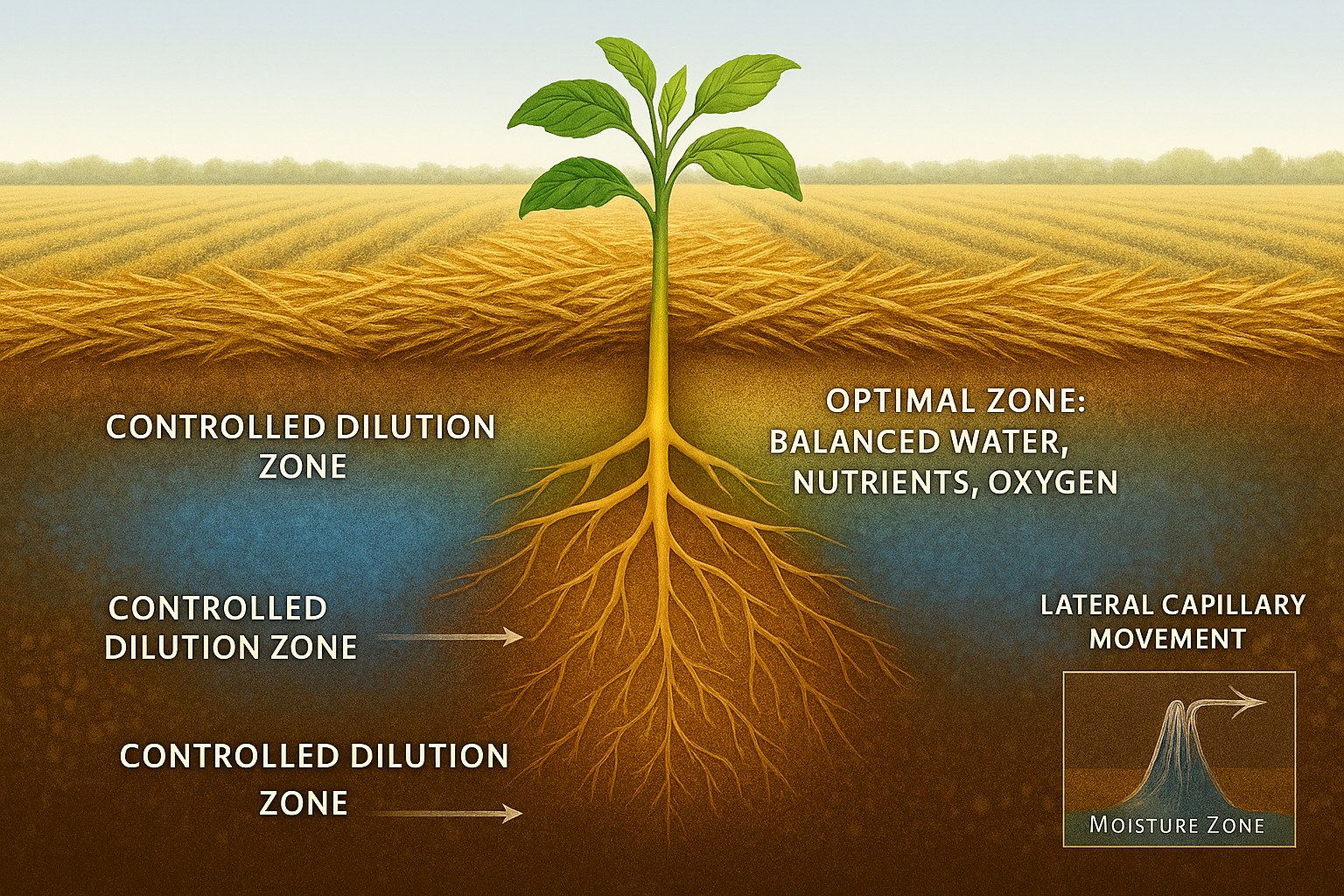
The physical architecture is specified precisely: an 8-inch-high, 42-inch-top-width trapezoidal bed with 52-inch base width and 18-inch furrows, engineered to create three functional zones as water moves laterally by capillary action, a hydration zone near the furrows (high water, low nutrient concentration), a gradient zone where dissolved nutrients accumulate along the flow path, and an accumulation zone at the bed center where nutrient concentration peaks. The paper treats intentional compaction of furrow bottoms from machinery passage not as a flaw but as a managed feature that directs water into the precise lateral infiltration pattern the whole system depends on.
Plant responses to these zones are documented in specific physiological detail: root hair density and length increase dramatically within 24-48 hours of encountering a dilute zone; high-affinity nutrient transporter expression rises 5-10 fold; mycorrhizal-recruiting strigolactone exudation increases roughly 3-fold, extending the root's effective absorptive radius 10-100 times; and localized proton extrusion lowers rhizosphere pH by 0.5-1.0 units to mobilize bound phosphorus and micronutrients. As roots extend into progressively concentrated zones, the paper describes calcium-wave anticipatory signaling, nutrient-specific triggers (nitrate for lateral roots, phosphate for root hairs, potassium for osmotic adjustment), and vacuolar nutrient storage for lean periods.
The paper explicitly contrasts this against three conventional irrigation approaches: flood irrigation creates homogeneous saturation that eliminates any adaptive stimulus, drip irrigation creates extreme point-source concentration gradients that risk salt accumulation and bypass natural soil nutrient pools, and rainfed or sprinkler systems create gradients too unpredictable to drive systematic adaptation. PQNK's claimed innovation is a gradient that is reproducible and moderate, steep enough to stimulate adaptive response, flat enough to avoid toxicity.
It closes with a four-step implementation protocol, break the hardpan, correct soil chemistry with strategic acid leaching where pH exceeds 8, build beds and plant deep-rooted Jantar as a biological drill, then retain all roots, mulch, and plant cash crops no-till, and frames the entire system as a continuous feedback loop in which engineered gradients drive plant adaptation, adaptation drives performance and soil improvement, and improved soil refines the gradients for the next cycle.
Full Paper
If you use “Listen”, the text of the page may be sent to your browser or operating system’s speech provider, such as Apple, Google or Microsoft, depending on the voice your device uses. Pedaver does not process, transmit or store any audio.
1. The PQNK Paradigm: From Exploitation to Ecological Partnership 1.1 The Crisis of Conventional Agriculture
Modern tillage-based agriculture has systematically dismantled nature's water and nutrient provisioning systems. Hardpan formation blocks infiltration, surface crusting accelerates runoff, and the destruction of soil structure eliminates the sponge-like capacity that sustains natural ecosystems. This has created artificial dependence on irrigation and soluble fertilizers while exacerbating drought, flood, and soil degradation cycles.
1.2 The PQNK Philosophical Foundation
PQNK—"the regenerative and sustainable Pristine Organic Farming System"—is grounded in Natural Ecosystem Science. It recognizes that plants evolved in heterogeneous soils and possess sophisticated genetic programming to respond to gradients. Rather than viewing this heterogeneity as a problem to overcome with uniform inputs, PQNK embraces and engineers controlled gradients as biological triggers. The system operates on four non-negotiable pillars:
1. Absolute No-Till to preserve soil structure, biology, and infiltration pathways
2. Permanent Organic Armor (Mulch) to harvest atmospheric moisture, suppress evaporation, and feed soil life
3. Engineered Raised Beds to optimize root zone physics (aeration, infiltration, gradient creation)
4. Biological Nutrient Management to fuel the system through in-situ organic cycling and mineral liberation
1.3 The Ultimate Goal: Hydrological and Nutrient Autonomy
PQNK's immediate manifestation—the raised bed with lateral seepage irrigation—is a precision tool for delivering water and stimulating plant vigor. However, this is intentionally transitional. The system's design systematically rebuilds the eight natural water supply mechanisms:
• Rain capture through enhanced infiltration
• Dew condensation on mulch and plant surfaces
• Humidity absorption by hygroscopic organic matter
• Capillary redistribution through soil pores
• Root-mediated hydraulic lift
• Mycorrhizal water transport
• Organic matter water retention
• Biological pore network formation
The end goal is a state of hydrological autonomy where crops are sustained primarily by redesigned landscapes that function like natural ecosystems, making every rain event, dewfall, and humid night a contribution to the farm's water budget.
1.4 The Geological Abundance Premise
Conventional agriculture operates from a "deficiency mindset"—viewing soil as an inert substrate requiring constant replenishment. PQNK replaces this with a "liberation and cycling mindset." The system is premised on the evidence that most agricultural soils possess sufficient geological mineral reserves (P, K, Ca, Mg, micronutrients) for perpetual production when accessed through biological weathering. PQNK doesn't add fertility; it activates the latent fertility already present.
2. System Engineering: The Raised Bed as a Biological Reactor 2.1 The Physical Architecture
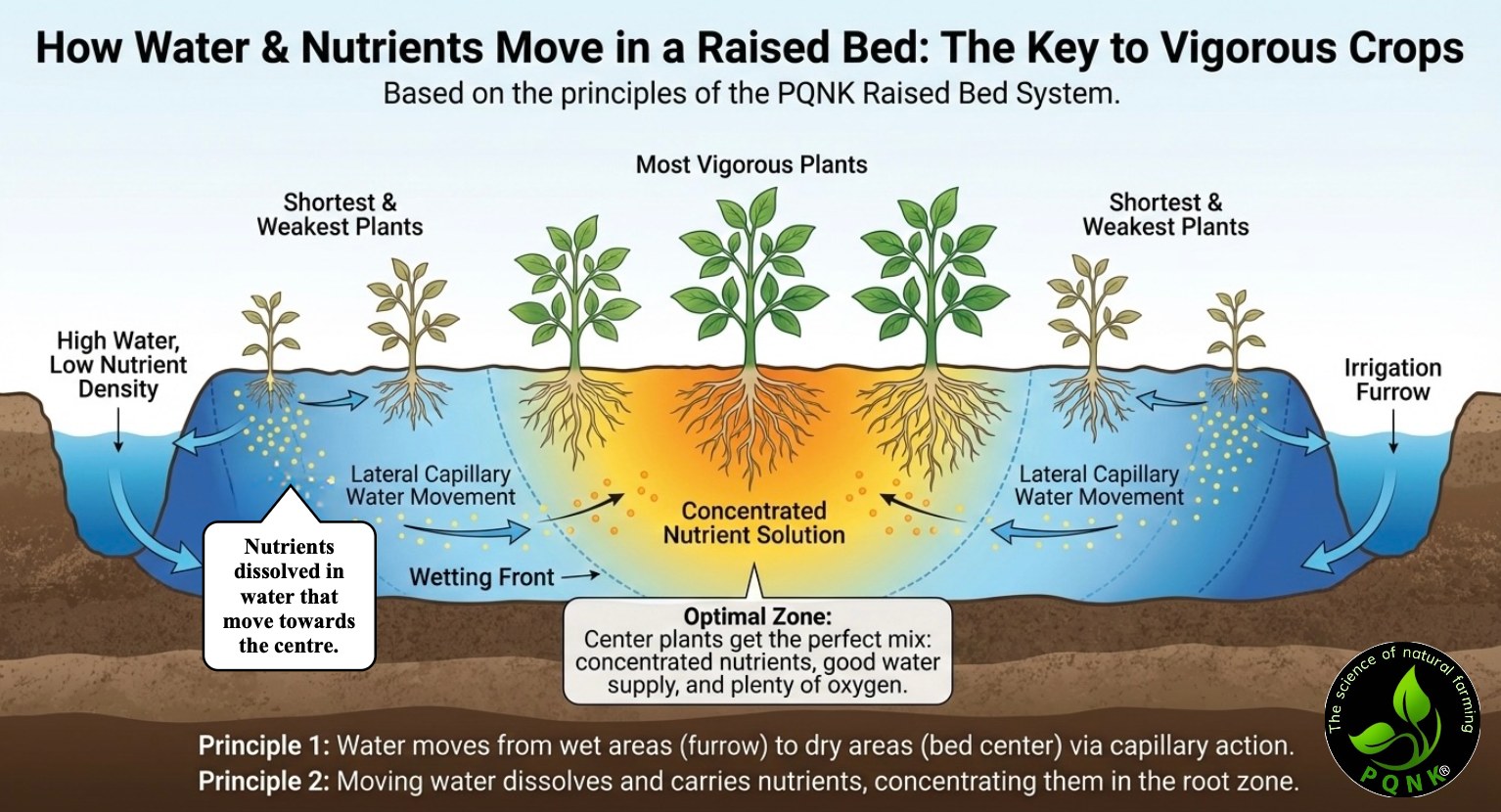
Figure 1: Engineered Hydraulic and Nutrient Gradients in the PQNK Raised Bed System. Lateral capillary movement from irrigation furrows creates a predictable gradient: water-rich but nutrient-dilute conditions near the furrows transition to an optimal central zone with concentrated nutrients, balanced water, and high oxygen availability. This heterogeneous environment stimulates the suite of plant physiological adaptations detailed in Sections 3 & 4. (Adapted from "Soil Water Dynamics, Microclimate Feedback, and Plant Vigor in Raised Bed Systems").
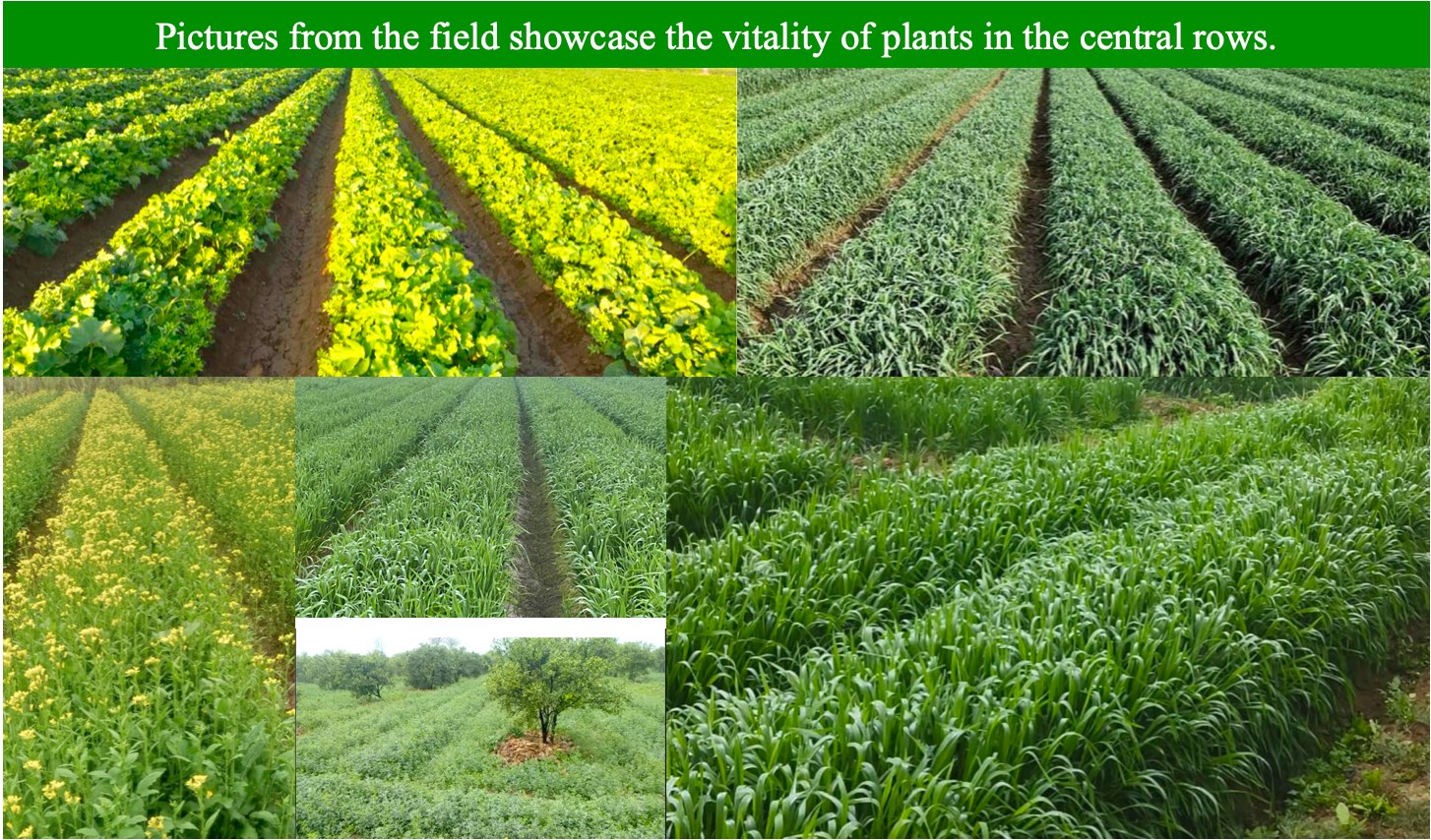
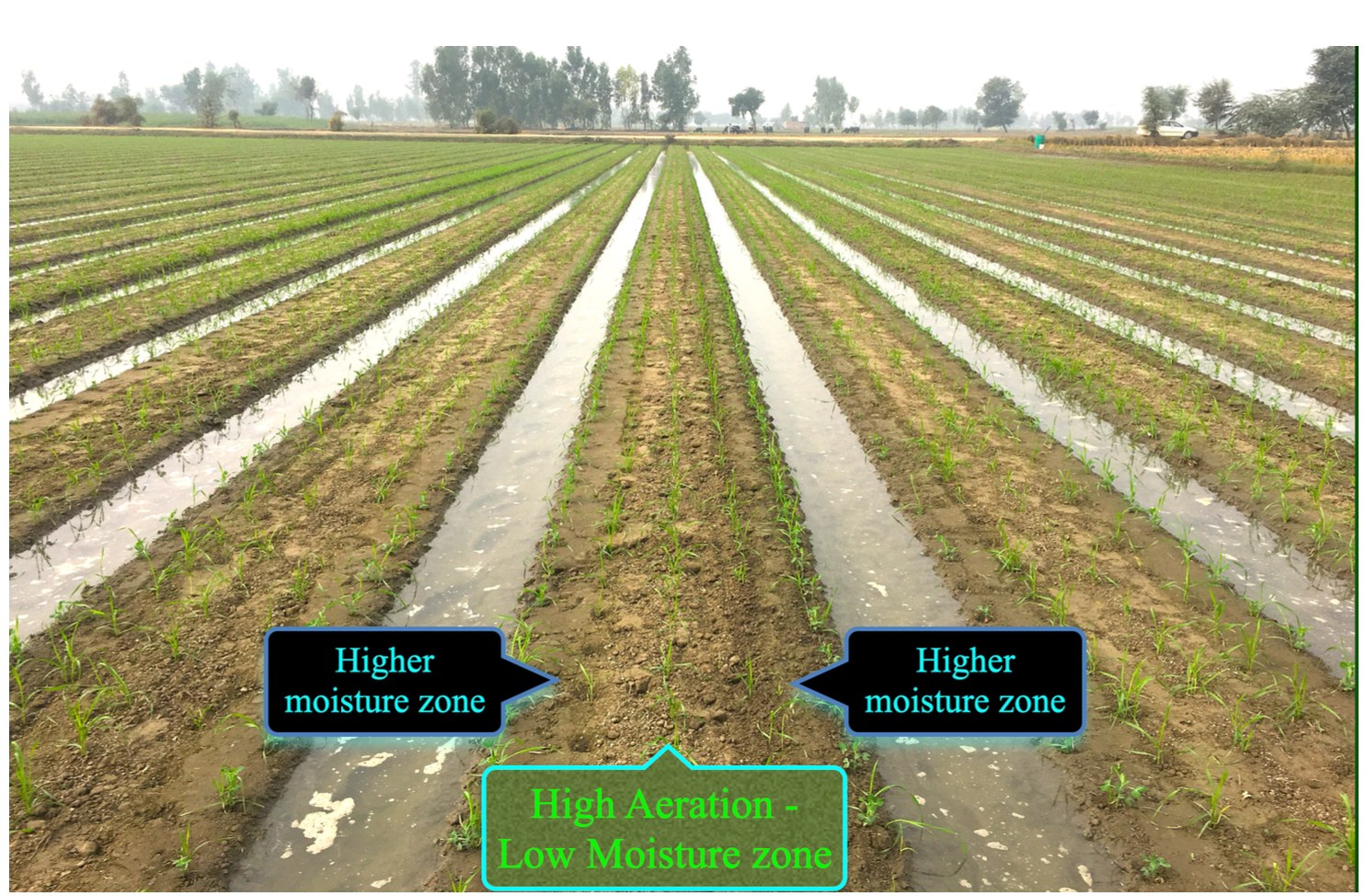
Figure 2: Aerobic Architecture of the PQNK Raised Bed. The raised geometry creates distinct vertical zones: saturated zones at the base of furrows, optimal aerobic zones in the upper bed shoulders, and a well-aerated central mound. This ensures that even as lateral water movement creates nutrient gradients (Fig. 1), the entire root zone maintains sufficient oxygen for vigorous root respiration and nutrient uptake. (Adapted from "The PQNK Raised Bed System Engineering...").
The PQNK bed is a precisely engineered trapezoid: 8-inch height, 42-inch top width, 52-inch base width, with 18-inch wide furrows. This geometry creates three distinct functional zones:
1. The Hydration Zone: Adjacent to furrows where moisture is high but nutrient concentration is lowest
2. The Gradient Zone: Intermediate areas where capillary water movement dissolves and transports accumulated nutrients
3. The Accumulation Zone: Bed centers where nutrient concentration peaks due to cumulative dissolution along flow paths The raised geometry creates distinct vertical zones: saturated furrow bases, optimal aerobic upper shoulders, and well-aerated central mounds. This ensures the entire root zone maintains sufficient oxygen for vigorous root respiration and nutrient uptake.
2.2 The Physics of Gradient Formation
Water moving through soil pores acts as a cumulative solvent, dissolving more minerals along its path. This creates a reproducible concentration gradient from furrow edges (dilute) to bed centers (concentrated). The system's design incorporates intentional compaction of furrow bottoms from machinery passage—not as a flaw, but as a managed feature that directs water to drift to furrows and laterally infiltrate, creating the precise capillary gradients essential to system function.
2.3 Four Engineered Scenarios for Plant Response
PQNK deliberately creates and manages four soil solution scenarios:
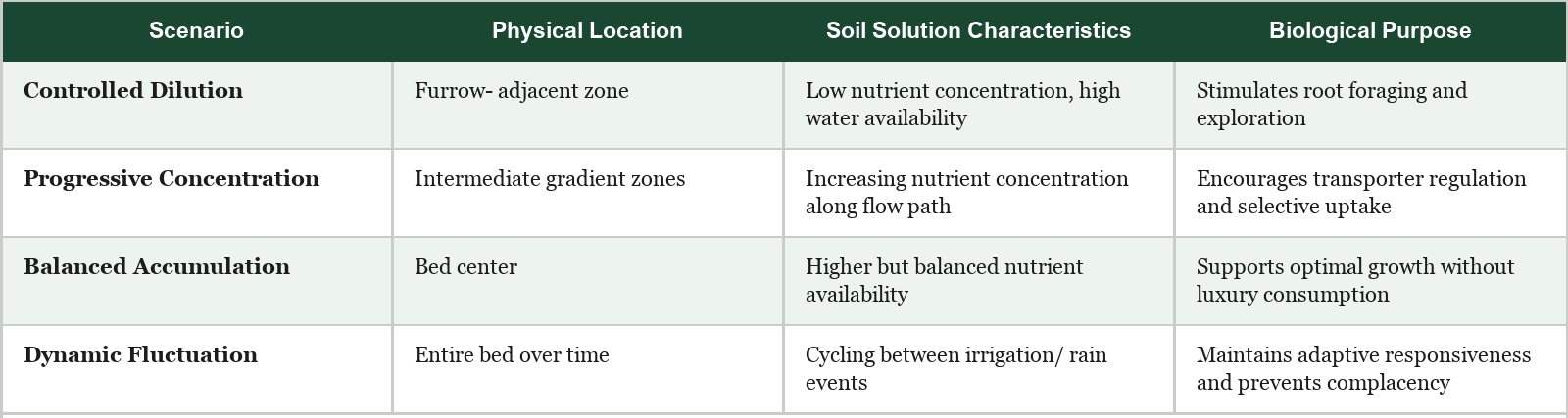
| Scenario | Physical Location | Soil Solution Characteristics | Biological Purpose |
|---|---|---|---|
| Controlled Dilution | Furrow- adjacent zone | Low nutrient concentration, high water availability | Stimulates root foraging and exploration |
| Progressive Concentration | Intermediate gradient zones | Increasing nutrient concentration along flow path | Encourages transporter regulation and selective uptake |
| Balanced Accumulation | Bed center | Higher but balanced nutrient availability | Supports optimal growth without luxury consumption |
| Dynamic Fluctuation | Entire bed over time | Cycling between irrigation/ rain events | Maintains adaptive responsiveness and prevents complacency |
2.4 Contrast with Conventional Systems
• Flood Irrigation: Creates homogeneous saturation, eliminating gradients and removing stimulus for adaptive root growth
• Drip Irrigation: Creates extreme point-source concentration gradients leading to salt accumulation and bypasses natural soil nutrient pools
• Sprinkler/Rainfed: Creates unpredictable, temporary gradients offering limited opportunity for systematic adaptation
PQNK's innovation lies in creating reproducible, managed gradients that are neither too steep (avoiding toxicity) nor too flat (maintaining stimulus), optimized for triggering beneficial plant responses.
3. Plant Physiological Adaptations to PQNK Gradients 3.1 Response to Controlled Dilution Zones
Plants encountering dilute nutrient solutions deploy a coordinated foraging strategy:
Morphological Adaptations:
• Root Hair Proliferation: Dramatic increase in density and length within 24-48 hours of encountering a dilute zone, exponentially expanding the root system's absorptive surface area.
• Lateral Root Initiation: Auxin redistribution directs growth toward nutrient-richer zones
• Root System Reconfiguration: Carbon allocation shifts toward fine, absorptive roots
Physiological Enhancements:
• High-Affinity Transport System (HATS) Upregulation: 5-10 fold increased expression of nutrient transporters
• Mycorrhizal Recruitment: Strigolactone exudation increases 3-fold, extending effective absorptive radius by 10-100 times
• Rhizosphere Engineering: Proton extrusion lowers local pH by 0.5-1.0 units, mobilizing bound phosphorus and micronutrients
PQNK Benefit: Creates extensive, responsive root systems that function optimally even as irrigation intervals lengthen, enhancing drought resilience.
3.2 Response to Progressive Concentration Gradients
As roots extend into zones of increasing concentration, plants implement precision management:
Selective Transport Regulation:
• Concentration-Dependent Uptake Kinetics: Modulation of HATS and LATS activity
• Anticipatory Signaling: Calcium waves prepare tissues for changing nutrient availability
• Nutrient-Specific Responses: Nitrate induces lateral roots, phosphate stimulates root hairs, potassium enhances osmotic adjustment
Osmotic and Storage Management:
• Compatible Solute Synthesis: Proline, glycine betaine, and sugars maintain favorable water potential
• Vacuolar Sequestration: Excess nutrients stored as reserves for lean periods
• Transpirational Dilution: Increased stomatal conductance helps maintain favorable internal concentrations
PQNK Benefit: Plants develop sophisticated nutrient management capabilities, avoiding both deficiency and toxicity while building internal buffers.
3.3 Response to Dynamic Fluctuation and Balance Challenges
The system's cycling trains plant homeostasis:
Cross-Talk and Integration:
• Nutrient Interaction Management: Upregulation of specific transporters for limited nutrients with competitive exclusion of excess
• Systemic Signaling Networks: Root-derived signals coordinate whole-plant responses
• Feedback Regulation: Internal nutrient pools inhibit luxury consumption
Temporal Adaptation:
• Memory and Priming: Previous exposure enhances subsequent responses through epigenetic modifications
• Predictive Allocation: Root growth anticipates irrigation/rain cycles
PQNK Benefit: Plants develop metabolic flexibility and resilience, efficiently managing nutrient ratios from organic mineralization.
3.4 The Fourth Adaptation: Managing Organic Nutrient Complexity
3.4.1 Microbial Recruitment for Mineral Liberation PQNK operates on a three-stage framework for accessing geological abundance:
Stage 1: Mineral Liberation
Microbial consortia and root exudates perform in-situ geochemistry through organic acids, chelators, and enzymes, unlocking bound minerals from parent soil material and clay complexes.
Stage 2: Nutrient Cycling
Liberated nutrients enter a tightly coupled biological loop with minimal leaching, creating a circular nutrient economy within the bed.
Stage 3: Ecosystem Abundance
The system reaches self-sustaining nutrient flux where constant biological activity maintains steady-state mineral release matched by efficient capture and recycling.
3.4.2 Direct Organic Acquisition
• Organic Nitrogen Uptake: Amino acid and peptide transporters bypass mineralization bottlenecks
• Enzyme Exudation: Phosphatases, chitinases break down organic complexes
• Mycorrhizal Mediation: Fungi access organic pools beyond plant capabilities
3.4.3 Toxicity Avoidance in Organic Systems
• Heavy Metal Chelation: Phytochelatins and metallothioneins bind and sequester toxins
• Phenol Tolerance: Enhanced antioxidant systems protect against decomposition compounds
• Pathogen Defense: Balanced nutrient status enhances systemic acquired resistance
PQNK Benefit: Leverages sophisticated plant-microbe partnerships to access nutrient forms conventional systems ignore while building soil health.
4. The PQNK Implementation Protocol 4.1 Four Steps to Regenerative Gradient Formation
Step 1: Break the Hardpan Shatter subsurface compaction using a subsoiler without soil inversion. This creates permanent pathways for deep water infiltration, root penetration, and subsoil aeration.
Step 2: Correct Soil Chemistry with Strategic Leaching
For soils with pH > 8, apply deep irrigation with dilute sulfuric acid (8 kg/acre) to leach salts, neutralize carbonates, and liberate bound nutrients, creating a chemically receptive environment.
Step 3: Build Beds and Plant Biological Drills
Construct permanent trapezoidal beds to specified dimensions. Immediately sow deep-rooted Jantar (Sesbania aculeata) whose taproots further fracture subsoil, create biopores, and initiate mineral translocation.
Step 4: Retain, Mulch, and Plant No-Till
At Jantar maturity: RETAIN ALL ROOTS in soil; CHOP AND DROP biomass as permanent mulch; PLANT CASH CROPS directly with no-till planter. This launches ecological succession toward autonomy.
4.2 PQNK Crop Ecology
Leafy Vegetables: Thrive on steeper nitrogen gradients that stimulate continuous foraging Fruiting Crops: Benefit from managed potassium gradients during reproduction Root Crops: Excel with consistent moisture gradients for uniform tuber development Perennials: Develop "gradient memory" that enhances year-to-year performance
4.3 System Diagnostics
Root Architecture Audit: Excavation reveals gradient response in action Leaf Tissue Revelation: Balanced nutrients indicate successful mineral liberation Gradient Verification: Soil solution sampling confirms intended hydraulic patterns Vigor Metrics: Uncompromised growth, deep color, and pest resistance reflect full genetic potential expression
5. The Regenerative Amplification Loop
The PQNK Feedback Loop; Engineered Gradients for Regenerative Amplification
PQNK Design Engineered Gradients
Enhanced Performance Plant Adaptation
Figure 3: The PQNK Regenerative Amplification Loop. The system operates as a continuous optimization cycle: the engineered design creates specific soil gradients; plants adapt to these gradients through physiological and morphological responses; these adaptations lead to enhanced plant performance and concurrent soil health improvement; these improvements refine the soil environment, thereby amplifying the system's effectiveness in the next cycle.
The system operates as a continuous optimization loop:
1. PQNK Design creates engineered gradients
2. Plant Adaptation responds through physiological mechanisms
3. Enhanced Performance yields vigorous crops while improving soil
4. Regenerative Amplification refines the system for next cycle
This loop systematically replaces the "deficiency mindset" with proven confidence in the land's perpetual abundance, moving irreversibly toward hydrological and nutrient autonomy.
6. Conclusion: Cultivating Intelligence, Harvesting Abundance
The PQNK system transcends agricultural technique to become a framework for ecological co-intelligence. It demonstrates that the highest-yielding, most resilient production emerges not from fighting nature with brute-force inputs, but from partnering with evolutionary wisdom through respectfully engineered challenges. By orchestrating optimal gradients of moisture, nutrients, and oxygen, PQNK creates conditions where plants:
1. Express self-reliant vigor through continuous "exercise" of adaptive capacities
2. Rebuild soils from within through responsive exudation and microbial partnership
3. Restore water cycles by progressing toward rain-dew-humidity capture
4. Access geological abundance through biological weathering of mineral reserves
This represents more than a farming method—it is a principled pathway to food sovereignty and ecological restoration. The future of resilient food systems lies not in more sophisticated chemistry, but in deeper ecological wisdom—the very wisdom PQNK is designed to activate and harness.
References
1. PQNK System Engineering Paper (2025) - Technical specifications of raised bed design
2. PQNK Soil Water Dynamics Paper (2025) - Hydraulic and microclimate measurements
3. Lynch, J.P. (2018) "Root Phenotypes for Improved Nutrient Capture"
4. Hodge, A. (2004) "The plastic plant: root responses to heterogeneous supplies of nutrients"
5. Forde, B.G. (2002) "Local and long-range signaling pathways regulating plant responses to nitrate"
6. Marschner's Mineral Nutrition of Higher Plants (3rd Ed.)
7. Chapin, F.S. (1980) "The mineral nutrition of wild plants"
8. PQNK Field Trial Data (2019-2023) - System validation evidence
9. Supporting PQNK papers on contour farming, micro-water cycles, and hydrological restoration Keywords: PQNK system, regenerative agriculture, nutrient gradients, root plasticity, plant adaptation, lateral seepage, bio-hacking, soil heterogeneity, rhizosphere engineering, organic farming, water autonomy, mineral liberation
Footnote: PQNK (pronounced 'picnic')—the regenerative & sustainable Pristine Organic Farming System—is grounded in Natural Ecosystem Science. This science employs perennial biodiversity, protects soil with organic mulch, and avoids practices like water inundation, tillage disturbance, and leaving soil bare.
PDF Knowledge papers: https://drive.google.com/drive/folders/ 1iadwV6mdUPyrUIpB3oRfNv6DLiackaUL?usp=sharing
About This Paper
- Problem
- Over-Irrigation · Saline / Alkaline / High-pH Soil · Unpredictable Rainfed Nutrient Gradients
- Science
- Soil · Plants · Water · Production Architecture
- Evidence
- Scientific Mechanism
- Authority
- Current / Approved PQNK Knowledge
Related PQNK Science
Key Takeaways
- PQNK raised beds are engineered to a specific trapezoidal geometry (8" height, 42" top width, 18" furrows) that creates three distinct nutrient concentration zones through lateral capillary water movement.
- Root hair density and length increase measurably within 24-48 hours of encountering a dilute nutrient zone, alongside a reported 5-10 fold increase in high-affinity nutrient transporter expression.
- Mycorrhizal-recruiting strigolactone exudation is reported increasing roughly 3-fold in response to engineered gradients, extending a root's effective absorptive radius by 10-100 times.
- Explicitly contrasts PQNK's reproducible, moderate gradients against flood irrigation (no gradient, no stimulus), drip irrigation (excessive, salt-risking gradient), and rainfed systems (unpredictable gradient).
- Frames intentional compaction of furrow bottoms from machinery traffic as a deliberately managed feature, not an engineering flaw, since it directs the lateral water movement the gradient system depends on.
- Presents the system as a continuous feedback loop: engineered gradients drive plant adaptation, which drives performance and soil improvement, which refines the gradient for the next cycle.
Related Knowledge
same problem
PQNK Factsheet: Production of HD Castor
A field factsheet for High-Density (HD) Castor grown as a 3-5 year perennial under PQNK, covering the mandatory land-preparation sequence, planting density, and the pruning schedule that keeps the crop productive across multiple harvest years.
same problem
Knowledge Paper: PQNK Rose Production
Cut-flower rose production is reframed as a closed-loop perennial system under PQNK, reaching a striking 8,712 plants per acre on twin-row permanent beds, with weeds treated as mulch, alfalfa grown as living nitrogen-fixing ground cover, and strict soil-moisture management replacing scheduled irrigation.
same problem
Knowledge Paper: Achieving High-Density Pomegranate Production Through the PQNK (Picnic) Pristine Organic Farming System
This knowledge paper sets out the full methodology for a 544-plant-per-acre pomegranate orchard under PQNK: the four-step soil recovery protocol that converts degraded land into a closed-loop system, and the four management pillars, zero soil disturbance, natural irrigation, inherent pest management, and structural pruning, that keep it that way.
same problem
Knowledge Paper: High-Density Amla Farming Under PQNK
Amla's naturally deep taproot makes it an ideal closed-loop PQNK crop, and this paper walks through the five-step protocol, hardpan breaking, pH correction, Jantar-built raised beds, no-till mulch planting, and phenology-timed pruning, that gets roughly 545 trees per acre to a sustained yield of 10-14 tonnes per acre by year five.