

KP-014 · Crop-Specific Guides
Commercial Rhodes Grass Production Under PQNK: A Factsheet for Punjab & Adjacent Areas
Rhodes grass (Chloris gayana) is a drought-tolerant fodder grass well suited to Punjab's erratic rainfall, and this factsheet lays out its PQNK production pathway from no-till establishment through 80-100 tonnes of chemical-free green fodder per acre per year, closing the loop with on-farm seed multiplication.
Read or listen to the full paper ↓Abstract
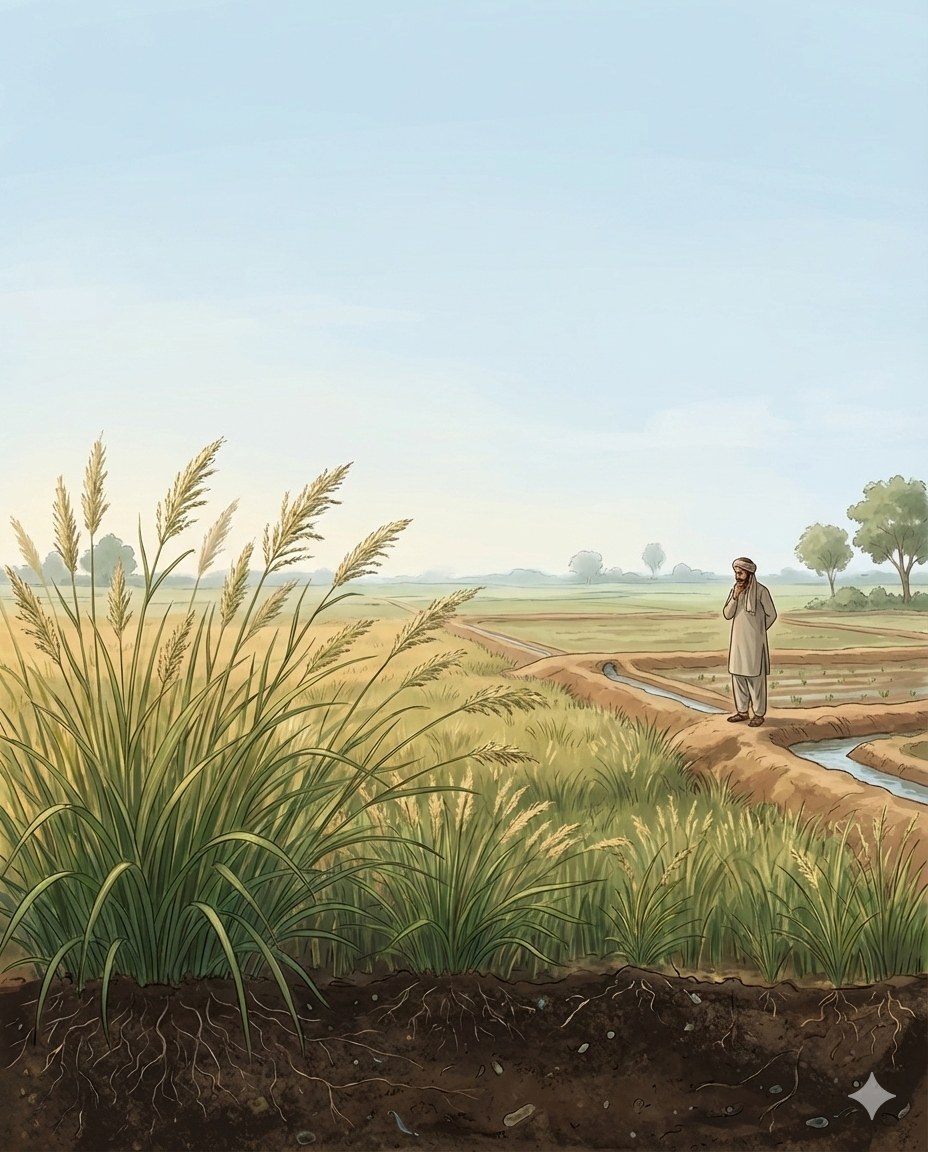
The factsheet frames Rhodes grass through PQNK's core philosophy of cultivating in harmony with natural rhythms rather than treating it as a purely extractive fodder commodity. For Punjab and adjacent semi-arid to arid areas, that means adapting to hot summers and mild, dormant winters below 15°C, and to erratic monsoon rainfall of 300-500mm, through rainwater harvesting via ponds and contour bunds, companion planting alongside nitrogen-fixing trees like Kikar or Shisham for shade and wind protection, and syncing sowing to February-March to capture spring warmth and monsoon rain.
Land preparation avoids deep tillage in favor of surface scarification with a chisel plough, preserving soil architecture and microbial networks, while fertility is built through 2-3 tonnes/acre of composted farmyard manure or vermicompost inoculated with native microbial jivamrta, and a preceding sunhemp or dhaincha green-manure crop turned in to boost organic matter and nitrogen. Seed selection favors locally adapted, open-pollinated varieties over hybrids to support seed sovereignty, sown at 2-3 kg/acre and treated with cow-dung-based microbial inoculants rather than chemical fungicides; cowpea is intercropped during establishment to fix nitrogen and suppress weeds.
Ongoing management pairs supplementary furrow irrigation (no more than a 4-inch head in the 18-inch furrow) with mulching to minimize evaporation, scheduled by soil moisture rather than a fixed calendar. Weeds are managed through high-density planting and initial hand weeding while tolerating a degree of weed diversity as soil indicators and insect habitat, and pests are rare enough that neem-based biopesticides are used only if needed. Annual fertility maintenance relies on compost top-dressing and foliar sprays of fermented plant extracts from nettle or moringa rather than synthetic inputs.
Harvest begins 60-75 days after sowing at 30-40cm height to preserve plant vigor, with subsequent cuts every 4-6 weeks in peak season. A firm PQNK rule leaves 10-15cm of stubble to protect the crown, speed regrowth, and feed soil microbes through root exudates, while non-harvested residue is returned as surface mulch to recycle nutrients and build soil organic carbon. Seed multiplication happens on an isolated, ungrazed plot allowed to flower 90-120 days after sowing, then hand-harvested, shade-dried, gently threshed, and stored with neem leaves, with PQNK encouraging farmer cooperatives to run community seed banks that preserve regional genetic diversity.
The factsheet closes on the economic and ecosystem case: 80-100 tonnes of green fodder per acre per year across multiple cuts, deep roots that break compaction and sequester carbon, drought tolerance that eases pressure on Punjab's depleting aquifers, and chemical-free fodder carrying 10-12% crude protein that improves livestock health and cuts veterinary costs. Framed as a keystone species rather than a mere crop, Rhodes grass under PQNK is presented as a step toward agricultural self-reliance that sustains both farm household and ecosystem.
Revision R1 (28 September 2026): the irrigation advice has been updated to the PQNK book (Chapters 26 and 27). PQNK irrigates only through the furrows of permanent raised beds, at no more than a 4-inch head in the 18-inch furrow and only when the soil-ball test shows need; there are no drip lines, sprinklers, pipes or emitters. Where a farm already has drip, as in an established orchard, it is run deeper and less often during transition. The PDF opens with a revision note; the original text follows unchanged.
Full Paper
If you use “Listen”, the text of the page may be sent to your browser or operating system’s speech provider, such as Apple, Google or Microsoft, depending on the voice your device uses. Pedaver does not process, transmit or store any audio.
Knowledge Paper KP-14 - Revision R1, 28 September 2026
The irrigation advice in this paper has been superseded by the PQNK book (Chapters 26 and 27, Soil Moisture Management and Organic Mulch).
PQNK irrigates only through the furrows of permanent raised beds. Water is run slowly in the 18-inch furrow at no more than a 4-inch head, about half the 8-inch furrow depth, and only when the soil-ball test shows the root zone needs it; mulch, rain, dew and capillary moisture supply the rest. There are no drip lines, sprinklers, pipes or emitters in a PQNK field. Where a farm already has drip, such as an established orchard, run it deeper and less often during transition while the permanent bed-and-furrow system takes over.
Where this paper says to use drip irrigation with mulching, use supplementary furrow irrigation as described above; the mulch and moisture-based scheduling it recommends still apply.
The original paper follows unchanged.
FACTSHEET: Commercial Production of Rhodes Grass (Chloris gayana) under the PQNK (Paedar Qudratti Nizam Kashatqari) Lens Region: Punjab & Adjacent Areas (Semi-Arid to Arid Climates)
1. PQNK Core Philosophy Applied
PQNK—pronounced ‘picnic’—is the regenerative Pristine Organic Farming System. For Rhodes grass, this means cultivating in harmony with nature’s rhythms, rebuilding soil life, enhancing the water cycle, and creating a resilient, self-sustaining farm ecosystem without synthetic chemicals. The crop is valued not just as a commodity, but as a living contributor to farm health.
2. Climatic Suitability & PQNK Adaptation
• Native Climate: Tropical/Subtropical, drought-tolerant, prefers warm seasons (25-35°C).
• Punjab & Adjacent Areas: Hot summers (ideal), mild winters (dormant below 15°C), annual rainfall 300-500mm (often erratic).
• PQNK Adaptation:
• Water Intelligence: Use rainwater harvesting (ponds, contour bunds) to capture monsoon rains for supplemental irrigation. Deep taproots access groundwater, making it a climate-resilient choice.
• Microclimate Creation: Plant alongside trees (e.g., Kikar or Shisham) for partial shade and wind protection.
• Season Syncing: Sow post-winter (Feb-March) to use spring warmth & monsoon rains. Avoid water-logged soils—PQNK emphasizes living soil structure for rapid infiltration.
3. Soil & Land Preparation under PQNK
• Soil Preference: Thrives in wellaerated loams to sandy loams; tolerates salinity & moderate alkalinity (common in Punjab).
• PQNK Practices:
• No Deep Tillage: Use surface scarification (e.g., chisel plough) to open soil without destroying its architecture and microbial networks.
• Bio-fertilization: Apply well-composted farmyard manure (FYM) or vermicompost (2-3 tonnes/acre) inoculated with native microbe jīvāmŕta.
• Green Manuring: Precede with a quick sunhemp or dhaincha crop, turned in to boost organic matter & nitrogen—nature’s fertilizer factory.
4. Seed Selection & Sowing with Biodiversity
• Varieties: Choose locally adapted, open-pollinated varieties (e.g., ‘Punjab Rhodes 1’) over hybrids to support seed sovereignty.
• Sowing Method: Broadcast or drill in rows (30-45 cm apart). Seed rate: 2-3 kg/ acre.
• PQNK Seed Treatment: Soak seeds in cow dung-based microbial inoculants or bījāmŕta instead of chemical fungicides to boost germination & disease resistance.
• Companion Planting: Intercrop with cowpea for fodder during establishment to suppress weeds and provide balanced nutrition for livestock.
5. Regenerative Crop Management
• Water: Use drip irrigation with mulching to minimize evaporation. Schedule based on soil moisture sensing—respect the water table.
• Weeds: Manage through high-density planting, initial hand weeding, and allowing balanced weed diversity (some weeds as soil indicators & insectaries).
• Pests/Diseases: Rare in Rhodes grass. PQNK encourages beneficial insect habitats (flowering strips) and neem-based biopesticides only if needed.
• Fertility: Annual top-dressing with compost and foliar sprays of fermented plant extracts (e.g., from nettle, moringa) to nourish soil & plant.
6. Harvesting for Productivity & Soil Health
• First Cut: 60-75 days after sowing, at 30-40 cm height to maintain plant vigor.
• Subsequent Cuts: Every 4-6 weeks in peak season.
• PQNK Rule: Leave 10-15 cm stubble to protect crown, encourage regrowth, and feed soil microbes via root exudates.
• Mulching: Return crop residues (non-harvested parts) as surface mulch to recycle nutrients, conserve moisture, and build soil organic carbon.
7. Seed Multiplication at Farm Level (Seed Sovereignty)
• PQNK Priority: On-farm seed production to close the loop, enhance local adaptation, and ensure genetic purity.
• Procedure:
1. Isolate a Dedicated Plot: Select a healthy, pest-free section. Do not graze or cut for fodder after initial establishment.
2. Let it Flower: Rhodes grass produces seed heads 90-120 days after sowing. Allow flowering and maturation (seed heads turn pale brown).
3. Harvest Seed: Cut seed heads manually, dry in shade on clean sheets, thresh gently to avoid damage.
4. Clean & Store: Winnow to remove chaff. Store in cool, dry conditions in cloth bags or airtight containers with neem leaves to repel pests.
5. Community Seed Banks: PQNK encourages farmer cooperatives to exchange and preserve diverse seed lines, strengthening regional resilience.
8. Economic & Ecosystem Benefits under PQNK
• High-Yielding Fodder: 80-100 tonnes green fodder/acre/year with multiple cuts, reducing external feed cost.
• Soil Regeneration: Deep roots break compaction, increase soil aeration & carbon sequestration.
• Water Resilience: Drought tolerance reduces irrigation demand, aligning with Punjab’s depleting aquifer concerns.
• Livestock Health: Chemical-free, nutrient-rich fodder (10-12% crude protein) improves animal health and reduces veterinary costs.
• Closed-Loop System: On-farm seed multiplication eliminates input dependency, completing the regenerative cycle.
PQNK Conclusion: Rhodes grass is not merely a crop; under the Paedar Qudratti Nizam Kashatqari, it becomes a keystone species in a thriving farm organism. It provides high-quality fodder while actively healing the land, conserving water, and empowering the farmer with seed sovereignty. Its cultivation in Punjab is a step towards agricultural swaraj (self-rule), where farming sustains both the household and the ecosystem for generations.
Footnote: Any Production Process That Inundates Soil With Water, Disturbs Soil Through Tillage, Or Leaves Soil Bare Without Organic Mulch Cover Does Not Qualify As Natural Ecosystem Science For Production Agriculture.
PQNK, to be pronounced as 'picnic', which stands for Paedar Qudratti Nizam Kashatqari, and means: the regenerative & sustainable Pristine Organic Farming System.
About This Paper
- Crop
- Rhodes Grass
- Problem
- Erratic / Unpredictable Weather Patterns · Saline / Alkaline / High-pH Soil · Groundwater / Aquifer Depletion · Animal Health / Welfare / Product Quality
- Science
- Soil · Water · Biodiversity · Production Architecture
- Evidence
- Demonstration
- Authority
- Current / Approved PQNK Knowledge
Related PQNK Science
Key Takeaways
- Rhodes grass tolerates Punjab's salinity, moderate alkalinity, and erratic 300-500mm rainfall while producing 80-100 tonnes of green fodder per acre per year.
- PQNK avoids deep tillage in favor of surface scarification, preserving soil architecture and microbial networks.
- On-farm seed multiplication, using isolated plots, shade-drying, and community seed banks, closes the loop and builds regional seed sovereignty.
- Leaving 10-15cm of stubble after each cut protects the crown, speeds regrowth, and feeds soil microbes through root exudates.
- Deep taproots break soil compaction and access groundwater, making Rhodes grass a climate-resilient choice as Punjab's aquifers deplete.
- Chemical-free fodder carries 10-12% crude protein, improving livestock health and lowering veterinary costs.
Related Crops
Related Knowledge
same problem
Knowledge Paper: PQNK Rose Production
Cut-flower rose production is reframed as a closed-loop perennial system under PQNK, reaching a striking 8,712 plants per acre on twin-row permanent beds, with weeds treated as mulch, alfalfa grown as living nitrogen-fixing ground cover, and strict soil-moisture management replacing scheduled irrigation.
same problem
Knowledge Paper: High-Density Amla Farming Under PQNK
Amla's naturally deep taproot makes it an ideal closed-loop PQNK crop, and this paper walks through the five-step protocol, hardpan breaking, pH correction, Jantar-built raised beds, no-till mulch planting, and phenology-timed pruning, that gets roughly 545 trees per acre to a sustained yield of 10-14 tonnes per acre by year five.
same problem
Chilli Production Under PQNK (PICNIC)
Chilli is biologically perennial and can remain productive for over a decade, but conventional short-cycle, urea-dependent management collapses that potential into a pest-prone annual grind. This paper shows how PQNK's soil-conversion framework and a single apical-pinching intervention restore chilli to a low-cost, high-density perennial crop, validated on a Hafizabad farm.
same problem
PQNK Factsheet: Production of HD Castor
A field factsheet for High-Density (HD) Castor grown as a 3-5 year perennial under PQNK, covering the mandatory land-preparation sequence, planting density, and the pruning schedule that keeps the crop productive across multiple harvest years.