

KP-048 · Soil Science & PQNK System
Breaking Hardpan Without Machinery
Written for small farmers without access to subsoiling equipment, this SOP treats hardpan as a symptom of interrupted biological function rather than a purely physical barrier, and lays out a six-step, machinery-free protocol, plus specific transitional expectations for wheat, pulses, and cotton, for repairing it entirely through roots, mulch, and time.
Read or listen to the full paper ↓Abstract
The paper opens by reframing hardpan as the physical expression of long-term biological collapse, caused by repeated tillage, machinery pressure, flood irrigation, oxygen deprivation, salt accumulation, and the destruction of continuous root systems, rather than merely a compacted layer to attack mechanically. Its central claim is that forests and grasslands built deep, porous soils for millions of years with no machinery at all, continuously fracturing soil biologically through roots, microbes, fungi, insects, and moisture cycles, so the real question is not whether biology can break hardpan, but whether agricultural management allows biology to function continuously.
Understood this way, hardpan develops as tillage destroys aggregates and fungal networks, machinery compresses particles, flood irrigation strips root-zone oxygen, salts accumulate, and roots stay shallow, producing a cascade of weak roots, collapsed microbial populations, slowed nutrient cycling, reduced infiltration, rising pest pressure, and growing dependence on external inputs. PQNK's recovery principle is that nature continuously repairs soil biologically wherever agriculture doesn't repeatedly interrupt that process through tillage, root destruction, residue burning, bare soil, compaction, excess irrigation, or chemical disturbance.
The paper's six-step, machinery-free SOP runs: correct the chemical environment where pH exceeds 8 with deep irrigation plus roughly 8 kg of sulfuric acid per acre, aimed at restoring a biologically functional environment rather than feeding the crop; establish permanent raised beds immediately, even directly over existing hardpan, since the upper root zone's oxygen, drainage, and biological activity improve right away; broadcast massive, mixed root biomass, especially deep-rooted Jantar (Sesbania), understood as underground biological engineering rather than simple biomass production; retain all roots in the soil after crop termination as biological drilling channels, infiltration pathways, and fungal highways; maintain continuous organic mulch to protect the surface and feed microbial populations; and maintain continuous living roots between cash crops through cover crops, volunteer vegetation, or relay cropping, since without them microbial populations and biological channels collapse again.
For farmers who cannot break hardpan mechanically at the outset, the paper insists transition should still begin immediately rather than waiting for ideal conditions, since delay only prolongs degradation and rising costs. Permanent raised beds are established anyway, since upper-zone aeration and drainage improve from the surface downward regardless of what lies beneath; irrigation shifts to what the paper calls Soil Moisture Management, smaller, more balanced volumes rather than saturation, since hardpan restricts drainage and standing water weakens biological recovery; and in these early cycles, priority goes to aggressive rooting covers and deep-rooted legumes over maximizing yield, on the premise that yield stability follows biological stability.
The paper closes with crop-specific transitional guidance and a long-term outlook: wheat's fibrous roots adapt relatively well early on, stabilizing aggregates and supporting microbial activity; pulses are highlighted as especially valuable transitional crops for stimulating biological activity, aggregation, and nitrogen cycling; and cotton initially struggles under restricted rooting and rising salt and pest pressure but progressively improves as rooting depth expands season after season under continuous mulch and permanent beds. Its final principle: 'eventually, biology itself becomes the subsoiler,' with mechanical subsoiling framed as fast assistance and biological recovery as the slower but more permanent path.
Full Paper
If you use “Listen”, the text of the page may be sent to your browser or operating system’s speech provider, such as Apple, Google or Microsoft, depending on the voice your device uses. Pedaver does not process, transmit or store any audio.
Biological Soil Recovery Through Permanent Raised Beds, Root Systems, and Continuous Living Biology
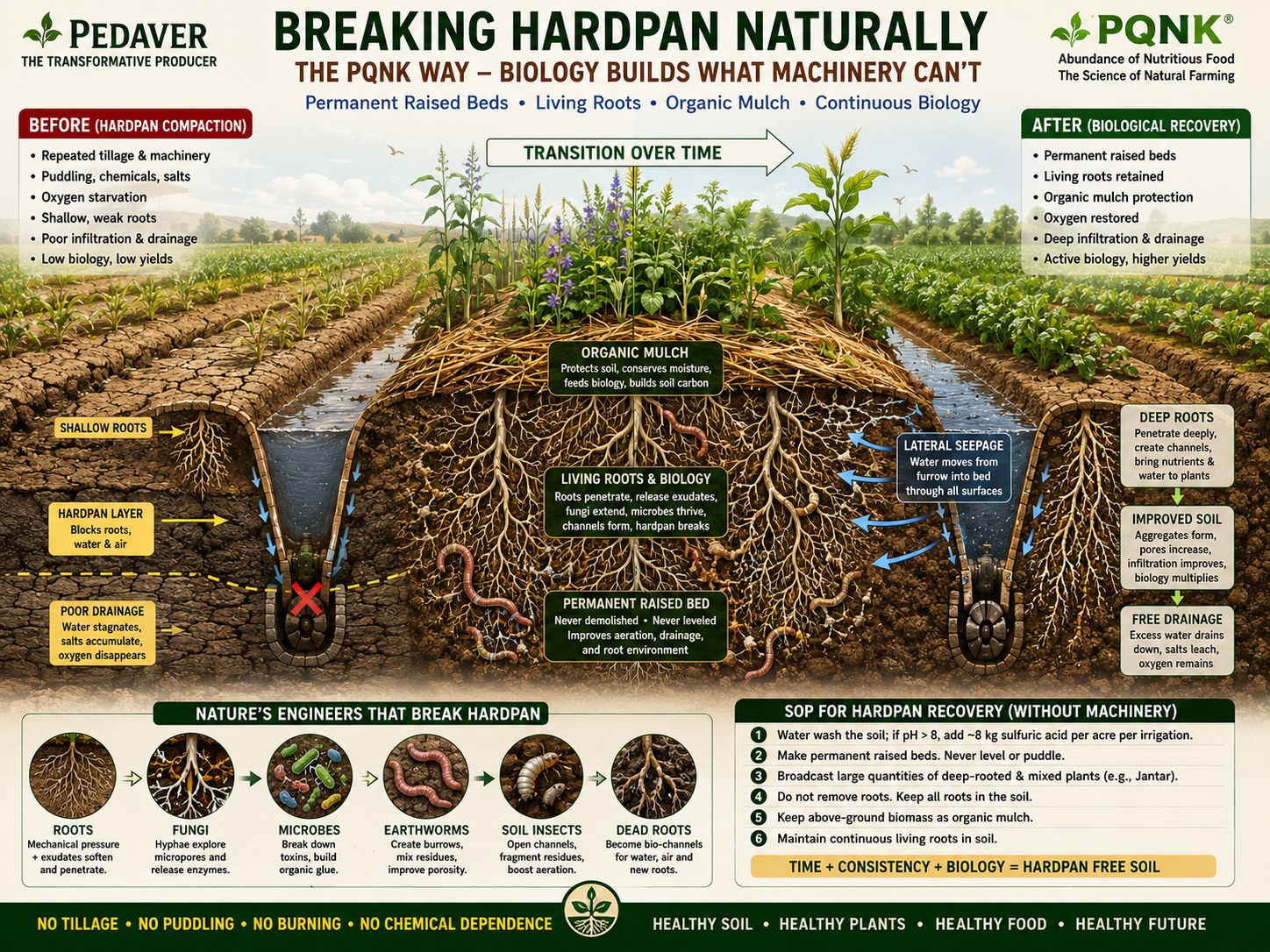
PQNK Biological Recovery SOP for Small Farmers
Introduction
Under PQNK understanding, hardpan is not merely a compacted soil layer. It is the physical expression of long-term biological collapse caused by repeated tillage, machinery pressure, flood irrigation, oxygen deprivation, salt accumulation, and destruction of continuous root systems.
Conventional agriculture attempts to solve hardpan mechanically while continuing the same practices that recreate it again. PQNK approaches the issue differently.
PQNK recognizes that natural ecosystems built deep porous soils for millions of years without machinery. Forests, grasslands, and natural vegetation continuously fracture soil biologically through roots, microbes, fungi, insects, moisture cycles, and organic matter accumulation.
Therefore, the central PQNK question is not whether biology can break hardpan.
The real question is whether agricultural management allows biology to function continuously.
Understanding Hardpan in PQNK
Hardpan develops when soil loses its biological structure.
Repeated tillage destroys aggregates and fungal networks. Heavy machinery compresses soil particles into dense layers. Flood irrigation removes oxygen from the root zone. Chemical salts accumulate. Root systems remain shallow. Soil life weakens progressively.
Eventually, water movement slows, root penetration stops, oxygen exchange declines, and the soil becomes physically and biologically disconnected.
Under these conditions:
• roots remain weak and shallow
• microbial populations collapse
• nutrient cycling slows
• water infiltration decreases
• salts accumulate near the surface
• pest pressure increases
• crops become increasingly dependent on external inputs
PQNK sees hardpan as a symptom of ecological system failure.
The PQNK Biological Recovery Principle
Nature continuously repairs soil through biology.
Roots penetrate compacted zones. Dead roots leave biological channels. Fungi stabilize aggregates. Earthworms create tunnels. Organic matter feeds microbial populations. Moisture and oxygen cycles soften the soil progressively.
However, agriculture repeatedly interrupts this natural recovery process through:
• repeated tillage
• root destruction
• burning residues
• bare soil exposure
• continuous compaction
• excess irrigation
• chemical disturbance
PQNK restores the conditions required for biological repair.
PQNK SOP for Breaking Hardpan Without Machinery
Step 1 — Correct the Chemical Environment
Where soil pH exceeds 8, PQNK recommends deep irrigation combined with approximately 8 kg sulfuric acid per acre irrigation cycle.
This process:
• separates ion clusters
• improves salt leaching
• unlocks bound nutrients
• improves infiltration
• reduces chemical hostility to roots and microbes
The objective is not crop feeding.
The objective is restoration of a biologically functional soil environment.
Without this correction, biological recovery remains slow because roots and microorganisms continue operating under chemically hostile conditions.
Step 2 — Establish Permanent Raised Beds Immediately
Even where subsoiling is not possible, PQNK recommends immediate establishment of permanent raised beds.
The beds should never again be leveled or repeatedly tilled.
Raised beds immediately improve:
• oxygen availability
• deep infiltration
• root respiration
• lateral water movement
• microbial activity
• surface stability
The raised bed itself becomes a biological rehabilitation zone.
Even over existing hardpan, the physical conditions above the compacted layer improve significantly.
Step 3 — Broadcast Massive Root Biomass
This is one of the most important steps in biological hardpan recovery.
PQNK recommends broadcasting large quantities of mixed rooting species, especially deep-rooted biological covers such as Jantar (Sesbania).
Different plants attack different soil zones.
Some roots penetrate vertically. Others create dense fibrous pore systems. Some release biological compounds that stimulate microbial and fungal activity. Others improve oxygen transport into deeper layers.
The purpose is not simply biomass production.
The purpose is underground biological engineering.
Step 4 — Retain All Roots Inside the Soil
PQNK considers root retention absolutely essential.
After crop termination:
• roots must remain in the soil
• the field must not be plowed
• roots must not be uprooted
Dead roots become:
• biological drilling channels
• water infiltration pathways
• oxygen exchange tunnels
• fungal highways
• carbon reservoirs
Future roots progressively follow these biological pathways deeper into the soil profile.
This is how biology slowly fractures compacted layers permanently.
Step 5 — Maintain Continuous Organic Mulch
Above-ground biomass should remain on the soil surface as organic mulch.
Mulch:
• protects the soil surface
• reduces temperature extremes
• stabilizes moisture
• prevents crust formation
• feeds microbial populations
• protects aggregates
• supports fungal development
Bare soil recreates compaction.
Protected soil gradually softens biologically.
Step 6 — Maintain Continuous Living Roots
PQNK sees living roots as the heartbeat of soil recovery.
Even between cash crops, the soil should remain biologically active through:
• cover crops
• volunteer vegetation
• relay cropping
• mixed biological covers
Without living roots:
• microbial populations collapse again
• aggregates weaken
• biological channels close
• soil structure deteriorates
Continuous living roots maintain continuous biological activity.
Can Biology Truly Break Hardpan?
PQNK understanding says yes.
Natural ecosystems prove this continuously.
Forests penetrate rock without machinery. Grasslands create deep porous soil profiles without tillage. Tree roots penetrate geological layers. Natural ecosystems continuously improve soil structure biologically.
The issue is not biological capability.
The issue is agricultural interruption.
If biological systems are protected continuously:
• roots deepen progressively
• aggregates stabilize
• infiltration improves
• oxygen exchange increases
• water storage improves
• biological diversity returns
Over time, the hardpan weakens naturally.
SOP When Hardpan Cannot Be Broken Initially
PQNK recognizes that many small farmers cannot mechanically break hardpan during transition.
In such cases, the system should still begin immediately rather than waiting for ideal conditions.
Delayed transition only prolongs:
• soil degradation
• chemical dependence
• biological collapse
• rising production costs
Begin Raised Beds Anyway
Even over existing hardpan, permanent raised beds immediately improve the upper root environment.
Benefits begin immediately:
• improved aeration
• reduced waterlogging
• better root respiration
• improved biological activity
• improved infiltration
The soil system begins recovering from the surface downward.
Reduce Irrigation Volume
Hardpan restricts infiltration.
Therefore PQNK recommends Soil Moisture Management (SMM) rather than saturation irrigation.
Avoid:
• standing water
• prolonged flooding
• excessive irrigation
• oxygen starvation
Instead:
• apply smaller irrigation volumes
• maintain balanced moisture
• encourage oxygen movement
• allow lateral seepage into beds
Excess water weakens biological recovery.
Use Root-Driven Biological Fracturing
During the first transition cycles, biological root systems become the primary soil-opening mechanism.
Before prioritizing maximum yields, priority should be given to:
• aggressive rooting covers
• deep-rooted legumes
• Jantar
• mixed rooting species
The first mission is ecological recovery.
Yield stability follows biological stability.
Transitional Crop Performance
Major regional cash crops such as wheat, pulses, and cotton can still be grown during biological recovery.
However, initial expectations must remain realistic because the soil system is still partially disconnected.
Hardpan causes:
• shallow rooting
• poor oxygen movement
• unstable moisture
• reduced microbial exchange
• poor nutrient access
• increased stress pressure
The problem is not lack of minerals in the soil.
The problem is interruption of the biological delivery system.
Wheat Under Transitional Recovery
Wheat adapts relatively well during early PQNK transition because its fibrous roots help:
• stabilize aggregates
• create biological pores
• support microbial activity
• improve surface structure
Five-row wheat on permanent raised beds progressively strengthens biological soil architecture.
Pulses Under Transitional Recovery
Pulses are highly valuable transitional crops.
They:
• stimulate biological activity
• improve aggregation
• support microbial partnerships
• contribute biological nitrogen cycling
• help fracture compacted layers progressively
Deep-rooted pulses accelerate biological recovery.
Cotton Under Transitional Recovery
Cotton strongly benefits from deep porous soil.
Under hardpan conditions:
• roots remain restricted
• salts accumulate more easily
• moisture imbalance increases
• stress pressure rises
• insect pressure increases
However, under permanent raised beds with continuous mulch and biological recovery, cotton performance progressively improves as rooting depth expands season after season.
The Long-Term PQNK Outcome
Mechanical subsoiling is fast biological assistance.
Biological recovery is slower initially but more permanent when the system remains undisturbed.
If permanent raised beds are maintained continuously:
• roots deepen each season
• aggregates stabilize
• oxygen movement improves
• infiltration increases
• soil biology expands
• moisture becomes balanced
• nutrient cycling strengthens
Eventually, biology itself becomes the subsoiler.
This is how natural ecosystems built deep living soils for millions of years without machinery.
Final PQNK Principle
Do not wait for perfect conditions to begin transition.
If machinery is unavailable:
• establish permanent raised beds immediately
• correct hostile chemistry where required
• grow aggressive biological root systems
• retain all roots in the soil
• maintain continuous organic mulch
• never demolish the beds
• maintain continuous living biology
Then nature itself progressively repairs the soil.
Under PQNK understanding, soil recovery is not driven primarily by machinery.
It is driven by continuous ecological function.
And when ecological function is protected continuously, biology gradually breaks the hardpan permanently.
Footnote:
Applying PQNK without understanding nature’s operating system will not deliver abundance, stability, or nutrient density.
PQNK (pronounced “picnic”)—the regenerative & sustainable Pristine Organic Farming System —is grounded in Natural Ecosystem Science. This science employs perennial biodiversity, protects soil with organic mulch, and avoids practices such as water inundation, tillage disturbance, and leaving soil bare.
It is the process that matters most. PQNK is a pristine production system designed not merely for yield, but for optimal, balanced output—where quality, sustainability, and ecological harmony emerge from a self‑regulated, zero‑external‑input methodology.
About This Paper
- Crop
- Wheat · Pulses (crop group) · Cotton
- Problem
- Hardpan · Soil Compaction (General) · Saline / Alkaline / High-pH Soil
- Science
- Soil · Transition
- Evidence
- Scientific Mechanism
- Authority
- Current / Approved PQNK Knowledge
Related PQNK Science
Key Takeaways
- Treats hardpan as a symptom of interrupted biological function, arguing forests and grasslands built deep porous soils for millions of years with no machinery at all.
- The six-step machinery-free SOP: correct hostile chemistry (8 kg sulfuric acid per acre only if pH exceeds 8), build permanent raised beds immediately, broadcast massive mixed root biomass like Jantar, retain all roots after harvest, maintain continuous mulch, and keep living roots in the ground between cash crops.
- Recommends beginning permanent raised beds even directly over unbroken hardpan, since upper-zone aeration and drainage improve immediately regardless of the pan below.
- Introduces Soil Moisture Management (SMM), smaller, more frequent irrigation rather than saturation, as the correct response to hardpan-restricted drainage during transition.
- Gives explicit, crop-specific transitional guidance: wheat's fibrous roots adapt relatively well early on, pulses are the most valuable transitional crop for accelerating recovery, and cotton initially struggles but improves season over season as rooting depth expands.
- Closing principle: 'eventually, biology itself becomes the subsoiler,' with mechanical subsoiling framed as fast assistance and biological recovery as the slower but more permanent path.
Related Knowledge
same problem
Chilli Production Under PQNK (PICNIC)
Chilli is biologically perennial and can remain productive for over a decade, but conventional short-cycle, urea-dependent management collapses that potential into a pest-prone annual grind. This paper shows how PQNK's soil-conversion framework and a single apical-pinching intervention restore chilli to a low-cost, high-density perennial crop, validated on a Hafizabad farm.
same problem
Can High-TDS Water Be Used to Rehabilitate Saline Soils?
Conventional guidelines flag groundwater above 1,000-1,500 ppm TDS as unsuitable for irrigation, pushing farmers to abandon productive land. This paper argues the real determinant isn't the water's salt concentration but the soil's physical and biological capacity to keep those salts moving instead of accumulating in the root zone, backed by a crop-by-crop salt-load data table.
same problem
Knowledge Paper: PQNK Rose Production
Cut-flower rose production is reframed as a closed-loop perennial system under PQNK, reaching a striking 8,712 plants per acre on twin-row permanent beds, with weeds treated as mulch, alfalfa grown as living nitrogen-fixing ground cover, and strict soil-moisture management replacing scheduled irrigation.
same problem
Wheat Growing Checklist, Duly Vetted by Dr. Asif Sharif
A dense, numbered field checklist distilled from PQNK wheat lectures, covering land preparation, wheat spacing (revised to 5 rows on 42-inch beds at 8-inch spacing, about 62,000 hills per acre), tiller and grain-count benchmarks against conventional wheat, and a national-yield comparison projecting up to 136 maunds per acre against Pakistan's 28-maund average.