

KP-069 · Crop-Specific Guides
Scientific Note: Agroforestry Species Selection under the PQNK Model
Asked why environmentalists condemn Eucalyptus as a water-guzzling, soil-degrading species while farmers keep planting it anyway, this note argues both camps are observing an effect of dead soil, not a property of the tree. It contends that under PQNK's restored soil biology, Eucalyptus behaves like any other well-nourished plant.
Read or listen to the full paper ↓Abstract
The note opens with a farmer's pointed question: environmentalists widely discourage Eucalyptus for excessive water use and soil degradation, yet farmers keep planting it anyway for its fast growth and income. Its answer starts from a first principle it says is commonly misunderstood, plants do not fix nitrogen or create nutrients themselves; all nitrogen fixation is done by soil microbes, and all minerals already exist in the soil's geological reserves, so plant behavior is a response to biological soil condition, not an inherent property of the species.
Applied to Eucalyptus specifically, the paper reframes the accusations against it as effects rather than causes: in degraded, saline, high-pH soils where nutrients are chemically present but biologically locked up and microbial activity is low, any fast-growing, nutrient-demanding species, Eucalyptus included, must transpire more water to pull in the diffuse, weakly available nutrients it needs, a response commonly misread as inherent 'water greed' rather than as a symptom of the soil it was planted into.
Under PQNK-managed soil, the paper argues, this dynamic changes entirely: fully restored microbial populations fix atmospheric nitrogen, solubilize and chelate minerals efficiently, and deliver nutrients to roots at the concentration needed, meeting even a demanding species' nutrient requirement without forcing excess transpiration, so that Eucalyptus in living soil behaves like an ecologically neutral, ordinary plant rather than the aggressive water consumer it becomes on degraded ground.
It resolves the apparent disagreement between environmentalists and farmers with a simple table of perspectives: environmentalists observe water stress and poor understory because they are looking at Eucalyptus planted at scale on dead soils; farmers observe fast growth and income because the tree is exploiting whatever geology is available to it; PQNK observes neutral behavior because soil biology, not species choice, is what actually regulates plant demand.
The note's stated position is that no species is inherently harmful and that soil condition, not ideology, should govern species selection, prioritizing species that actively accelerate soil biological recovery (deep-rooted biomass producers, high root-exudation species, continuous organic matter contributors) as primary choices, while treating Eucalyptus as acceptable once soil life is already established, closing on the principle that soil autonomy must precede plant selection, not follow it.
Full Paper
If you use “Listen”, the text of the page may be sent to your browser or operating system’s speech provider, such as Apple, Google or Microsoft, depending on the voice your device uses. Pedaver does not process, transmit or store any audio.
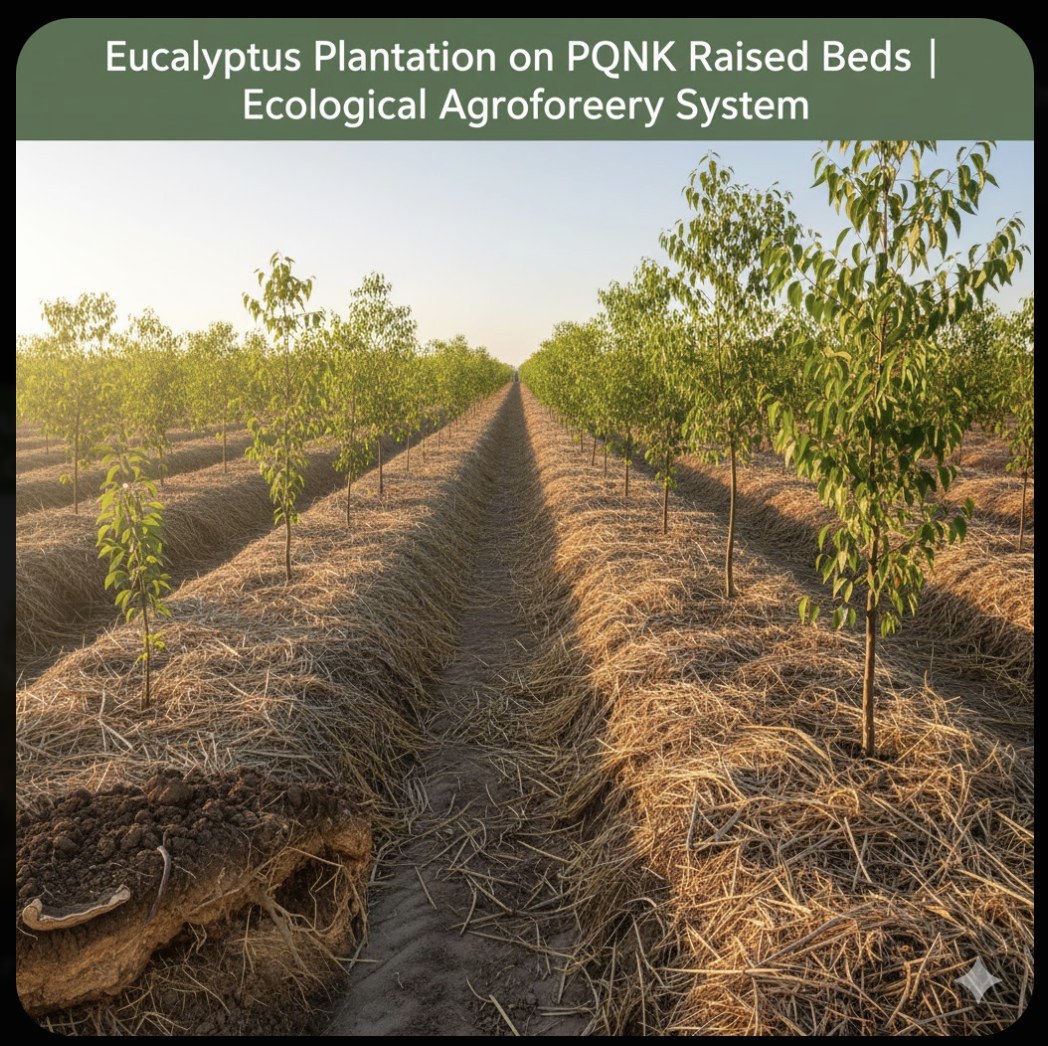
PQNK First Principle: Soil Life Is the Engine
Under Paedar Qudratti Nizam Kashatqari (PQNK), it is essential to correct a common misconception:
Plants do not fix nitrogen, nor do they create nutrients. All nitrogen is fixed by soil microbes, and all minerals already exist in the soil’s geological band. Plants merely access what soil life makes available.
Therefore, plant behavior is a response to soil biological condition, not an inherent property of the species.
Reframing Eucalyptus: Cause vs Effect
Eucalyptus is often accused of:
Excessive water use
Soil degradation
Ecological harm
These observations are effects of biologically dead soils, not causes.
In degraded, saline, high-pH soils:
Nutrients are chemically present but biologically locked
Microbial activity is low
Nutrient concentration in soil solution is weak
Plants must transpire more water to meet nutritional demand
Eucalyptus, being fast-growing and nutrient-demanding, responds by increasing transpiration. This is frequently misinterpreted as “water greed.”
What Changes under PQNK Soils
In PQNK-managed soils:
Soil microbial populations are fully restored
Atmospheric nitrogen is fixed biologically
Minerals are microbially solubilized and chelated
Nutrients are delivered efficiently to roots
Even under ultra-dense planting, nutrient demand is met
As a result:
Eucalyptus behaves like a normal plant—no excessive transpiration, no ecological stress, no soil degradation.
Thus, Eucalyptus does not damage good soil; bad soil forces abnormal plant behavior.
Why Environmentalists and Farmers See Different Outcomes

| Perspective | What They Observe | Why |
|---|---|---|
| Environmentalists | Water stress, poor understory | Eucalyptus planted on dead soils at large scale |
| Farmers | Fast growth, income | Tree exploits available geology |
| PQNK | Neutral behavior | Soil biology regulates plant demand |
PQNK Position on Agroforestry Species
Under PQNK:
No species is inherently harmful
Soil condition governs outcomes
Trees are evaluated by how they interact with soil life, not ideology
That said, PQNK prioritizes species that actively accelerate soil biological recovery, such as:
Deep-rooted biomass producers
High root exudation species
Continuous organic matter contributors
Eucalyptus:
Is not a primary soil-regenerating species
Can be included after soil life is established
Performs normally within a biologically complete system
Key Message for Farmers
Do not judge a tree by its behavior on dead soil. Restore soil life first—and the plant will regulate itself.
PQNK does not oppose Eucalyptus. PQNK opposes planting any species without restoring the soil ecosystem.
Conclusion
Nitrogen is fixed by microbes, not plants
Minerals are geologically abundant but biologically unlocked
Soil life—not species choice—determines sustainability
Under PQNK, even Eucalyptus becomes ecologically neutral
Soil autonomy precedes plant selection.
—————————
Footnote: PQNK (pronounced 'picnic')—the regenerative & sustainable Pristine Organic Farming System—is grounded in Natural Ecosystem Science. This science employs perennial biodiversity, protects soil with organic mulch, and avoids practices like water inundation, tillage disturbance, and leaving soil bare.
www.Facebook.Com/Pedaver
https://www.youtube.com/@pedaverpqnk3167/videos
pedaver@gmail.com
WhatsApp +92 320 677 6666
About This Paper
- Crop
- Eucalyptus
- Problem
- High Crop Water Demand · General Soil Fertility / Land Degradation · Excess Vegetative Growth (at expense of yield/flowering)
- Science
- Soil · Plants · Biodiversity
- Evidence
- Philosophical/Framework Argument
- Authority
- Current / Approved PQNK Knowledge
Related PQNK Science
Key Takeaways
- Argues Eucalyptus's reputation for excessive water use and soil degradation is an effect of the degraded soil it is typically planted into, not an inherent property of the species.
- Reframes the core mechanism: plants do not fix nitrogen or create nutrients themselves; that is entirely the work of soil microbes, so plant behavior tracks soil biological condition.
- Argues fast-growing, nutrient-demanding species over-transpire specifically when soil nutrients are chemically present but biologically locked up, not because of the species' inherent character.
- Resolves the environmentalist-versus-farmer disagreement over Eucalyptus by attributing both observations to different soil contexts rather than to contradictory facts about the tree.
- PQNK's stated position: no species is inherently harmful; soil condition, not ideology, should govern agroforestry species selection.
- Prioritizes deep-rooted, high-exudation, soil-regenerating species as primary agroforestry choices, with more demanding species like Eucalyptus reserved for once soil life is already established.
Related Crops
Related Knowledge
same problem
Why Only 4 kg of NP During PQNK Transition?
Answers a transitioning farmer's question, why is PQNK's transitional dose only about 4 kg of NP per acre, by tracing how a plant actually feeds through a water-based soil solution shaped by transpiration, mass flow and diffusion rather than by counting fertilizer bags, and by drawing a precise distinction between over-irrigation and waterlogging that explains why excess soluble nitrogen produces lush, delayed, insect-prone growth.
same problem
Modern (Green Revolution) Semi-Dwarf Wheat vs. Heirloom and Ancient Wheat Varieties
A critical review of the popular claim that Green Revolution semi-dwarf wheat is inherently more harmful than heirloom varieties. Applying the PQNK lens, the paper argues the farming system, not just the genetics, is the overlooked variable driving gluten-related health concerns, and that soil biology can meaningfully change a grain's nutritional and digestive profile regardless of variety.
same problem
Factsheet: Commercial Bamboo Plantation Under PQNK
Bamboo behaves as a 'soil engine' under PQNK: a no-till, hardpan-broken planting of 726 plants per acre that needs no synthetic inputs, sequesters carbon, and stays productive for 60-100 years once established. This factsheet lays out species selection, the four-phase establishment protocol, and the water, nutrient, and weed management rules that keep the system self-sustaining.
same problem
The Weeds as Soil Physicians: A PQNK Diagnostic Guide to Soil Health in the Punjab Region
This regional diagnostic guide teaches Punjab farmers to read specific weed combinations, not single species, as a whole-field soil diagnosis, then prescribes a 'principle of substitution': replacing each wild pioneer weed with a cultivated crop that performs the identical remediation function while also producing a yield.