

KP-190 · Workforce & Practice Advisories
Why Only 4 kg of NP During PQNK Transition?
Answers a transitioning farmer's question, why is PQNK's transitional dose only about 4 kg of NP per acre, by tracing how a plant actually feeds through a water-based soil solution shaped by transpiration, mass flow and diffusion rather than by counting fertilizer bags, and by drawing a precise distinction between over-irrigation and waterlogging that explains why excess soluble nitrogen produces lush, delayed, insect-prone growth.
Read or listen to the full paper ↓Abstract
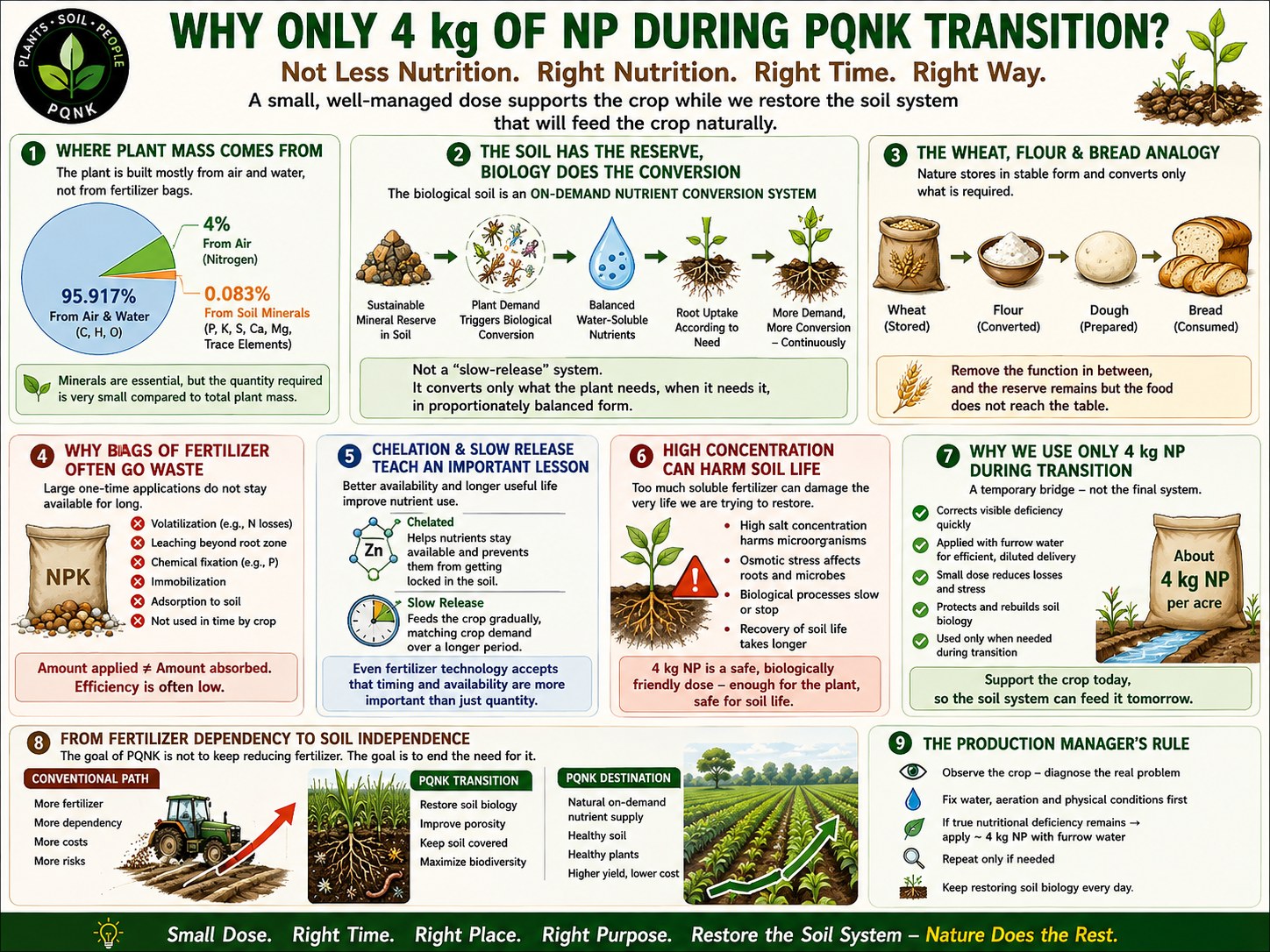
A farmer transitioning to PQNK asked a reasonable question: if conventional agriculture recommends bags of fertilizer per acre, how can roughly 4 kg of NP possibly be enough? The paper's answer starts with plant mass composition: approximately 95.917% of a plant's body is built from carbon, hydrogen and oxygen sourced from air and water, roughly 4% is nitrogen ultimately traceable to atmospheric sources, and only about 0.083% represents mineral elements drawn from the soil's geological reserve. But the paper pushes past that figure to the real questions: in what form can a root actually absorb a nutrient, how does that nutrient reach the root, and what role does water play in that journey?
The answer runs through a water-based soil solution. Roots do not eat soil; most mineral nutrients cross root membranes as ions dissolved in the water surrounding the root, delivered mainly by mass flow (carried along with moving soil water) and diffusion (movement along a concentration gradient created as roots remove nearby nutrients), with mycorrhizal fungi extending the effective acquisition network for immobile nutrients like phosphorus. A functioning biological soil is described as an on-demand nutrient-conversion and acquisition system, continuously coupling plant demand to root-microbial interaction, in contrast to a fertilizer bag, which introduces a large nutrient quantity from outside the system at one time: fertilizer applied is not fertilizer available is not nutrient absorbed, since nitrogen can volatilize, leach or become immobilized and phosphorus can fix into less available forms before the crop ever uses it.
The paper adds a substantially deeper physiological layer on transpiration and irrigation. Transpiration serves several interconnected functions, temperature regulation, gas exchange, water transport and nutrient mass-flow, constrained by leaf area, stomatal conductance and the physical environment rather than driven by nutrient demand alone; the paper explicitly flags as an untested hypothesis, not settled science, the idea that a dilute soil solution causes a plant to expand leaf area specifically to transpire more and acquire more minerals. It then draws a precise distinction the earlier edition did not: over-irrigation and waterlogging are not the same condition. Over-irrigation can coexist with vigorous vegetative growth as the root zone cycles through excess moisture toward a favorable window, while persistent waterlogging restricts oxygen diffusion long enough to impair root respiration and eventually suppress growth altogether.
This physiology reframes the paper's treatment of nitrogen and the 4 kg NP dose itself. Nitrogen is a special case: plants can absorb it beyond immediate need in a pattern plant science calls luxury consumption, and nitrate itself acts as a signaling molecule affecting root architecture and leaf development, which is why excess soluble nitrogen tends to produce larger leaves, denser canopies, delayed maturity and, per PQNK field observation, greater susceptibility to sucking insects, even though root uptake remains physiologically regulated throughout. NPK correcting a macronutrient shortfall is also explicitly not the same as complete nutrition. Against that backdrop, the roughly 4 kg NP per acre dose is reaffirmed as a temporary, furrow-delivered corrective bridge, not a fertilizer programme, with the paper's real destination named directly: Soil Moisture Management, keeping the soil's continuous mineral-reserve-to-root continuum functioning so that routine fertilizer intervention becomes unnecessary.
Full Paper
If you use “Listen”, the text of the page may be sent to your browser or operating system’s speech provider, such as Apple, Google or Microsoft, depending on the voice your device uses. Pedaver does not process, transmit or store any audio.
The Farmer's Question
A farmer transitioning from conventional agriculture to PQNK asked a very reasonable question:
If conventional agriculture recommends bags of fertilizer per acre, how can only about 4 kg of NP be used when a crop shows deficiency during PQNK transition?
The apparent contradiction comes from the way modern agriculture has taught us to think about plant nutrition. We normally measure what enters the field: kilograms of nitrogen, phosphorus and potassium applied per acre. But the plant does not consume fertilizer bags. It absorbs particular nutrient ions, in particular quantities, at particular stages of its development.
The real questions are therefore different:
How much mineral matter does a plant actually require? In what form can the root absorb it? How does that nutrient reach the root? What role does water play? What determines how much nutrient enters the plant? And what happens when we artificially place a large concentration of soluble fertilizer into this naturally regulated system?
To understand why PQNK uses only a small corrective NP intervention during transition, we must first understand how a plant actually feeds.
1. Most of the Plant Does Not Come From the Soil
A plant does not build most of its body from fertilizer, nor even from soil minerals.
In the PQNK plant-mass framework, approximately 95.917% of plant mass is represented by carbon, hydrogen and oxygen originating from air and water. Approximately 4% is nitrogen, which in the natural ecosystem ultimately originates from atmospheric nitrogen through biological processes. The remaining approximately 0.083% represents the other mineral elements derived from the geological soil reserve.
These proportions must not be misunderstood.
The small mass of mineral elements does not mean that minerals are unimportant. Phosphorus, potassium, calcium, magnesium, sulfur, iron, zinc, manganese, boron, copper, molybdenum and other essential elements perform indispensable biological functions.
A very small quantity can be essential to an enormous biological process.
The point is simply that the physical body of a crop is not principally constructed from bags of fertilizer. The overwhelming majority of its mass originates from atmosphere and water.
PQNK therefore distinguishes importance from quantity.
2. The Soil Is a Mineral Reserve, Not an Empty Container
Natural soil contains a geological reserve of mineral elements. But presence in the soil does not automatically mean availability to the plant.
A nutrient may be abundant in the soil and nevertheless be unavailable to the root because it exists in a mineral, adsorbed, precipitated, organic or otherwise inaccessible form.
This creates the first essential distinction:
Total nutrient in soil is not the same as plant-available nutrient.
The challenge of natural plant nutrition is therefore not simply to possess minerals. It is to continuously make the required fraction accessible to the living root.
That is where biology enters the system.
3. The Biological Pathway
Plants do not operate independently of the organisms surrounding their roots.
Roots release carbon compounds and other substances into the rhizosphere. Bacteria, fungi and other organisms interact with roots, organic matter and mineral surfaces. Mycorrhizal fungi extend the nutrient-acquiring network beyond the physical root.
Through these biological and biochemical relationships, nutrients can be mineralized, solubilized, mobilized, exchanged and made accessible in plant-available forms.
The simplified pathway is:
Geological and biological reserve → root–microbial interaction → nutrient mobilization/conversion → plant-available ions → soil solution → root acquisition.
This is why saying that "microbes bring food to the plant" is useful only as a very rough analogy.
The actual system is much more sophisticated.
Biology participates in converting and accessing nutrients. Water provides the medium in which dissolved ions move. Roots then regulate their entry into the plant.
PQNK therefore describes a functioning soil as an on-demand biological nutrient-conversion and acquisition system.
This does not mean that microorganisms manufacture an exact measured dose every second like an electronic fertilizer injector. Biology responds to plant roots and environmental conditions, but it is also governed by moisture, temperature, oxygen, substrates and the composition of the biological community.
The essential distinction is that natural nutrient supply is continuously coupled to a living plant–soil system rather than being imposed as a large soluble dose according to a fertilizer calendar.
4. The Chemical Pathway: What Happens When We Apply a Fertilizer Bag?
Conventional agriculture often reaches the plant through another route.
Suppose a farmer applies urea, NP, DAP or NPK.
After dissolution and chemical transformation, part of that fertilizer contributes soluble nutrient ions to the soil solution.
The root does not know that the nitrate originated from a fertilizer factory. Once nitrate is present at the root surface, the plant deals with the ion through its physiological transport mechanisms.
But there is a fundamental difference in how the nutrient arrived there.
The biological pathway begins with the soil reserve and living conversion/access processes operating continuously around plant demand.
A fertilizer bag introduces a comparatively large nutrient quantity from outside the system, often at one time.
The farmer may therefore suddenly change the concentration and balance of the soil solution far beyond what existed immediately before application.
And the entire fertilizer quantity does not wait patiently beside the root until the plant requires it.
Nitrogen can undergo leaching, gaseous losses, immobilization and transformations. Phosphorus can react with soil constituents and become less immediately available. Other ions may be adsorbed, precipitated, immobilized, leached or otherwise redistributed.
Therefore:
Fertilizer applied ≠ fertilizer available ≠ nutrient absorbed.
This is one of the fundamental errors created by measuring crop nutrition in bags per acre.
5. Plants Take Mineral Nutrients From a Water-Based Soil Solution
This is perhaps the most important missing link in farmers' understanding of plant nutrition.
Roots do not eat soil.
They do not swallow mineral particles.
Most mineral nutrients ultimately cross living root membranes as ions from the aqueous environment surrounding the root.
Nitrate, ammonium, phosphate, potassium, calcium, magnesium, sulfate and micronutrients enter through highly regulated physiological pathways.
Water is therefore not separate from plant nutrition.
It is part of the nutrient-delivery environment.
Nutrients reach roots by several mechanisms. Some mobile nutrients are carried toward the root with moving soil water through mass flow. Others move importantly through diffusion, responding to concentration gradients created as roots remove nutrients from their immediate surroundings. Root growth and root hairs bring the absorbing surface into contact with additional soil, while mycorrhizal fungi can extend the effective acquisition network.
For mobile nutrients, the principle can be understood very simply:
Water movement × nutrient concentration influences the nutrient quantity delivered toward the root by mass flow.
This immediately changes the way we should think about irrigation.
6. The Two Litres of Water Example
Imagine, only for explanation, that under a particular environment a plant transpires two litres of water during a day.
Those two litres cannot be considered independently of the nutrient environment through which the plant is operating.
If the soil solution associated with water movement toward the root contains an appropriate concentration of a mobile nutrient, a certain nutrient quantity can arrive at the root surface.
If the concentration is substantially lower, the same volume of water carries a smaller quantity of that nutrient by mass flow.
This does not mean every nutrient behaves identically. Phosphorus, for example, is relatively immobile and relies heavily on short-distance diffusion, root exploration and biological/mycorrhizal access.
But the principle is fundamental:
The quantity of water moving through the soil–plant system and the concentration of nutrients in that water cannot always be considered separately.
This helps explain why simply saying "the crop has plenty of water" tells us very little about its nutritional condition.
7. The Plant Cannot Transpire Any Quantity It Wishes
Transpiration is not controlled by nutrient demand alone.
It is constrained by the physical environment and the plant itself.
Leaf surface area, stomatal conductance, ambient temperature, relative humidity, solar radiation, wind and the water available to the roots all influence transpiration.
This qualification is extremely important.
Research showing that plants can modify stomatal conductance and transpiration in relation to nutrient availability does not mean nutrient demand always controls transpiration.
Consider a crop facing an ambient temperature above 45°C.
The immediate biological problem may be survival.
Where adequate water is available and stomata can remain sufficiently open, evaporation from leaves provides powerful cooling. The plant may therefore maintain high transpiration because it must prevent damaging leaf temperatures, regardless of whether it presently requires additional mineral nutrients.
Under another environment, high temperature combined with inadequate soil water can force stomatal closure, reduce transpiration and remove this cooling mechanism.
Therefore transpiration serves several interconnected functions:
temperature regulation, gas exchange, water transport, internal solute transport and contribution to nutrient movement toward the root.
No single one of these should be treated as its universal controlling purpose.
8. Leaf Area, Transpiration and Resource Acquisition
Leaf area now becomes important.
Under the same atmospheric conditions, a larger functional canopy can potentially provide a greater total transpiring surface than a smaller canopy.
Plants also alter their architecture and allocation of biomass according to their resource environment. Roots, shoots, leaves, reproductive organs and storage tissues compete for the products of photosynthesis.
Nutrient availability participates in regulating these developmental decisions.
This gives us a useful physiological framework for interpreting an observation familiar to farmers: crops under certain high-moisture and nutrient conditions can invest heavily in vegetative growth.
But scientific discipline is necessary here.
We should not claim that whenever the soil solution becomes dilute, the plant deliberately says, in effect, "I need more nutrients, therefore I will manufacture more leaves so that I can transpire more water."
Plant responses are not that simple, and severe nutrient deficiency normally restricts growth rather than producing unlimited leaf area.
What we can say is that:
water availability, nutrient availability, leaf area, root architecture, stomatal behavior, transpiration and biomass allocation form an interconnected physiological system.
The balance among them influences whether resources are directed predominantly toward vegetative growth, reproductive development, storage or survival.
9. Flood Irrigation Is Not the Same as Waterlogging
This distinction is critical.
Immediately after conventional flood irrigation, a large proportion of soil pore space may become occupied by water.
But in a reasonably aerated soil this condition does not necessarily remain permanent.
Water subsequently infiltrates deeper, is absorbed by roots and is lost from the surface through evaporation. Air progressively returns to pore spaces.
The root zone therefore moves through a sequence:
excessive moisture → improving water–air relationship → favorable moisture/aeration window → progressive drying → moisture stress → next irrigation.
The crop may spend only part of the irrigation interval in the favorable zone.
This is particularly relevant where irrigation is governed by a rotational canal-water schedule. The farmer may receive water according to land entitlement and a weekly turn rather than according to the actual moisture condition of the root zone.
The availability of irrigation water can therefore determine when irrigation occurs, even when plant and soil demand should be making that decision.
This is fundamentally different from Soil Moisture Management.
10. Over-Irrigation and Waterlogging Must Not Be Confused
Over-irrigation can create a temporarily excessively wet root zone without producing persistent waterlogging.
During this period, the proportions of water and air in the pore system change. Soil-solution concentrations and nutrient distributions can also change as water enters and moves through the profile.
The crop may continue growing vigorously and, under some combinations of moisture, temperature and nitrogen availability, may show strong vegetative growth.
Waterlogging is the more severe and persistent condition.
When excessive soil water persists sufficiently to restrict oxygen diffusion for an extended period, root respiration suffers. Energy-dependent membrane processes are impaired. Root hydraulic and nutrient-acquisition functions deteriorate. Anaerobic processes become increasingly important.
Eventually plant growth is suppressed rather than stimulated.
We should therefore never use the two conditions interchangeably:
Over-irrigation can coexist with vigorous vegetative growth.
Persistent waterlogging eventually suppresses plant growth.
Duration, infiltration, soil structure, temperature and crop tolerance determine where one condition develops into the other.
11. The Soil Solution Is Continuously Changing
Flood irrigation does more than change soil moisture.
It changes the environment in which nutrient acquisition occurs.
When a large volume of relatively low-solute irrigation water enters the root zone, concentrations and spatial distributions of soluble nutrients can change. Mobile ions can move with that water, sometimes deeper into the profile. At the same time, exchange reactions, mineral dissolution, biological mineralization, root uptake and diffusion continually modify the solution.
Therefore "dilution" should not be understood as pouring water into a glass containing fertilizer and assuming the soil behaves identically.
Soil buffers, exchanges, transforms and replenishes ions.
Nevertheless, nutrient concentration in the soil solution matters, particularly for nutrient delivery by mass flow and diffusion.
A plant subjected repeatedly to flood-and-dry irrigation therefore experiences not merely fluctuating water availability, but a fluctuating:
water–air–nutrient–biological environment.
PQNK seeks to stabilize that environment.
12. Why Rainy Periods Can Produce Strong Vegetative Growth
Farmers commonly observe vigorous vegetative growth during favorable rainy periods.
This should not be attributed to one mechanism alone.
Rain can relieve previous moisture limitation. Warm moist soil can stimulate biological processes and nutrient mineralization. Roots can exploit a larger active soil volume. Nutrient mobility changes. Nitrogen availability may increase. Atmospheric humidity, temperature, radiation and vapor-pressure conditions also change transpiration and photosynthesis.
Where moisture and available nitrogen become abundant while reproductive limitations are present, strong vegetative growth can result.
The PQNK interpretation additionally asks us to examine the concentration and balance of the soil solution relative to water movement and plant demand.
That is a legitimate physiological question.
But we should distinguish established mechanisms from field interpretation. The proposition that dilution of the soil solution itself causes a crop to expand leaf area specifically in order to transpire additional water and thereby obtain more minerals remains a hypothesis requiring direct experimental demonstration.
PQNK should investigate that proposition rather than present it prematurely as settled plant physiology.
13. What Happens When Nutrient Concentration Is Too High?
Now consider the opposite extreme.
A large soluble fertilizer application can create temporarily high concentrations of particular ions in portions of the root zone.
More concentration does not mean unlimited uptake.
Plant roots are living selective interfaces. Membrane transport proteins regulate the acquisition of nitrate, ammonium, potassium, phosphate and other nutrients according to multiple internal and external signals.
At excessive total salt concentrations, the osmotic potential of the soil solution can also make water acquisition more difficult and can damage roots and sensitive soil organisms.
Therefore there is no biological advantage in surrounding the root with the maximum possible nutrient concentration.
The objective is appropriate and balanced availability.
14. Nitrogen Is a Special Case
Nitrogen deserves particular attention because it is required in much greater quantities than most mineral nutrients and because nitrate and ammonium have highly developed uptake, transport, assimilation and signaling systems.
Roots regulate nitrogen uptake.
That scientific fact should be stated clearly.
However, regulation does not mean that a plant always excludes all nitrogen beyond its immediate growth requirement.
Under abundant nitrogen availability, plants can take up nitrogen beyond immediate metabolic demand and store part of it, including nitrate in vacuoles. Plant science recognizes forms of this behavior as luxury consumption.
Nitrogen is also more than a structural nutrient. Nitrate itself acts as a signaling molecule affecting root architecture, leaf development and wider plant metabolism.
This provides an important scientific context for a long-standing PQNK field observation:
When externally supplied soluble nitrogen is excessive, crops frequently become excessively vegetative.
Leaves become larger and canopies denser, maturity may be delayed, reproductive balance may be disturbed, and tissues may remain lush.
The mechanism should not be described by saying that nitrogen simply "passes through the root filter." Roots regulate nitrogen uptake too.
A more accurate interpretation is that nitrogen has exceptional mobility, uptake, storage, signaling and growth-promoting roles, and abundant external nitrogen can therefore influence plant growth even though uptake remains physiologically regulated.
PQNK field observations further associate such lush nitrogen-driven crops with increased susceptibility to sucking insects. This relationship should be evaluated crop by crop rather than treated as an absolute rule, because insect response depends upon the species, plant tissue chemistry, environment and many other factors.
15. Biology and the Fertilizer Bag Therefore Behave Differently
We can now see the fundamental difference.
A functioning biological soil continuously links:
plant demand ↔ roots ↔ microorganisms ↔ mineral reserve ↔ soil solution.
It does not normally place an entire season's nutrient requirement into the root zone as one concentrated soluble dose.
A fertilizer bag does.
The issue is therefore not simply whether the molecule entering the root is "natural" or "chemical."
The important differences are:
source, concentration, timing, balance, spatial distribution and synchronization with plant demand.
This is why PQNK seeks restoration of the biological nutrient-supply system rather than merely replacing one commercial fertilizer with another input.
16. What Happens If Biology Is Not Working and Fertilizer Is Stopped?
This point is essential because PQNK must never be reduced to the slogan:
"Stop fertilizer."
Imagine a conventionally managed soil whose biological nutrient-conversion and acquisition system has been severely impaired.
Now remove fertilizer immediately.
The plant still requires nitrogen, phosphorus, potassium, sulfur, calcium, magnesium and essential micronutrients.
If the soil system cannot make sufficient nutrients available at the required time, the crop becomes deficient.
Photosynthesis falls. Root and shoot development suffer. Reproductive development can be compromised. Yield declines.
That is not successful PQNK.
It is simply an undernourished crop.
The transition must therefore restore the natural nutrient-supply machinery while protecting the crop from genuine temporary deficiency.
That is the purpose of the 4 kg NP intervention.
17. NPK Is Also Not Complete Nutrition
The opposite error is equally serious.
Supplying nitrogen, phosphorus and potassium does not mean that we have supplied complete plant nutrition.
Plants require a broad spectrum of essential elements in very different quantities and relationships.
NPK fertilizer can correct important macronutrient deficiencies and can support high biomass and yield where those nutrients are limiting.
But NPK alone cannot guarantee balanced mineral nutrition or nutrient-dense food.
This distinction matters.
A crop can be large without necessarily being nutritionally balanced.
It can be green without every physiological system operating optimally.
And high harvested weight does not by itself establish the nutritional quality of the harvested food.
PQNK therefore evaluates the functioning of the entire soil–plant system rather than treating NPK response as the definition of fertility.
18. Why Only About 4 kg of NP?
We can finally return to the farmer's original question.
The approximately 4 kg NP used during PQNK transition is not intended to provide the crop's complete seasonal mineral requirement.
It has a much narrower purpose.
When the crop visibly demonstrates genuine nutritional deficiency while the biological soil system is still recovering, a small NP dose can be introduced with furrow irrigation water.
The water distributes and dilutes the intervention through the active root environment.
The objective is:
correct the immediate deficiency without recreating the high-concentration external nutrient environment from which the soil system is being transitioned.
If the plant recovers, no additional fertilizer is required merely because a calendar says another dose is due.
If genuine deficiency remains, another limited intervention may be considered according to the PQNK transitional protocol.
The crop is observed.
The root-zone condition is diagnosed.
Water and aeration problems are corrected first.
Only then is nutritional intervention considered.
Therefore:
4 kg NP is a corrective bridge, not a fertilizer programme.
19. Why Not Apply a Bag "Just to Be Safe"?
Because "more" is not the same as "safer."
A large soluble application may exceed immediate crop demand, increase soil-solution concentration, disturb nutrient balance, expose recovering biology to unnecessary osmotic and ionic stress, and create losses before the crop ever uses the nutrients.
It can also continue the very dependency PQNK is attempting to remove.
The objective during transition is therefore not:
maximum nutrient supply.
It is:
minimum necessary intervention while maximum biological function is restored.
20. The Real Meaning of Soil Moisture Management
This discussion also reveals why Soil Moisture Management is one of the foundations of PQNK.
SMM is often misunderstood merely as an irrigation-water-saving technique.
It is much more.
Water determines whether nutrients can dissolve and move.
Air-filled pore space determines whether roots and aerobic organisms can respire effectively.
Biological activity determines whether the mineral reserve can be accessed and cycled.
Root physiology determines which ions enter.
Atmospheric conditions and leaf architecture influence transpiration.
Transpiration influences water movement and the mass-flow delivery of mobile nutrients toward roots.
These are not separate systems.
They form a continuum:
soil mineral reserve → biology → soil solution → root surface → selective uptake → xylem transport → leaf → atmosphere.
PQNK Soil Moisture Management seeks to keep that continuum functioning instead of repeatedly driving it between excessive wetness and excessive dryness.
21. From Flood-and-Dry Agriculture to a Stable Root Environment
Conventional periodic irrigation frequently asks the crop to adapt to the irrigation system.
PQNK asks the irrigation system to serve the biological requirements of the crop.
The distinction is fundamental.
The conventional cycle may be:
irrigate heavily → excessive moisture → water soaking away → favorable window → drying → stress → irrigate heavily again.
The PQNK objective is:
maintain favorable moisture while preserving the air required by the living root zone.
This is why the farmer must observe soil condition rather than irrigating simply because water has become available.
The production manager manages soil moisture, not irrigation events.
22. The Real Transition: From External Supply to Biological Function
Conventional fertilizer agriculture asks:
How much nutrient should we put into the field?
PQNK asks:
How do we restore the soil–plant system so that nutrients become available in the right form, concentration, balance, place and time?
These are fundamentally different questions.
The first makes fertilizer supply the central management operation.
The second makes biological function the central management objective.
During transition, there may still be moments when the damaged biological system cannot meet crop demand.
PQNK does not deny that reality.
It supports the crop temporarily.
But every intervention must move the field toward independence rather than establishing another permanent input schedule.
Conclusion: The Plant Does Not Need Bags. It Needs a Functioning Supply System.
The original question was:
How can 4 kg of NP replace bags of fertilizer?
The answer is now clearer:
It does not replace them.
The comparison itself is wrong.
A conventional fertilizer programme attempts to provide a substantial proportion of crop nutrition through repeated external soluble nutrient applications.
The PQNK transitional intervention has another purpose entirely.
It temporarily supports a crop while the natural nutrient-acquisition system is being rebuilt.
The deeper lesson is that plant nutrition cannot be understood by counting fertilizer bags.
The plant operates within a continuous soil–water–air–biology–root–atmosphere system.
Minerals must become accessible.
Water must be present.
Air must remain in the root zone.
Nutrients must move toward roots.
Living membranes must selectively acquire them.
The plant must transport and use them.
And the entire process must respond to changing demands for growth, reproduction, environmental adaptation and survival.
At 45°C, transpiration may become critically important for cooling.
Under another environment, transpiration-driven mass flow may contribute importantly to nutrient acquisition.
During excessive wetness, the water–air–nutrient relationship changes.
Under prolonged waterlogging, oxygen deficiency can suppress the root system.
Under excessive soluble fertilizer supply, nutrient concentration and balance can move beyond immediate crop requirement.
Under a damaged biological system with no fertilizer support, the crop can become deficient and yield can collapse.
None of these conditions can be explained by the quantity of fertilizer alone.
The destination of PQNK is therefore neither "4 kg fertilizer" nor "zero fertilizer by instruction."
It is a soil–plant ecosystem functioning so effectively that routine fertilizer intervention becomes unnecessary.
Do not measure plant nutrition by what enters the field.
Measure it by whether the plant receives balanced nutrition when it needs it, while the soil becomes increasingly capable of supplying that nutrition through its own living system.
That is why the 4 kg NP is a bridge.
The destination is not a smaller fertilizer bag. The destination is restoration of the natural nutrient-supply system.
——————————
Applying PQNK without understanding nature’s operating system will not deliver abundance, stability, or nutrient density.
PQNK (pronounced “picnic”)—the regenerative & sustainable Pristine Organic Farming System—is grounded in Natural Ecosystem Science. This science employs perennial biodiversity, protects soil with organic mulch, and avoids practices such as water inundation, tillage disturbance, and leaving soil bare.
It is the process that matters most. PQNK is a pristine production system designed not merely for yield, but for optimal, balanced output—where quality, sustainability, and ecological harmony emerge from a self‑regulated, zero‑external‑input methodology.
Connect & Resources
Pedaver.Com Facebook: www.Facebook.Com/Pedaver YouTube (PQNK): https://www.youtube.com/@pedaverpqnk3167/videos YouTube: http://www.youtube.com/@aasifsharif PDF Knowledge Papers: https://drive.google.com/drive/folders/1iadwV6mdUPyrUIpB3oRfNv6DLiackaUL?usp=sharing Email: pedaver@gmail.com WhatsApp: +92 320 677 6666
About This Paper
- Problem
- Nutrient Deficiency Symptoms (Plant-Visible) · External Input Dependency · Preventive/Prophylactic Over-Application of Inputs (Fertilizer/Nitrogen) · Nutrient Retention / Delivery Efficiency Concerns · Over-Irrigation · Waterlogging · Excess Vegetative Growth (at expense of yield/flowering)
- Science
- Soil · Nutrition · Transition · Water · Plants
- Evidence
- Scientific Mechanism
- Authority
- Current / Approved PQNK Knowledge
Related PQNK Science
Key Takeaways
- Nutrients reach roots mainly by mass flow (carried in moving soil water) and diffusion, so transpiration and soil-solution concentration jointly determine how much nutrient actually arrives at the root — not the kilograms of fertilizer applied to the field.
- Fertilizer applied is not the same as fertilizer available is not the same as nutrient absorbed: nitrogen losses (leaching, volatilization, immobilization), phosphorus fixation, and the plant's own regulated uptake all stand between a bag and the crop's actual nutrition.
- Over-irrigation and waterlogging are explicitly not the same condition: over-irrigation can coexist with vigorous vegetative growth, while persistent waterlogging cuts root-zone oxygen and eventually suppresses growth — duration and drainage determine which one develops.
- Nitrogen is a special case: plants can take up nitrogen beyond immediate need ('luxury consumption'), and nitrate itself acts as a signaling molecule affecting root architecture and leaf development, which is why excess soluble nitrogen tends to produce lush, delayed-maturity, insect-prone growth even though uptake stays physiologically regulated.
- NPK fertilizer is not complete plant nutrition: it can correct macronutrient shortfalls and drive biomass, but a large, green crop is not automatically a nutritionally balanced one.
- The roughly 4 kg NP per acre transitional dose is a corrective bridge delivered through furrow water only when a crop shows genuine deficiency, never a calendar-driven programme; the actual destination is Soil Moisture Management — restoring the continuous soil-water-air-biology-root system so routine fertilizer intervention becomes unnecessary.
Related Knowledge
same problem
Plant Nutrition Is a Living System, Not an Input Prescription: Why PQNK Restores the Nutrient-Cycling Environment Instead of Feeding the Plant Element by Element
Modern agriculture describes plant nutrition element by element: identify what the plant contains, calculate what the crop removes, replace it from a bag. This paper argues that framing mistakes an accounting exercise for a biological one. A plant's mass is built mostly from air and water, its nitrogen comes from the atmosphere through biological fixation, and the net new mineral draw on the geological reserve after recycling is very small; what determines whether a crop can acquire a nutrient is the living biological interface between mineral and root, not the total inventory in the soil. PQNK therefore restores the nutrient-cycling environment rather than writing an ever-longer fertiliser prescription: manage the habitat, and the living system manages plant nutrition.
same problem
Chemical Fertiliser Dependency Through the PQNK Lens
An evidence-qualified review of the article “Chemical Fertilizer Industry”. It keeps the article's warning about soil degradation, nutrient pollution and biological decline, disciplines its headline numbers, and argues that fertiliser dependency is a symptom of a damaged production system (tillage, flooding, bare soil and simplified biology) that PQNK removes by restoring aerated, covered, living soil, reaching zero purchased fertiliser and pesticide at maturity.
same problem
Why Unscientific "Organic" Farming Can Be Dangerous — and How PQNK Prevents It
Argues that soil health depends on oxygen, water movement, structure, and biological order, not on whether an input is labeled organic, and that common organic practices (plastic mulch, daily irrigation, sugar-based brews) push soil into an anaerobic state that can be more dangerous than chemical farming.
same problem
From Chemistry to Biology: What PQNK Really Means
Answers a practicing farmer's question, why does PQNK say agriculture is moving "from chemistry to biology" when chemical reactions clearly continue in every living soil, by distinguishing externally managed chemistry (chemistry imposed from outside through purchased inputs) from biologically regulated chemistry (chemistry organized by living roots, microorganisms and fungi), and explaining why PQNK's four principles must work together to restore that biological regulation.