

KP-010 · Crop-Specific Guides
Achieving a High-Density Kinnow Plantation through the PQNK Framework: A Comparative Analysis of Rootstock Options and Their Synergy with Regenerative Soil Ecology
High-density Kinnow planting depends on getting two decisions right together: rootstock selection and soil environment. This paper argues that Flying Dragon Trifoliata's dwarfing trait is a deliberate design choice, not a compromise, and shows how it only delivers its full benefit inside a PQNK raised-bed root zone.
Read or listen to the full paper ↓Abstract
High-density planting (HDP) is a critical lever for improving yield and land-use efficiency in Kinnow mandarin (Citrus reticulata x Citrus sinensis) orchards, but the paper argues its full potential is only realized when rootstock genetics and soil ecology are designed together. It opens by reframing grafting itself: because Kinnow was bred as a hybrid for fruit quality rather than root performance, its own root system is unselected and often lacks the vigor, efficiency, and disease resistance needed under cultivation. Grafting, then, is not a correction for a defective plant but a strategic selection process that lets the orchardist impose specific, desirable traits onto the tree's foundation.
For a PQNK high-density system planted at 8 ft. by 10 ft. spacing (1,089 plants per acre), the paramount desired trait is controlled canopy size, and the paper's comparative rootstock analysis identifies Flying Dragon Trifoliata as the definitive choice. Its genetic dwarfing is presented not as a weakness to be managed but as the very trait selected for: it maintains orchard geometry with minimal pruning effort, freeing the tree's energy for fruiting rather than vegetative sprawl, and keeping orchard size control biological rather than mechanical.
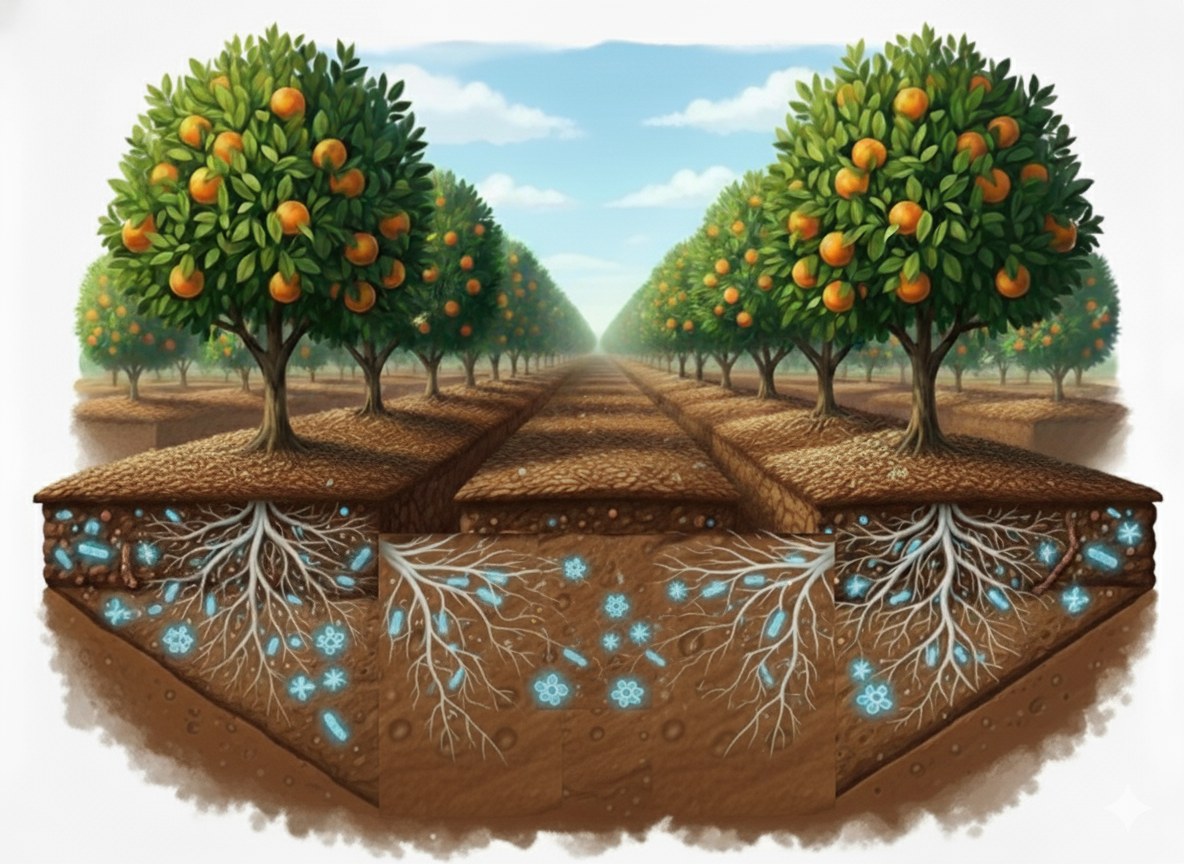
That genetically controlled canopy is paired with a purpose-built below-ground environment: the field is laser-leveled and the historical hardpan shattered with a subsoiler for deep drainage; permanent raised beds are formed at 42 inches top width, 18-inch furrows, and 8 inches height; a diverse cover crop is grown and returned as surface mulch to start the soil life cycle without tillage; and grafted plants are set without soil disturbance, with the graft union kept well above the soil surface. The resulting root zone holds roughly 30% water-filled to 70% air-filled pore space, with microbes extracting a balanced nutrient spectrum and a competitive microbiome providing built-in disease suppression.
Two management protocols get particular emphasis. Water shoots (suckers) emerging below the graft union must be cut flush to the trunk with sharp secateurs to prevent the tree reverting toward its own weak root system. And the graft union itself must sit at least 4-6 inches above final soil grade — burying it risks scion rooting, which bypasses the dwarfing rootstock entirely and also raises the risk of Phytophthora Foot Rot. The paper also covers advisory cases: where Flying Dragon isn't available and a more vigorous rootstock like Cleopatra Mandarin or Carrizo Citrange must be substituted, intensive structural and maintenance pruning becomes mandatory to hold the high-density geometry; and it notes that own-rooted, non-hybrid citrus varieties such as lemon, lime, and certain local mandarins can thrive on their own roots specifically because the PQNK soil environment removes the waterlogging, compaction, and biological imbalance that would otherwise stress them.
The paper's overall argument is one of synergy: the dwarfing rootstock supplies the biological form (a naturally small tree), while the PQNK raised-bed habitat supplies the function (effortless nutrient cycling, moisture regulation, and disease protection) that lets that form actually perform. Neither element alone, the paper argues, delivers the sustainability, resilience, profitability, and orchard longevity that the combination achieves.
Full Paper
If you use “Listen”, the text of the page may be sent to your browser or operating system’s speech provider, such as Apple, Google or Microsoft, depending on the voice your device uses. Pedaver does not process, transmit or store any audio.
Publication: PQNK Knowledge Series - Volume orchards
Date: October 9, 2025
Authoring Philosophy: Paedar Qudratti Nizam Kashatqari (The Regenerative & Sustainable Pristine Organic Farming System)
Abstract
The transition to high-density planting (HDP) in Kinnow mandarin (Citrus reticulata x Citrus sinensis) orchards is a critical step for enhancing yield and optimizing land use. This paper presents a paradigm for high-density Kinnow cultivation through the principles of Paedar Qudratti Nizam Kashatqari (PQNK) - the regenerative and sustainable Pristine Organic Farming System. We provide a comparative analysis of rootstocks, demonstrating that the strategic selection of a dwarfing rootstock like Flying Dragon Trifoliata is not a correction for weakness, but a deliberate choice to impose the trait of controlled canopy architecture. Furthermore, the paper elucidates the synergistic relationship between this chosen rootstock genetics and the vibrant, self-sustaining soil ecosystem of the PQNK framework. We demonstrate that the full potential of a high-density orchard is only realized when the rootstock's biological design is hosted in a soil that provides optimal physics, biology, and moisture dynamics. This integrated approach offers a resilient, productive model where superior fruit quality and orchard longevity are driven by strategic biology and foundational soil health.
1. Introduction: The PQNK Philosophy and the Logic of Grafting
Paedar Qudratti Nizam Kashatqari (PQNK) is not merely a set of techniques; it is a holistic farming philosophy. Its objective is to create a pristine, regenerative agro-ecosystem that functions on the principles of nature, moving beyond input-intensive agriculture.
The Foundational Principle of Grafting in PQNK A core practice in PQNK is grafting the Kinnow scion onto a specialized rootstock. This is often misunderstood as simply replacing a "bad" root system. The reality is more nuanced. The Kinnow mandarin, being a hybrid (Citrus reticulata x Citrus sinensis), was bred for the superior quality of its fruit, not for the performance of its root system. Its own roots are unselected and often lack the vigor, efficiency, and disease resistance required for thriving in a cultivated setting.
Therefore, grafting is not just a correction; it is a strategic selection process. It allows the orchardist to impose specific, desirable traits onto the plant's foundation. In a standard orchard, one might select a rootstock for maximum vigor and disease resistance (e.g., Rough Lemon). In a high-density PQNK system, the paramount desired trait is controlled canopy size. Thus, we deliberately choose a dwarfing rootstock like Flying Dragon. This strategic choice ensures the orchard's geometry is maintained biologically, not mechanically, aligning perfectly with the PQNK goal of creating a low-input, self-regulating system.
2. The Pillars of High-Density Kinnow under PQNK
Successful HDP under PQNK rests on two interdependent pillars: the strategic selection of the biological architecture (rootstock) and the creation of its ideal habitat (the PQNK soil environment).
2.1. The Strategic Foundation - The Dwarfing Rootstock
The choice of rootstock is the most critical long-term decision. For a high-density system with a planting geometry of 8 ft. (plant-to-plant) by 10 ft. (row-to-row), the rootstock must provide the genetic instruction for a compact canopy.
2.2. A Comparative Analysis of Rootstock Options for PQNK Systems
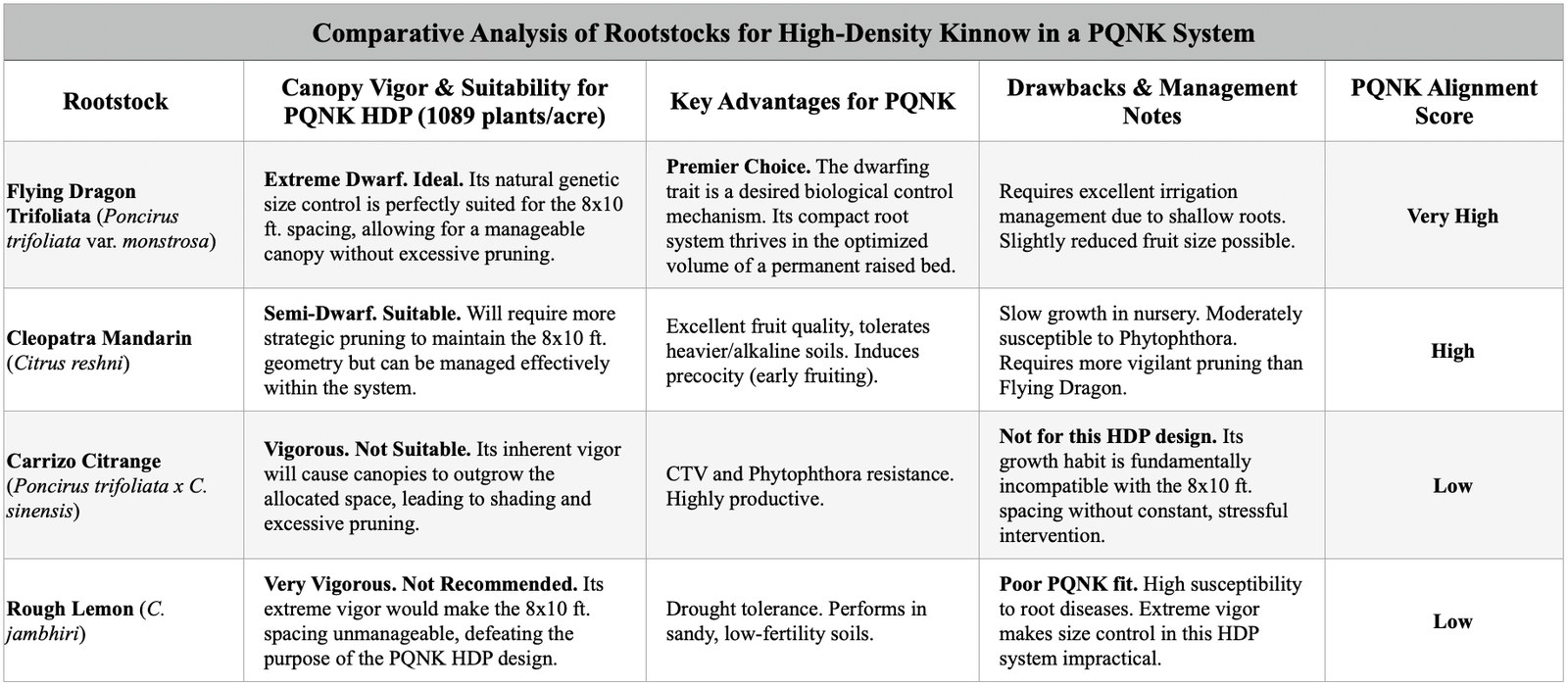
The following table provides a comparative analysis of rootstock options, evaluating them specifically for their ability to support the PQNK HDP geometry of 1089 plants/acre.
Table 1: Comparative Analysis of Rootstocks for High-Density Kinnow in a PQNK
| Rootstock | Canopy Vigor & Suitability for PQNK HDP (1089 plants/acre) | Key Advantages for PQNK | Drawbacks & Management Notes | PQNK Alignment Score |
|---|---|---|---|---|
| Flying Dragon Trifoliata (Poncirus trifoliata var. monstrosa) | Extreme Dwarf. Ideal. Its natural genetic size control is perfectly suited for the 8x10 ft. spacing, allowing for a manageable canopy without excessive pruning. | Premier Choice. The dwarfing trait is a desired biological control mechanism. Its compact root system thrives in the optimized volume of a permanent raised bed. | Requires excellent irrigation management due to shallow roots. Slightly reduced fruit size possible. | Very High |
| Cleopatra Mandarin (Citrus reshni) | Semi-Dwarf. Suitable. Will require more strategic pruning to maintain the 8x10 ft. geometry but can be managed effectively within the system. | Excellent fruit quality, tolerates heavier/alkaline soils. Induces precocity (early fruiting). | Slow growth in nursery. Moderately susceptible to Phytophthora. Requires more vigilant pruning than Flying Dragon. | High |
| Carrizo Citrange (Poncirus trifoliata x C. sinensis) | Vigorous. Not Suitable. Its inherent vigor will cause canopies to outgrow the allocated space, leading to shading and excessive pruning. | CTV and Phytophthora resistance. Highly productive. | Not for this HDP design. Its growth habit is fundamentally incompatible with the 8x10 ft. spacing without constant, stressful intervention. | Low |
| Rough Lemon (C. jambhiri) | Very Vigorous. Not Recommended. Its extreme vigor would make the 8x10 ft. spacing unmanageable, defeating the purpose of the PQNK HDP design. | Drought tolerance. Performs in sandy, low-fertility soils. | Poor PQNK fit. High susceptibility to root diseases. Extreme vigor makes size control in this HDP system impractical. | Low |
Analysis and Recommendation for PQNK:
As evidenced in Table 1, Flying Dragon Trifoliata is the definitive choice for a PQNK-aligned, high-density system. Its genetic dwarfing is not a weakness but the very trait we select for. It ensures the orchard geometry is maintained with minimal pruning effort, allowing the tree's energy to be directed toward fruiting. This is the essence of strategic rootstock use in PQNK.
2.3. The Optimized Habitat - The PQNK Raised Bed System
The genetically controlled canopy must be matched with an optimal below-ground environment. The PQNK raised bed system is engineered specifically for this purpose.
Bed Preparation and Planting:
Land Preparation: The field is laser-leveled. The historical hardpan is shattered with a subsoiler to ensure deep water infiltration.
Primary Bed Formation: Permanent raised beds are formed (42" top width, 18" furrow, 8" height).
Ecological Priming: A diverse cover crop is grown and returned as surface mulch, initiating the soil life cycle without tillage.
Planting: Kinnow plants grafted onto Flying Dragon rootstock are planted without soil disturbance. The graft union must remain well above the soil surface.
The Self-Sustaining Root Zone:
Moisture & Aeration: The bed and mulch maintain the ideal ratio of 30% water-filled pores to 70% air-filled pores.
Nutrient Cycling: Microbes extract a balanced spectrum of nutrients from the soil's mineral matrix.
Disease Suppression: A thriving, competitive microbiome provides systemic, in-built protection.
3. Orchard Management through the PQNK Lens
3.1. Irrigation and Pruning
Irrigation: Water is applied sparingly and precisely. The system's design drastically reduces water requirements.
Pruning: Pruning is minimal and strategic. The primary size control is genetic, not mechanical.
3.2. Critical Management Protocols
A. Managing Water Shoots (Suckers)
PQNK Protocol: Identify shoots emerging from below the graft union. Use sharp secateurs to cut them off flush with the trunk to remove the auxiliary bud and prevent regrowth.
B. The Imperative of Graft Union Placement
The PQNK Mandate: The graft union must remain at least 4-6 inches above the final soil grade.
Rationale: Burying the union can induce scion rooting, which bypasses the dwarfing rootstock and causes the tree to revert to the weak, unselected Kinnow root system, undermining the entire system design. It also increases the risk of fatal diseases like Phytophthora Foot Rot.
4. Advisory Notes and Recommendations for Other Citrus Varieties
4.1. Advisory: Canopy Management with Non-Ideal Rootstock
If the recommended dwarfing rootstock (Flying Dragon) is not available and a more vigorous rootstock (like Cleopatra Mandarin or Carrizo Citrange) must be used, intensive and regular pruning becomes mandatory to maintain the high-density geometry.
When to Prune: Conduct structural pruning immediately after the harvest season. Perform maintenance pruning (heading back vigorous shoots) during the summer growing season to control canopy volume.
How to Prune:
Head Back Long Shoots: Reduce the length of overly vigorous branches to an outward-facing bud to encourage lateral growth and control size.
Thin Out Crowded Branches: Remove entire branches that are crossing, shading the interior, or growing too densely to maintain an open canopy for light and air penetration.
Manage Canopy Height: Periodically "top" the trees to maintain a manageable height, ideally not exceeding the row spacing (10 ft.).
4.2. Advisory: Applicability to Other Citrus Varieties
The specific recommendation for grafting onto a specialized rootstock is particularly critical for hybrid varieties like Kinnow, whose own-rooted systems are unselected and often weak. However, the PQNK system's principles are universally beneficial.
For other citrus varieties, the following approach is recommended:
Grafted Varieties (e.g., Valencia Orange, Grapefruit): The PQNK system will greatly enhance the performance of any grafted tree, regardless of the rootstock, by providing an optimal soil environment. Rootstock selection should still be based on local soil conditions and desired tree size.
Non-Hybrid, Own-Rooted Tolerant Varieties (e.g., Lemon, Lime, certain local Mandarins): Many of these varieties can be successfully grown on their own roots as their root systems are genetically stable and robust. In a PQNK system, these own-rooted plants will thrive exceptionally well because the system eliminates soil-borne stresses (waterlogging, compaction, biological imbalance) that would challenge them in a conventional setting. The vibrant PQNK soil biome provides the same benefits of nutrient cycling and disease suppression, making them vigorous and productive.
5. Discussion: The Synergy of Strategic Design and Regenerative Ecology
The PQNK model achieves success through synergy. The strategic selection of the Flying Dragon rootstock provides the desired biological form—a naturally small tree. The PQNK habitat provides the ideal function—a vibrant soil ecosystem that supports this tree with effortless nutrient cycling, moisture regulation, and disease protection.
This is a decisive advance over conventional HDP:
Sustainability: Free from chemical dependencies.
Resilience: Buffered against stress by a robust soil food web.
Profitability: High early yields, low input costs, and premium fruit quality.
Longevity: Adherence to protocols like graft union placement ensures the strategic rootstock choice remains effective for the life of the orchard.
6. Conclusion
The path to a successful high-density Kinnow orchard lies in the harmonious integration of strategic biological design and regenerative ecological management. The Paedar Qudratti Nizam Kashatqari (PQNK) system provides the framework. The deliberate choice of a dwarfing rootstock provides the form. By understanding grafting as a strategic tool to impose desirable traits, and by placing this designed plant within a deeply living, self-regulating soil ecosystem, we create a production system that is not only high-yielding but also inherently aligned with the principles of a pristine and intelligent natural world.
References: [1] Pedaver. "The PQNK Raised Bed System: Engineering Optimal Root Zone Environments for Vigorous Plant Production." [2] Specific scientific literature on citrus rootstocks, soil ecology, and mycorrhizal associations can be listed here.
Footnote: Any Production Process That Inundates Soil With Water, Disturbs Soil Through Tillage, Or Leaves Soil Bare Without Organic Mulch Cover Does Not Qualify As Natural Ecosystem Science For Production Agriculture.
PQNK, to be pronounced as 'picnic', which stands for Paedar Qudratti Nizam Kashatqari, and means: the regenerative & sustainable Pristine Organic Farming System.
www.Facebook.Com/Pedaver
https://www.youtube.com/@pedaverpqnk3167/videos
pedaver@gmail.com
WhatsApp +92 320 677 6666
About This Paper
- Crop
- Citrus (Kinnow)
- Problem
- Excess Vegetative Growth (at expense of yield/flowering) · Fungal / Bacterial Disease · Seed Sourcing / Genetic Vulnerability
- Science
- Soil · Plants · Production Architecture
- Evidence
- Scientific Mechanism
- Authority
- Current / Approved PQNK Knowledge
Related PQNK Science
Key Takeaways
- Flying Dragon Trifoliata is identified as the definitive rootstock for PQNK high-density Kinnow at 8 ft. x 10 ft. spacing (1,089 plants/acre), chosen deliberately for its dwarfing trait.
- Grafting is reframed as strategic trait selection, not correction: Kinnow's own root system is unselected and weak because the variety was bred for fruit quality, not rootstock performance.
- The PQNK raised-bed root zone (42" beds, subsoiled hardpan, cover-crop mulch) targets roughly 30% water-filled / 70% air-filled soil pore space.
- The graft union must stay 4-6 inches above soil grade; burying it risks scion rooting and Phytophthora Foot Rot.
- Water shoots below the graft union must be cut flush to the trunk to prevent the tree reverting to its weak own-root system.
- If a more vigorous rootstock must substitute for Flying Dragon, intensive structural and maintenance pruning becomes mandatory to hold canopy geometry.
Related Crops
Related Knowledge
same problem
Sugarcane: The Bamboo Principle
Sugarcane is conventionally treated like wheat, sown, harvested, and replanted every few years, but this paper uses bamboo as an analogy for a rhizome-forming perennial that can be harvested repeatedly from a protected living base. It lays out the wide-spacing planting geometry and selective-cut discipline behind PQNK field cases of eight harvest cycles from one planting, with recorded yields of over two thousand maunds per acre, with documented fields reaching 2,800 maunds (about 112 tonnes) (revised R1, per the PQNK book).
same problem
Sugarcane Cultivation on PQNK: A Perennial, Circular Production System
This companion knowledge paper turns the bamboo-principle reframe into an operating system: selective, year-round harvesting from overlapping generations of cane within the same clump, with rising density treated as a soil-health signal rather than a problem to be thinned.
same problem
Potato Planting Depth vs Mulch-Based No-Till Planting: A Production, Economics, and Quality Analysis under the PQNK System
A scientific and economic comparison of conventional 6-inch deep seed burial against PQNK's surface-placement-plus-mulch method, showing that mulch delivers the same tuber-zone temperature control as deep burial while also enabling earlier sowing, denser planting, and a roughly 90% cut in per-acre production cost.
same problem
Channeling Plant Energy: A PQNK Guide to Managing Vegetative Growth for Regenerative Production
With no grazing animals left to signal plants that their surplus foliage is being used, PQNK farmers must manually replicate that missing pressure. This guide sets out four directives, stamping, grazing, pruning and pinching, and bruising, with a crop-by-crop protocol for redirecting a plant's vegetative surplus into reproductive yield.