

KP-110 · Crop-Specific Guides
Why Conventional Rice Keeps Failing: At the Mill, At the Table, and At the EU Border
Answering a farmer's direct question about what actually changes inside a rice grain under PQNK, this paper traces the mechanism from root-zone moisture through grain-filling stress to milling yield, aroma, and grain safety, then applies it directly to the specific EU border rejections costing Pakistan's basmati export trade.
Read or listen to the full paper ↓Watch the Mechanism
Abstract
The paper is framed as a direct answer to a farmer's question: what actually changes when rice is grown under PQNK instead of conventional flooded paddy? It traces every visible difference a farmer notices at harvest and at the mill back to root-zone conditions no flooded field can offer, and grounds the whole argument in the system's founding trial, published in the peer-reviewed journal Paddy and Water Environment in 2011, which measured 12.84 tonnes per hectare against a regional conventional average of 4.2, using seventy percent less irrigation water, before the fuller hardpan-fracture and permanent-mulch protocol described in this paper was even added.
PQNK's rice work began in 2009 with an inaugural 44-acre moist-soil trial, the first attempt to grow rice in moist rather than inundated soil and the foundation on which PQNK itself was later established. That original, mechanised-SRI trial cut irrigation-water application by about 70% against the conventional flooded reference. Water savings scaled further as the system matured beyond that first trial: mature, fully-established PQNK beds, using direct seeding, permanent mulch cover and Soil Moisture Management, have since recorded water use as low as 321 liters per kilogram of rice produced, against a conventional reference of roughly 5,000 liters per kilogram, a reduction of about 93%. That later figure belongs to the mature system's own field records, not to the original 2009 trial. The technology was presented at the International Rice Congress held in Vietnam on October 30, 2010, and has since been adopted, in similar form, by growers in Israel, China, and Korea.
Section 2 establishes the foundational mechanism: PQNK rice is grown moist, at roughly 30-40% water-filled pore space, never flooded, which lets roots run deep past the hardpan that confines flooded paddy roots to a shallow, oxygen-poor zone. A grain-safety consequence follows directly: under the strongly reducing, anaerobic conditions continuous flooding produces, arsenic becomes markedly more soluble, and controlled comparisons have measured grain arsenic concentrations ten to fifteen times higher in flooded rice, with aerobic management cutting total grain arsenic by roughly sixty percent.
The paper's grain-quality core traces chalkiness and fissuring, the two structural flaws that break rice apart in the mill, to the same underlying cause: stress during grain-filling, specifically heat-and-humidity extremes and rapid rewetting or overdrying. A PQNK bed's steady, mulch-buffered moisture supply removes both stress patterns, and because the rice hull reaches close to its final size well before the kernel finishes filling, a fuller-filled kernel behind an unchanged hull directly raises milling recovery; PQNK farmers report a ten-to-forty-percent processing recovery gain across grain crops, oilseeds, sugarcane, and cotton, offered explicitly as a field-observed range pending formal laboratory authentication.
Aroma is traced through a specific biochemical path: 2-acetyl-1-pyrroline, rice's fragrance compound, is synthesised from proline and rises with nitrogen management and soil organic matter, a pathway the paper ties directly to Jantar (Sesbania) green manure, PQNK's own nitrogen-fixing cover crop, closing the loop between the system's biological-reconstruction practice and grain fragrance.
The paper's final section applies all of this to a documented trade problem: EU Rapid Alert System data shows Pakistan generating 66 food-safety notifications on rice against 25 from every other supplying country combined, despite supplying under ten percent of EU rice imports, driven by pesticide residues and aflatoxin contamination. PQNK eliminates the pesticide-residue cause outright (there is no synthetic pesticide applied to detect), and the paper sets out four independent, separately documented mechanisms, competing beneficial fungi, antifungal soil bacteria, stress-free uniform maturation, and undamaged grain structure, working against aflatoxin risk at once, while explicitly declining to claim a laboratory-tested guarantee of zero aflatoxin in any specific batch.
Full Paper
If you use “Listen”, the text of the page may be sent to your browser or operating system’s speech provider, such as Apple, Google or Microsoft, depending on the voice your device uses. Pedaver does not process, transmit or store any audio.
How PQNK Rice Passes Every Test, From the Root to the Border
A farmer's question, answered from the root up: what actually changes inside a rice grain when the soil beneath it changes.
Author: PQNK Team
Founder: Asif Sharif, Paedar Qudratti Nizam Kashatqari (PQNK)
Date: July 2026
ABSTRACT
A farmer asked a simple, direct question: what actually changes when rice is grown under PQNK instead of conventional flooded paddy? The honest answer starts below the surface, in a set of growing conditions no flooded field can offer, a soil held moist rather than submerged, root systems free to run deep instead of stopping at a hardpan, and a mycorrhizal partnership that flooding itself switches off. Every visible difference a farmer notices at harvest and at the mill traces back to those root-zone conditions.
This paper works through the mechanism in order. A rice plant growing in balanced, moist, biologically active soil fills its grain steadily and without stress, producing kernels free of the internal chalk and fissures that snap apart under the miller's rollers. The same balanced nutrition that prevents that stress also delivers a fuller mineral and protein profile to the grain, and the same absence of stress that protects the kernel's structure is what gives it a fuller, more aromatic, better-tasting finish. The husk, meanwhile, was always going to form at roughly the same size regardless of how the season went; a well-filled kernel inside it means less husk as a share of total harvest weight, and more milled rice recovered from every tonne of paddy that reaches the mill.
None of this is presented as untested theory. The founding trial behind this system, conducted in Pakistan and published in the peer-reviewed journal Paddy and Water Environment in 2011, already measured the yield and water side of this story directly: 12.84 tonnes per hectare against a regional conventional average of 4.2, using seventy percent less irrigation water than flooded paddy, a first-year result achieved before the fuller protocol described in this paper, hardpan fracture and permanent mulch cover among them, was added in the seasons that followed. This paper sets out the grain-quality science underneath those published numbers, the part of the story a yield figure alone does not show.
1. THE QUESTION: WHAT DOES "BETTER RICE" ACTUALLY MEAN AT HARVEST?
A yield number tells a farmer how many tonnes left the field. It does not tell the fuller story a miller, a trader, or a household actually experiences: how much of that tonnage survives milling intact, how the grain smells when the bag is opened, how it looks in the light, and how satisfying it is at the table. A farmer growing rice under PQNK and asking how the crop actually differs from conventional paddy is asking about all of it at once, because in a rice plant, all of it is produced by the same few weeks of growth, under the same root-zone conditions, through the same handful of biological mechanisms. This paper follows those mechanisms from the soil to the mill, answering the question in the order the grain itself experiences it: first the growing conditions, then the way the grain fills and matures, and finally what that maturation produces at harvest and under the miller's rollers.
2. MOIST, NOT FLOODED: THE WATER-AIR BALANCE A RICE ROOT ACTUALLY NEEDS
Conventional paddy rice is grown submerged, under standing water, for most of its life. PQNK rice is not. The system replaces flooding with soil maintained at or near field capacity, moist throughout the root zone but never saturated at the surface, following the same water-to-air balance target used across the PQNK system, roughly thirty to forty percent of soil pore space filled with water and the remainder open to air. This single change carries consequences that compound through everything described in this paper. Section 9 traces exactly how this water management was proven, from the founding 2011 field trial through to the fuller protocol in use since.
The most immediate consequence is root architecture. Flooded paddy rice grows over a hardpan, a compacted layer produced by repeated tillage in standing water, and its roots are confined to the shallow, oxygen-poor zone above it; the anaerobic soil below the flood layer is biologically hostile to root growth. Rice grown on a permanent, undisturbed PQNK bed has no hardpan to stop at, and its roots run deep into soil that has been kept aerated rather than flooded season after season. Deeper roots reach a larger volume of soil, and a larger volume of soil is where a larger share of a season's nutrients and water actually sit.
A second, less visible consequence concerns grain safety. Under the strongly reducing, anaerobic conditions that continuous flooding produces, arsenic naturally present in paddy soils becomes markedly more soluble and more available for root uptake; controlled comparisons have measured grain arsenic concentrations ten to fifteen times higher in flooded rice than in aerobically grown rice, with aerobic management cutting total grain arsenic by roughly sixty percent in field trials. A PQNK farmer growing rice on moist, unflooded beds is, without any additional intervention, growing a measurably safer grain.
3. WHY FLOODING CUTS RICE OFF FROM ITS OWN BIOLOGY
Every other crop in the PQNK system depends on the mycorrhizal partnership, the fungal network that extends a plant's effective root system far beyond what its own roots could reach and that delivers phosphorus, zinc, and a wider mineral spectrum in exchange for plant sugars. Conventional flooded rice is unusual among PQNK crops in one specific respect: it is grown in a way that actively suppresses that partnership. Flooding is a critical factor limiting the establishment of the rice-mycorrhizal symbiosis, and continuous flooding measurably depresses colonisation of rice roots by arbuscular mycorrhizal fungi compared with soil that retains higher dissolved oxygen. The relationship is directly oxygen-dependent: intermittent flooding, which allows periods of higher soil oxygen, supports substantially more mycorrhizal colonisation in rice roots than continuous flooding does.
This reframes what PQNK's moist, unflooded rice management actually accomplishes. It is not simply a water-saving technique. It is the removal of the one condition that has kept rice, alone among the world's staple crops, largely cut off from the same fungal partnership every other PQNK crop already depends on. Where mycorrhizal colonisation has been re-established, the yield effect is direct: mycorrhizal inoculation combined with phosphorus application produced fifty-four percent higher grain yield in direct-seeded rice under water-stressed conditions in controlled trials, alongside higher leaf greenness, higher relative water content, and a substantially higher net photosynthetic rate. A PQNK rice bed does not need artificial inoculation to see this effect; it needs only the oxygen that continuous flooding has been denying the fungus for as long as paddy rice has been grown.
4. COMPLETE BIOLOGICAL NUTRITION VERSUS AN NPK DIET
A plant's visible size and its actual nutritional completeness are not the same measurement, and conventional paddy rice illustrates the gap directly. Fertiliser programmes built around nitrogen, phosphorus, and potassium produce large, leafy plants, because those three elements drive vegetative growth most visibly, but a plant's requirement for a functioning physiology extends to a much wider list: zinc, iron, manganese, boron, sulphur, and a range of further trace elements the standard NPK programme does not supply in any deliberate way. A rice plant growing in soil with an active mycorrhizal network and undisturbed biological cycling receives this fuller mineral spectrum as a matter of course, delivered by the same fungal partnership described in Section 3, rather than as an occasional, isolated foliar correction applied only once a visible deficiency has already appeared.
The measurable effect on the grain itself is consistent with this mechanism. Nitrogen management alone is well documented to move rice grain protein content substantially, from roughly one percent to seven percent of grain weight across a normal fertiliser-response range in controlled trials, confirming that grain composition tracks nutrient supply directly rather than being fixed by variety alone. Zinc and iron biofortification trials show the same pattern for minerals: soil and foliar micronutrient treatments have raised grain zinc to over thirty parts per million and grain iron to well over one hundred parts per million, against a baseline of roughly two parts per million iron and sixteen parts per million zinc in an untreated, standard polished grain. The scale of these responses demonstrates that a rice grain's mineral and protein content is not a fixed genetic ceiling; it is substantially a function of what the root zone actually supplies across the season, which is precisely the argument this paper series has made about genetic potential more broadly: the seed sets the ceiling, and the soil decides how close to it the grain actually gets.
5. A GRAIN THAT MATURES WITHOUT STRESS: CHALKINESS, FISSURES, AND THE RINGS THAT BREAK IN THE MILL
A farmer's observation that PQNK rice "doesn't have rings that cause broken rice during processing" describes two related but distinct phenomena in rice science, and both trace to the same underlying cause: stress during the grain-filling period.
The first is chalkiness, an opaque, chalky-white patch in an otherwise translucent grain, caused by loosely packed, irregular starch granules and air spaces in the endosperm rather than the tightly packed, uniform structure of a fully, evenly filled grain. Chalkiness is a complex trait shaped by variety, but the dominant environmental triggers are well established: high temperature during the ripening phase, combined with high humidity and low vapour pressure deficit, are the most important environmental drivers, and cultural practices including fertilisation and irrigation timing directly influence how much of it appears in a given crop. A chalky grain is not simply a cosmetic problem. It is measurably weaker: chalkiness reduces a grain's resistance to the physical forces applied during milling, and chalky grains, packed with loosely arranged starch granules, are demonstrably more prone to breaking apart under the miller's rollers, directly reducing the percentage of whole, unbroken head rice a mill recovers.
The second phenomenon is fissuring, the fine internal cracks a farmer may be describing as "rings," which form when a grain is exposed to a rapid change in moisture, either in the field or after harvest. Rice grain develops fissures upon rapid hydration or dehydration, whether that stress occurs while the crop is still standing or later during drying; the resulting cracks form as stress gradients build up faster than moisture can equalise through the kernel, most often running perpendicular to the length of the grain, precisely the orientation that leaves a grain least able to withstand the pressure of milling. A crop that experiences an uneven water supply during grain filling, a dry spell followed by a sudden flood-up, or a hard rain after the crop has already begun drying down in the field, is a crop primed for exactly this kind of fissuring before it ever reaches a mill.
Both mechanisms point to the same practical conclusion. A PQNK bed's moisture supply, replenished steadily through mulch-conserved retention and lateral seepage from the furrow rather than through the sudden flood-and-dry cycle of conventional paddy management, removes the two specific stress patterns, heat-and-humidity extremes during ripening, and rapid rewetting or overdrying, that the published literature identifies as the primary drivers of both chalkiness and fissuring. A grain that fills steadily, without those swings, is a grain built to survive the mill intact.
6. MORE GRAIN, LESS HUSK: WHY A FULL KERNEL FILLS THE HULL
A rice hull forms early in grain development and reaches close to its final size well before the starchy endosperm inside it has finished filling; in a properly developed grain, the hull makes up roughly twenty to twenty-two percent of total rough rice weight, with the starchy endosperm that becomes milled white rice making up the majority of the remainder. This sequencing matters directly to the farmer's observation about husk and recovery. When a crop suffers nutrient deficiency, temperature extremes, or drought stress during the grain-filling window, the hull, already largely built, stays close to its normal size, while the inner kernel fails to fill out completely behind it, leaving a proportionately larger, emptier hull relative to the grain weight it actually contains. The direct consequence is a disproportionately high hull-to-grain ratio and a correspondingly lower milling yield: less usable rice recovered for every sack of paddy delivered to the mill.
A PQNK bed's season-long, uninterrupted nutrient and moisture supply, described in Sections 2 through 4, is specifically what prevents this shortfall. A kernel that fills completely behind an already-formed hull is a kernel that occupies more of the hull's volume and contributes more weight to the harvested total; the hull's own size does not change, but its share of that total weight falls. This is the precise, physical basis for a farmer's field observation that PQNK rice produces "more grain, less husk": not a different hull, but a fuller kernel behind an identical one, recovering more milled rice from the same volume of paddy at the mill.
PQNK's own field observation, offered here explicitly as a farmer-reported range rather than a laboratory-confirmed figure, is that this recovery gain is not unique to rice. Across grain crops, oilseeds, sugarcane, and cotton, PQNK farmers report a processing recovery increase in the range of ten to forty percent over conventional produce, with the size of the gain tracking the maturity of the soil system and varying by crop type, consistent with the mechanism this section describes: a fuller kernel, seed, or stalk behind an unchanged outer structure. Formal laboratory authentication of this range is in progress; until published, it should be read as a consistent, cross-crop field pattern rather than a settled statistic, in the same spirit as the field observations recorded elsewhere in this paper series.
7. SHINE, AROMA, AND TASTE: WHAT FULL-SCALE NUTRITION ACTUALLY PRODUCES
A grain's shine and translucency at the table are the visual counterpart to Section 5's structural argument: a densely, evenly filled kernel transmits light cleanly and reads as glossy and translucent, while a chalky, unevenly filled kernel scatters light through its internal air pockets and reads as dull and opaque, the same structural difference that determines how well the grain survives milling also determines how it looks in the hand.
Aroma follows a separate but equally well-documented nutritional path. The compound chiefly responsible for rice fragrance, 2-acetyl-1-pyrroline, is synthesised from proline and related nitrogen compounds, and its concentration in the grain responds directly to nitrogen management, balanced fertilisation, trace-element supply, and soil organic matter during the growing season. One documented pathway is particularly relevant to PQNK's own established practice: leguminous green manure return raises soil organic matter and nitrogen content, which in turn raises free-proline levels in the rice plant and promotes 2-AP synthesis in the grain, precisely the mechanism a Jantar, Sesbania, cover crop grown ahead of or alongside a PQNK rice crop is already providing as part of the system's nitrogen-fixation and biological-reconstruction role. A rice crop grown with steady, complete, biologically delivered nutrition is, by the same mechanism that improves its protein and mineral content in Section 4, also a crop with more of the precursor supply its aroma compound is built from.
Taste closes the loop in the way this paper series has argued elsewhere: flavour, aroma, and nutrient density in a grain crop are not three separate outcomes competing for a breeder's or a farmer's attention. They are produced together, by the same well-nourished, stress-free grain-filling process, because a plant's biochemistry does not manufacture sugars, aromatic precursors, and mineral-rich tissue through separate, unrelated channels. A PQNK rice grain smelling better, shining more, and tasting fuller than a conventional grain is not three coincidences. It is one underlying cause, expressed three different ways at the table.
8. WHY PAKISTANI RICE GETS REJECTED AT THE EU BORDER, AND WHY THAT RISK DOES NOT CARRY INTO PQNK RICE
Pakistan's rice exports face a documented, worsening problem at the European Union's border. Analysis of the EU's Rapid Alert System for Food and Feed shows Pakistan generating far more food-safety notifications on rice than any other single origin, sixty-six notifications against twenty-five from every other supplying country combined in one recent multi-year review, despite Pakistan supplying under ten percent of the EU's rice imports across the same period. Two separate causes drive these rejections. The first is pesticide residues exceeding the EU's maximum residue limits, a problem that intensified sharply through 2023 and 2024 as alerts on basmati shipments from Pakistan and India surged, traced by exporters and researchers to farmers applying pesticides at higher-than-recommended concentrations or too close to harvest, compounded by inconsistent access to correct-application training. The second is aflatoxin contamination, where Pakistan has recorded more mycotoxin notifications than India over the same period, with the documented root cause identified specifically as inadequate post-harvest practice, premature harvesting at high grain moisture followed by suboptimal drying, creating exactly the conditions Aspergillus flavus, the aflatoxin-producing fungus, needs to establish.
The pesticide-residue half of this problem does not apply to PQNK rice in any partial or probabilistic sense. PQNK uses no synthetic pesticide at any stage of production. A residue limit measures the presence of a chemical that was applied; there is nothing for an EU laboratory to detect in a crop that never received one.
The aflatoxin half is a genuine biological question rather than a simple input-substitution answer, and it is worth answering at the level of actual soil ecology. A living soil hosts hundreds of fungal species, and the overwhelming majority of them support the plant directly, the mycorrhizal partnership described in Section 3 is only the most consequential example. The comparatively small number of fungal species capable of producing aflatoxin, Aspergillus flavus among them, are ecologically opportunistic decomposers: their natural role is breaking down dead, damaged, or senescent plant tissue, not colonising the intact, living tissue of a vigorously growing, well-defended plant. This is precisely why the leading biocontrol strategy against aflatoxin works by deliberately introducing more competing fungus rather than by trying to remove Aspergillus flavus outright: non-toxigenic strains of the same species, applied to soil, physically compete for and displace toxin-producing strains from the same ecological niche, an approach documented to cut soil aflatoxin levels by roughly sixty-nine percent in field trials. Beneficial bacteria naturally present in a rice plant's own microbiome reinforce the same effect directly, rice-associated Bacillus species have been shown to inhibit Aspergillus flavus growth and aflatoxin production outright, through both competitive exclusion and directly secreted antifungal compounds.
A mature PQNK bed compounds this biological suppression with the removal of the specific field conditions the EU's own rejection data identifies as the actual trigger. Grain that matures uniformly, without the plant stress described in Section 5, does not force a farmer into premature, high-moisture harvest. Grain with an intact, uncracked wall structure, rather than the fissured or chalky structure stress produces, presents Aspergillus flavus with far less of the damaged, penetrable tissue its opportunistic biology depends on. None of this amounts to a laboratory-tested guarantee of zero aflatoxin in any specific batch, and this paper does not claim one. It is, however, four independent, separately documented mechanisms, a dominant beneficial fungal community, active bacterial antifungal suppression, uniform stress-free maturation, and undamaged grain structure, working against the same outcome at once, rather than a single untested assertion standing in for all four.
9. WHAT THE PUBLISHED RECORD ALREADY SHOWS
The mechanisms in Sections 2 through 7 are not offered as untested theory standing in for field results, and the founding field trial behind them is worth describing accurately rather than in the compressed shorthand that later summaries of it sometimes use. In 2009, in Punjab, Pakistan, newly formed raised beds, the first of their kind on that farm, were planted by transplanting young rice seedlings, ten to twelve days old, by hand into the bed surface: a purpose-built water-wheel transplanting machine punched a water-filled pit at precise spacing, and a single seedling was dropped into each pit. The soil beneath the beds was kept dry rather than puddled beforehand, a deliberate departure from standard local practice. Fertiliser was applied as a precisely placed band of NPK compound fertiliser together with compost, not eliminated outright, and weeding was carried out mechanically, combining weed control with soil aeration. At the time this system was called Mechanised SRI, part of a wider approach its developer named Paradoxical Agriculture; the name PQNK was applied to the continuing body of work only afterward. Two elements of the fuller protocol described elsewhere in this paper series, fracturing the hardpan and covering the bed surface with a permanent organic mulch, were not yet part of this first trial. The farm leased for this trial totalled 44 acres. Four acres were kept under conventional flood management as a control, and the remaining 40 acres were levelled and shaped into the new raised beds; the formal crop-cut sampling and yield analysis submitted for peer review, observed by the Pakistan Agricultural Research Council and the University of Agriculture, Faisalabad, covered a 20-acre (8 hectare) block within that planted area, and it is this monitored block's results that the published paper reports.
Even without those later refinements, the results were unambiguous. The crop yielded 12.84 tonnes of rice per hectare against a conventional regional average of 4.2 tonnes, more than three times the district average, while cutting irrigation water by seventy percent against conventional flooded paddy grown by farmers in the same district in the same season. Root growth and tillering were visibly transformed: crop-cut measurements averaged roughly nineteen productive tillers per plant at harvest, with individual plants recorded as high as ninety tillers at 72 days, both figures well beyond what flooded paddy typically produces. Labour fell by a similar margin, not because transplanting was eliminated, the operation remained, but because it was mechanised: the water-wheel transplanter cut the labour required from roughly 85 man-hours per hectare under manual transplanting into flooded, puddled fields to roughly 25. These results were reproduced in subsequent seasons and published in peer-reviewed form in Paddy and Water Environment, the journal of the International Society of Paddy and Water Environment Engineering, in 2011. Once the fuller protocol, hardpan fracture opening deeper water storage below the beds, and a permanent mulch layer removing surface evaporation, was added in the seasons that followed, water use fell further still, to roughly eight percent of conventional consumption, a ninety-two percent reduction, recorded in PQNK's own subsequent field records rather than in this specific peer-reviewed paper. The distinction matters: the 70% figure is the published, citable result of the first, partial-protocol trial; the 92% figure describes what the complete PQNK protocol achieved once every element described in this paper series, not raised beds and transplanting alone, was in place.
One further point is worth making explicitly, because it resolves an apparent contradiction in the wider published literature. Trials of aerobic rice, rice grown without flooding but without PQNK's other changes, commonly report yield reductions of nine to thirty-one percent against flooded paddy, a result PQNK's own findings appear to contradict. The contradiction dissolves once the difference in method is made explicit: most aerobic rice trials remove flooding alone, while leaving the crop on tilled, hardpan-affected soil under a conventional NPK fertiliser programme, addressing one of PQNK's four permanent principles, no inundation, while leaving the other three, no soil disturbance, permanent biological cover, and maximum biodiversity, unaddressed. Removing flooding without restoring the soil biology and root architecture that flooding's absence alone cannot repair is a partial intervention, and Sections 2 through 4 of this paper explain directly why a partial intervention produces a partial, sometimes negative, result. PQNK's rice yield is not evidence against the aerobic rice literature. It is evidence for what happens when aerobic management is the fourth principle applied alongside the other three, rather than a substitute for them.
10. WHERE THIS SITS RELATIVE TO SRI
A reasonable question at this point is how everything described above relates to the System of Rice Intensification, SRI, the most widely adopted alternative to conventional flooded-paddy management in use anywhere in the world today. SRI was developed by Fr. Henri de Laulanié in Madagascar in the early 1980s and brought to global attention chiefly through the research and advocacy of Norman Uphoff and Cornell University's International Institute for Food, Agriculture and Development. Its core principles, transplanting single seedlings at a very young age, typically eight to fourteen days, wide spacing to reduce root and canopy competition, active soil aeration during the vegetative period, intermittent rather than continuous flooding, and a reliance on organic matter for fertility, have been documented across a large body of field trials to increase yield substantially while cutting water use by roughly a third to half and seed requirements by up to ninety percent.
The relationship between SRI and the argument in this paper is not a comparison between two competing systems. It is closer to a direct lineage. PQNK's rice protocol did not arise independently of SRI; its founder's own first peer-reviewed rice publication, appearing in this same journal in 2011, was a technical report specifically on mechanizing SRI's field operations at scale for Punjab, Pakistan. That paper documented a substantial reduction in both water and labour requirements achieved by mechanising the transplanting, spacing, and water-management operations that correctly practised manual SRI depends on, and it went on to describe extending the same permanent raised-bed infrastructure, organic fertilisation, and zero-tillage management to other crops grown in rotation on those same beds. The combination was described in that paper as "paradoxical agriculture": higher output achieved with reduced input, precisely because it merged SRI's rice-specific agronomy with the permanent-bed, no-till Conservation Agriculture principles this paper series has set out at length.
Read this way, SRI is not the alternative this paper is arguing against. Correctly practised SRI, on soil that has not been compacted or sealed by wet tillage, already captures a meaningful share of the mechanisms described in Sections 2 through 8: young, single-seedling transplanting at wide spacing reduces early competition and supports deeper root development, and intermittent rather than continuous flooding already moves a field a long way from the anaerobic, mycorrhiza-suppressing conditions Section 3 describes. Where PQNK's rice protocol goes further is in the specific extensions its founder's own subsequent work added to that starting point: a permanent raised-bed and furrow geometry with the hardpan fractured once and never re-tilled, replacing the seasonal wet-tillage and puddling cycle most SRI fields still use to prepare the paddy and manage weeds between wetting and drying phases; mechanised, no-till direct seeding through a mulch layer as an alternative to manual transplanting for growers where labour availability is the binding constraint, addressing directly the adoption barrier that paper's own abstract identifies as SRI's single biggest obstacle to scaling, the initial labour intensity of correct manual transplanting and weeding; a permanent mulch layer standing in for intermittent flooding as the primary weed-control mechanism, removing the periodic flooding SRI still relies on between drying phases; and integration of the rice crop into a wider, continuously rotated cropping system on the same permanent beds, rather than treating the paddy as a stand-alone, seasonally re-prepared field. None of this is offered as a claim that PQNK has superseded SRI. It is offered as an honest account of where one began and the other continued.
11. WHAT THIS MEANS AT THE MILL AND AT THE BORDER: A PRACTICAL SUMMARY
The table below traces each of the farmer's original observations to the specific mechanism behind it, as set out in the sections above.
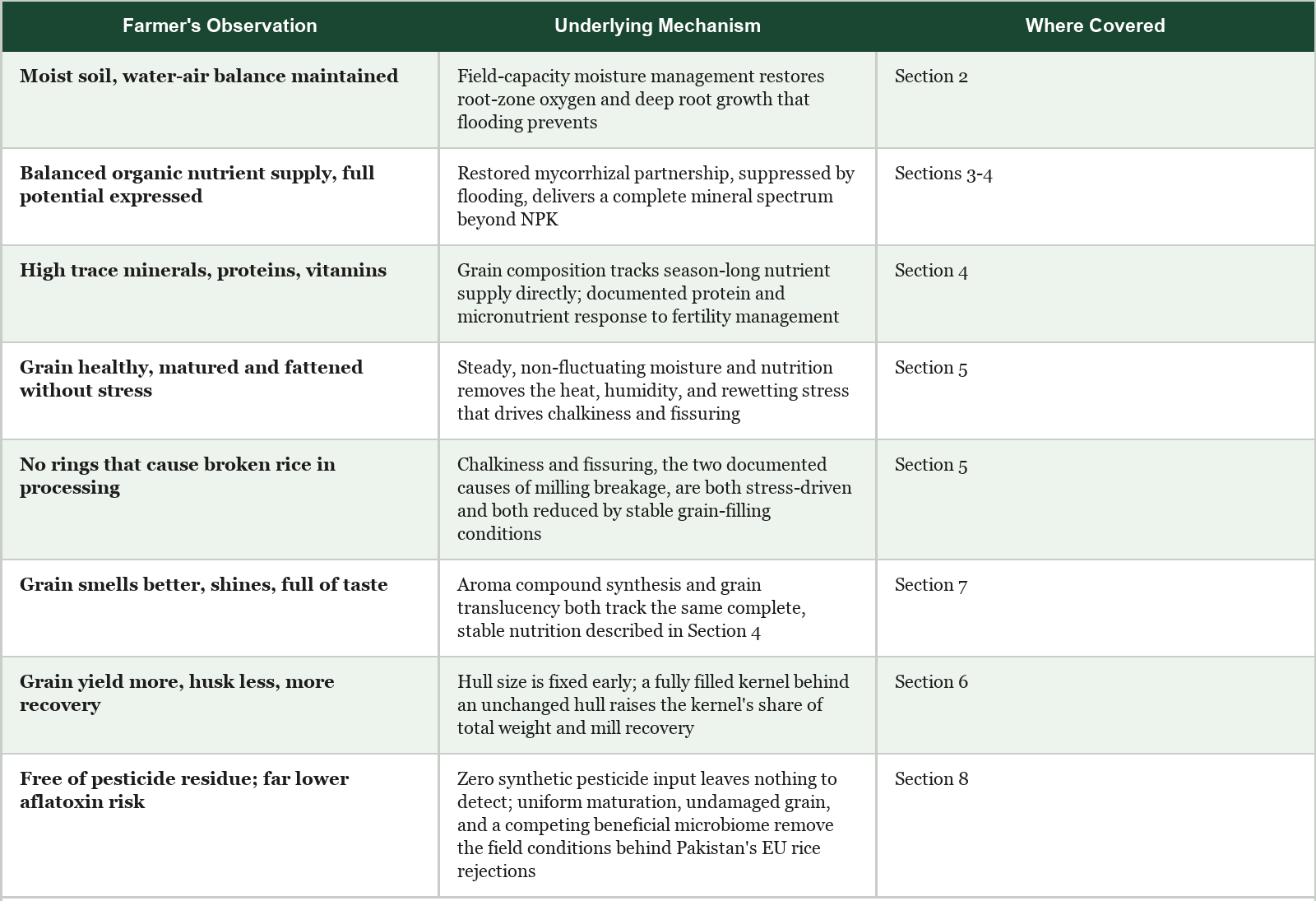
| Farmer's Observation | Underlying Mechanism | Where Covered |
|---|---|---|
| Moist soil, water-air balance maintained | Field-capacity moisture management restores root-zone oxygen and deep root growth that flooding prevents | Section 2 |
| Balanced organic nutrient supply, full potential expressed | Restored mycorrhizal partnership, suppressed by flooding, delivers a complete mineral spectrum beyond NPK | Sections 3-4 |
| High trace minerals, proteins, vitamins | Grain composition tracks season-long nutrient supply directly; documented protein and micronutrient response to fertility management | Section 4 |
| Grain healthy, matured and fattened without stress | Steady, non-fluctuating moisture and nutrition removes the heat, humidity, and rewetting stress that drives chalkiness and fissuring | Section 5 |
| No rings that cause broken rice in processing | Chalkiness and fissuring, the two documented causes of milling breakage, are both stress-driven and both reduced by stable grain-filling conditions | Section 5 |
| Grain smells better, shines, full of taste | Aroma compound synthesis and grain translucency both track the same complete, stable nutrition described in Section 4 | Section 7 |
| Grain yield more, husk less, more recovery | Hull size is fixed early; a fully filled kernel behind an unchanged hull raises the kernel's share of total weight and mill recovery | Section 6 |
| Free of pesticide residue; far lower aflatoxin risk | Zero synthetic pesticide input leaves nothing to detect; uniform maturation, undamaged grain, and a competing beneficial microbiome remove the field conditions behind Pakistan's EU rice rejections | Section 8 |
CONCLUSION
Every difference a farmer notices between PQNK rice and conventional paddy, at harvest, at the mill, and at the table, traces back to a single decision made months earlier: whether the crop was grown submerged or grown moist. Submersion confines roots above a hardpan, suppresses the mycorrhizal partnership that delivers complete nutrition, and exposes the grain to the arsenic uptake anaerobic soil chemistry favours. Moist, biologically active management does the opposite on every count, and the grain that results is not merely more abundant. It is structurally sounder under the miller's rollers, more completely nourished, more fragrant, and more satisfying to eat, because all of those outcomes are produced by the same stress-free grain-filling process, not by four separate improvements that happened to arrive together.
PQNK's published 2011 field results already demonstrated the yield and water side of this story at more than three times the regional average, using a fraction of the water. This paper has set out the mechanism underneath those numbers, and the reason a partial imitation, removing flooding alone without restoring the rest of the soil's biology, does not reproduce them.
A rice grain does not know it is being farmed for yield, aroma, or milling recovery. It only knows whether its roots spent the season stressed or fed. Everything a farmer values at the mill is that single answer, expressed in four different ways.
KEY TAKEAWAYS
Moist Beats Flooded at the Root: PQNK rice is managed at field capacity, never submerged, allowing deep root growth past the hardpan that confines conventional flooded paddy.
Flooding Specifically Suppresses Rice's Own Mycorrhizal Partnership: continuous flooding depresses AM fungal colonisation in rice roots; restoring aerobic conditions has produced up to 54% higher grain yield in controlled water-stress trials with AMF present.
Grain Composition Tracks Season-Long Nutrition, Not Just Variety: documented fertility-response trials move rice grain protein from roughly 1% to 7% and raise grain zinc and iron several-fold, confirming the soil, not a fixed genetic ceiling, decides the grain's final nutrient content.
Chalkiness and Fissuring Are Stress Injuries, Not Random Defects: heat-and-humidity extremes during ripening cause chalky, loosely packed endosperm; rapid rewetting or overdrying causes internal fissures. Both measurably increase breakage at the mill.
Husk Size Is Fixed Early, Kernel Fill Is Not: a nutrient- or water-stressed crop leaves an emptier kernel inside an already-formed hull, raising the hull's share of total weight and lowering milling recovery; a fully filled kernel does the opposite.
Aroma and Shine Share Their Cause With Nutrition: 2-acetyl-1-pyrroline synthesis responds to the same nitrogen and trace-element supply that builds grain protein; Jantar (Sesbania) green manure is a documented contributor to this pathway.
The Yield Case Is Already Published: the founding 2009 trial, transplanted young seedlings onto newly formed raised beds, produced 12.84 t/ha against a 4.2 t/ha regional average with 70% less water, published in Paddy and Water Environment in 2011; the fuller protocol added since, hardpan fracture and permanent mulch, has since cut water use further, to roughly 8% of conventional.
PQNK's Rice Protocol Is a Continuation of SRI, Not a Rival to It: that same 2011 paper was a technical report on mechanising SRI's own field operations in Punjab; PQNK's permanent raised beds, mulch-based weed control, and no-till direct seeding are the further extensions its founder added afterward, addressing the labour-intensity barrier that paper's own abstract names as SRI's chief obstacle to scaling.
Removing Flooding Alone Is Not the Same as PQNK: generic aerobic-rice trials that skip tillage cessation and biological restoration often show yield losses; PQNK's result depends on all four permanent principles applied together, not water management alone.
Pakistan's Rice Is Being Rejected at the EU Border at a Disproportionate Rate: sixty-six EU food-safety notifications on Pakistani rice against twenty-five from every other origin combined in one recent review, despite under 10% import share, split between pesticide MRL violations and aflatoxin.
Zero Pesticide Input Means Zero Pesticide Residue: this is a direct logical consequence, not a probability, since a residue limit has nothing to detect in a crop that never received the chemical.
Aflatoxin Risk Falls Through Four Independent, Documented Mechanisms, Not One: a dominant beneficial fungal and bacterial community that competitively excludes and directly inhibits Aspergillus flavus, plus uniform stress-free maturation and undamaged grain structure removing the field conditions the EU's own data blames for Pakistan's rejections.
The Recovery Gain Extends Across Crops, on Present Field Evidence: PQNK farmers report a 10-40% processing recovery increase across grain crops, oilseeds, sugarcane, and cotton, varying with soil system maturity and crop type; this is a reported field range pending formal laboratory authentication, not yet a published statistic.
REFERENCES
Sharif, A. (2011). Technical adaptations for mechanized SRI production to achieve water saving and increased profitability in Punjab, Pakistan. Paddy and Water Environment, 9, 111-119. https://doi.org/10.1007/s10333-010-0223-5
Uphoff, N. & Kassam, A. H. (2009). System of Rice Intensification (SRI). In Agriculture for Developing Countries, Annex 3, Science and Technology Options Assessment (STOA) Project, European Technology Assessment Group.
Cornell SRI International Network and Resources Center (SRI-Rice), Cornell University. System of Rice Intensification: origins (Fr. Henri de Laulanié, Madagascar, early 1980s), principles, and global adoption data.
Xu, X. Y., McGrath, S. P., Meharg, A. A., & Zhao, F. J. (2008). Growing rice aerobically markedly decreases arsenic accumulation. Environmental Science & Technology, 42(15), 5574-5579.
PMC. Effects of Arbuscular Mycorrhizal Fungi on Rice Growth Under Different Flooding and Shading Regimes.
PMC (2024). Arbuscular Mycorrhizal Fungi Mediate the Acclimation of Rice to Submergence.
PubMed (2022). Arbuscular mycorrhizal fungi inoculation and phosphorus application improve growth, physiological traits, and grain yield of rice under alternate wetting and drying irrigation.
ScienceDirect. Effects of Different Nitrogen Fertilizer Levels and Native Soil Properties on Rice Grain Fe, Zn and Protein Contents.
Scientific Reports. Biofortified indica rice attains iron and zinc nutrition dietary targets in the field.
Tandfonline (Plant Production Science). Endosperm Structure of White-Belly and White-Core Rice.
PMC. Genome-Wide Association Study of Grain Appearance and Milling Quality in a Worldwide Collection of Indica Rice Germplasm.
ResearchGate. Factors affecting cracking and breakage of rice (Oryza sativa L.) during milling: A Review.
ASABE. Understanding Pre- and Post-Milling Crack Formation in Rice Grain.
IRRI Rice Knowledge Bank. Milling yields; Quality problems in milling.
Science Publishing Group, American Journal of Mechanical and Industrial Engineering. Key Factors Affecting the Quality of Milling Recovery in Rice Processing.
Genes (2025). Environmental Regulation of 2-Acetyl-1-pyrroline Biosynthesis in Fragrant Rice: From Metabolic Pathways to Sustainable Quality Management.
Journal of Agricultural and Food Chemistry. Biosynthesis of 2-Acetyl-1-pyrroline in Fragrant Rice: Recent Insights into Agro-management, Environmental Factors, and Functional Genomics.
PMC (2023). Increasing basal nitrogen fertilizer rate improves grain yield, quality and 2-acetyl-1-pyrroline in rice under wheat straw returning.
MDPI, Agronomy (2019). Grain Yield and Resource Use Efficiencies of Upland and Lowland Rice Cultivars under Aerobic Cultivation.
Paddy and Water Environment, Springer Nature. Assessing aerobic rice systems for saving irrigation water and paddy yield at regional scale.
Foods (2025). Analysis of Reported Aflatoxin Levels in EU's Rapid Alert System for Food and Feed (RASFF) Notifications. https://doi.org/10.3390/foods14183250
EU RASFF trade press coverage (2024-2026). Pakistani rice shipment rejections for pesticide MRL violations, EU/UK/US markets.
PMC. Aflatoxins in rice: Worldwide occurrence and public health perspectives.
PMC. Biological Control and Mitigation of Aflatoxin Contamination in Commodities.
PMC. Rice Phyllosphere Bacillus Species and Their Secreted Metabolites Suppress Aspergillus flavus Growth and Aflatoxin Production In Vitro and in Maize Seeds.
PQNK — Paedar Qudratti Nizam Kashatqari
Connect & Resources
Facebook: www.Facebook.Com/Pedaver
YouTube (PQNK): https://www.youtube.com/@pedaverpqnk3167/videos
YouTube: http://www.youtube.com/@aasifsharif
PDF Knowledge Papers: https://drive.google.com/drive/folders/1iadwV6mdUPyrUIpB3oRfNv6DLiackaUL?usp=sharing
Email: pedaver@gmail.com
WhatsApp: +92 320 677 6666
About This Paper
- Crop
- Rice
- Problem
- Contamination / Residue / Food Safety Risk · Grain Quality Defects (Chalkiness, Breakage, Shriveling) · Weak Flavor / Aroma / Quality Sensory Markers
- Science
- Soil · Water · Plants · Food Quality · Economics
- Evidence
- External Scientific Evidence
- Authority
- Current / Approved PQNK Knowledge
Related PQNK Science
Key Takeaways
- The founding 2011 field trial, published in Paddy and Water Environment, measured 12.84 tonnes/hectare against a 4.2 t/ha regional average using a 70% reduction in externally supplied irrigation water, before the fuller PQNK rice protocol described in this paper was added.
- PQNK's original 2009 trial, a 44-acre moist-soil planting, cut irrigation-water application by about 70% against the conventional flooded reference; water savings then scaled further as the system matured, reaching 321 liters per kilogram of rice (a ~93% reduction against a ~5,000 L/kg conventional reference) on later, mature PQNK beds, not the original trial. Presented at the International Rice Congress in Vietnam on October 30, 2010, and since adopted in similar form by growers in Israel, China, and Korea.
- Flooded rice's anaerobic soil raises grain arsenic 10-15x versus aerobic PQNK beds, which cut total grain arsenic by roughly 60% in controlled comparisons.
- Chalkiness and fissuring, the two conditions that break rice apart in the mill, both trace to grain-filling stress (heat/humidity extremes, rapid rewetting) that PQNK's steady, mulch-buffered moisture removes.
- A fuller-filled kernel behind an unchanged hull raises the mill's recovered whole-rice percentage; PQNK farmers report 10-40% higher processing recovery across grain crops, oilseeds, sugarcane, and cotton.
- 2-acetyl-1-pyrroline, rice's aroma compound, rises with nitrogen and organic matter delivered through Jantar (Sesbania) green manure, tying PQNK's own cover-crop practice directly to grain fragrance.
- Pakistan generated 66 EU food-safety notifications on rice against 25 from all other origins combined despite supplying under 10% of EU rice imports; PQNK removes the pesticide-residue cause outright and suppresses aflatoxin risk through four independently documented biological mechanisms.
Related Crops
Related Knowledge
same problem
Knowledge Paper: Mitigating Post-Harvest Losses in Rice Through Controlled Environment Agriculture PQNK – A Case Study in Grain Structural Integrity
Broken rice kernels sell for 30-50% less than whole grain, and this paper traces that breakage back to micro-cracks formed during the growing season itself, not the milling process, arguing that a PQNK-style controlled, consistent growing environment produces a structurally uniform grain that survives milling intact.
same problem
PQNK - The Paradigm Shift for Sustainable, Profitable, and Climate-Resilient Rice Cultivation
Pakistan's Basmati export sector faces a triple threat of quality rejections, water scarcity, and methane emissions from flooded paddies. This paper presents PQNK's move 'beyond flooded fields' to direct-seeded rice on permanent mulched beds, arguing it solves all three problems simultaneously rather than trading one for another.
same problem
Nutrition-Dense Food and the Recovery of Ecological Quality
Industrial agriculture measures food primarily by yield and appearance, leaving taste, aroma, shelf stability, and mineral density as afterthoughts. This paper argues those qualities are not separate from ecology, they are the biological expression of a stable soil system, and walks through the specific mechanisms, deep rooting, fungal continuity, secondary metabolites, that connect soil health directly to what a crop tastes, smells, and how long it keeps.
same problem
Chemical Fertiliser Dependency Through the PQNK Lens
An evidence-qualified review of the article “Chemical Fertilizer Industry”. It keeps the article's warning about soil degradation, nutrient pollution and biological decline, disciplines its headline numbers, and argues that fertiliser dependency is a symptom of a damaged production system (tillage, flooding, bare soil and simplified biology) that PQNK removes by restoring aerated, covered, living soil, reaching zero purchased fertiliser and pesticide at maturity.