

KP-033 · Soil Science & PQNK System
Unlocking the Secrets of the Soil: Understanding Deep Topsoil and Nature's Partnership
Answering a farmer's questions about topsoil and the plant-air-soil nutrient split, this paper explains how PQNK builds 'deep topsoil' many inches below the surface through a plant-microbe carbon pump, and unpacks why nature evolved a system where over 95% of a plant's mass comes from air and water while a mere 0.083% mineral fraction from soil governs everything.
Read or listen to the full paper ↓Abstract
Responding to questions from a farmer named Vasudha Ji, this paper first redefines 'deep topsoil.' Where farmers typically know topsoil as the thin, dark, crumbly first few inches of a tired field, the paper argues that on a vibrant PQNK farm this life-filled layer is not confined to the surface but extends 12, 24, or more inches down, built not by deep ploughing but by the ongoing work of plant roots and soil life.
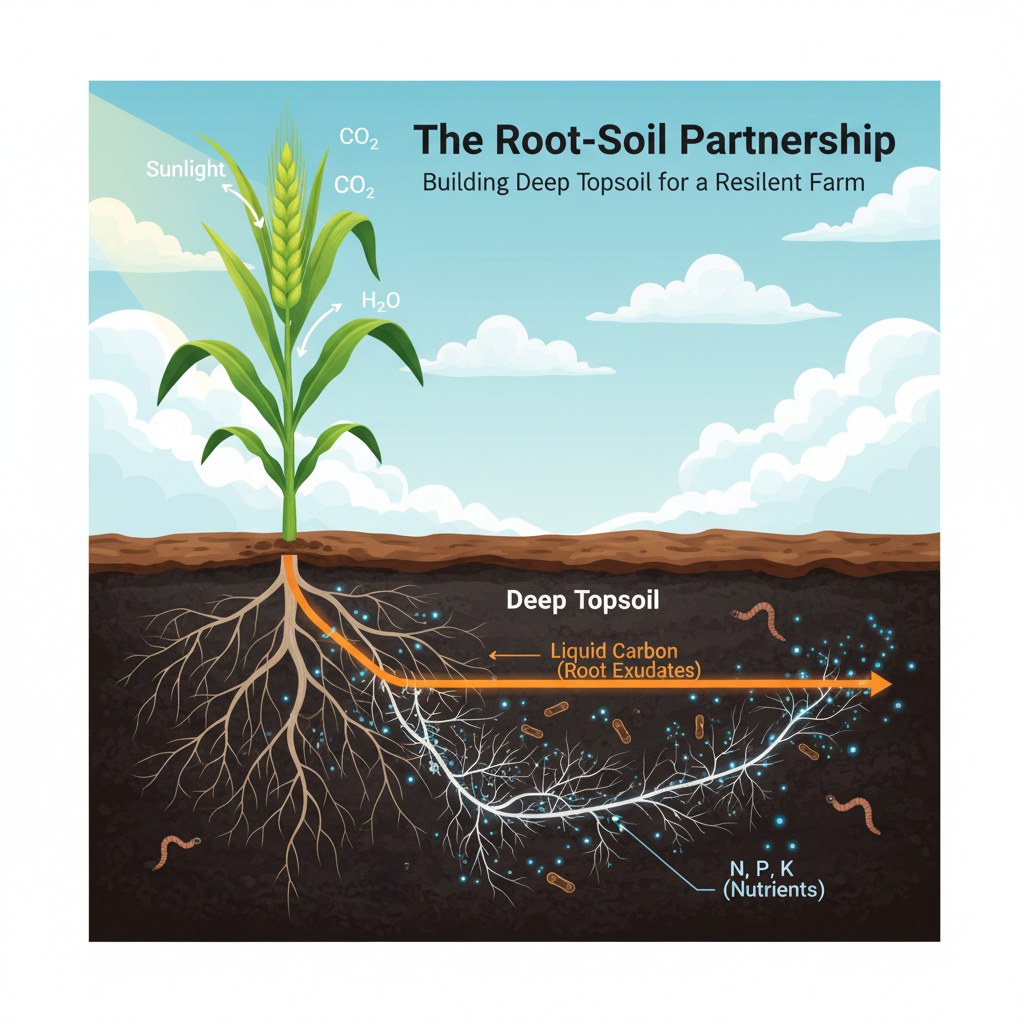
The mechanism is described as a natural construction project: plants act as builders, sending sugary root exudates down through their roots to feed soil microbes, while bacteria and especially thread-like mycorrhizal fungi act as architects, gluing soil particles into stable aggregates, building porous sponge-like structure, and converting exudate carbon into stable humus. Season after season this partnership functions as a 'carbon pump,' pulling CO2 from the air and depositing it as solid carbon throughout the root zone, gradually transforming hard, compact subsoil into rich, fertile deep topsoil.
Deep topsoil is framed as a farmer's greatest asset for four reasons: it acts as a drought-resilience reservoir soaking up and holding rainwater; it lets the soil 'mine' and release its own locked mineral nutrients, cutting input costs; its aggregated structure resists erosion by wind and water; and a plant grown in it, like a person eating a balanced diet, becomes naturally resistant to disease and pests.
The second half of the paper takes up a striking paradox: over 95% of a plant's dry weight comes from air and water, while less than 5% comes from soil minerals, and the most critical fraction of that is a mere 0.083% of essential elements. Far from a design flaw, the paper argues this forces cooperation: the atmosphere is the 'wholesale supplier' of bulk carbon, hydrogen, and oxygen via free sunlight and rain, while the soil is the 'specialist pharmacy,' supplying the tiny but irreplaceable nitrogen, phosphorus, potassium, and trace elements that act as sparks and catalysts the plant cannot use its atmospheric harvest without. The plant trades sugar it made from the air for these microbially unlocked minerals, making the 95%/5% split not an imbalance but the engine of a coevolved partnership.
A follow-up answer to Vasudha Ji extends the framework to the fifth Panchamahabhuta element, Ākāsha (space), arguing that soil pore space is literally Ākāsha in the earth: the room that allows air, water, roots, and microbial communication to coexist. The paper concludes that the PQNK farmer's role shifts from input manager to ecosystem facilitator, tasked with keeping living roots in the ground, feeding soil life with mulch, eliminating tillage and chemicals, and diversifying crops so this partnership can keep building deep topsoil for generations.
Full Paper
If you use “Listen”, the text of the page may be sent to your browser or operating system’s speech provider, such as Apple, Google or Microsoft, depending on the voice your device uses. Pedaver does not process, transmit or store any audio.
A Knowledge Paper for Farmers
From the PQNK (Paedar Qudratti Nizam Kashatqari) Series
Based on the Principles of "Roots of Abundance"
Greetings to the Farming Community, This paper addresses two profound questions from a fellow farmer, Vasudha Ji. Her observations get to the very heart of why the PQNK system—the regenerative Pristine Organic Farming System—works so effectively. Let us explore these ideas in simple, clear terms that we can all apply on our farms.
Part 1: What is "Deep Topsoil"?
The Common Understanding:
We all know topsoil as the dark, crumbly, living "skin" of the earth—the first few inches where seeds germinate and most biological activity happens. In many tired or over-worked fields, this layer is sadly very thin.
The PQNK Understanding - "Deep Topsoil":
In a vibrant, healthy farm managed on PQNK principles, this rich, life-filled layer is not just on the surface. It extends deep down—12 inches, 24 inches, or even further. This is what we call "Deep Topsoil." It is not created by deep ploughing, but by the silent, powerful work of plant roots and soil life.
How is Deep Topsoil Formed? The Living Process
Think of it as a natural construction project undertaken by your crops and the microbes in your soil:
1. The Plant's Role (The Builder): Plants, especially those with deep and strong roots, do not just take from the soil. They are active builders. Through photosynthesis in their leaves, they capture energy from the sun. They send a significant portion of this energy (as sugary "root exudates" or "root rinse") down into the soil through their roots to feed microbes.
2. The Microbe's Role (The Architects and Engineers): Soil bacteria and fungi, especially the thread-like mycorrhizal fungi, feast on these root exudates. In return, they get to work:
• They glue tiny soil particles together into stable, little lumps called "aggregates."
• This process creates a porous, well-aerated soil structure, like a sponge.
• They take the carbon from the root exudates and convert it into stable humus—the very stuff that makes soil black, fertile, and water-retentive.
3. The "Carbon Pump": Season after season, this partnership acts like a pump. The plant pulls carbon dioxide (CO₂) from the air and "pumps" it deep into the ground as solid carbon (humus). This humus is deposited throughout the root zone, gradually transforming hard, compact subsoil into rich, fertile, deep topsoil.
Why is Deep Topsoil a Farmer's Greatest Asset?
• Drought Resilience: It acts like a massive underground reservoir, soaking up rainwater and holding it for your crops to use during dry spells.
• Reduced Input Costs: A deep, living soil can "mine" and release natural nutrients locked in the soil minerals, reducing your dependence on external fertilizers.
• Prevents Erosion: The strong, aggregated structure prevents soil from being washed away by rain or blown away by wind.
• Healthy Crops, Fewer Pests: A plant growing in such a soil is like a person eating a balanced, nutritious diet—it becomes strong and naturally resistant to diseases and pests.
Part 2: The 95% vs. 5% Paradox: Nature's Master Plan for Partnership
A fascinating truth from our "Roots of Abundance" paper is that over 95% of a plant's dry weight comes from air and water (from the atmosphere), and less than 5% comes from the soil's mineral nutrients. The most crucial part of that 5% is a tiny 0.083% of essential elements from the soil.
Why would Nature design such a seemingly unbalanced system?
This is not a flaw. It is a brilliant design to force cooperation and create abundance.
1. The Atmosphere is the "Wholesale Supplier"
• It provides the bulk raw materials: Carbon (from CO₂), Hydrogen, and Oxygen (from water).
• These are universal, free, and delivered by sun and rain.
• The plant's leaves are masterful factories that use sunlight to turn these gases into solid mass (sugars, cellulose). This is the primary engine of growth.
2. The Soil is the "Specialist Pharmacy & Intelligence Center"
• It provides the tiny but absolutely critical minerals: Nitrogen, Phosphorus, Potassium, and all the trace elements (the 0.083%).
• While needed in small quantities, these minerals act as sparks, catalysts, and building blocks for every vital process in the plant—from photosynthesis to disease resistance. Without them, the plant cannot use the 95% from the air effectively.
The Genius of the Partnership:
Nature, in its wisdom, made the plant a master of the air, but dependent on the soil for the "magic sparks." But the plant cannot access these minerals directly.
• So, the plant offers a trade. It uses some of the sugar it made from the air to produce "root exudates"—a sweet liquid food for soil microbes.
• In return, the bacteria and fungi in the soil "wake up" the locked-up minerals, process them, and deliver them in a perfect, plant-available form directly to the roots.
In essence, the plant's massive harvest from the air (the 95%) is its contribution to the partnership—it's the fuel. The soil's tiny but critical mineral supply (the 0.083%) is its contribution—it's the intelligence that directs that fuel to create strong, healthy, and nutritious crops.
The PQNK Way Forward: Our Role as Farmers
When we understand this, our job changes. We are no longer just "input managers," pouring fertilizer onto passive soil. We become Ecosystem Facilitators. Our primary role is to nurture the conditions for this sacred partnership to thrive:
1. Keep Living Roots in the Ground: As much as possible, through cover crops and perennials. A living root is a factory feeding the soil.
2. Feed the Soil Life: Retain crop residue and mulch to build organic matter. This is the food for the "livestock" in your soil.
3. Don’t Disturb the Soil: Eliminate tillage and avoid harsh chemicals. This protects the delicate fungal networks and soil structure that take years to build.
4. Diversify: Grow a variety of crops. Diversity above ground leads to diversity below ground, creating a more resilient and balanced soil food web.
By working with this natural law, we build deep topsoil, enhance our farm's natural fertility, and secure abundance for generations to come.
Let the Green Revolution of Regenerative Agriculture flourish in every field! To the health of our soil and the prosperity of farmers everywhere!
Disclaimer: This knowledge paper is based on the principles of PQNK and is intended for the education and empowerment of the global farming community. It is a living document that celebrates the farmer as the true custodian of the land.
Footnote: Any Production Process That Inundates Soil With Water, Disturbs Soil Through Tillage, Or Leaves Soil Bare Without Organic Mulch Cover Does Not Qualify As Natural Ecosystem Science For Production Agriculture.
PQNK, to be pronounced as 'picnic', which stands for Paedar Qudratti Nizam Kashatqari, and means: the regenerative & sustainable Pristine Organic Farming System.
Answer to the follow up question on “Unlocking the Secrets of the Soil: Understanding Deep Topsoil and Nature's Partnership”
Question:
Got much clarity! Before starting to read, I thought, if we take into account the sun and the space factors, the distribution might not be said to be disproportionate! Incidentally, the roles of the earth पृथ्वी, water आप, the sun तेज, air वायू out of the Panchmahabhutas are easily understandable. What is the role of space आकाश in plant growth? Deep redards, Vasudha
Answer:
Namaste Vasudha Ji, Your insight is profound and absolutely correct. When we expand our view to include the sun and space, the distribution is not disproportionate at all, but a perfect cosmic symphony. Your question about Ākāsha (आकाश)—the fifth element of Panchamahabhuta—touches the very essence of PQNK, which sees farming not just as a soil-based activity, but as a dynamic interaction with the entire cosmos. The role of Ākāsha (Space) in plant growth is subtle, yet fundamental. It is not a passive emptiness, but a foundational field of potential and connection. Here is how we can understand its role:
The Role of Ākāsha (Space) in Plant Growth: The Unseen Dimension
In the PQNK system, we recognize Ākāsha not as a "nothing," but as the field of intelligence and relationship that allows the other four elements to interact and express life.
1. Ākāsha as the Container for Potential and Intelligence:
• Just as the silent space in a musical hall allows for the creation and appreciation of symphony, Ākāsha provides the dimensional field in which the "dance of the elements" can take place.
• It holds the potential for a tiny seed to become a giant tree. The entire blueprint— the genetic intelligence that dictates whether a seed will become a mango tree or a wheat plant—is held within the spatial arrangement of its molecules, governed by the principle of Ākāsha. It is the space that allows for this complex information to be stored and expressed.
2. Ākāsha as the Medium for Cosmic Influences:
• Ākāsha is the medium through which non-physical energies travel. The most significant of these is sunlight (Tej), which is not just a particle but also a wave of energy and information traveling through space.
• The rhythms of the moon and planets (the basis for ancient agricultural practices like following the lunar cycle for sowing and harvesting) exert their subtle influences through this connective medium of Ākāsha. It is the conduit for the cosmic rhythms that govern all life on Earth.
3. Ākāsha as the Facilitator of Form and Structure:
• In the Plant: A plant's form—the space between its branches, the arrangement of its leaves to capture sunlight (phyllotaxis), the hollow structure of its stems—is a manifestation of Ākāsha. It provides the room for growth and the architecture that allows for the efficient flow of energy and nutrients.
• In the Soil: This is its most critical, tangible function in the PQNK context. The health of the soil is the health of its Ākāsha.
• Pore Spaces: The vital pore spaces in well-aggregated, deep topsoil are Ākāsha in the earth. These spaces are not empty; they are filled with air (Vayu), allow for the percolation and holding of water (Aap), and provide the habitat for the entire soil food web—roots, bacteria, fungi, and earthworms.
• Without this "soil Ākāsha," there is no room for life, no room for roots to breathe, and no room for water to infiltrate. Compacted soil is, in essence, soil where Ākāsha has been destroyed.
4. Ākāsha as the Principle of Interconnectedness:
• The symbiotic relationship between a plant's roots and mycorrhizal fungi is a relationship that happens in space. The communication through chemical signals (root exudates) travels through the soil's pore spaces (Ākāsha).
• It represents the interconnected web of life, where every element is related to every other through the common field of Ākāsha.
Summary: The Panchamahabhuta in PQNK
Let us now see the complete picture of the five great elements working in harmony: A. Ākāsha (Space): The field of intelligence and potential. It provides the room for growth, the pore spaces in the soil for life, and the medium for cosmic influences. B. Vayu (Air): The vehicle of gases (CO₂, O₂, N₂) and the element of movement and exchange, both above and below the ground. C. Agni / Tej (Fire): The solar energy that powers photosynthesis, the transformative force that drives all biochemical processes. D. Aap (Water): The solvent of life, the transporter of nutrients, the element of cohesion that moves through the plant and the soil.
E. Prithvi (Earth): The provider of mineral nutrients and the physical anchor; the "mother" that holds the entire system.
Conclusion:
Vasudha Ji, your intuition was perfect. The role of Ākāsha completes the circle. It teaches us that our duty as PQNK farmers is not just to manage solids and liquids, but to manage the space—to create and protect the pore spaces in our soil through organic matter and minimal disturbance. By doing so, we are not just farming the earth; we are curating a living universe beneath our feet, allowing the cosmic intelligence of Ākāsha to manifest as abundance on our farms.
In the PQNK system, a healthy farm is one where the Panchamahabhuta are in perfect balance, and the role of Ākāsha is honored as the sacred space where life can truly flourish.
About This Paper
- Problem
- Sandy / Low-Fertility Soil Texture · Drought / Water Scarcity · High Input / Production Cost · Soil Erosion
- Science
- Soil · Plants
- Evidence
- Philosophical/Framework Argument
- Authority
- Current / Approved PQNK Knowledge
Related PQNK Science
Key Takeaways
- 'Deep topsoil' in a mature PQNK system can extend 12, 24, or more inches down, built entirely by root exudates and microbial activity, never by ploughing.
- A plant-microbe 'carbon pump' converts atmospheric CO2 into stable humus deposited throughout the root zone, gradually turning hard subsoil into fertile deep topsoil.
- Over 95% of a plant's dry weight comes from air and water; less than 5% comes from soil, and the truly critical fraction of that is just 0.083% of essential elements.
- The plant trades sugar (root exudates) for microbially unlocked minerals, a coevolved exchange the paper frames as nature's design for forced cooperation, not an imbalance.
- Deep topsoil delivers four concrete farmer benefits: drought resilience, lower input costs, erosion prevention, and naturally stronger, more pest-resistant crops.
- A follow-up answer extends the Panchamahabhuta framework to argue that healthy soil pore space is literally Ākāsha (space) in the earth, the room that allows roots, air, water, and microbial life to interconnect.
Related Knowledge
same problem
A Farmer's Guide to Establishing a Prosperous Olive Orchard
A practical planting guide for olive growers in Mediterranean-equivalent climates, laying out two distinct PQNK establishment paths, high-density irrigated beds versus a low-cost curved-furrow-and-borehole system for rain-fed sloping land, plus a year-by-year yield projection showing how consistent soil biology breaks the crop's typical biennial-bearing cycle.
same problem
Restoring Earth's Operating System: The PQNK Framework for Regenerative Agriculture
A comprehensive policy and investment brief that models global agriculture's degenerative trajectory against a PQNK-led alternative, laying out true-cost economics, a five-year implementation roadmap with quarterly KPIs, and specific financial instruments, from transition bonds to farmer cooperative financing, meant to move PQNK from pilot to planetary scale.
same problem
Rain Where It Falls: Restoring the Soil Before Building More Water Storage
Rajendra Singh’s Rajasthan story shows that slowing runoff lets water enter the ground and restore wells and rivers. PQNK moves that principle upstream into the field itself: correct the hardpan, stop disturbing the soil, keep the surface covered, and let every acre receive and hold the rain where it falls, so that agricultural water demand stays within what the landscape renews.
same problem
Soil Strategy for Citrus in Yellow Sand Dunes
A short practical guide for establishing Kinnow and other citrus on loose, low-fertility yellow sand dunes, using a cover-crop mix, mulch, and microbial inputs to build a living root zone in ground that would otherwise drain water too quickly to support the orchard.