

KP-153 · Soil Science & PQNK System
Knowledge Paper: The Soil Biome & Water-Nutrient Dynamics in PQNK
Answers a chili farmer's specific dead-mulch irrigation plan by explaining why a living root system, not mulch alone, is what activates the soil's microbial nutrient-delivery machinery, and reconciles the 'sugar-in-water' dilution concern with how a functioning PQNK system actually regulates nutrient concentration.
Read or listen to the full paper ↓Abstract
Written as a direct response to a practicing farmer's mulch and irrigation plan, this paper frames fertile soil as a factory that stays in standby mode until activated by a living plant root, its 'primary manager and power source.' Roots are cast in three simultaneous roles: civil engineers that physically structure macropores and micropores, employers that feed the microbial workforce through both root exudates and decomposing organic matter, and CEOs that transmit species-specific biochemical demand signals into the rhizosphere, which microbes then decode and fulfill.
Microbes are described as the soil factory's skilled laborers, solubilizing locked minerals and converting them into the 'soil solution,' the only form (dissolved in the soil's water film) in which minerals actually enter roots via osmosis and mass flow.
The paper directly addresses the farmer's 'sugar-in-water' concern, that adding nutrients to irrigation water simply dilutes them, by distinguishing a degraded, low-microbial-activity soil (where the dilution analogy holds) from a fully activated PQNK system, where microbes act as a demand-driven buffer, releasing precise nutrient amounts into the rhizosphere only when a root's exudate signal requests them, with mulch stabilizing rhizosphere moisture to prevent the wet-dry cycling that would otherwise disrupt this exchange.
It then compares the farmer's planned dead-mulch strategy against a live cover crop such as Jantar (Sesbania): dead mulch is credited with excellent physical and hydrological benefits (evaporation shield, temperature moderation, improved rainfall infiltration, weed suppression) but is called biologically inert, since it provides no root exudates and therefore cannot start the microbial activation cycle; a live cover crop is presented as delivering all of dead mulch's benefits plus soil plumbing, microbial recruitment, nutrient cycling, and nitrogen fixation.
The paper's concrete recommendation for the farmer is a four-step integration: install the dead mulch as planned to conserve moisture, transplant chili seedlings promptly since the seedlings themselves become the new soil-factory managers, monitor soil moisture under the mulch 2-3 days after rain or 7-10 days without it, and plan a short 40-50 day live-mulch cover crop cycle before the next planting to fully complete the PQNK sequence.
Full Paper
If you use “Listen”, the text of the page may be sent to your browser or operating system’s speech provider, such as Apple, Google or Microsoft, depending on the voice your device uses. Pedaver does not process, transmit or store any audio.
1.0 Executive Summary
This paper elucidates the core principles of the PQNK ("Picnic") system, focusing on the interdependent roles of plants, microbes, water, and minerals in creating a self-sustaining soil ecosystem. It addresses the practitioner's specific concerns regarding mulch, irrigation, and nutrient availability, clarifying that a living root system is non-negotiable for full system activation. While dead mulch provides critical hydrological benefits, it is the living plant— through its roots and exudates—that orchestrates the soil's biological machinery, ensuring precise nutrient cycling and resilience.
2.0 The Core Tenet: The Soil is a Factory Powered by Roots
The PQNK system posits that fertile soil is not a mere substrate but a living factory. This factory remains in standby mode until activated by its primary manager and power source: the living plant root.
• Roots as Civil Engineers: They physically structure the soil, creating macropores (for water infiltration and aeration) and micropores (for water retention and microbial habitat). This architecture is dynamic and responsive.
• Roots as Employers & Sustenance Providers: Roots feed the microbial workforce through two primary channels:
1. Root Exudates: Actively secreted compounds (sugars, amino acids, organic acids). This is a direct "payment" or energy subsidy from the plant to specific microbes in exchange for services.
2. Decomposing Organic Matter: Sloughed-off root cells and later, the entire root system post-harvest, provide a slow-release food source.
• Roots as CEOs Placing Orders: Each plant species transmits specific biochemical signals (demands) to the rhizosphere microbiome. A chili plant's "order" for nutrients (type, ratio, timing) differs from that of maize or jantar. Microbes decode these signals and work to fulfill them.
3.0 The Microbial Workforce & The Nutrient Solution
Microbes (bacteria, fungi, protozoa, etc.) are the skilled laborers of the soil factory. Their functions include:
• Nutrient Mining & Cooking: They solubilize locked-up minerals from soil particles and organic matter.
• Nutrient Delivery: They convert these nutrients into soluble forms that dissolve in the soil's water film.
• The "Soil Solution": This water-nutrient blend is the only form in which minerals enter plant roots via osmosis and mass flow. The plant absorbs the water it needs, and the dissolved nutrients "hitch a ride.”
4.0 Reconciling the "Sugar-in-Water" Analogy with a Living System
The practitioner's confusion is insightful. In a degraded or inert soil system, where microbial activity is low, adding soluble fertilizer to water is akin to the sugar analogy: dilution by excess irrigation reduces concentration and uptake efficiency.
However, in a fully activated PQNK system, the analogy transforms:
• The Microbial Buffer: Microbes do not release all nutrients at once into the soil solution. They act as a smart, demand-driven reservoir.
• Precision Delivery: When the plant places an order (via exudate signals), microbes release precise amounts of nutrients into the soil solution adjacent to the root (rhizosphere). Here, the volume of water is relatively small and controlled by the plant's own transpiration pull and the soil's moisture-holding capacity.
• The Role of Mulch: A good mulch maintains this rhizosphere moisture at a stable level, preventing the drastic wet-dry cycles that disrupt this delicate, concentrated exchange zone. Thus, the "solution" remains optimally potent because its volume (water) and solute (nutrients) are regulated biologically, not by flood irrigation.
5.0 Addressing the Practitioner's Dilemma: Dead Mulch vs. Live Mulch
5.1 The Dead Mulch Strategy (Practitioner's Current Plan)
• Strengths: Excellently addresses the physical and hydrological mandates of PQNK.
◦ Evaporation Shield: Prevents moisture loss, preserving the soil solution.
◦ Temperature Modulator: Cools soil, favoring microbial life.
◦ Rainfall Optimizer: Enhances infiltration, reduces runoff, and minimizes evaporation loss post-rain.
◦ Weed Suppressant: Reduces competition for sunlight.
• Critical Limitation: It is biologically inert. It cannot initiate the microbial activation cycle because it provides no root exudates. The soil factory lacks a manager to power it up.
5.2 The Live Mulch Strategy (The Ideal PQNK Pathway)
• Superior Function: A cover crop like Jantar (Sesbania) or others performs ALL the functions of dead mulch PLUS the vital biological functions:
◦ Soil Plumbing: Its deep roots break hardpan and create stable pores.
◦ System Boot-Up: Its roots exude carbon, directly recruiting and feeding the microbial workforce, "jump-starting" the factory.
◦ Nutrient Cycling: It mines nutrients from depth and fixes atmospheric nitrogen.
◦ Biomass Production: When terminated (e.g., by rolling/chopping), it provides a massive, in-situ dead mulch layer that is already inoculated with microbes.
6.0 Integrated Recommendation for the Chili Farmer
Your plan is a strong half-measure. To transition it into a successful PQNK application:
1. Proceed with Dead Mulch Installation: Lay your grass mulch on the prepared beds. This will conserve the precious moisture from the anticipated rains/dew/humidity, creating a favorable physical environment for transplanting.
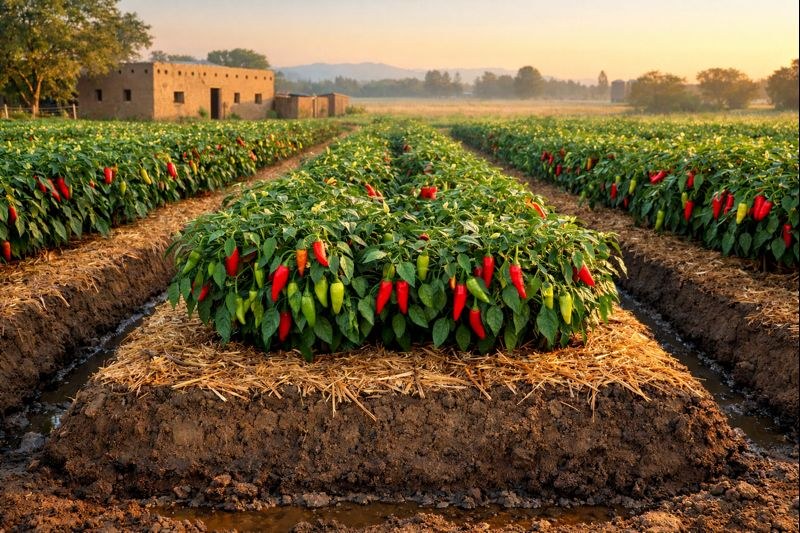
2. Transplant Chili Seedlings Promptly: This is the crucial step to activate the system. The chili seedlings are not just your cash crop; they are the new managers for the soil factory under the mulch.
◦ Upon transplanting, their roots will immediately begin exploring the moist, mulched soil and releasing exudates.
◦ This signals to any dormant or existing microbes that the factory is now open for business. Microbial activation begins.
3. Monitor Closely Post-Transplant: Check soil moisture under the mulch near the roots 2-3 days after rain or 7-10 days without rain. The mulch should have maintained adequate moisture for root establishment. If the soil is dry, a single, targeted irrigation at the transplant stage is a wise investment to ensure the "manager" (chili plant) survives to boot up the system.
4. Future Optimization: For your next cycle, plan to integrate a short-duration live mulch/cover crop (e.g., 40-50 days of Jantar) before your main crop. Terminate it to form a "bio-mulch," then transplant into that. This sequence fully embodies the PQNK principle.
7.0 Conclusion
In PQNK, water is managed by physics (mulch) but life is governed by biology (roots). Your mulch strategy brilliantly solves the water equation, creating a moisture-stable environment. However, the nutrient equation and full soil revival are only solved with the introduction of a living root system—your chili plants. They will activate the microbial "workers" who will, in turn, prepare the balanced "soil solution" from the existing mineral bank. Your approach, with the critical inclusion of the living chili plant, can therefore succeed, merging traditional wisdom with the deep ecological understanding of the PQNK system: a true Regenerative & Sustainable Pristine Organic Farming System.
Footnote: PQNK (pronounced 'picnic')—the regenerative & sustainable Pristine Organic Farming System—is grounded in Natural Ecosystem Science. This science employs perennial biodiversity, protects soil with organic mulch, and avoids practices like water inundation, tillage disturbance, and leaving soil bare.
It is the process that matters most. PQNK is a pristine production system designed not merely for yield, but for optimal, balanced output—where quality, sustainability, and ecological harmony emerge from a self-regulated, zero-external-input methodology.
PDF Knowledge papers: https://drive.google.com/drive/folders/ 1iadwV6mdUPyrUIpB3oRfNv6DLiackaUL?usp=sharing
About This Paper
- Crop
- Chilli · Jantar (Sesbania)
- Problem
- Nutrient Retention / Delivery Efficiency Concerns · Soil Biology / Microbiome Decline
- Science
- Soil · Water · Nutrition · Plants
- Evidence
- Scientific Mechanism
- Authority
- Current / Approved PQNK Knowledge
Related PQNK Science
Key Takeaways
- Fertile soil is described as a factory that remains in standby until a living root activates it; dead mulch alone cannot start microbial nutrient cycling because it produces no root exudates.
- Roots perform three functions simultaneously: physically structuring macropores/micropores, feeding microbes via exudates and decomposing tissue, and transmitting species-specific biochemical 'orders' that direct which nutrients microbes mobilize.
- The 'sugar-in-water' dilution concern only holds in a degraded, low-microbial soil; in an activated PQNK system, microbes act as a demand-driven buffer releasing nutrients precisely when root exudates signal need.
- Dead mulch delivers strong physical/hydrological benefits (evaporation shield, temperature moderation, weed suppression) but is biologically inert without a living root system to pair with it.
- The paper's concrete recommendation is a four-step sequence: install dead mulch, transplant seedlings promptly to activate the system, monitor rhizosphere moisture on a 2-3/7-10 day rain-dependent schedule, and add a 40-50 day live cover-crop cycle before the next planting.
Related Crops
Related Knowledge
same problem
Chemical Fertiliser Dependency Through the PQNK Lens
An evidence-qualified review of the article “Chemical Fertilizer Industry”. It keeps the article's warning about soil degradation, nutrient pollution and biological decline, disciplines its headline numbers, and argues that fertiliser dependency is a symptom of a damaged production system (tillage, flooding, bare soil and simplified biology) that PQNK removes by restoring aerated, covered, living soil, reaching zero purchased fertiliser and pesticide at maturity.
same crop
Chilli Production Under PQNK (PICNIC)
Chilli is biologically perennial and can remain productive for over a decade, but conventional short-cycle, urea-dependent management collapses that potential into a pest-prone annual grind. This paper shows how PQNK's soil-conversion framework and a single apical-pinching intervention restore chilli to a low-cost, high-density perennial crop, validated on a Hafizabad farm.
same problem
The Underground Network We Have Been Farming Against
New 3D synchrotron imaging (Braunmiller et al., New Phytologist 2026) shows mycorrhizal hyphae spanning air-filled pores, bridging soil particles and growing along roots in intact soil. This paper separates what the research shows from what it means for PQNK: soil architecture is part of the root-fungal partnership, conventional farming dismantles it after every harvest, and a moist but aerated, undisturbed root zone protects it.
same problem
Why Only 4 kg of NP During PQNK Transition?
Answers a transitioning farmer's question, why is PQNK's transitional dose only about 4 kg of NP per acre, by tracing how a plant actually feeds through a water-based soil solution shaped by transpiration, mass flow and diffusion rather than by counting fertilizer bags, and by drawing a precise distinction between over-irrigation and waterlogging that explains why excess soluble nitrogen produces lush, delayed, insect-prone growth.