

KP-038 · Soil Science & PQNK System
Deep Subsoil Remediation & Activation: Strategic Pathways for Compacted Soils
This paper lays out PQNK's two-track response to hardpan: a preferred one-time mechanical subsoiling where machinery is available, and a patient, plant-and-fungi-driven biological pathway for farms where it isn't, with mycorrhizal fungi cast as the ecosystem's 'stone breaker.'
Read or listen to the full paper ↓Abstract
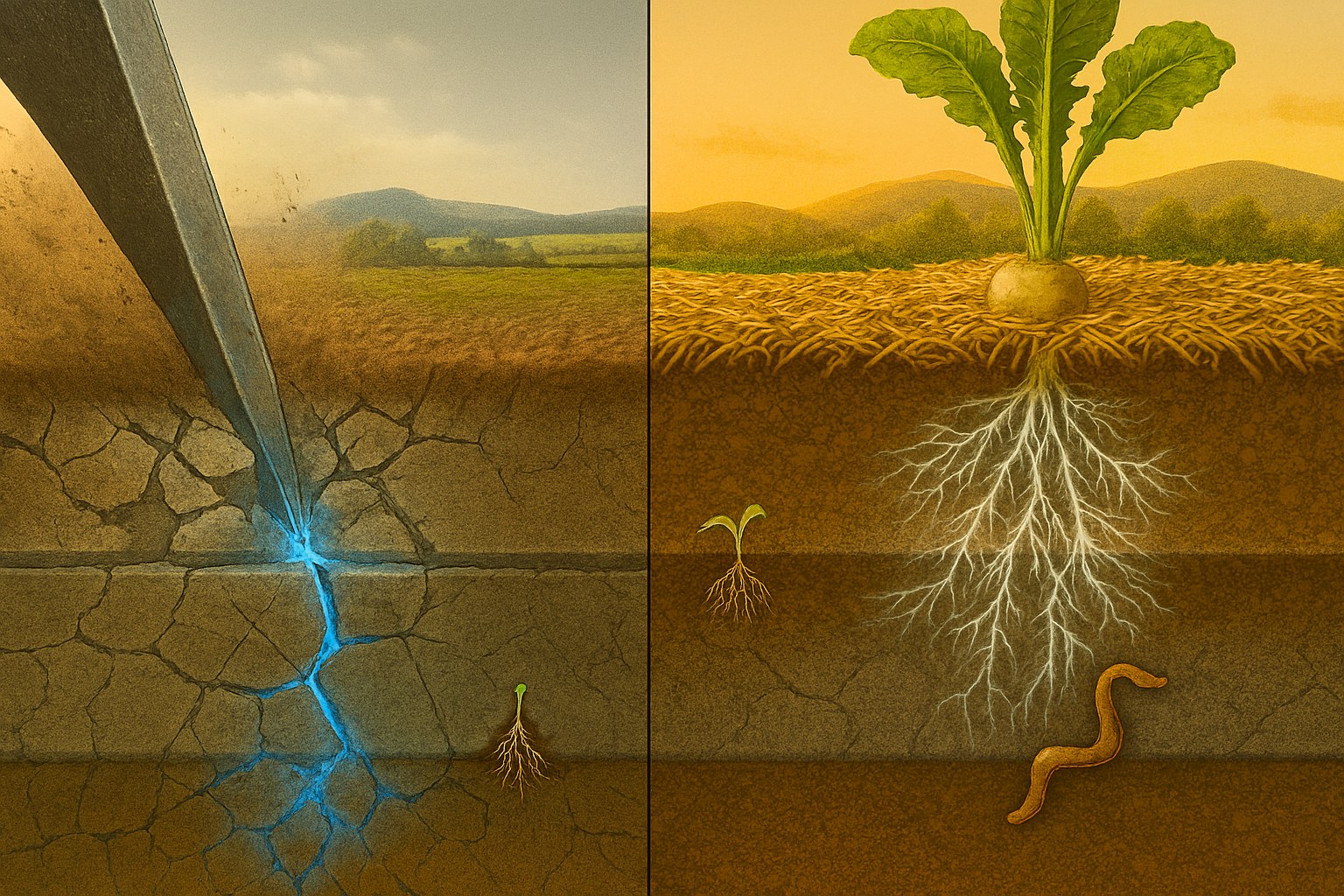
The paper's executive summary identifies the subsoil hardpan, a dense, concrete-like layer formed by pneumatic tire compaction and the smearing action of spring-tine cultivators, discs, and moldboard ploughs, as one of the most severe constraints in conventional agriculture. Typically beginning at 6 inches and extending to 20 inches deep, it severs the soil's hydraulic function, restricts root exploration, and imprisons biological life. PQNK's response is a hierarchy of solutions based on context and capacity rather than a single prescribed fix.
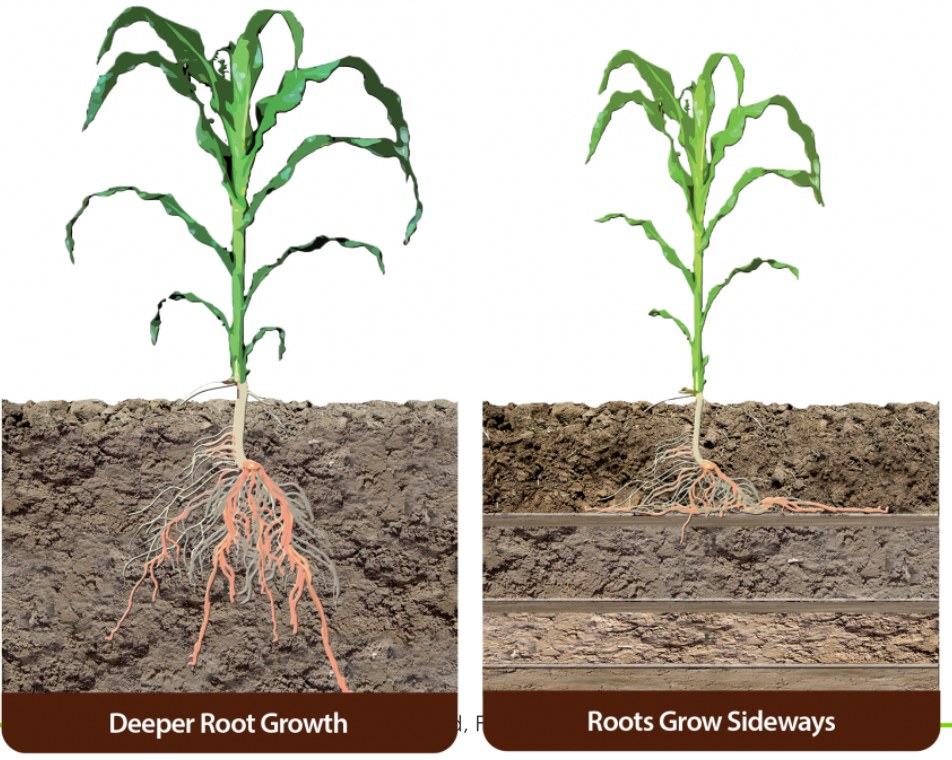
The problem section is explicit that this hardpan is not a natural geological feature but a human-engineered barrier: concentrated pneumatic tire weight and repeated implement passes at a consistent depth polish and compress soil particles into a layer with the consistency of weak concrete, root-proof, water-proof, and life-proof, breaking the earth's natural water and nutrient cycles.
PQNK's stated hierarchy places immediate mechanical fracture as the preferred, most effective solution where equipment is available: a one-time deep subsoiling pass physically shatters the hardpan and restores hydrological connectivity and root access in a single operation. Long-term biological remediation is positioned as essential, not inferior, in rolling lands, small-scale farms, or systems committed to zero mechanical disturbance, working in harmony with the closed-loop system's core tenet of minimal external intervention.
The biological pathway proceeds in four steps: establishing permanent raised beds as a sanctuary from future compaction; sowing deep-rooted pioneer crops like tillage radish or Jantar, whose primary role in extreme, concrete-like hardpan is not immediate fracture but attracting and feeding the true breakers through their root exudates; relying on mycorrhizal fungi as the primary agent, described as the ecosystem's 'stone breaker,' whose hyphae produce organic acids and enzymes that chemically weather and dissolve mineral bonds in compacted soil; and maintaining absolute no-till, mulch, and microbial cultivation as the protected habitat where a consortium of fungi, bacteria, and earthworms works over years, not months, to physically pry apart, chemically dissolve, and biologically glue the compacted layer back together with glomalin.
The paper closes by matching pathway to context: severely degraded, aggressively tilled soils are usually best served by an initial mechanical subsoiling pass followed immediately by the permanent bed and no-till system, while milder cases or hazardous, sloped land can start directly on the biological pathway. Both converge on the same end state, a permanently raised, never-disturbed, mulch-covered bed where soil life autonomously manages structure, hydrology, and fertility, and the paper frames outside intervention, chemical or mechanical beyond the initial reset, as disruptive to the very microbial intelligence performing the repair.
Full Paper
If you use “Listen”, the text of the page may be sent to your browser or operating system’s speech provider, such as Apple, Google or Microsoft, depending on the voice your device uses. Pedaver does not process, transmit or store any audio.
Executive Summary
The creation of a subsoil hardpan—a dense, concrete-like layer formed by pneumatic tire compaction, and the smearing action of spring-tine cultivators, discs, and moldboard ploughs—represents one of the most severe constraints in conventional agriculture. This barrier, typically beginning at 6 inches and extending to 20 inches deep, severs the soil’s hydraulic function, restricts root exploration, and imprisons biological life. PQNK recognizes a hierarchy of solutions based on context and capacity. Where available and applicable, a one-time mechanical subsoiling intervention provides immediate relief. However, in regions where machinery is inaccessible, impractical, or where a strictly biological management philosophy is applied, a patient, plant-driven strategy is employed. This paper details both pathways, with a focus on the biological system for activating the subsoil through permanent raised beds, deep-rooted crops, and the silent, relentless work of soil microbes—particularly mycorrhizal fungi—to naturally fracture and reunify the soil profile.
1.0 The Problem: The Engineered Hardpan
The modern agricultural hardpan is not a natural geological feature. It is a human-engineered compaction layer resulting from:
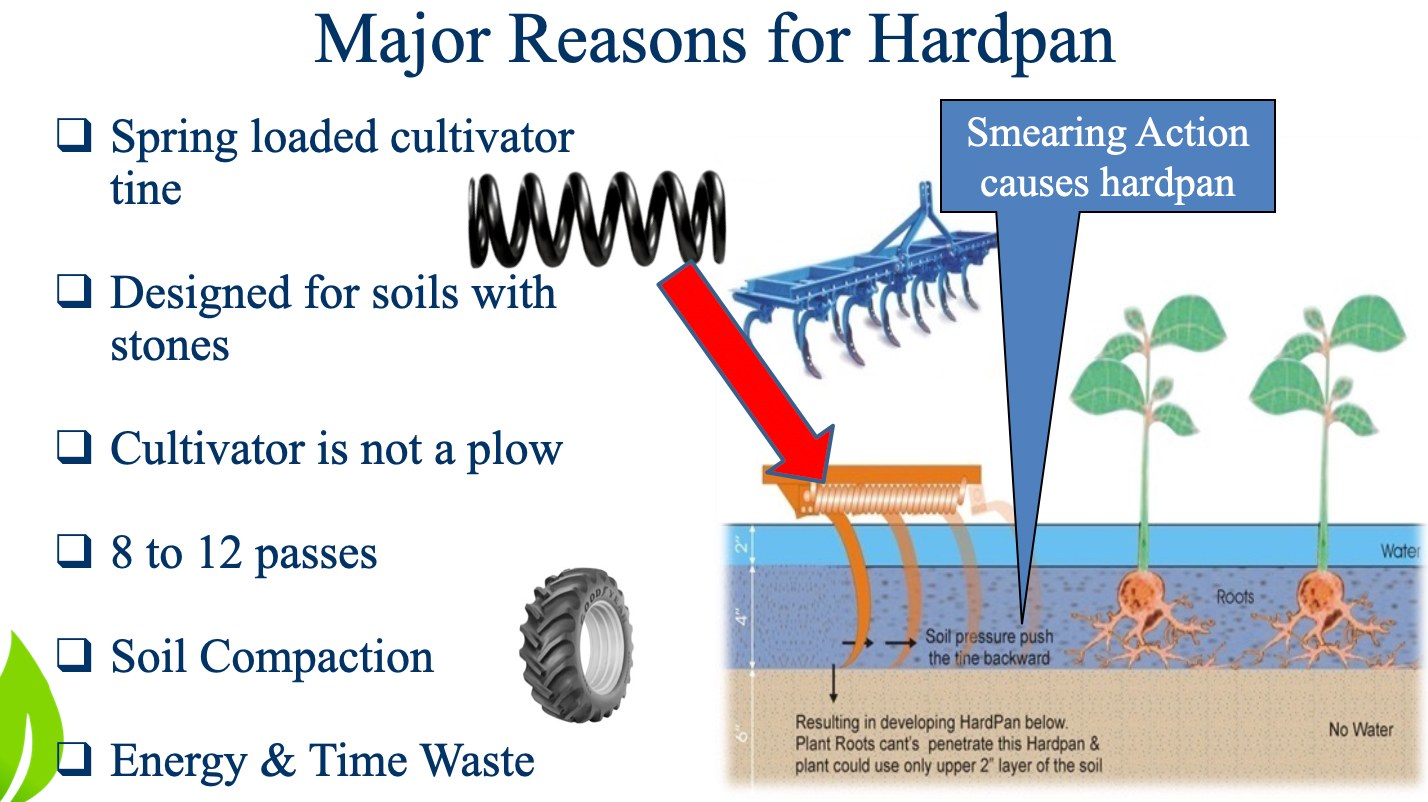
• Pneumatic Tire Pressure: C o n c e n t r a t e d w e i g h t o f machinery.
• I m p l e m e n t S m e a r i n g : Repeated passes of spring-tine c u l t i v a t o r s , d i s c s , a n d moldboard ploughs at a consistent depth polish and compress soil particles into a nearly impermeable barrier.
Characteristics: This layer has the
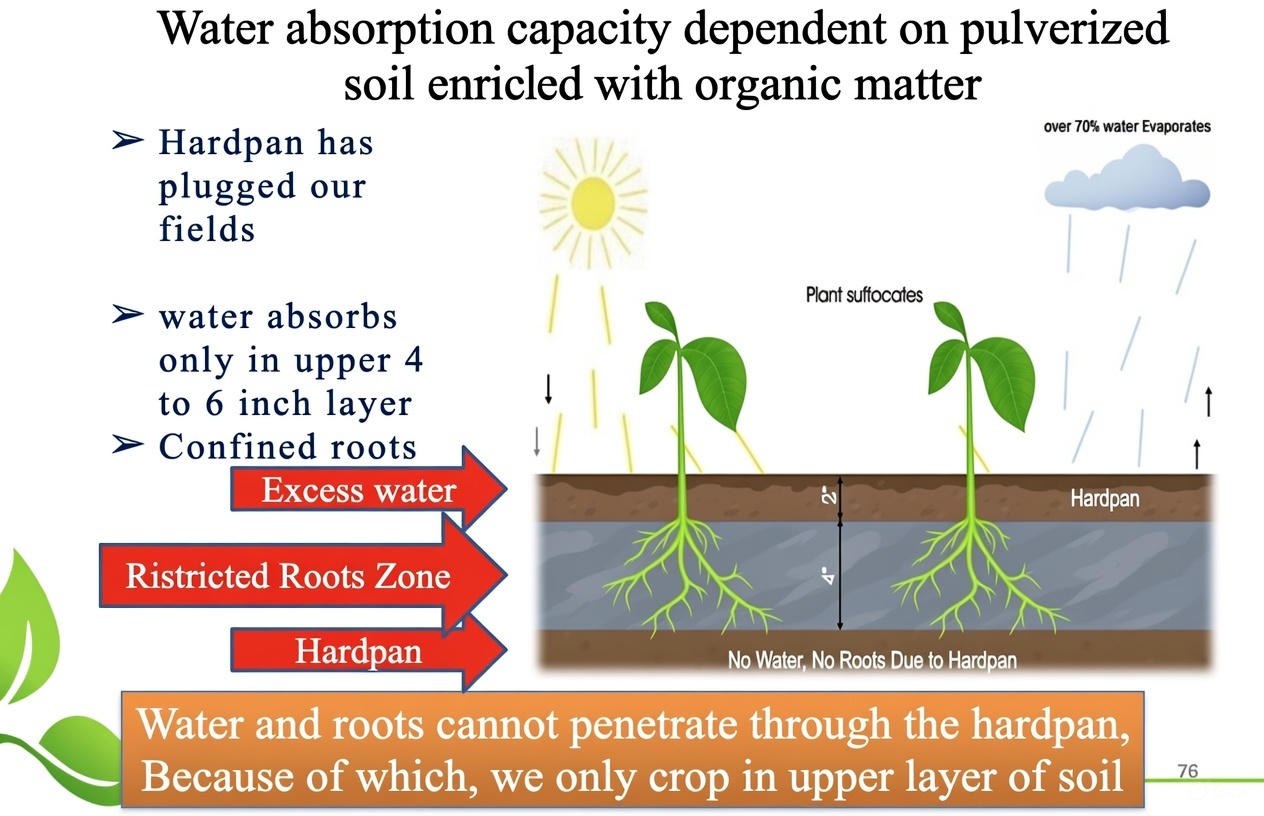
consistency of weak concrete, starting at ~15 cm (6 inches) and often extending to ~50 cm (20 inches) deep. It is root-proof, water-proof, and life-proof, creating a definitive boundary between topsoil and subsoil that breaks the Earth's natural water and nutrient cycles. Reference: PQNK Paper, “The Hidden Crisis: How Industrial Agriculture Has Broken Earth's Water Cycle.”
2.0 The PQNK Principle: Context-Dependent Solutions
PQNK is a principle-based system, not a rigid dogma. The optimal solution is determined by the severity of compaction and the operational context. Hierarchy of Intervention:
1. I m m e d i a t e M e c h a n i c a l
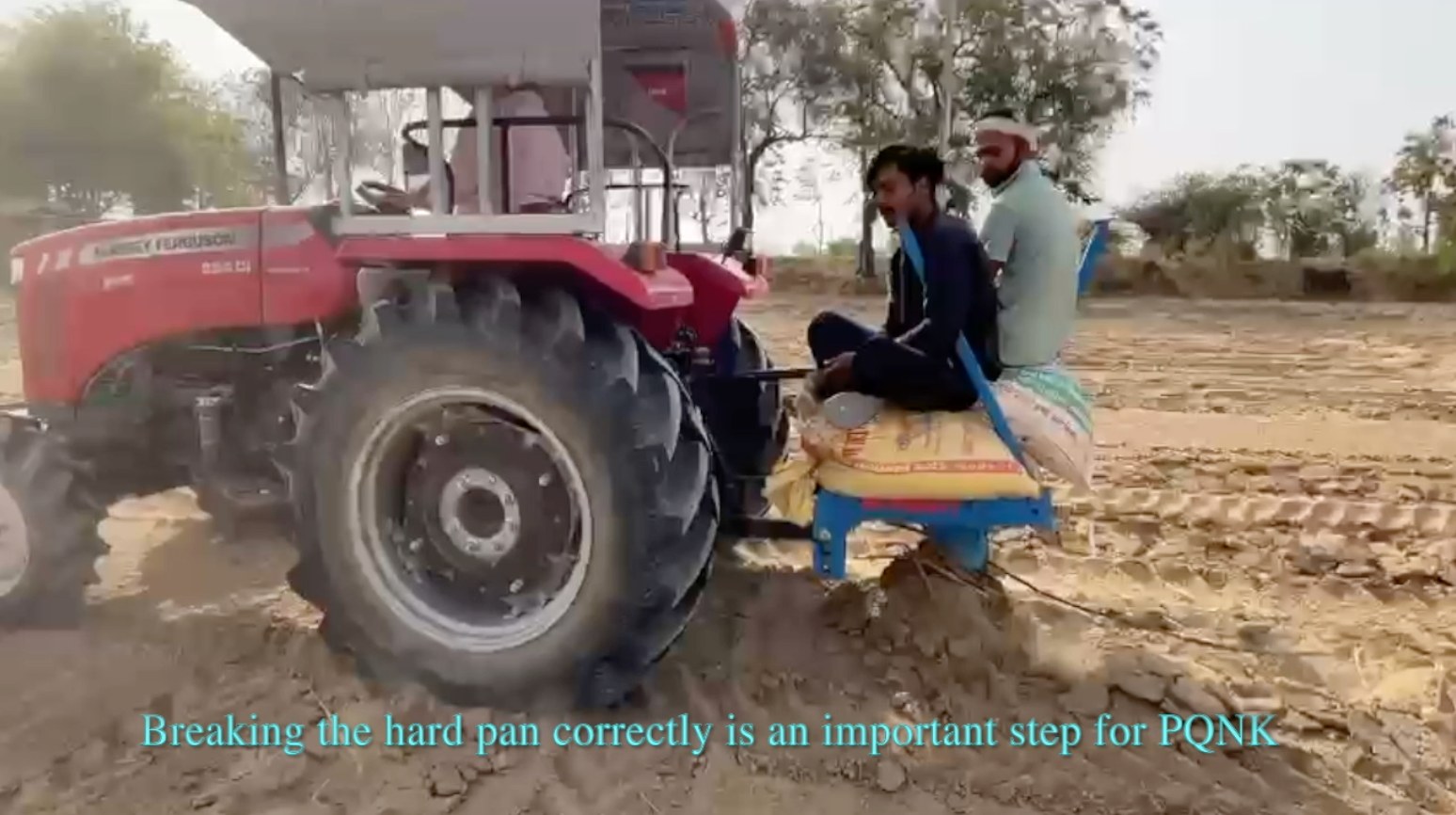
Fracture (Preferred where
feasible): In severely compacted fields where equipment is available, a one-time deep subsoiling operation is the most effective and immediate solution. It physically shatters t h e h a r d p a n , r e s t o r i n g hydrological connectivity and root access in a single pass. This
is the definitive correction for aggressively tilled soils.
2. L o n g - T e r m B i o l o g i c a l Remediation (Essential where machinery is not an option): In rolling lands, small-scale farms, or systems committed to zero-mechanical disturbance, biology becomes the primary tool. This process is slower but works in harmony with the closed-loop system’s core tenet of minimal external intervention.
3.0 The Biological Pathway: When the Subsoiler is Not an Option
In nominated areas where machinery cannot be used or is absent, the system relies on strategic biology and intelligent infrastructure. Step 1: The Architectural Foundation – Permanent Raised Beds
• Construction: Create permanent, undisturbed raised beds. This demarcates a permanent growth zone that will never again suffer wheel traffic or implement smearing.
• Purpose: The bed becomes a sanctuary for soil life. By eliminating all future compaction events, we create a stable environment for the slow, biological work of subsoil repair.
Step 2: The Biological Drilling Corps – Deep-Rooted Crops
• Acknowledged Limitation: In cases of extreme, concrete-like hardness, initial root penetration by plants like tillage radish or Jantar (Sesbania) may be minimal. Their primary role shifts from immediate fracture to pioneering.
• Function: Even slight root exploration into surface cracks, combined with their prolific root exudates, serves to attract and feed the true breakers: mycorrhizal fungi and microbial communities. They are the vanguard that begins the chemical and biological weathering of the hardpan surface.
Step 3: The Primary Agent – Mycorrhizal Fungi as the "Stone Breaker"
• Mechanism: Mycorrhizal fungi are the ecosystem's ultimate geological engineers. Their hyphae produce organic acids and enzymes that chemically weather and dissolve mineral bonds in compacted soil, effectively converting "rock-like" structure back into permeable soil.
• Partnership: These fungi form symbiotic relationships with the deep-rooted crops on the beds. The plants supply carbon, and in return, the fungal networks extend far into the compacted zone, beginning the slow process of fracturing and reconnecting soil strata.
Step 4: The Undisturbed Cycle – No-Till, Mulch, and Microbial Cultivation
• No-Till Planting: Cash crops are planted directly into the bed mulch with a no-till planter. Absolute zero disturbance is maintained to protect the fragile fungal networks and soil structure.
• Mulch as a Microclimate: A permanent, thick organic mulch regulates temperature and moisture, creating the ideal, stable habitat for the fungi and microbes undertaking the deep work.
• The Slow Unification: Within these protected, undisturbed beds, a complex consortium of life—mycorrhizal fungi, bacteria, earthworms, and other microbes— takes up the task. They work synergistically to physically pry apart, chemically dissolve, and biologically glue (with glomalin) the compacted layer. This is a process of years, not months. The hardpan is gradually mitigated, and the upper soil is slowly, biologically rejoined with the lower subsoil.
4.0 The Pathway Decision: Assessing the Context
• For Severely Degraded, Aggressively Tilled Soils: The hardpan is often absolute. A one-time subsoiling intervention followed by the immediate establishment of the permanent bed/no-till system is the most pragmatic and rapid path to restoration.
• For Milder Cases or Rolling Lands: Where historical tillage was less aggressive, or on slopes where machinery is hazardous, the biological pathway is initiated directly. The inherent soil strength is higher, and biological agents can make perceptible progress season by season.
• The Unifying Principle: Both pathways converge on the same end state: a permanently raised, never-disturbed, mulch-covered bed where soil life autonomously manages soil structure, hydrology, and fertility in a closed loop.
5.0 The Closed-Loop Imperative: Patience and Non-Interference
The biological pathway is a testament to the PQNK principle of working within natural time scales.
• Provision: As the mycorrhizal network expands, it unlocks the mineral abundance held in the subsoil and parent material, feeding the crop in perfect balance.
• Protection: A reconnected soil profile produces deeply rooted, resilient plants. The fully developed ecosystem within the bed supports layered predator-prey relationships that manage pests.
• The Ultimate Insight: Intervention from outside—whether chemical or mechanical —disrupts the very microbial and fungal intelligence executing the repair. The system must be allowed to self-organize without interruption.
6.0 Conclusion: Strategic Patience in System Repair
Deep subsoil remediation requires clear-eyed diagnosis and strategic action. The mechanical subsoiler is a valid and powerful reset button for a broken system. However, in contexts where it is not an option, PQNK provides a rigorous, biologically-driven alternative. This alternative demands patience and faith in microbial time. It acknowledges that while radish and Jantar may not punch through concrete in one season, they are essential hosts and facilitators for the mycorrhizal fungi that will, over years, perform the alchemy of turning hardpan back into living soil. By establishing permanent, undisturbed raised beds, we create the sacred space for this slow, sure, and ultimately self-sustaining repair to unfold. The result is not just a fractured pan, but a biologically re-fused soil profile, capable of sustaining abundance for generations. PQNK – Applying Intelligence Contextually, Always in Service of Life’s Own Remedial Power.
Footnote: Any Production Process That Inundates Soil With Water, Disturbs Soil Through Tillage, Or Leaves Soil Bare Without Organic Mulch Cover Does Not Qualify As Natural Ecosystem Science For Production Agriculture.
PQNK, to be pronounced as 'picnic', which stands for Paedar Qudratti Nizam Kashatqari, and means: the regenerative & sustainable Pristine Organic Farming System.
About This Paper
- Problem
- Hardpan · Soil Compaction (General) · Weak / Shallow Root Establishment · Waterlogging
- Science
- Soil
- Evidence
- Scientific Mechanism
- Authority
- Current / Approved PQNK Knowledge
Related PQNK Science
Key Takeaways
- The modern hardpan (roughly 6 to 20 inches deep) is described as a human-engineered compaction layer from tire pressure and implement smearing, not a natural soil feature.
- PQNK is explicitly non-dogmatic here: one-time mechanical subsoiling is the preferred, fastest fix where equipment is available and feasible.
- Where machinery can't be used, deep-rooted pioneers like tillage radish or Jantar may barely penetrate concrete-hard pans at first; their real function is feeding and attracting mycorrhizal fungi.
- Mycorrhizal hyphae are cast as the ecosystem's 'stone breaker,' producing organic acids and enzymes that chemically weather and dissolve mineral bonds in compacted soil.
- The biological pathway is a multi-year process, gluing the fractured hardpan back together with glomalin as fungi, bacteria, and earthworms work in concert.
- Both the mechanical and biological pathways converge on the same end state: a permanently raised, undisturbed, mulch-covered bed where soil life manages structure on its own.
Related Knowledge
same problem
When 13 Inches of Rain Falls in Eight Hours
After 13 inches of rain in eight hours, the PQNK orchard beds of Jaskaran Singh in Fazilka district, Indian Punjab, had taken the water into the soil and could be walked on in slippers, while neighbouring conventional orchards and fields stood under water, and so did a strip of his own orchard where the hardpan had not been broken. The paper explains why hardpan is a water barrier as well as a root barrier, and why the soil is the first reservoir.
same problem
Why PQNK Sugarcane Does Not Need Earthing Up
Earthing up is mandatory in conventional sugarcane: the set is placed in a furrow 6 to 8 inches deep between ridges 6 to 8 inches high, above a compacted hardpan, roots stay shallow, and the profile has to be reversed with soil piled around the stool. PQNK removes the cause instead: the hardpan is broken once, cane grows on permanent beds, roots go deep, the crown stays near the aerated surface and the full sugar-rich base can be harvested.
same problem
The Healer's Dialogue: From Weed Signal to Soil Silence — A PQNK Pathway to Self-Regulating Abundance
Responding to a farmer's question about using weeds as nutrient-deficiency indicators, this dialogue explains that in PQNK the goal isn't to manage weeds as permanent indicator crops, but to run a four-step protocol that resolves the soil problems they signal so the weeds voluntarily depart.
same problem
The Management of Soil Density within the Closed-Loop Regenerative System
This knowledge paper gives PQNK's soil-density protocol precise numbers: a target bulk density of 1.0-1.3 g/cm³ for loamy field soil, with compaction onset flagged above 1.4 and severe compaction above 1.6, then walks through the same four-step transition sequence used to hit and hold that range without any external soil amendment.