

KP-066 · Plant Physiology & Production Systems
Knowledge Paper: The Plant as CEO — A PQNK Perspective on Biological Agency in Rhizobial Partnerships
Reading a 2018 transcriptomic study that found rhizobia activate over 2,400 rice genes, this paper argues the standard framing has the causality backwards: the plant is not colonized, it is informed, and it makes the decision. It develops a full 'plant as CEO' recruitment-interview analogy for how legumes and rice actively select, test, and hire their bacterial partners.
Read or listen to the full paper ↓External Knowledge — this paper is sourced from outside Pedaver/PQNK. It is presented as supporting evidence, not as PQNK's own approved doctrine.
Abstract
The paper takes as its evidentiary base Jing et al. (2018), which documented that inoculating rice roots with Sinorhizobium meliloti 1021 differentially expressed 2,414 rice genes across 26 functional categories, alongside increased shoot height, dry weight, and cell enlargement. It argues the conventional interpretive language surrounding such findings, 'colonization,' 'infection,' 'regulation by rhizobia,' 'growth-promoting bacteria,' quietly casts the microbe as the active agent and the plant as a passive recipient, and sets out to invert that reading using the study's own data.
Its central device is the 'Plant as CEO' analogy, developed as a five-step recruitment process: the plant posts a 'job description' by secreting a specific flavonoid blend under nitrogen-limited conditions; compatible rhizobia respond with a chemical 'application,' Nod factor signals produced via their NodD receptors; the plant 'interviews' candidates through LysM-domain receptor kinases that bind Nod factors only with precise structural compatibility; the plant makes a 'hiring decision' by activating its own symbiotic signaling pathway, triggering nodule formation and infection thread development; and it conducts 'ongoing performance management' by housing rhizobia in plant-derived symbiosomes, controlling their oxygen supply, paying them in carbon, and terminating the relationship if performance is unsatisfactory.
The paper's strongest evidence for plant-directed causality is temporal: differentially expressed genes appeared in rice shoots at just 1 and 2 days after inoculation, while the bacteria were still confined to the roots, meaning the shoot was responding to a long-distance internal signal, not to bacterial presence itself. Among the genes activated, the paper highlights 46 cell cycle genes (including cyclins CycA, CycB, CycD), 8 expansin genes governing cell wall loosening, 104 transcription factors across 25 families, and changes across auxin, gibberellin, brassinosteroid, and cytokinin pathways, all plant genes, activated by the plant's own transcriptional machinery in response to received information rather than bacterial instruction.
It extends the analogy to a broader 'microbial internet': flavonoids, Nod factors, quorum-sensing molecules, volatile organic compounds, and internal calcium waves together form a distributed sensory network that makes the plant aware of its soil environment, and cites separate research showing plants can detect and preemptively counter bacterial quorum-sensing signals before a pathogen population turns dangerous, evidence, the paper argues, that plants intercept and strategically use microbial communication rather than merely reacting to it.
Its practical payoff is a reframing of what tillage destroys: not simply a nitrogen-fixing service, but the plant's primary sensory connection to its soil environment, its 'early warning system,' its extended nutrient-gathering reach through mycorrhizae, and its epigenetic calibration input. The paper maps specific PQNK practices, no-till permanent beds, residue retention, no synthetic fertilizer, minimal irrigation, diverse rotation, to the specific piece of the signaling infrastructure each one preserves, concluding that PQNK's yield gains come from reconnecting a sensorily capable plant to a network it depends on, not from any external input.
Full Paper
If you use “Listen”, the text of the page may be sent to your browser or operating system’s speech provider, such as Apple, Google or Microsoft, depending on the voice your device uses. Pedaver does not process, transmit or store any audio.
1. Introduction: Reframing the Question
The Jing et al. paper is a valuable piece of work. It meticulously documents that inoculation of rice roots with live Sinorhizobium meliloti
1021 leads to increased shoot height, dry weight, parenchyma cell enlargement, and—critically—the differential expression of 2,414 rice genes across 26 functional categories including signaling, cell cycle regulation, phytohormone metabolism, and cell wall expansion . The authors rightly identify these as molecular correlates of growth promotion.
However, the prevailing interpretive framework in plant-microbe research often implies a directional causality: bacteria act, plant responds. The language of "colonization," "infection," "regulation by rhizobia," and even "growth-promoting bacteria" subtly positions the microbe as the active agent and the plant as the passive recipient. The PQNK lens demands we invert this reading.
Paedar Qudratti Nizam Kashatqari (PQNK) — a regenerative, no-till, nature-mimicking farming system practiced in South Asia—rests on a foundational ecological insight: soil is not a substrate but a living information network . Under PQNK management, permanent raised beds are never tilled, crop residues are retained as mulch, and synthetic inputs are eliminated. Farmers practicing PQNK report yield increases, dramatic water savings, and improved soil health—not because they have added anything, but because they have stopped destroying the pre-existing biological infrastructure .
What, then, does the Jing et al. study actually show when read through this lens? Not bacteria reprogramming the plant. Rather: the plant responding —through its own receptor systems, its own transcriptional machinery, its own hormonal intelligence—to molecular signals carried by the rhizobial network. The 2,414 differentially expressed genes are the plant's own genes, activated by the plant's own biological decisions in response to information it received.
This distinction matters. It places biological agency where it belongs: in the plant-soil system as a whole, not in any single organism within it.
2. The Plant as CEO: A Management Analogy for Biological Sovereignty
Recent work in organizational management has drawn explicit parallels between plant behavior and intelligent corporate strategy . The "living company" concept—organizations as adaptive, learning, growth-oriented entities—finds a surprising resonance in plant biology. We extend this analogy formally.
2.1 The Plant as Decision-Maker
Consider the plant as the Chief Executive Officer (CEO) of its micro-environment. The CEO does not manufacture every component of the production system. Rather, the CEO:
• Senses the external environment (soil conditions, nutrient availability, threat presence);
• Evaluates information against internal goals (growth, reproduction, defense);
• Recruits appropriate partners (microbes, fungi, soil fauna) who "apply for jobs" within the production system;
• Signals its requirements through chemical exudates (flavonoids, strigolactones, carbohydrates);
• Integrates feedback loops to calibrate resource allocation;
• Maintains sovereignty over all critical decisions—which genes to express, which pathways to activate, which partnerships to terminate.
2.2 The Recruitment Interview: How Rhizobia "Apply for Jobs"
In the legume-rhizobium symbiosis—and, as Jing et al. show, in the rice-rhizobium association as well—the recruitment process follows a well-defined sequence :
Step 1: The Plant Posts a Job Description. Under nitrogen-limited conditions, the plant secretes a specific blend of flavonoid compounds into the rhizosphere. These are not mere exudates; they are position descriptions specifying the plant's current requirements .
Step 2: Candidates Respond. Rhizobia possessing compatible NodD receptors detect these flavonoids and activate their nod genes, producing lipochitooligosaccharide Nod factors . This is the bacterial "job application"—a chemical resume indicating specialized capability.
Step 3: The Plant Interviews Candidates. Plant LysM-domain receptor kinases (NFR1 and NFR5 in Lotus, their homologs in rice) bind directly to Nod factors. High-affinity binding occurs only when there is precise structural compatibility—the plant is discriminating among applicants .
Step 4: The Plant Makes a Hiring Decision. Upon recognition of a compatible signal, the plant activates a common symbiotic signaling pathway, initiating cortical cell divisions (nodule primordia formation), infection thread development, and ultimately endophytic accommodation of the selected bacteria . The plant opens the door; the bacteria do not force entry.
Step 5: Ongoing Performance Management. Once recruited, rhizobia are housed within symbiosomes—organelle-like compartments bounded by plant-derived membranes. The plant continues to regulate the relationship: controlling oxygen tension to enable nitrogenase activity, supplying carbon skeletons as payment for fixed nitrogen, and—if performance is unsatisfactory—terminating the association.
2.3 Evidence from Jing et al.: The Plant's Transcriptional Response
The Jing et al. data are entirely consistent with this CEO model. Critically, 195 differentially expressed genes were detected in rice shoots at 1 day after inoculation—while bacteria were still confined to the roots. By 2 DAI, this had risen to 1,390 DEGs, again before rhizobial ascension to above-ground tissues .
This temporal pattern is decisive. The shoot is responding to information, not to bacterial presence. The roots have detected compatible signals, and have communicated this information long-distance to the shoot— activating signaling pathways, transcription factors, and cell cycle regulators in anticipation of future benefit.
The plant is not a passive victim of colonization. It is an anticipatory, intelligent system that has decided to invest resources in growth based on information received about its microbial neighborhood.
3. The Microbial Internet: Rhizobia as an Information Infrastructure
If the plant is CEO, what are the rhizobia? They are not employees in any simple sense. They are nodes in an information network—the "internet of the plant world."
3.1 Signaling as Information Transfer
The molecular dialogue between plants and rhizobia involves multiple classes of signals:
• Flavonoids (plant → microbe): "Here is my current status and requirements."
• Nod factors (microbe → plant): "I am a compatible partner with relevant capabilities."
• Quorum sensing molecules (microbe ↔ microbe): Information about population density and community composition .
• Volatile organic compounds (microbe → plant): Long-distance, airborne information .
• Calcium waves (cell → cell within plant): Information propagation through tissues .
These signals collectively constitute a distributed sensory network that makes plants aware of their soil environment, their microbial neighborhood, and the conditions around their roots.
3.2 The Plant Reads, The Plant Decides
Recent research has shown that plants can detect bacterial quorum sensing signals and mount preemptive defenses before the bacterial population reaches pathogenic density . Arabidopsis perceives 2'-aminoacetophenone (2'-AA), a volatile signal from Pseudomonas aeruginosa, and deploys a tripartite defense: intracellular immunity, extracellular quorum quenching via acetic acid release, and root microbiome restructuring .
What is notable here is that the plant is intercepting microbial communication and using it for its own purposes. The plant does not merely react to bacterial presence; it eavesdrops on bacterial conversations and acts strategically.
Similarly, in the Jing et al. study, the plant does not simply grow more because rhizobia are present. It upregulates cell cycle genes (CycA, CycB, CycD1, D2, D3) at 2 DAI—three days before the rhizobia ascend from roots to shoots . This is not a reflexive response. It is a strategic investment decision, made by the plant, in anticipation of future resource availability.
3.3 What Is Lost When the Network Is Destroyed?
The PQNK framework emphasizes that conventional tillage agriculture— plowing, inundation, bare soil exposure, synthetic fertilizer application— destroys the microbial internet.
Consider what is lost:
1. Sensory bandwidth: Without an intact microbial network, the plant cannot detect soil conditions beyond its immediate root tips.
2. Early warning systems: Quorum sensing interception, pathogen detection, and immune priming all depend on microbial signaling.
3. Nutrient access: Mycorrhizal networks and nitrogen-fixing rhizobia extend the plant's reach beyond its own root architecture.
4. Stress resilience: Microbial partners produce osmolytes, phytohormones, and antioxidants that buffer environmental stress.
5. Epigenetic calibration: The plant's transcriptional decisions depend on information from the microbial neighborhood. When the rhizobial network is destroyed, the plant is not merely losing a service. It is losing its primary connection to the information system through which it reads and responds to the world. The plant becomes sensorily deprived—blind, deaf, and numb to its own environment.
This is why PQNK farming achieves such remarkable results without external inputs. It restores the information infrastructure. The plant, once reconnected to its microbial internet, can intelligently recruit partners, allocate resources, and optimize its own growth.
4. Transcriptomic Evidence for Plant Sovereignty
The Jing et al. dataset provides specific molecular evidence consistent with the plant-as-CEO model.
4.1 The Plant Activates Its Own Growth Machinery
Among the 2,414 DEGs, the authors identified:
• 46 cell cycle genes up-regulated at 2 DAI, including cyclins (CycA, CycB, CycD) and CDK regulators ;
• 8 EXPANSIN genes up-regulated at 2 and 5 DAI, involved in cell wall loosening and cell enlargement ;
• 104 transcription factors from 25 families, including E2F (cell proliferation), CPP, and G2-like (chloroplast development) ;
• 74 protein kinase genes from 5 groups, including calcium/ calmodulin-dependent kinases and MAPKs .
None of these are bacterial genes. They are the plant's own genes, activated by the plant's own transcriptional machinery, in response to information the plant received.
4.2 Phytohormone Genes: The Plant Calibrates Its Own Growth Regulators
The study found differential expression of genes involved in auxin (AUX), gibberellin (GA), brassinosteroid (BR), and cytokinin (CK) metabolism . These are the plant's internal growth regulators. Rhizobia do not "supply" these hormones in meaningful quantities; rather, the plant adjusts its own hormone biosynthesis and signaling in response to rhizobial information.
Specifically:
• 16 AUX-related genes were differentially expressed, including PIN1 (auxin transport), IAA-amino acid hydrolase, and SAUR family genes;
• 3 GA-related genes were up-regulated at 2 DAI, including gibberellin-stimulated transcripts;
• 2 GA synthesis genes were uniquely detected at 5 DAI, including ent-copalyl diphosphate synthase (3.0-fold increase).
The plant is tuning its own hormonal network based on information received. The rhizobia provide data; the plant makes the decision.
4.3 Long-Distance Signaling: The Shoot Responds Before Bacterial Arrival
The most decisive evidence for plant sovereignty is the temporal sequence. DEGs were detected in shoots at 1 and 2 DAI—while bacteria were still confined to roots . The shoot responded to a signal, not to the bacteria themselves.
This implies the existence of a long-distance communication system— likely involving systemic signaling via xylem sap, phloem-mobile RNAs, or electrical/hydraulic signals. The plant is not a collection of independent organs. It is an integrated information-processing system in which root-derived information shapes shoot gene expression.
When tillage destroys the rhizobial network, it is not merely reducing nitrogen fixation. It is silencing the signals that would otherwise inform the shoot about soil conditions, enabling the plant to calibrate its growth strategy.
5. Implications: From Mechanism to Meaning
5.1 Rethinking Biological Agency
The dominant narrative in molecular plant-microbe research is implicitly anthropocentric and mechanistic. We speak of "pathogens," "symbionts," "colonization," "infection," "regulation," "manipulation"—all verbs that assume the microbe acts and the plant reacts.
The PQNK lens suggests an alternative: the plant acts; the microbe informs.
The 2,414 DEGs in the Jing et al. study are not evidence of bacterial control. They are evidence of plant intelligence—of a sovereign organism using molecular information to optimize its own growth, reproduction, and survival.
This is not mere semantics. How we frame biological agency shapes research priorities. If bacteria "promote growth," we search for bacterial molecules that might be deployed as agricultural inputs. If plants recruit and respond to bacteria based on their own assessment of need, we instead focus on restoring the conditions—intact soil, living mulch, no tillage— that enable the plant to exercise its intelligence.
5.2 PQNK as Applied Plant Sovereignty
The PQNK farming system operationalizes this understanding. Key practices include :
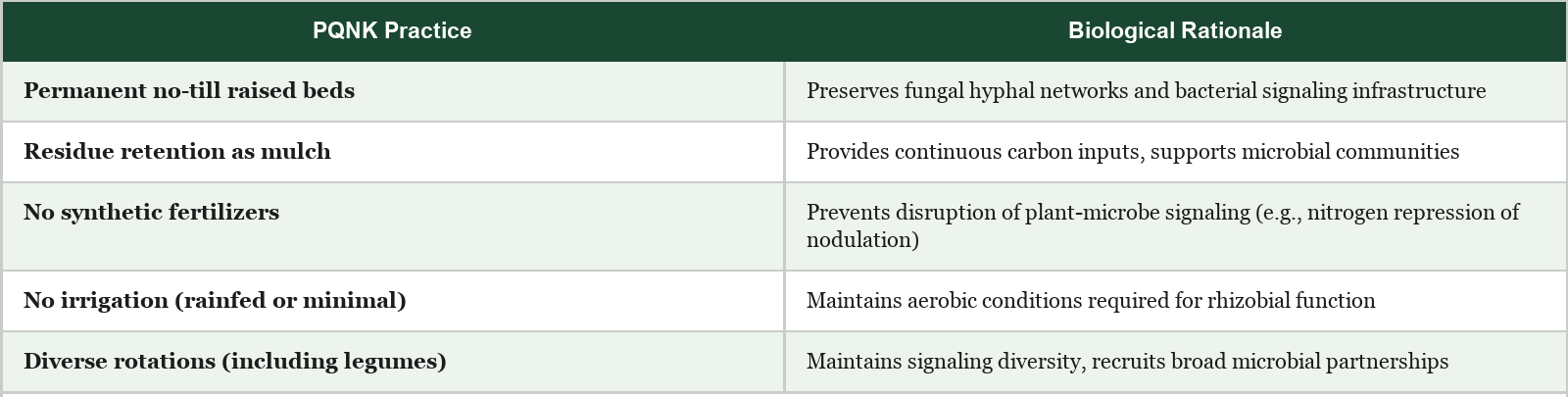
| PQNK Practice | Biological Rationale |
|---|---|
| Permanent no-till raised beds | Preserves fungal hyphal networks and bacterial signaling infrastructure |
| Residue retention as mulch | Provides continuous carbon inputs, supports microbial communities |
| No synthetic fertilizers | Prevents disruption of plant-microbe signaling (e.g., nitrogen repression of nodulation) |
| No irrigation (rainfed or minimal) | Maintains aerobic conditions required for rhizobial function |
| Diverse rotations (including legumes) | Maintains signaling diversity, recruits broad microbial partnerships |
Under PQNK, the plant is not "treated" with inputs. It is reconnected to its information network. The farmer's role is not to feed the plant but to protect the internet.
5.3 The Cost of Network Destruction
Conventional rice production typically involves:
• Puddling and inundation: Creates anaerobic conditions that kill aerobic rhizobia;
• Synthetic nitrogen fertilizers: Repress nodulation and rhizobial signaling;
• Tillage: Physically disrupts hyphal networks and redistributes microbial communities;
• Monoculture: Reduces signaling diversity.
From a PQNK perspective, these practices are not merely inefficient. They are sensory deprivation for the plant. The plant is surrounded by soil but cannot read it. It has been disconnected from the information system through which it evolved to perceive and respond to its environment.
The yield gains reported by PQNK farmers—doubling of production with less than one-third the water—are not mysterious . They are the result of restoring the plant's native intelligence by reconnecting it to its microbial internet.
6. Conclusion: The Sovereign Plant
The Jing et al. paper is a valuable piece of work. What it documents is not bacteria reprogramming or dictating to the plant. It is the plant responding —through its own receptor systems, its own transcriptional machinery, its own hormonal intelligence—to molecular signals carried by the rhizobial network.
Rhizobia, in this reading, function as a signaling infrastructure that makes plants aware of their soil environment, their microbial neighborhood, and the conditions around their roots. What plants do with that awareness— how they adjust their micro-environment, redirect their energy, and calibrate their own growth responses—is the plant's own intelligence at work.
The bacteria do not command; they inform. The plant is sovereign.
This distinction matters because it places biological agency where it belongs: in the plant-soil system as a whole, not in any single organism within it. And it means that when the rhizobial network is destroyed—by tillage, inundation, or bare soil exposure—the plant is not merely losing a service. It is losing its primary connection to the information system through which it reads and responds to the world.
The PQNK framework offers a path forward: restore the network, reconnect the plant, and trust the intelligence that has evolved over 450 million years of plant-microbe coevolution. The plant, given access to its microbial internet, knows what to do.
References
1. Jing, Y. et al. (2018). Rhizobia promote the growth of rice shoots by targeting cell signaling, division and expansion. Plant Molecular Biology.
2. Liu, C.-W., & Murray, J.D. (2016). The role of flavonoids in nodulation host-range specificity. Frontiers in Plant Science.
3. Broghammer, A. et al. (2012). Legume receptors perceive the rhizobial lipochitin oligosaccharide signal molecules by direct binding. PNAS.
4. (2026). Perception of a bacterial quorum sensing signal activates a tripartite plant immune strategy. PNAS, 123(18).
5. IMBB Educational Farm Tour Report. (2025). University of Lahore.
6. IMBB Guest Lecture on PQNK. (2024). University of Lahore.
7. PQNK Model for Farming. (2024). News Potli (Hindi).
8. Celebrating 20 Years of Genetic Discoveries in Legume Nodulation. (2022). The Plant Cell.
9. Organization Botany: Lessons in Management from the Plant
Kingdom. (2025). IEEE Xplore.
10. Plant 'first responder' cells warn neighbors about bacterial pathogens. (2025). Science Signaling / EurekAlert.
Acknowledgments: This paper was developed through dialogue with practitioners of PQNK farming, whose lived experience of restoring soil information networks inspired the theoretical framing presented here.
Correspondence: Viewed through the PQNK lens, the plant is sovereign. The question is not whether we can engineer better microbes, but whether we can stop destroying the microbial internet that plants have depended on for half a billion years.
Applying PQNK without understanding nature’s operating system will not deliver abundance, stability, or nutrient density.
PQNK (pronounced “picnic”)—the regenerative & sustainable Pristine Organic Farming System —is grounded in Natural Ecosystem Science. This science employs perennial biodiversity, protects soil with organic mulch, and avoids practices such as water inundation, tillage disturbance, and leaving soil bare.
It is the process that matters most. PQNK is a pristine production system designed not merely for yield, but for optimal, balanced output—where quality, sustainability, and ecological harmony emerge from a self‑regulated, zero‑external‑input methodology.
About This Paper
- Crop
- Rice
- Problem
- Tillage Damage to Soil Biology / Structure · Weak Below-Ground Symbiosis (Mycorrhizae/Nitrogen-Fixers)
- Science
- Soil · Plants · Biodiversity
- Evidence
- External Scientific Evidence
- Authority
- External Knowledge / Evidence
Related PQNK Science
Key Takeaways
- Reframes the 2018 Jing et al. finding that rhizobia activate 2,414 rice genes: the paper argues these are the plant's own genes, triggered by the plant's own transcriptional decisions, not bacterial control.
- Develops a five-step 'Plant as CEO' analogy for legume/rice-rhizobium symbiosis: job posting (flavonoids), application (Nod factors), interview (receptor binding), hiring decision (symbiotic signaling), and ongoing performance management (symbiosome control).
- Its key evidence for plant-directed causality is temporal: shoot gene expression changed within 1-2 days of root inoculation, while bacteria were still confined to the roots, implying a plant-generated long-distance signal, not bacterial action on the shoot.
- Cites separate research showing plants can detect and preemptively counter bacterial quorum-sensing signals before a pathogen population becomes dangerous.
- Maps specific PQNK practices (no-till, residue retention, no synthetic fertilizer, diverse rotation) to the specific pieces of plant-microbe signaling infrastructure each one is argued to preserve.
- Reframes what tillage destroys: not just a nutrient-delivery service, but the plant's primary sensory and early-warning connection to its soil environment.
Related Crops
Related Knowledge
same problem
The Underground Network We Have Been Farming Against
New 3D synchrotron imaging (Braunmiller et al., New Phytologist 2026) shows mycorrhizal hyphae spanning air-filled pores, bridging soil particles and growing along roots in intact soil. This paper separates what the research shows from what it means for PQNK: soil architecture is part of the root-fungal partnership, conventional farming dismantles it after every harvest, and a moist but aerated, undisturbed root zone protects it.
same problem
Plant Nutrition Is a Living System, Not an Input Prescription: Why PQNK Restores the Nutrient-Cycling Environment Instead of Feeding the Plant Element by Element
Modern agriculture describes plant nutrition element by element: identify what the plant contains, calculate what the crop removes, replace it from a bag. This paper argues that framing mistakes an accounting exercise for a biological one. A plant's mass is built mostly from air and water, its nitrogen comes from the atmosphere through biological fixation, and the net new mineral draw on the geological reserve after recycling is very small; what determines whether a crop can acquire a nutrient is the living biological interface between mineral and root, not the total inventory in the soil. PQNK therefore restores the nutrient-cycling environment rather than writing an ever-longer fertiliser prescription: manage the habitat, and the living system manages plant nutrition.
same problem
The Underground Air: Why Soil's Water:Air Balance Governs Nitrogen Fixation, and Every Other Root Function, in the PQNK System
Sparked by a farmer's hunch that nitrogen-fixing microbes must be breathing 'underground air' rather than atmospheric oxygen, this heavily-referenced paper explains that insight through the biochemistry of nitrogenase, then, at a Cornell researcher's prompting, extends the same governing principle to phosphorus and potassium solubilization, soil bioporosity, pH stability, and root water uptake in non-leguminous crops.
same problem
Production Architecture: Engineering the Farm So the Living System Never Has to Be Rebuilt
Explains the physical engineering behind the four PQNK principles: permanent raised beds and furrows that separate destructive tractor traffic and irrigation from a protected biological zone, so a field accumulates biological function crop after crop instead of being torn down and rebuilt every season.