

KP-197 · Soil Science & PQNK System
Plant Nutrition Is a Living System, Not an Input Prescription: Why PQNK Restores the Nutrient-Cycling Environment Instead of Feeding the Plant Element by Element
Modern agriculture describes plant nutrition element by element: identify what the plant contains, calculate what the crop removes, replace it from a bag. This paper argues that framing mistakes an accounting exercise for a biological one. A plant's mass is built mostly from air and water, its nitrogen comes from the atmosphere through biological fixation, and the net new mineral draw on the geological reserve after recycling is very small; what determines whether a crop can acquire a nutrient is the living biological interface between mineral and root, not the total inventory in the soil. PQNK therefore restores the nutrient-cycling environment rather than writing an ever-longer fertiliser prescription: manage the habitat, and the living system manages plant nutrition.
Read or listen to the full paper ↓Abstract
Modern agriculture has come to describe plant nutrition in the language of individual elements: identify what the plant contains, calculate what the crop removes, and replace those nutrients from a bag. This paper argues that framing mistakes an accounting exercise for a biological one. The structural mass of a plant is built overwhelmingly from carbon, hydrogen and oxygen drawn from air and water; nitrogen originates from the atmosphere through biological fixation; and the net new mineral draw on the geological reserve, once biological recycling is accounted for, is very small. Mineral elements are indispensable, but a trace element can be physiologically essential while forming a minute fraction of plant mass, so small quantity does not mean small importance.
A mineral atom taken up by one generation of vegetation does not disappear when that plant dies. If roots remain in the soil and above-ground biomass returns to the surface, decomposition, microbial processing and subsequent uptake move those elements through repeated cycles. Between the geological mineral and the growing plant stands a biological interface, roots and exudates, bacteria and fungi, mycorrhizal networks, decomposing residues and the oxygen in soil pores, and it is that interface, not the total mineral inventory, that determines whether a crop can acquire what it needs. PQNK, the Natural Ecosystem Science of Production Agriculture, therefore does not try to anticipate every future discovery with an ever-longer fertiliser prescription. It restores the nutrient-cycling environment: no routine soil disturbance, no unnecessary inundation, permanent biological cover, living roots and returned residues, encouraged biodiversity, and moisture managed while aeration is preserved. Crop-nutrient removal is treated as a measurement, not automatically a fertiliser requirement; and during the transition from a chemically dependent system a small corrective dose, up to about four kilograms of NP per acre and at most three applications where genuinely required, is used as a bridge, applied only when the crop itself shows a genuine deficiency. The governing principle: PQNK manages the habitat; the living system manages plant nutrition.
Full Paper
If you use “Listen”, the text of the page may be sent to your browser or operating system’s speech provider, such as Apple, Google or Microsoft, depending on the voice your device uses. Pedaver does not process, transmit or store any audio.
1. From element-by-element thinking to the ecosystem
Modern production agriculture has gradually come to understand plant nutrition through the language of individual nutrients. Attention concentrated first on nitrogen, phosphorus and potassium. The list expanded as deficiencies of other elements became better understood, eventually taking in secondary nutrients and micronutrients. Today plant science recognises many essential elements and also studies numerous beneficial and trace elements whose functions and interactions are still being investigated (Marschner, 2012). This progression has greatly expanded scientific
Figure 1. Plant nutrition as a living system. Where a plant's mass originates (air and water, atmospheric nitrogen, and only a very small net draw on the geological mineral reserve after recycling); why minerals present in the soil are not always available; and the PQNK management sequence of observe the crop, diagnose a genuine deficiency, correct minimally, observe again, and then let the restored biology carry the nutrition. knowledge. It has also encouraged a particular way of thinking about crop production: identify what the plant contains, calculate what the crop removes, and replace those nutrients through external inputs.
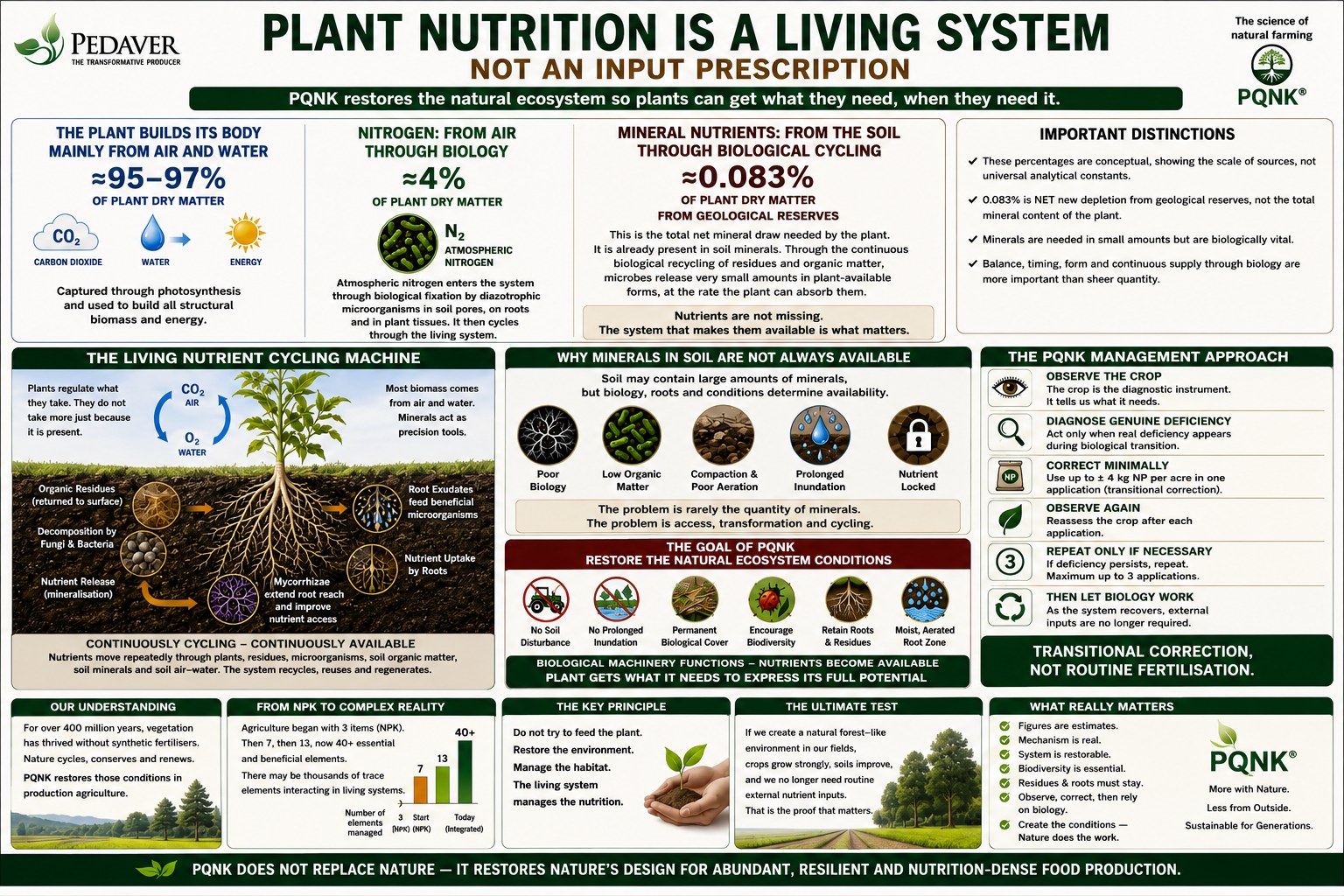
PQNK approaches the question from a different direction. It begins not with the fertiliser bag but with the natural ecosystem. Terrestrial vegetation evolved for hundreds of millions of years before manufactured fertilisers, nutrient recommendations, soil-test prescriptions or an agricultural input industry existed. Natural ecosystems developed complex mechanisms through which atmosphere, water, geological minerals, plants, animals and immense biological communities continually exchange and recycle matter.
PQNK does not claim that plants do not require nitrogen, phosphorus, potassium or other mineral elements, nor that nutrients can be created from nothing. Its proposition is different: production agriculture should restore the ecological machinery through which plants acquire, recycle and regulate their nutrition, rather than attempting to substitute human nutrient prescriptions for that machinery.
2. The plant is mostly built from air and water
One of the most consequential errors in agriculture is the assumption that a crop is principally constructed from the soil. It is not. The overwhelming structural mass of plant dry matter comes from carbon, hydrogen and oxygen. Carbon enters primarily as atmospheric carbon dioxide; hydrogen originates predominantly from water; oxygen is incorporated through both carbon dioxide and water. Through photosynthesis and the biochemistry that follows it, plants convert these relatively simple materials into carbohydrates, proteins, oils, fibres and the extraordinary complexity of living biomass.
Mineral elements are indispensable, but their importance should not be confused with their proportion of total biomass. A trace element can be physiologically essential while constituting an extremely small fraction of plant mass. Small quantity does not mean small importance. This distinction is central to understanding PQNK.
3. The percentages are estimates, not a chemical formula
PQNK educational material has used an approximate conceptual distribution: about 95.917 percent carbon, hydrogen and oxygen associated with air and water; about 4 percent nitrogen ultimately originating from the atmospheric nitrogen reservoir through biological fixation and cycling; and about 0.083 percent as the estimated net new mineral draw from geological reserves after biological recycling. These numbers should not be read as universal analytical constants applicable identically to every crop, plant organ, growth stage, soil and environment. They are estimates used to explain relative scale and nutrient origin within the PQNK conceptual framework.
The distinction matters. The 0.083 percent figure does not mean that the total concentration of mineral nutrients within plant tissue is only 0.083 percent. A plant may contain substantially more mineral material, because much of that material is already circulating within the biological system. A mineral atom taken up by one generation of vegetation does not necessarily disappear when that plant completes its life cycle. If the root remains in the soil and the above-ground biomass is returned to the surface, those elements remain within the biological cycle: decomposition, microbial processing, root activity and subsequent uptake move them through repeated generations.
The relevant question is therefore not simply how much mineral the plant contains. It is how much new mineral must be withdrawn from the geological reserve once biological recycling has been accounted for. Those are very different quantities.
4. Nutrient requirement is not the same as geological depletion
Conventional nutrient accounting can easily confuse the two. Suppose a plant takes up potassium from the soil. At harvest, part of that potassium leaves the field in the harvested product, while another part remains in roots, stems, leaves and other residues. If those residues are returned and decomposed, their potassium has not vanished; it becomes part of the next biological cycle. The same principle applies, in different ways and proportions, to phosphorus, calcium, magnesium, sulphur and the many trace elements incorporated into biological material.
A natural ecosystem therefore operates substantially through cycling rather than repeated reconstruction from zero. Forests are the most obvious demonstration. Enormous quantities of nutrients pass every year through leaves, wood, roots, microorganisms, animals, litter and soil, and yet the forest receives no fertiliser recommendation after each growing season. Material falls. Roots die and regenerate. Organisms consume one another. Organic matter decomposes. Minerals are released, immobilised, transformed and acquired again. Life continuously rebuilds life from previously assembled biological material while interacting with atmosphere, water and geological reserves. PQNK seeks to restore this principle to production agriculture.
5. Nitrogen illustrates the difference
Nitrogen occupies a special position because the atmosphere holds an immense reservoir of molecular nitrogen. Plants cannot manufacture nitrogen; atmospheric N2 must first enter biologically usable pathways. Natural ecosystems accomplish this through nitrogen-fixing microorganisms. Agriculture commonly associates biological nitrogen fixation with the legume and rhizobium symbiosis, but fixation is not confined to legumes: free-living, associative and endophytic diazotrophic microorganisms also occur in soil and in plant-associated environments.
PQNK therefore regards biologically active, aerated soil as more than a physical rooting medium. The air occupying soil pores is part of the biological environment. Nitrogen-fixing organisms can use the atmospheric N2 present within this soil and atmosphere continuum and introduce biologically fixed nitrogen into nutrient cycles, after which it moves repeatedly through microorganisms, roots, residues and later vegetation. The approximate 4 percent figure used in PQNK explanations should be understood as a conceptual estimate of nitrogen's contribution to plant biomass and its ultimate atmospheric origin, not as a claim that every plant under every condition contains exactly 4.000 percent nitrogen or obtains it through one bacterial species or one pathway. PQNK does not depend on one nitrogen-fixing organism any more than its pest protection depends on one predatory insect. It depends on the restoration of a functioning biological community.
6. From NPK to an increasingly complex understanding
Agricultural history is itself a warning against excessive confidence in simplified nutrient prescriptions. Practical fertilisation once concentrated almost entirely on the familiar NPK framework. Understanding then expanded to include additional macronutrients, secondary nutrients and micronutrients, and increasingly sensitive analytical techniques can now detect many more elements in biological material. Not every element detected in a plant is essential, and detection should not be confused with demonstrated necessity. But the direction of travel makes a larger point: the living plant and soil system is considerably more complex than an NPK formulation.
There may be elements required in extremely small concentrations. There may be interactions among elements. There may be beneficial effects that do not meet the formal definition of essentiality. And there are biological relationships governing acquisition that no quantity printed on a fertiliser bag can represent. PQNK does not try to anticipate every future discovery by writing an ever-longer prescription. It restores the system.
7. The biological machinery is the central issue
A soil can contain substantial quantities of an element while a plant growing in it struggles to acquire that element. This apparent contradiction occurs because total mineral inventory and biological availability are not the same thing. Between the geological mineral and the growing plant stands an extraordinary biological interface. Roots release compounds into the rhizosphere. Bacteria and fungi transform materials. Mycorrhizal networks extend the effective nutrient-acquisition zone of the roots. Organic residues decompose. Microorganisms immobilise nutrients temporarily and release them again. Roots alter their immediate chemical environment. Water transports dissolved materials. Soil pores supply the oxygen that aerobic biological activity and root respiration require. Living and dying organisms continuously move elements between biological and mineral pools.
The presence of a nutrient in the soil does not by itself determine whether the crop can use it. Accessibility is a biological function. This is one of the fundamental differences between the PQNK understanding of fertility and input-centred agriculture.
8. Why soil aeration matters
The biological machinery cannot function well without an appropriate soil environment, which is why PQNK treats water management as a biological issue rather than merely an irrigation one. Water is essential, but roots also require oxygen, as do many of the organisms involved in nutrient transformation and cycling. When pore spaces stay inundated for extended periods, water displaces air and changes the biological environment profoundly. PQNK therefore seeks a moist but aerated root zone rather than routine inundation.
This is particularly important in rice, where standing water has become so closely associated with the crop that flooding is often treated as though it were a physiological requirement of rice itself. Rice tolerates flooded conditions exceptionally well, but tolerance should not be confused with biological necessity. Flooding has historically provided real agronomic benefits, above all weed suppression. PQNK separates that management function from the plant's actual requirements and keeps sufficient moisture while preserving aeration wherever it is practicable.
9. Organic matter: more is not automatically the principle
The same systems thinking changes how organic matter should be understood. If chemical fertilisation can become an input prescription, organic agriculture can inadvertently reproduce the same philosophy with different materials: how many tonnes of manure, how much compost, how much organic fertiliser. PQNK asks a different question: why should a functioning field continually depend on importing biological material when the field itself is capable of producing enormous quantities of biomass?
The priority is therefore to retain and recycle what the production ecosystem already produces. Roots stay in the soil. Crop residues stay within the biological system wherever practicable. The soil surface stays protected. Living plants occupy the system for as much of the year as possible. Biodiversity is encouraged. Soil disturbance is avoided. Water is managed to maintain biological function. Under these conditions organic matter becomes a continuous biological process rather than another purchased input. External organic material may sometimes help, particularly during restoration or where biomass has historically been removed, but “apply as much organic matter as possible” should not become a universal PQNK prescription. The objective is self-renewing biological cycling.
10. The crop becomes the diagnostic instrument
Restoring biological function does not mean ignoring the crop; it means the opposite. PQNK gives the plant an important role in deciding whether intervention is necessary. During transition from a chemically dependent, biologically degraded system, biological nutrient pathways may not immediately recover to full function, and a crop may express a visible deficiency. PQNK does not ask the farmer to sacrifice that crop to prove that external nutrients are unnecessary. Instead the farmer observes.
If the crop is healthy, nothing is applied merely because the calendar says fertiliser is due. If a genuine deficiency appears during transition, a small corrective dose can be used. Under the current PQNK transitional field protocol this may be up to about four kilograms of NP per acre in one application, followed by observation of the crop; if the deficiency persists, another small corrective application may be considered, to a maximum of three where genuinely required. The principle matters more than the number: observe, diagnose, correct minimally, observe again. This is fundamentally different from applying a predetermined fertiliser programme regardless of what the crop and the biological system are demonstrating. The corrective input is a bridge during biological restoration, not the foundation of the production system.
11. Crop removal is not a fertiliser prescription
Agronomic nutrient budgets commonly calculate how much nitrogen, phosphorus, potassium and other nutrients leave the field in harvested produce. Such measurements are useful. But another step is needed before concluding that the same quantity must be purchased and reapplied. A production ecosystem contains interacting nutrient pools. Some nutrients leave in harvested grain, fruit, fibre or tubers. Some remain in roots. Some remain in residues. Some cycle through microorganisms. Some are temporarily immobilised. Some become newly accessible from mineral reserves. Nitrogen can enter biological circulation through fixation, and atmospheric deposition and other natural processes also contribute material.
Crop nutrient removal is an accounting measurement. It is not automatically a fertiliser prescription. PQNK seeks to reduce unnecessary external replacement by maximising biological retention, recycling and acquisition. This is also why removing every piece of crop biomass from a field while claiming that nature will recycle it would be self-contradictory: material that physically leaves the biological system cannot be recycled within it. PQNK consequently places great importance on retaining roots and returning residues.
12. The ultimate test is the functioning crop
There is a danger in letting a discussion of plant nutrition become so absorbed in percentages that the biological reality disappears. Whether the estimated net geological contribution is precisely 0.083 percent is not the foundation on which PQNK stands. Whether nitrogen is precisely 4.000 percent of every crop is not the foundation either. Plants vary. Crops vary. Plant organs vary. Growth stages vary. Soils vary. Climates vary. Biological communities vary. And scientific understanding of the relationships among plants, microorganisms and trace elements will keep developing.
PQNK does not need to wait until humanity has identified and quantified every one of those relationships. Nature did not wait. The practical question is whether a restored production ecosystem can sustain healthy crop growth, competitive production, biological protection and continuing soil improvement while progressively reducing dependence on externally supplied agrochemicals. If crops repeatedly demonstrate that they can, that biological performance is itself evidence worthy of systematic measurement and documentation.
13. The production manager restores the habitat
This leads to the simplest description of PQNK nutrient management. The production manager does not try to replace the plant's biological intelligence; the production manager creates the conditions in which that intelligence can function. Do not routinely disturb the soil. Do not unnecessarily inundate the root zone. Keep the soil biologically covered. Maintain living roots and return residues. Encourage biodiversity. Protect the fungi, bacteria, predators and the wider soil food web. Manage moisture while maintaining aeration. Let roots and microorganisms interact with the geological mineral reserve. Intervene only when the biological system shows that assistance is genuinely required.
The result is a profound change in the role of agriculture. Instead of continually asking “what should we feed the crop?”, PQNK asks “what have we done to prevent the natural soil and plant system from feeding itself?” Once that question is asked, fertiliser dependency, residue management, tillage, inundation, biodiversity and soil biology cease to be separate subjects. They become parts of one production ecosystem.
14. Conclusion: manage the habitat, not the periodic table
Plants are among the most sophisticated biological production systems on Earth. For hundreds of millions of years, terrestrial ecosystems have captured carbon, cycled nitrogen, weathered minerals, reused biological residues and regenerated vegetation without fertiliser schedules designed by humans. PQNK does not try to recreate those processes one nutrient at a time. It restores their operating environment.
The approximate figures used to illustrate the origins of plant biomass are useful for showing scale, but they are not the principle itself. The precise percentage of every element may vary, and scientific understanding of trace elements and biological interactions will keep evolving. PQNK does not depend on knowing whether the complete list contains seventeen elements, forty elements or eventually many more biologically relevant trace constituents. Its proposition is more fundamental: restore the natural ecosystem conditions, protect the biological machinery, retain and recycle what the field produces, maintain water and air in the root zone, allow plants and their biological partners to access what they require, observe the crop, and intervene minimally when a genuine deficiency shows the need.
The purpose of PQNK is not to prove that nutrients do not matter. It is to recognise that nutrition is a biological process before it is an input programme. Which leads to the principle that should govern production agriculture: PQNK manages the habitat; the living system manages plant nutrition.
References
Marschner, P. (ed.) (2012). Marschner's Mineral Nutrition of Higher Plants, 3rd ed. London: Academic Press. (For the essential-elements framework and the distinction between essentiality and abundance.)
Companion Pedaver Knowledge Papers: The Plant Does Not Produce for Humans Alone: Carbon, Biological Production, Harvest and the Real Meaning of Agricultural Productivity; and The Earth Has Not Stopped Working: A Production-Agriculture Response to Environmental Fatalism.
The PQNK practices, the transitional NP dose and the field results referred to here are documented across the Pedaver Knowledge Papers and in PQNK: The Natural Ecosystem Science of Production Agriculture.
• • •
Applying PQNK without understanding nature's operating system will not deliver abundance, stability or nutrient density.
PQNK (pronounced “picnic”), the regenerative and sustainable Pristine Organic Farming System, is grounded in Natural Ecosystem Science. It employs perennial biodiversity, protects soil with organic mulch, and avoids practices such as water inundation, tillage disturbance and leaving soil bare.
It is the process that matters most. PQNK is a pristine production system designed not merely for yield, but for optimal, balanced output, where quality, sustainability and ecological harmony emerge from a self-regulated, zero-external-input methodology.
Connect and Resources
Pedaver.com | Facebook: facebook.com/Pedaver | YouTube (PQNK): youtube.com/@pedaverpqnk3167/videos | YouTube: youtube.com/@aasifsharif | Email: pedaver@gmail.com | WhatsApp: +92 320 677 6666
About This Paper
- Problem
- Nutrient Deficiency Symptoms (Plant-Visible) · Locked / Unavailable Soil Minerals · External Input Dependency · Preventive/Prophylactic Over-Application of Inputs (Fertilizer/Nitrogen) · Weak Below-Ground Symbiosis (Mycorrhizae/Nitrogen-Fixers)
- Science
- Soil · Plants · Nutrition · Water · Biodiversity
- Evidence
- Philosophical/Framework Argument
- Authority
- Current / Approved PQNK Knowledge
Related PQNK Science
Key Takeaways
- Element-by-element nutrient thinking, identify what the plant contains, calculate what the crop removes, replace it from a bag, mistakes an accounting exercise for a biological one.
- A plant's structural mass is built overwhelmingly from carbon, hydrogen and oxygen from air and water; nitrogen comes from the atmosphere through biological fixation; the net new mineral draw on the geological reserve after recycling is very small, and is not the same as the mineral content of plant tissue.
- Small quantity is not small importance: a trace element can be physiologically essential while forming a minute fraction of plant mass.
- Minerals cycle rather than disappear, an atom taken up by one crop returns to the biological cycle if roots and residues stay in the field, so crop-nutrient removal is a measurement, not automatically a fertiliser prescription.
- Accessibility is a biological function: a soil can hold plenty of an element while the plant struggles to acquire it, because the biological interface (roots, exudates, bacteria, fungi, mycorrhizae, decomposing residues, soil oxygen), not total inventory, governs availability.
- Organic agriculture can reproduce the input-prescription mistake with different materials (how many tonnes of manure or compost); the PQNK priority is to retain and recycle the biomass the field already produces, not to import it.
- The crop is the diagnostic instrument: nothing is applied on a calendar; during transition a small corrective dose, up to about four kilograms of NP per acre and at most three applications, bridges biological restoration, applied only when a genuine deficiency appears. The governing principle: PQNK manages the habitat; the living system manages plant nutrition.
Related Knowledge
same problem
Why Only 4 kg of NP During PQNK Transition?
Answers a transitioning farmer's question, why is PQNK's transitional dose only about 4 kg of NP per acre, by tracing how a plant actually feeds through a water-based soil solution shaped by transpiration, mass flow and diffusion rather than by counting fertilizer bags, and by drawing a precise distinction between over-irrigation and waterlogging that explains why excess soluble nitrogen produces lush, delayed, insect-prone growth.
same problem
Chemical Fertiliser Dependency Through the PQNK Lens
An evidence-qualified review of the article “Chemical Fertilizer Industry”. It keeps the article's warning about soil degradation, nutrient pollution and biological decline, disciplines its headline numbers, and argues that fertiliser dependency is a symptom of a damaged production system (tillage, flooding, bare soil and simplified biology) that PQNK removes by restoring aerated, covered, living soil, reaching zero purchased fertiliser and pesticide at maturity.
same problem
The Earth Has Not Stopped Working: A Production-Agriculture Response to Environmental Fatalism, and What PQNK Restores
A widely shared social-media message, built on Lovelock's Gaia Hypothesis, ends in resignation: the planet will correct a stressed system with floods and extinctions, and all we can do is await nature's revenge. This paper accepts that we are not separate from nature but rejects the fatalism. Drawing on more than fifty years in production agriculture, it argues the core error was redesigning natural systems before understanding them, that agriculture is the clearest case, and that a degraded field is a suppressed system rather than an extinguished one, so the answer is not to fear nature's revenge but to stop fighting nature and learn again to produce with it.
same problem
PQNK Knowledge Paper: The Origin of Plant Mass and the Role of the Soil System
Countering the assumption that plants are built from soil nutrients, this paper traces a plant's physical bulk to photosynthesis, condensed carbon dioxide and water, and reframes soil minerals, typically just 1-10% of a plant's dry matter, as catalysts a restored microbial community makes available rather than bulk the farmer must supply.