

KP-115 · Soil Science & PQNK System
PQNK Knowledge Paper: The Origin of Plant Mass and the Role of the Soil System
Countering the assumption that plants are built from soil nutrients, this paper traces a plant's physical bulk to photosynthesis, condensed carbon dioxide and water, and reframes soil minerals, typically just 1-10% of a plant's dry matter, as catalysts a restored microbial community makes available rather than bulk the farmer must supply.
Read or listen to the full paper ↓Abstract
The paper opens by naming a misconception it treats as foundational to conventional agriculture and the input industry: that plants require external soluble nutrients to grow. Under PQNK's 'perpetual abundance' framing, restored soil provides everything a plant needs in balanced proportion, and the farmer's job is to restore and maintain the soil's living conditions, not to feed the plant directly.
Its central physical claim is that a plant's structural bulk, carbohydrates, cellulose, lignin, and protein, is synthesized from atmospheric carbon dioxide and water absorbed by the roots, through photosynthesis, so that the solid matter of a plant is, in the paper's own phrase, 'condensed air and water.' Soil's role in this process is not to provide bulk but to provide conditions and catalysts, specifically the soil biology that makes a small percentage of mineral elements available for the plant's metabolic processes.
That mineral, or 'ash,' fraction is quantified precisely: typically 1-5% of a plant's fresh weight and 5-10% of its dry matter, composed of nitrogen, phosphorus, potassium, calcium, magnesium, sulfur, silicon, and micronutrients. The paper's diagnostic reframing follows directly: these elements are already present in the soil's parent material, so a deficiency is a deficiency of the soil's biological function to make the element available, not a deficiency of the element itself.
PQNK is described as a zero-external-input model after an initial, one-time restoration phase, operating on plant-microbe synergy, roots exude sugars to feed specific microbes, which solubilize and chelate the exact minerals the plant needs at that growth stage, and a closed-loop cycle in which crop residues and intact roots return nutrients to the soil rather than being removed. The four-step restoration protocol is set out as the system's only external intervention: breaking hardpan, correcting soil chemistry with minimal targeted amendments, establishing permanent raised beds, and cover cropping into no-till planting.
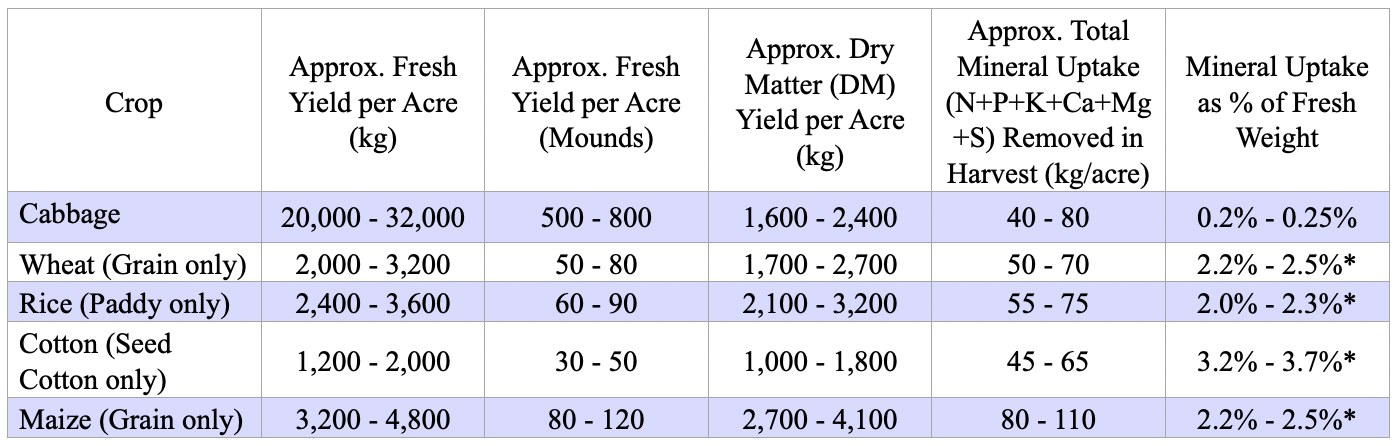
A per-acre quantitative table (Table 1) closes the paper, showing total dry-matter yield against total mineral uptake for various crops, calibrated to the minerals actually removed in the harvested, sold portion rather than the plant's full uptake, since residues are returned as mulch. The paper concludes that this net removal is minuscule and easily met by natural weathering and biological cycling, so the farmer's focus should remain on the four restoration steps and protecting the soil's living conditions, not drowned, not disturbed, and kept within a livable temperature range, rather than on external nutrient addition.
Full Paper
If you use “Listen”, the text of the page may be sent to your browser or operating system’s speech provider, such as Apple, Google or Microsoft, depending on the voice your device uses. Pedaver does not process, transmit or store any audio.
Introduction: The Perpetual Abundance Paradigm
A fundamental misconception, perpetuated by conventional agricultural science and the input industry, is that plants require the external addition of soluble nutrients to grow. This has led to a cycle of dependency on synthetic fertilizers and micronutrient supplements. The PQNK (Pristine Organic Farming System) model, rooted in the principles of perpetual abundance, presents a contrasting reality: a closed-loop, self-sustaining system where the soil, once restored, provides all the necessary nutrients in a perfectly balanced proportion. The primary role of the farmer is not to feed the plant, but to restore and maintain the living conditions of the soil.
The Source of Plant Biomass: Air and Water
The physical mass of a plant does not originate from the soil's mineral component in any significant proportion. The structural components—carbohydrates, cellulose, lignin, and proteins—are synthesized from carbon dioxide (CO₂) drawn from the atmosphere and hydrogen from water (H₂O) absorbed by the roots. This process is driven by photosynthesis. The solid matter of a plant is, therefore, condensed air and water.
The soil's role in this process is not to provide bulk, but to provide the conditions and the catalysts. The catalysts are the soil biology, which makes available the small percentage of mineral elements essential for the plant's metabolic processes.
The "Small Amount from Below": Essential Minerals as Catalysts
The mineral fraction of a plant, often referred to as the ash content, is the only part that is physically sourced from the soil's mineral matrix. This fraction represents a very small percentage of the plant's total fresh weight (typically 1-5%, and 5-10% of its dry matter). This ash is composed of elements like Nitrogen (N), Phosphorus (P), Potassium (K), Calcium (Ca), Magnesium (Mg), Sulfur (S), Silicon (Si), and a host of micronutrients.
In the PQNK model, it is understood that all these elements are already present in the soil's parent material. The issue is not a deficiency of the element in the soil, but a deficiency of the soil's biological function required to make that element available to the plant.
PQNK Principles: No External Inputs
The PQNK system is a zero-external-input model after the initial restoration phase. The practice of adding external micronutrients or minerals, even in powdered form, is viewed as an unnecessary intervention that disrupts the natural balance and the plant's inherent intelligence. The system operates on the following principles:
Microbial Abundance: Every necessary microbe is already present in the soil. They exist in a dormant state. The task is to revive them, not import them.
Plant-Microbe Synergy: Plants exude sugars and carbohydrates from their roots to feed specific microbes. In return, these microbes solubilize and chelate the exact proportion of minerals the plant requires at that specific growth stage.
Closed-Loop System: The cycling of nutrients is managed entirely from within. Crop residues are left as mulch, roots are left intact to decay and create humus, and the soil food web completes the nutrient cycle.
The PQNK Restoration Protocol: Establishing the Sustained State
External additions are strictly limited to the initial regenerative period, which is a one-time intervention to correct anthropogenically damaged soil. The four steps are designed to revive the soil's innate capability, after which no further inputs are added.
Breaking Hardpan: Deep ripping to shatter compacted layers, allowing for gaseous exchange, water infiltration, and deep root penetration.
Correcting Soil Chemistry: Addressing extreme imbalances with minimal, targeted natural amendments to create a livable pH range for microbes. This is a correction, not a fertilization event.
Permanent Raised Beds: Creating a structured, aerobic microenvironment that is never compacted by foot or machinery, ensuring optimal gas exchange and preventing root drowning.
Cover Cropping and No-Till Planting: A multi-species cover crop is grown. Its roots are left intact to feed soil biology and create biopores. The above-ground biomass is used as mulch. The cash crop is planted directly into this living, undisturbed medium using a no-till planter. This establishes a permanent state of soil armor and continuous root growth.
After these steps, the system enters a sustained state. The plants, through their microbial partners, "mine" the soil minerals and access nitrogen cycled through the biology, receiving a perfectly balanced diet.
Quantitative Analysis: The "Small Amount" from Soil
The following table illustrates the total dry matter (DM) production and the total mineral uptake (the "ash content" or the "small amount from below") for various crops on a per-acre basis. This data has been carefully calibrated to reflect the actual mineral mass removed from the field in the harvested portion, reinforcing the understanding that this requirement is a minute fraction of the total yield and well within the capacity of a biologically active soil to supply from its native mineral reserve.
Table 1: Per-Acre Crop Yield and Total Mineral Uptake (Removed in Harvested Portion)
| Crop | Approx. Fresh Yield per Acre (kg) | Approx. Fresh Yield per Acre (Mounds) | Approx. Dry Matter (DM) Yield per Acre (kg) | Approx. Total Mineral Uptake (N+P+K+Ca+Mg+S) Removed in Harvest (kg/acre) | Mineral Uptake as % of Fresh Weight |
|---|---|---|---|---|---|
| Cabbage | 20,000 - 32,000 | 500 - 800 | 1,600 - 2,400 | 40 - 80 | 0.2% - 0.25% |
| Wheat (Grain only) | 2,000 - 3,200 | 50 - 80 | 1,700 - 2,700 | 50 - 70 | 2.2% - 2.5%* |
| Rice (Paddy only) | 2,400 - 3,600 | 60 - 90 | 2,100 - 3,200 | 55 - 75 | 2.0% - 2.3%* |
| Cotton (Seed Cotton only) | 1,200 - 2,000 | 30 - 50 | 1,000 - 1,800 | 45 - 65 | 3.2% - 3.7%* |
| Maize (Grain only) | 3,200 - 4,800 | 80 - 120 | 2,700 - 4,100 | 80 - 110 | 2.2% - 2.5%* |
Note on Values:
The fresh yield ranges represent realistic, good agricultural yields per acre.
The mineral uptake values represent the nutrients contained only in the harvested economic part (e.g., cabbage head, wheat grain) that are physically removed from the field. In a closed-loop PQNK system where all crop residues (straw, stover, stalks) are returned to the soil as mulch, the vast majority of the minerals taken up by the plant are recycled back onto the field. The actual net removal is limited to the minerals in the sold produce.
The percentage of minerals in the fresh weight of high-moisture produce like cabbage is very low (0.2-0.25%). For dry grains, the percentage is higher because the water has been removed, concentrating the minerals.
Conclusion
The PQNK model demonstrates that the conventional approach of external nutrient supply is redundant. A properly restored soil system provides a complete and balanced diet to the crop, mediated entirely by biology. The data confirms that the physical quantity of minerals removed from the field in the harvested produce is minuscule. This small requirement is easily met by the natural weathering of soil minerals and the biological cycling of organic matter within a functioning soil ecosystem, without any external addition. The farmer's focus, therefore, must remain on the four restoration steps and the protection of the soil's living conditions—ensuring it is not drowned, not disturbed, and kept within a livable temperature range. This is the path to true, perpetual agricultural abundance.
——————————
Applying PQNK without understanding nature’s operating system will not deliver abundance, stability, or nutrient density.
PQNK (pronounced “picnic”)—the regenerative & sustainable Pristine Organic Farming System—is grounded in Natural Ecosystem Science. This science employs perennial biodiversity, protects soil with organic mulch, and avoids practices such as water inundation, tillage disturbance, and leaving soil bare.
It is the process that matters most. PQNK is a pristine production system designed not merely for yield, but for optimal, balanced output—where quality, sustainability, and ecological harmony emerge from a self‑regulated, zero‑external‑input methodology.
Connect & Resources Facebook: www.Facebook.Com/Pedaver YouTube (PQNK): https://www.youtube.com/@pedaverpqnk3167/videos YouTube: http://www.youtube.com/@aasifsharif PDF Knowledge Papers: https://drive.google.com/drive/folders/1iadwV6mdUPyrUIpB3oRfNv6DLiackaUL?usp=sharing Email: pedaver@gmail.com WhatsApp: +92 320 677 6666
About This Paper
- Problem
- Nutrient Deficiency Symptoms (Plant-Visible) · External Input Dependency
- Science
- Plants · Soil · Nutrition
- Evidence
- Scientific Mechanism
- Authority
- Current / Approved PQNK Knowledge
Related PQNK Science
Key Takeaways
- States plainly that a plant's structural bulk, carbohydrates, cellulose, lignin, protein, is synthesized from atmospheric CO2 and water absorbed by roots via photosynthesis, not drawn in bulk from the soil's mineral matrix.
- The mineral ('ash') fraction of a plant is typically just 1-5% of fresh weight and 5-10% of dry matter, framed as a catalyst supply rather than the plant's structural building material.
- Reframes nutrient deficiency as a biological-access problem, not a shortage of the element itself: all needed minerals are already present in the soil's parent material, dormant until microbial activity is revived.
- Describes the plant-microbe exchange as transactional: roots exude sugars to feed specific microbes, which solubilize and chelate the precise minerals the plant needs at each growth stage.
- Summarizes PQNK's four-step, one-time restoration protocol, breaking hardpan, correcting soil chemistry, establishing permanent raised beds, and cover cropping into no-till planting, as the only external intervention the system requires.
- A per-acre yield/mineral-uptake table shows that because crop residues are returned as mulch, actual net mineral removal is limited to only the minerals in sold produce, a small fraction of total seasonal uptake.
Related Knowledge
same problem
The Self-Liberating Mineral Cycle: Rejecting the Input Paradigm in the Restored Biome
This foundational document takes direct aim at the practice of applying rock dust, basalt, or other mineral amendments, even under the banner of 'accelerated weathering,' arguing that any felt need for such inputs is a diagnostic signal that a farm's PQNK conversion is incomplete, not a legitimate prescription.
same problem
Knowledge Paper: PQNK Rose Production
Cut-flower rose production is reframed as a closed-loop perennial system under PQNK, reaching a striking 8,712 plants per acre on twin-row permanent beds, with weeds treated as mulch, alfalfa grown as living nitrogen-fixing ground cover, and strict soil-moisture management replacing scheduled irrigation.
same problem
Knowledge Paper: The Perpetual Abundance Principle
Using subcontinental wheat-yield data, this paper shows that even a modest 2-tonne-per-acre crop removes only a tiny fraction of the phosphorus, potassium, and nitrogen already banked in the topsoil, roughly 1 part in 182 for phosphorus alone, and argues that nutrient deficiency is therefore a biological access problem, not a resource shortage.
same problem
Plant Nutrition Is a Living System, Not an Input Prescription: Why PQNK Restores the Nutrient-Cycling Environment Instead of Feeding the Plant Element by Element
Modern agriculture describes plant nutrition element by element: identify what the plant contains, calculate what the crop removes, replace it from a bag. This paper argues that framing mistakes an accounting exercise for a biological one. A plant's mass is built mostly from air and water, its nitrogen comes from the atmosphere through biological fixation, and the net new mineral draw on the geological reserve after recycling is very small; what determines whether a crop can acquire a nutrient is the living biological interface between mineral and root, not the total inventory in the soil. PQNK therefore restores the nutrient-cycling environment rather than writing an ever-longer fertiliser prescription: manage the habitat, and the living system manages plant nutrition.