

KP-121 · PQNK Philosophy, Framework & Economics
Knowledge Paper: The Looming Convergence of Oil and Food Crises — The Imperative for a Paradigm Shift toward PQNK
Written against the backdrop of an escalating Middle East conflict and its spillover into global oil markets, this paper maps how deeply Pakistan's and India's food systems are structurally dependent on fossil fuel, from Haber-Bosch fertilizer to diesel-pumped irrigation, and argues PQNK is the only de-risking strategy that breaks the link entirely rather than subsidizing around it.
Read or listen to the full paper ↓Abstract
The paper opens against a specific geopolitical backdrop, escalating conflict involving Iran, the United States, and Israel spreading through the broader Middle Eastern oil-producing region, and argues this is a structural turning point in global energy geopolitics rather than a transient disruption. For oil-dependent nations like Pakistan and India, it argues the consequences strike directly at food security, because conventional industrial agriculture is not merely a consumer of oil but a derivative of it: diesel powers tractors and transport, natural gas synthesizes nitrogen fertilizer through the Haber-Bosch process, and petrochemicals underpin pesticides and irrigation plastics.
Four specific points of oil vulnerability in the South Asian food chain are mapped: fertilizer inputs (Pakistan and India as major urea and rock phosphate importers, with gas-price spikes translating directly into fertilizer-price spikes), mechanization (diesel-powered tillage, harvesting, and threshing of wheat, rice, and sugarcane), irrigation (diesel or electric pumps across the Indo-Gangetic plains, with diesel as the backup wherever rural electricity grids are unstable), and logistics and storage (diesel-dependent 'last mile' grain transport and energy-intensive cold storage).
PQNK is presented as a strategic de-risking strategy rather than merely a health choice: unlike transitional organic models that substitute purchased organic inputs for synthetic ones, PQNK's closed-loop soil, once restored through the four non-negotiable laws (hardpan break, pH correction, permanent beds, root retention), generates nutrition internally, insulated from volatile global gas and phosphate markets. Fuel consumption for tillage drops to zero structurally once the system is a two-pass, go-planting, go-harvesting operation, and irrigation pumping is targeted for an 80-100% reduction in matured systems through Soil Moisture Management, which meets crop water demand through rain, dew, humidity, and capillary uptake.
The paper models a specific 'cost-push inflation spiral': if oil prices double, the cost of urea, harvesting, and transporting flour to the city all double in turn, forcing governments into a 'subsidy trap' between cutting energy and fertilizer subsidies (hyperinflating food prices) or maintaining them (ballooning fiscal deficits toward currency devaluation). PQNK's 70-90% reduction in cost of production is framed as an affordability buffer that converts farmers from price-takers into surplus holders without requiring either option.
The paper closes with policy recommendations for Pakistan and India: prioritize strategic food logistics, healthcare, and water treatment fuel access during any prolonged energy crisis; limit government support to transitional, one-time infrastructure (hardpan-shredding machinery, bed shapers) rather than perpetual consumable subsidies, including for organic inputs; and shift the state's role explicitly from subsidizing inputs to enforcing PQNK's four biological laws as the national production standard, with the PQNK Validation System proposed as the legal trade standard replacing paperwork-based certification.
Full Paper
If you use “Listen”, the text of the page may be sent to your browser or operating system’s speech provider, such as Apple, Google or Microsoft, depending on the voice your device uses. Pedaver does not process, transmit or store any audio.
Crises – The Imperative for a Paradigm Shift toward PQNK (Pristine Organic Farming System)
1. Introduction: The Geopolitical Tinderbox and the Food System’s Achilles’ Heel
The recent escalation of conflict involving Iran, the United States, and Israel, which has now engulfed the broader Middle Eastern oil-producing region, marks a pivotal turning point. This is not a transient disruption but a fundamental restructuring of global energy geopolitics. For nations like Pakistan and India—classified as heavily oil-dependent—the consequences extend far beyond fuel prices at the pump. They strike at the very heart of national survival: food security.
The conventional industrial agricultural model, which underpins the food supply of these nations, is not merely a consumer of oil; it is a derivative of it. From the diesel that powers tractors and transport trucks, to the natural gas that synthesizes nitrogen-based fertilizers, to the petrochemical base of pesticides and the plastic for irrigation pipes—modern agriculture is fossil fuel in a different form.
In this context, the Paedar Qudratti Nizam Kashatqari (PQNK)—the regenerative and sustainable Pristine Organic Farming System—is no longer a niche alternative. It is emerging as a strategic national security imperative. Regenerative, within the PQNK framework, is understood as the transitional phase of correcting biological violations (hardpan, chemistry, structure). The sustained state is achieved only through strict adherence to the four non-negotiable laws, resulting in a self-perpetuating, closed-loop ecosystem.
2. The Anatomy of Vulnerability: Oil’s Grip on the Food Chain
To understand the gravity of a protracted Middle East conflict for South Asia, one must analyze the food supply chain as a linear function of oil dependency.
• Inputs (Fertilizers): The Haber-Bosch process, which produces urea (nitrogen fertilizer), relies almost entirely on natural gas (methane). A spike in gas prices directly translates to a spike in fertilizer costs. Pakistan and India are major importers of urea and rock phosphate.
• Mechanization: Wheat, rice, and sugarcane—the staples of the subcontinent—are harvested and threshed using diesel-powered machinery. Conventional tillage operations consume vast quantities of diesel.
• Irrigation: In the Indo-Gangetic plains, where groundwater depletion is rampant, farmers rely on diesel or electric pumps. Where electricity grids are unstable (particularly in rural Pakistan), diesel remains the backup. Oil price hikes increase the cost of lifting every liter of water.
• Logistics & Storage: India and Pakistan have complex supply chains moving grain from farms to cities. This "last mile" depends entirely on diesel trucks. Furthermore, cold storage facilities (essential for fruits, vegetables, and dairy) are energy-intensive.
3. PQNK (Pristine Organic Farming System): A Strategic De-risking Strategy
PQNK posits a model that breaks the fossil fuel dependency loop. Its adoption is not merely about health; it is about sovereignty. Unlike transitional "organic" models that substitute synthetic inputs with purchased organic ones, PQNK is a closed-loop system where the soil, once restored, creates a self-sustaining microenvironment requiring no external inputs from beyond the field.
• Elimination of Synthetic Fertilizers: PQNK does not rely on external on-farm inputs such as compost, green manure, or bio-fertilizers brought from outside. Instead, it establishes a closed-loop system where the soil biology, restored through the four non-negotiable laws (Hardpan break, pH correction, permanent beds, and root retention), generates nutrition internally. The soil itself becomes the factory, insular from volatile global natural gas and phosphate markets.
• Reduction of Tillage and Fuel Use: PQNK is not merely a "reduced-till" system; it is a two-pass operation: go-planting, go-harvesting. Once permanent raised beds are established and the hardpan is shattered, mechanical tillage is eliminated entirely. Fuel consumption for soil disturbance drops to zero structurally, not temporarily.
• Water Efficiency: Regenerative practices increase soil organic matter, which acts as a sponge. However, in a fully realized PQNK system, irrigation is not required. Through Soil Moisture Management (SMM) , crops meet their water demand entirely through rain, dew, humidity, and capillary uptake. The need for diesel or electric pumping for irrigation is eliminated (80–100% reduction in matured systems), breaking the link between energy volatility and water availability.
• Localized Supply Chains: PQNK enables circular production models where supply chains are designed for year-round availability without the necessity of storing perishable or semi-perishable produce. This eliminates the vulnerability of the food system to diesel shortages for long-haul transportation and reduces the energy footprint of cold storage.
4. Assessment: Consumption, Availability, and Import Dependency
To contextualize the urgency, the following table assesses the critical sectors for Pakistan and India. The data represents the current structural dependency that PQNK aims to mitigate.
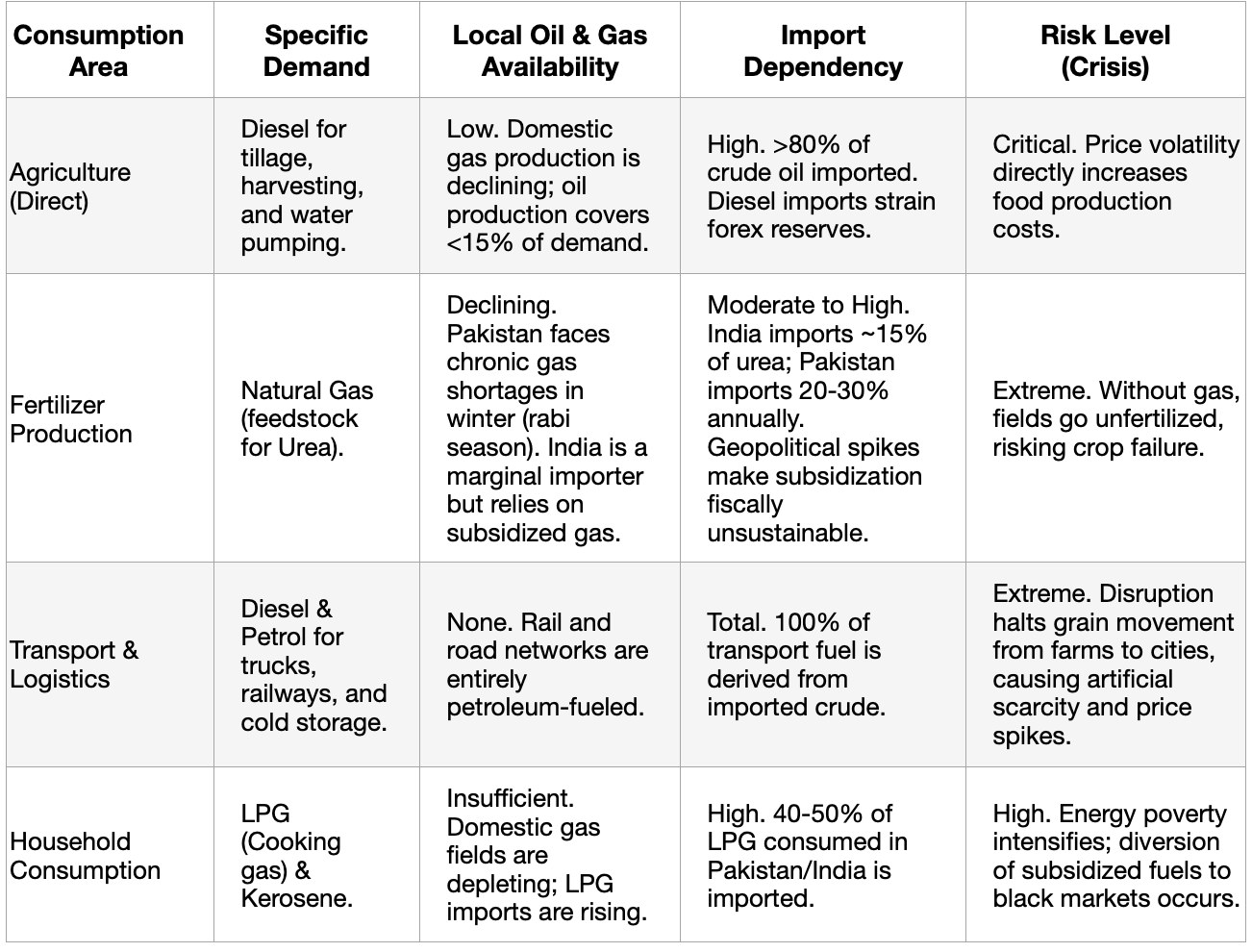
| Consumption Area | Specific Demand | Local Oil & Gas Availability | Import Dependency | Risk Level (Crisis) |
|---|---|---|---|---|
| Agriculture (Direct) | Diesel for tillage, harvesting, and water pumping. | Low. Domestic gas production is declining; oil production covers <15% of demand. | High. >80% of crude oil imported. Diesel imports strain forex reserves. | Critical. Price volatility directly increases food production costs. |
| Fertilizer Production | Natural Gas (feedstock for Urea). | Declining. Pakistan faces chronic gas shortages in winter (rabi season). India is a marginal importer but relies on subsidized gas. | Moderate to High. India imports ~15% of urea; Pakistan imports 20-30% annually. Geopolitical spikes make subsidization fiscally unsustainable. | Extreme. Without gas, fields go unfertilized, risking crop failure. |
| Transport & Logistics | Diesel & Petrol for trucks, railways, and cold storage. | None. Rail and road networks are entirely petroleum-fueled. | Total. 100% of transport fuel is derived from imported crude. | Extreme. Disruption halts grain movement from farms to cities, causing artificial scarcity and price spikes. |
| Household Consumption | LPG (Cooking gas) & Kerosene. | Insufficient. Domestic gas fields are depleting; LPG imports are rising. | High. 40-50% of LPG consumed in Pakistan/India is imported. | High. Energy poverty intensifies; diversion of subsidized fuels to black markets occurs. |
5. Essential Sectors for Government Prioritization
In a scenario of prolonged conflict and soaring oil prices, governments in Islamabad and New Delhi will face rationing constraints. To maintain social stability, three sectors must be prioritized:
1. Strategic Food Logistics: Fuel for the Food supply chain must be guaranteed. Moving the strategic wheat and rice reserves to urban centers must be treated as a military logistical priority.
2. Healthcare & Water Treatment: Hospitals and municipal water pumping stations cannot afford fuel shortages. Civil unrest is often triggered by the collapse of water supply.
3. Transitional Support for PQNK Adoption: In the short term, fuel allocations may be necessary for the one-time hardpan correction and bed-shaping machinery. However, this is a transitional requirement, not a structural dependency.
6. Cost Affordability of Essential Items
The convergence of oil and food crises creates a "cost-push inflation" spiral that devastates the urban poor and small-holder farmers.
• The Equation: If oil prices double, the cost of urea doubles; the cost of harvesting doubles; the cost of transporting a bag of flour to the city doubles.
• The Subsidy Trap: Both Pakistan and India have historically subsidized energy and fertilizers to keep food affordable. In a protracted crisis, global prices will outpace fiscal capacity. Governments will face a choice: cut subsidies (leading to hyperinflation of food) or balloon fiscal deficits (leading to currency devaluation and sovereign default).
• PQNK as an Affordability Buffer: By eliminating the need for purchased inputs (chemicals, fuels, and external organic matter), PQNK collapses the cost of production by 70–90% . This converts farmers from price-takers into surplus holders and stabilizes consumer prices without requiring fiscally unsustainable subsidies.
7. The Missing Element: The Water-Energy-Food (WEF) Nexus & Institutional Role
While the analysis above covers oil, food, and inputs, one critical factor is often overlooked: the conflation of subsidies with solutions.
In both Pakistan and India, policy has historically subsidized inputs (urea, diesel, electricity) to mask the inefficiencies of degraded soil. In a prolonged oil crisis, this model collapses.
PQNK addresses this missing element by redefining the role of the state. As outlined in the PQNK Policy Framework for Pakistan, the role of institutions is not to innovate or subsidize inputs, but to enforce biological compliance.
• No to Input Subsidies: Subsidizing bio-fertilizers or compost merely replaces one dependency with another. PQNK requires zero external inputs.
• Yes to Enabling Infrastructure: Support must be limited to service infrastructure that enables compliance—such as access to hardpan-shredding machinery and permanent bed shapers—not the perpetual supply of consumables.
• Solar Transition: Where irrigation is still required during the transitional regenerative phase, energy subsidies for tube wells should be shifted to capital subsidies for solar-powered irrigation. However, the ultimate goal (and the sustained state of PQNK) is the elimination of irrigation dependency through Soil Moisture Management.
8. Conclusion: From Industrial Agriculture to Sovereign Resilience
The lingering conflict in the Middle East serves as a stress test for the industrial agricultural models of Pakistan and India. These models, optimized for high yields through high chemical and fuel inputs, are fundamentally fragile in an era of energy volatility.
The PQNK system—Paedar Qudratti Nizam Kashatqari—offers a pathway to decouple food security from geopolitical instability. It is not a reform of the existing system; it is a production reset. By mandating compliance with the four non-negotiable laws (hardpan break, pH correction, permanent raised beds, and root retention), PQNK restores the soil as a living organism. This restoration eliminates the need for fossil-fuel-based fertilizers, reduces machinery passes to two per season, and frees the farmer from the volatility of oil markets.
Key Recommendation: Governments must shift from subsidizing inputs to mandating biological compliance. The PQNK Policy Framework explicitly prohibits subsidies for fertilizers (synthetic or organic) and fuel. Instead, state resources should be directed toward:
1. Enforcement: Establishing the four PQNK laws as the national production standard.
2. Infrastructure: Enabling service providers to offer PQNK-specific machinery (hardpan breakers, bed shapers) to farmers, ensuring the one-time correction is accessible.
3. Validation: Establishing the PQNK Validation System (laboratory-based nutritional and residue verification) as the legal trade standard, replacing certification based on paperwork and process. The era of cheap oil is over. The era of resilient, localized, and biologically compliant agriculture must begin. PQNK is not just an option; it is the only sustainable future.
Applying PQNK without understanding nature’s operating system will not deliver abundance, stability, or nutrient density.
PQNK (pronounced “picnic”)—the regenerative & sustainable Pristine Organic Farming System —is grounded in Natural Ecosystem Science. This science employs perennial biodiversity, protects soil with organic mulch, and avoids practices such as water inundation, tillage disturbance, and leaving soil bare.
It is the process that matters most. PQNK is a pristine production system designed not merely for yield, but for optimal, balanced output—where quality, sustainability, and ecological harmony emerge from a self‑regulated, zero‑external‑input methodology.
About This Paper
- Crop
- Wheat · Rice · Sugarcane
- Problem
- Price Volatility / Market Glut · External Input Dependency · High Irrigation Cost / Dependency
- Science
- Water · Soil · Economics · Climate
- Evidence
- Economic Model/Projection
- Authority
- Current / Approved PQNK Knowledge
Related PQNK Science
Key Takeaways
- Frames conventional agriculture in Pakistan and India as 'fossil fuel in a different form': diesel-powered tillage and transport, natural-gas-dependent Haber-Bosch nitrogen fertilizer, petrochemical pesticides, and plastic irrigation infrastructure.
- Traces four points of oil vulnerability in the South Asian food chain: fertilizer inputs, mechanized tillage and harvest, diesel or electric irrigation pumping, and diesel-dependent logistics and cold storage.
- Argues PQNK breaks the fossil-fuel dependency loop structurally rather than substituting one purchased input for another, citing an 80-100% reduction in irrigation pumping targeted in matured systems through Soil Moisture Management.
- Models a 'cost-push inflation spiral' where doubling oil prices doubles urea, harvesting, and flour-transport costs, and frames PQNK's 70-90% cost-of-production reduction as an affordability buffer that avoids the fiscal 'subsidy trap' of choosing between hyperinflation and currency devaluation.
- Recommends governments prioritize strategic food logistics, healthcare, and water treatment, plus transitional (one-time, non-recurring) fuel support for PQNK conversion machinery, during any prolonged energy crisis.
- Calls for shifting state policy from subsidizing inputs, fertilizer, fuel, even organic substitutes, to enforcing PQNK's four non-negotiable biological laws as the national production standard, with the PQNK Validation System proposed as the legal trade standard.
Related Crops
Related Knowledge
same problem
The Farmers' Crisis Will Not Be Solved by Another Support Price: Why Pakistan's Farmers Must Reduce Cost, Improve Quality and Build Independence Through PQNK
A nationwide farmers' association's press conference voiced real distress over diesel, fertiliser, wheat and sugarcane policy, and the danger that one failed crop leaves a farmer unable to finance the next. This paper argues that distress is real but the standard remedy, another support price or subsidy, cannot be the permanent foundation of farm viability, because it exchanges biological dependence for political dependence. PQNK reframes the question: since a farmer cannot control the market price, government policy, rainfall or the exchange rate, his strongest and most durable defence is progressively lowering his own cost of production by restoring the soil's biological functions, while building resilience to climate shocks and competing through demonstrable produce quality.
same problem
Creating On-Farm "Micro-Water Cycles": Landscape Design to Maximize Rain, Dew, and Humidity Capture at the Microclimate Level
This foundational document argues that irrigation dependency is a design failure, not a water-supply problem, and backs the claim with per-crop data: PQNK sugarcane and rice show an 88-93% reduction in externally supplied irrigation water compared to conventional production. It lays out the landscape design, contour work, and mulch management that let a farm meet its own water needs from rainfall, dew, and humidity alone.
same crop
Can High-TDS Water Be Used to Rehabilitate Saline Soils?
Conventional guidelines flag groundwater above 1,000-1,500 ppm TDS as unsuitable for irrigation, pushing farmers to abandon productive land. This paper argues the real determinant isn't the water's salt concentration but the soil's physical and biological capacity to keep those salts moving instead of accumulating in the root zone, backed by a crop-by-crop salt-load data table.
same problem
Five Decades of Agricultural Innovation: Interventions and Achievements in Chronological Order, 1973–2023
Asif Sharif's own year-by-year record of fifty years of hands-on agricultural intervention in Pakistan, from early machinery and seed distribution through the 2008 development of PQNK and its crop-by-crop expansion since, presented as the primary evidentiary record behind PQNK: a ground-up, farmer-verified track record rather than a journal citation.