

KP-061 · Plant Physiology & Production Systems
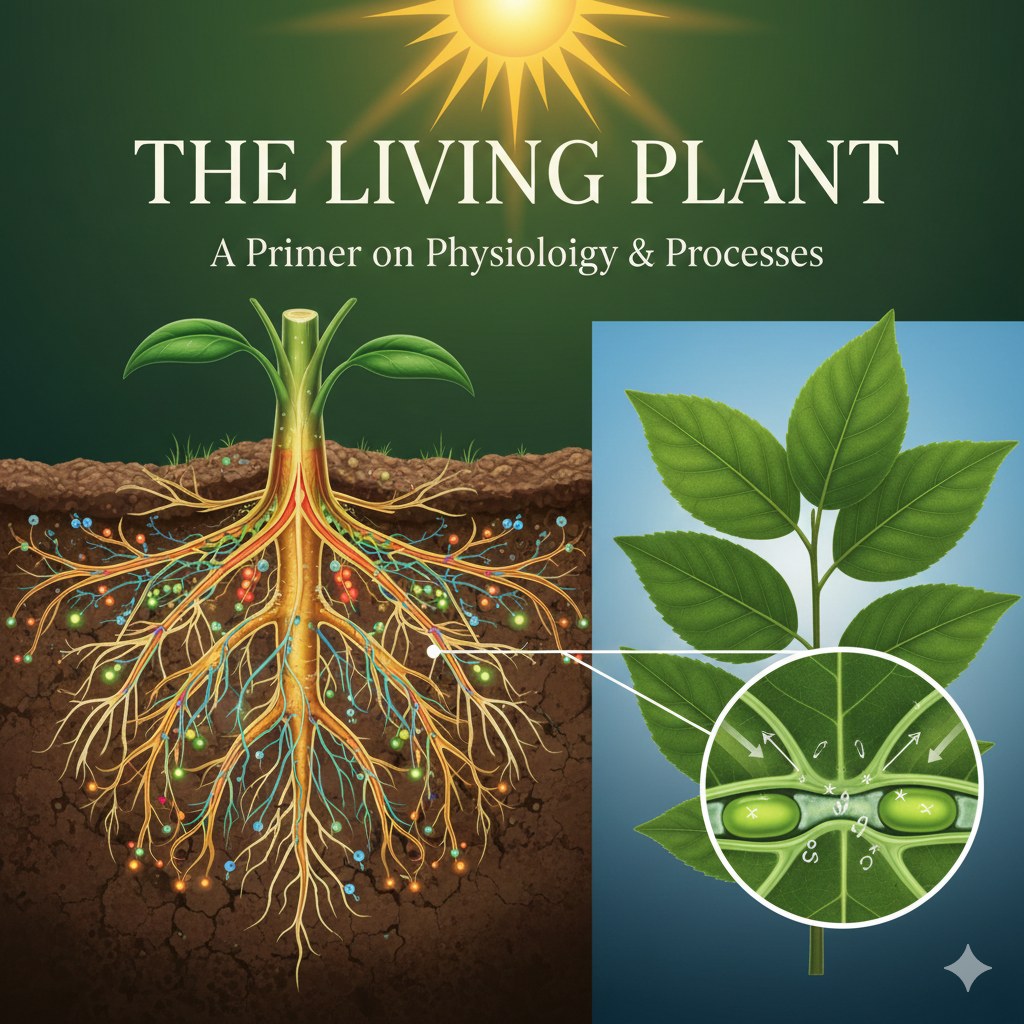
The Living Plant: A Primer on Physiology & Processes
This primer reframes the plant not as something to be fed but as a sovereign organism that builds its own body from sunlight, air, and water, then hires and pays soil microbes to mine the minerals it cannot make itself. It walks through photosynthesis, rhizosphere partnership, the plant's internal circulatory system, and its immune response as four interlocking processes the PQNK farmer exists to protect.
Read or listen to the full paper ↓Abstract
The paper opens by rejecting the metaphor of soil as a 'food bowl' and roots as 'mouths,' arguing instead that a plant is a self-sufficient chemical factory carrying the complete genetic code to build its body, defend itself, and reproduce using only sunlight, air, and water, with soil serving as foundation and gut rather than feeding trough. It divides the plant's life into two coordinated worlds: the above-ground shoots, which capture light and CO2 to manufacture food through photosynthesis (the plant's 'source'), and the below-ground roots, which secure water and manage microbial partnerships (the realm of community and synergy).
Photosynthesis is presented as the foundation of the PQNK claim that 'the solid matter of a plant is condensed air and water': chlorophyll captures sunlight and uses that energy to split water and recombine its hydrogen with carbon from atmospheric CO2 into sugars, releasing oxygen as a byproduct. The paper's stated implication is that the bulk mass of any crop, wheat grain, cotton boll, cabbage head, is built by the plant itself from free and abundant air and water, not supplied by the farmer.
The rhizosphere section explains why the plant still needs soil at all: it cannot eat rock directly, so it invests an estimated 20-40% of its photosynthesized sugars as root exudates, paying specific bacteria and fungi to solubilize locked phosphorus, potassium, and calcium from the mineral matrix, fix atmospheric nitrogen into usable ammonium, and, through mycorrhizal fungal hyphae, extend the root's effective reach many times over in exchange for that sugar payment. The paper's sharpest claim here is that synthetic fertilizer breaks this economy by removing the plant's need to pay for the service, starving and killing the microbial workforce and turning a self-sufficient plant into what it calls a dependent 'junkie' reliant on the next input.
Transpiration is explained as the plant's circulatory engine: xylem carries water and dissolved minerals upward from roots to leaves, driven by suction created as water evaporates through stomata, while phloem carries photosynthesized sugars downward to roots, fruits, and growing tips. The paper stresses this entire system depends on aerobic, undisturbed soil, since waterlogging stops root function and tillage physically severs the pipelines the plant has built.
The final process covered is plant immunity, framed as a function of complete nutrition rather than external protection: a plant supplied a balanced mineral diet by its microbial partners builds thick cell walls and produces defensive secondary metabolites, while insects and disease are described as being drawn to weak, chemically over-fed plants (soft, sappy growth from excess soluble nitrogen is singled out as an aphid magnet), making the pest a symptom of imbalance rather than an external enemy to be sprayed away. The paper concludes that the PQNK farmer's job across all four processes is habitat management, not feeding.
Full Paper
If you use “Listen”, the text of the page may be sent to your browser or operating system’s speech provider, such as Apple, Google or Microsoft, depending on the voice your device uses. Pedaver does not process, transmit or store any audio.
The Actors:
Sunlight: The energy source.
Chlorophyll: The green pigment in leaves, the "solar panel."
Water (H₂O): Drawn up by the roots from the soil.
Carbon Dioxide (CO₂): A gas from the air, drawn into the leaves through tiny pores called stomata.
The Process: Inside the leaf, chlorophyll captures sunlight. It uses that energy to split the water molecule (H₂O) into its parts. It then recombines the Hydrogen with the Carbon from Carbon Dioxide (CO₂) to create simple sugars (Carbohydrates like C₆H₁₂O₆).
The PQNK Understanding:
The Equation: 6CO₂ (from air) + 6H₂O (from soil) + Sunlight → C₆H₁₂O₆ (sugar/plant tissue) + 6O₂ (oxygen released).
The Implication: The carbon, oxygen, and hydrogen that make up the bulk of the cabbage, the wheat grain, or the cotton boll all came from the air and water. The farmer did not "give" this mass to the plant. The plant created it itself, using free and abundant resources.
3. Process Two: The Plant's "Gut" – The Rhizosphere and Microbial Mining
If the plant makes its own food from air, what does it need the soil for? It needs the mineral catalysts. But it cannot simply eat rocks. This is where the plant's most brilliant strategy comes into play: the Rhizosphere.
The Actors:
Root Exudates: The plant takes a significant portion of the sugars it made during photosynthesis (some estimates say 20-40%) and pumps them out through its roots into the soil. This is not a loss; it is a calculated investment.
Soil Microbes: Bacteria, fungi, nematodes, and protozoa in the soil.
The Soil Mineral Matrix: The "rocks" and organic matter that contain the essential elements (N, P, K, Ca, etc.).
The Process:
The Payment: The plant pumps out sugars (exudates) to feed specific bacteria and fungi. This creates a halo of life around the root called the rhizosphere. The plant is effectively "paying" the microbes in high-energy food.
The Service: In return for this food, the microbes perform services.
Solubilization: Bacteria and fungi produce acids that dissolve the mineral matrix, releasing locked-up nutrients like phosphorus, potassium, and calcium into the soil solution.
Nitrogen Fixation: Specific bacteria (like Rhizobium on legumes or free-living Azotobacter in the soil) take inert nitrogen gas (N₂) from the air pockets in the soil and convert it into ammonium (NH₄⁺), a form the plant can use.
Nutrient Delivery: Mycorrhizal fungi act as an extension of the plant's root system. Their thread-like hyphae explore far more soil than the root ever could, mining for water and minerals and trading them directly to the root in exchange for sugars.
The PQNK Understanding:
The plant is the manager. It pays the microbes to do the hard work of mining and refining its own "fertilizer" from the native soil.
The plant does not need the farmer to supply soluble N, P, or K. The plant can create its own N (via microbes) and mine its own P and K (via microbes) if the soil is alive and undisturbed.
This is why synthetic fertilizers are so destructive. When the farmer provides soluble salts directly, the plant stops paying the microbes. The microbial workforce starves and dies, and the soil becomes a dead medium. The plant becomes a dependent "junkie," reliant on the farmer's next fix.
4. Process Three: Transpiration – The Plant's Circulatory System
How do the minerals and water get from the roots to the leaves? How do the sugars from the leaves get to the roots and fruits? The plant has a sophisticated circulatory system.The Actors:
Xylem: Tubes that carry water and dissolved minerals from the roots up to the leaves.
Phloem: Tubes that carry the sugars (food) made in the leaves down to the roots, fruits, and growing tips.
Stomata: The tiny pores on the underside of leaves.
The Process (The Xylem Upward Flow):
Water evaporates from the leaves through the stomata. This is called transpiration. It is like a plant "sweating."
This evaporation creates a negative pressure, a suction.
This suction pulls a continuous column of water up from the roots, through the xylem, to the leaves. As the water travels, it carries with it the tiny amounts of minerals that were solubilized by the microbes.
The Process (The Phloem Downward Flow):
The leaves produce sugars through photosynthesis.
These sugars are loaded into the phloem and transported to wherever they are needed: to the roots to pay the microbes, to the developing fruits to fill the grain, or to the growing tips to build new cells.
The PQNK Understanding:
This system requires the soil to be aerobic (full of air) . If the soil is waterlogged (drowned), the roots cannot function, and the transpiration stream stops.
It requires the soil to be undisturbed. Cutting roots with tillage breaks the pipelines.
The plant's own "sweating" (transpiration) is the engine that drives nutrient delivery.
5. Process Four: The Plant's Immune System – Defense Through Balance
In a PQNK system, we do not spray pesticides. Why? Because a plant that is fed properly is not a target.The Process:
Complete Nutrition: When the plant gets a perfectly balanced diet of minerals from the microbial mining process, its cell walls are thick and strong. Its metabolic pathways run smoothly. It produces the right amount of sugars and proteins.
The Pest as a Messenger: Insects and diseases are nature's recyclers. They are attracted to weak, unbalanced plants. A plant with too much soluble nitrogen (from synthetic urea) has soft, sappy growth that is a magnet for aphids and caterpillars. The pest is not the problem; it is a symptom of the imbalance the farmer created.
Secondary Metabolites: A healthy plant, under mild stress (like the sun and wind), produces compounds called secondary metabolites. These are natural pesticides and antioxidants that make the plant unpalatable to pests and nutritious for humans.
The PQNK Understanding:
Pesticides are not needed. We do not kill the messenger (the pest); we correct the message (the plant's health).
By feeding the soil biology, which in turn feeds the plant a balanced diet, the plant's own immune system is fully operational.
Conclusion: The Farmer's Role in the Plant's Life
When you understand these four processes—Photosynthesis, Rhizosphere Management, Translocation, and Immunity—you see the plant in a new light. It is not a helpless infant.
It builds its own body from air and water.
It hires and pays its own workforce of microbes to mine its minerals.
It runs its own circulatory system powered by the sun and water.
It operates its own immune system when kept in balance.
The PQNK farmer is not a "feeder." The PQNK farmer is a habitat manager. The four steps of PQNK restoration (breaking hardpan, correcting chemistry, creating permanent beds, and cover cropping) are simply the actions we take to build the perfect habitat so this sovereign being can do what it does best: thrive and create abundance, all by itself.
This is the knowledge we must share. It frees the farmer from the slavery of input companies and restores them to their rightful place as a partner with nature.
——————————
Applying PQNK without understanding nature’s operating system will not deliver abundance, stability, or nutrient density.
PQNK (pronounced “picnic”)—the regenerative & sustainable Pristine Organic Farming System—is grounded in Natural Ecosystem Science. This science employs perennial biodiversity, protects soil with organic mulch, and avoids practices such as water inundation, tillage disturbance, and leaving soil bare.
It is the process that matters most. PQNK is a pristine production system designed not merely for yield, but for optimal, balanced output—where quality, sustainability, and ecological harmony emerge from a self‑regulated, zero‑external‑input methodology.
Connect & Resources Facebook: www.Facebook.Com/Pedaver YouTube (PQNK): https://www.youtube.com/@pedaverpqnk3167/videos YouTube: http://www.youtube.com/@aasifsharif PDF Knowledge Papers: https://drive.google.com/drive/folders/1iadwV6mdUPyrUIpB3oRfNv6DLiackaUL?usp=sharing Email: pedaver@gmail.com WhatsApp: +92 320 677 6666
About This Paper
- Problem
- General Pest Pressure · Waterlogging · Tillage Damage to Soil Biology / Structure · External Input Dependency
- Science
- Plants · Soil · Crop Protection
- Evidence
- Scientific Mechanism
- Authority
- Current / Approved PQNK Knowledge
Related PQNK Science
Key Takeaways
- Reframes soil as the plant's 'foundation and gut,' not its food bowl; the plant builds its own bulk mass from sunlight, air, and water through photosynthesis.
- Estimates the plant invests 20-40% of its photosynthesized sugars as root exudates, effectively paying microbes to mine and deliver minerals it cannot access on its own.
- Argues synthetic fertilizer breaks the plant-microbe economy by removing the plant's need to 'pay' for nutrients, starving the microbial workforce it depends on.
- Explains the xylem (upward water/mineral flow) and phloem (downward sugar flow) as a circulatory system that requires aerobic, undisturbed soil to function.
- Frames plant immunity as a product of balanced nutrition rather than external protection; pests are described as attracted to nitrogen-imbalanced, chemically forced growth.
- Concludes the PQNK farmer's role across all four processes (photosynthesis, rhizosphere management, transpiration, immunity) is habitat manager, not feeder.
Related Knowledge
same problem
The Underground Network We Have Been Farming Against
New 3D synchrotron imaging (Braunmiller et al., New Phytologist 2026) shows mycorrhizal hyphae spanning air-filled pores, bridging soil particles and growing along roots in intact soil. This paper separates what the research shows from what it means for PQNK: soil architecture is part of the root-fungal partnership, conventional farming dismantles it after every harvest, and a moist but aerated, undisturbed root zone protects it.
same problem
Chilli Production Under PQNK (PICNIC)
Chilli is biologically perennial and can remain productive for over a decade, but conventional short-cycle, urea-dependent management collapses that potential into a pest-prone annual grind. This paper shows how PQNK's soil-conversion framework and a single apical-pinching intervention restore chilli to a low-cost, high-density perennial crop, validated on a Hafizabad farm.
same problem
Why Only 4 kg of NP During PQNK Transition?
Answers a transitioning farmer's question, why is PQNK's transitional dose only about 4 kg of NP per acre, by tracing how a plant actually feeds through a water-based soil solution shaped by transpiration, mass flow and diffusion rather than by counting fertilizer bags, and by drawing a precise distinction between over-irrigation and waterlogging that explains why excess soluble nitrogen produces lush, delayed, insect-prone growth.
same problem
Knowledge Paper: The Perpetual Abundance Principle
Using subcontinental wheat-yield data, this paper shows that even a modest 2-tonne-per-acre crop removes only a tiny fraction of the phosphorus, potassium, and nitrogen already banked in the topsoil, roughly 1 part in 182 for phosphorus alone, and argues that nutrient deficiency is therefore a biological access problem, not a resource shortage.