

KP-040 · Soil Science & PQNK System
Managing Soil Electrical Conductivity & Redox Potential in a Pristine, No-Chemical System for Optimal Nutrient Uptake
This paper reframes two conventionally input-driving soil metrics, electrical conductivity and redox potential, as emergent properties of root-microbe communication rather than parameters to correct with salts or drainage, and lays out what a PQNK farmer should, and should not, do in response to them.
Read or listen to the full paper ↓Abstract
The paper's core principle, stated up front, is that 'biology dictates chemistry; the plant, through its microbial allies, designs its own ideal rhizosphere.' After the standard PQNK conversion steps, breaking hardpan, forming permanent raised beds, growing and retaining cover-crop roots, and maintaining no-till precision planting, the soil is said to regain an innate ability to self-regulate electrical conductivity (EC) and redox potential (Eh) at the rhizosphere level to meet plant needs precisely, rather than these being parameters a farmer forcibly adjusts with inputs.
On EC, the paper contrasts the conventional use of EC as a proxy for soluble salts and fertilizer need with a PQNK view of EC as a bio-electric signature of root-microbe communication: slightly elevated EC near roots reflects a dense, biologically generated, plant-specific 'nutrient soup' rather than excess salts, self-regulated via a steady carbon flow from mulch and retained roots that fuels microbes to mobilize and retain ions on soil colloids. Permanent mulch is described as an EC buffer, moderating moisture so evaporation doesn't drive surface salt accumulation even where irrigation water carries some salt load.
On redox potential, the paper argues Eh is microbiologically modulated at the microsite level rather than left to chance waterlogging: root-released phenolic compounds and other signals recruit specific microbial consortia that create microscale anaerobic zones even within an otherwise aerobic bed, reducing iron, manganese, and other nutrients into plant-available forms exactly where roots need them. The stable aggregate structure built by permanent beds, fungal networks, and earthworms creates a 'redox mosaic' of pore sizes, larger pores staying oxygenated and smaller ones mildly reduced, enabling simultaneous nitrification, denitrification, nitrogen conservation, and micronutrient chelation side by side.
The paper spells out both what to monitor and what not to do. Recommended indicators are plant vigor and color, soil aesthetics like crumb structure, earthy aroma, and mycorrhizal hyphae, and water infiltration speed, since bulk EC/Eh readings can't capture the bed's true microscale variability. The explicit prohibitions are not applying salts, minerals, or supplements to 'correct' EC or Eh readings, not disturbing soil structure through tillage, which collapses the redox mosaic and the biology regulating it, and never interrupting the living root cycle that maintains the biochemical dialogue.
The paper's conclusion and final assertion frame the farmer's role narrowly: 'in the pristine system, the farmer's role is to maintain the conditions for life; life itself manages the chemistry.' By providing permanent bed structure, continuous living roots, mulch protection, and zero chemical disturbance, the system is said to tune its own electrical and redox properties plant by plant, root by root, at a level of precision no external input regimen can match.
Full Paper
If you use “Listen”, the text of the page may be sent to your browser or operating system’s speech provider, such as Apple, Google or Microsoft, depending on the voice your device uses. Pedaver does not process, transmit or store any audio.
Managing Soil Electrical Conductivity & Redox Potential in a Pristine, No-Chemical System for Optimal Nutrient Uptake
PQNK
Preamble: The Pristine System as a Self-Regulating Whole
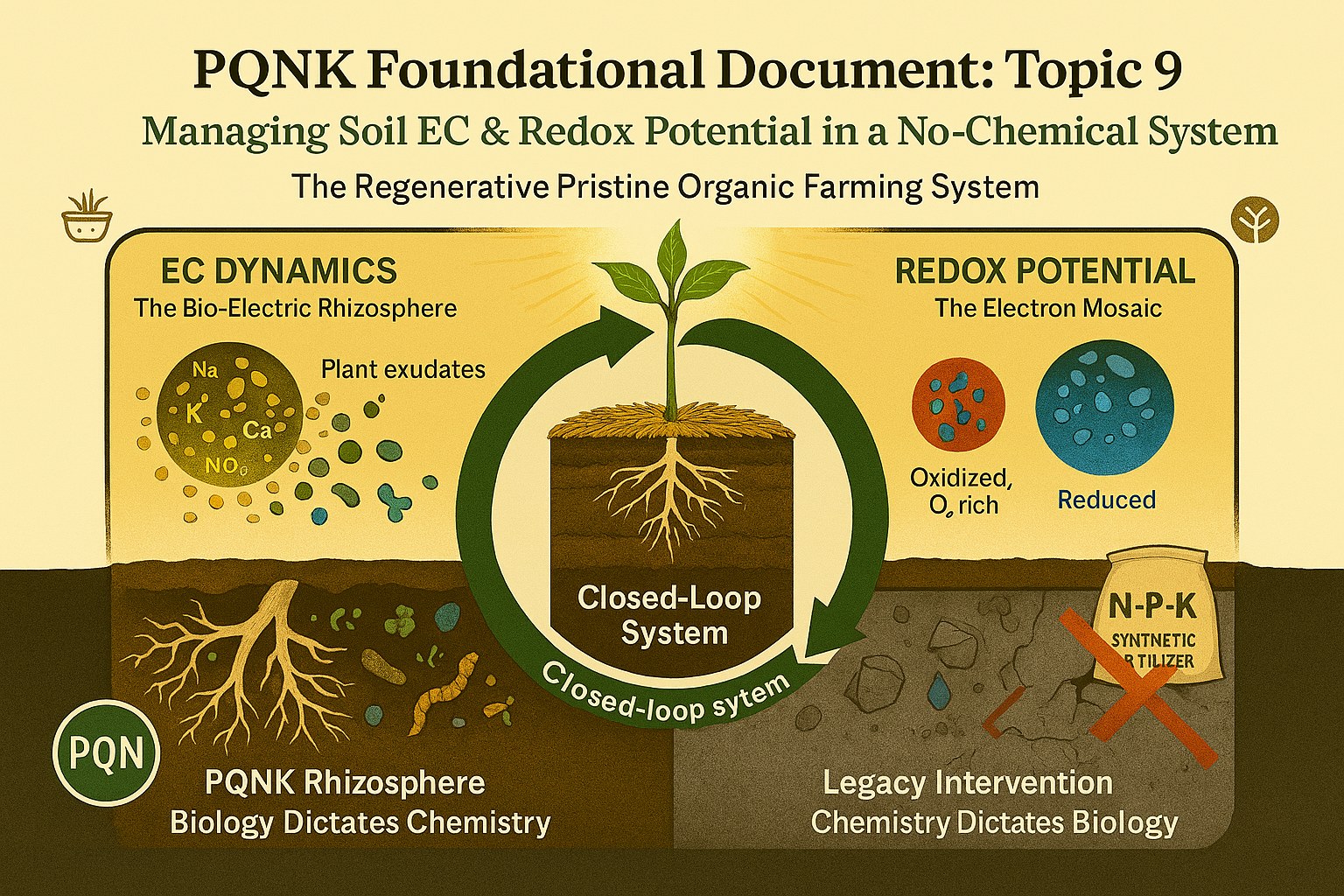
Paedar Qudratti Nizam Kashatqari (PQNK) restores the farm as a closed-loop, self-sufficient ecosystem. In this system, soil chemistry is not managed through external inputs but emerges from the dynamic interplay between plant roots and soil biology. Electrical Conductivity (EC) and Redox Potential (Eh) are not parameters to be forcibly adjusted, but rather emergent properties of a thriving soil-plant-microbe continuum. In a PQNK system, after the conversion steps— breaking hardpan, forming permanent raised beds, growing and retaining cover crop roots, and maintaining no-till precision planting through organic mulch—the soil regains its innate ability to self-regulate EC and Eh at the rhizosphere level to meet plant needs precisely.
Core PQNK Principle: “Biology dictates chemistry; the plant, through its microbial allies, designs its own ideal rhizosphere.”
Electrical Conductivity (EC) in a PQNK Context
What EC Truly Represents in a Pristine System
In conventional agriculture, EC is often used to measure soluble salts and infer nutrient availability, leading to fertilizer adjustments. In PQNK, EC is viewed as the signature of biological activity and root-microbe communication.
• EC as a Bio-Electric Phenomenon: In the rhizosphere, plant exudates (sugars, acids, enzymes) and microbial metabolites create a unique electrolytic environment. The slightly elevated EC near roots is not from excess salts, but from a dense, biologically generated “nutrient soup” that is perfectly balanced and plant-specific.
• Self-Regulation via the Carbon Pathway: The permanent mulch and retained root systems provide a steady, diverse carbon flow. This fuels microbial communities that, in turn, regulate ion mobilization and retention on soil colloids, preventing nutrient loss and maintaining an ideal EC zone around roots without buildup.
• The Mulch Buffer: The permanent organic mulch layer moderates soil moisture, preventing the evaporation-driven surface salt accumulation common in bare soils. Even if irrigation water contains salts, the biological filtration and constant carbon addition
PQNK Practices for Natural EC Balance
• Permanent Soil Armor: Mulch from cover crop tops maintains
consistent soil moisture, minimizing EC fluctuations caused by wet-dry cycles.
• Living Root Continuity: Year-round living roots (cover crops + cash
crops in succession) ensure continuous exudation, feeding microbes that manage nutrient release at rates matching plant demand, thus avoiding ionic imbalances.
• No External Inputs: The prohibition of compost, manure, or
fertilizers from outside the field prevents the introduction of excess salts or imbalanced ions. All nutrient cycling occurs in situ from decomposed organic matter and biologically fixed nutrients.
Redox Potential (Eh) in a PQNK Context
The Biology-Driven Redox Engine
Redox potential indicates the electron flux in soil—whether conditions are aerobic (oxidizing) or anaerobic (reducing). In PQNK, this is not left to chance waterlogging but is microbiologically modulated at the microsite level to benefit plant nutrition.
• Root-Microbe Orchestration: Plant roots release phenolic compounds and other biochemical signals that attract specific microbial consortia. These microbes, in response to root exudates, create microscale redox zones. For example, in an otherwise aerobic bed, anaerobic microsites near root surfaces can facilitate reduction of iron, manganese, or other nutrients into plant-available forms exactly where needed.
• Aggregate Structure as a Redox Mosaic: The stable soil structure built by permanent raised beds, fungal networks, and earthworms creates a gradient of pore sizes. This results in a mosaic of redox conditions—larger pores stay oxygenated, smaller pores may be mildly reduced—enabling simultaneous nitrification and denitrification, nitrogen conservation, and chelation of micronutrients.
• The No-Till Advantage: No-till preserves these gas and water diffusion pathways, preventing the disruption that leads to large-scale anaerobic zones (which would be detrimental). Instead, PQNK supports beneficial, localized redox tuning.
PQNK Practices for Optimal Redox Dynamics
• Permanent Raised Beds: Elevation and structure ensure excess water
soaks away, preventing wholesale reducing conditions, while micropores within aggregates host reversible redox reactions.
• Continuous Biological Porosity: Root channels and biopores from
previous crops act as conduits for oxygen diffusion, allowing roots to penetrate deeply and maintain aerobic respiration even in moist conditions.
• Cover Crop Diversity: Different root architectures and exudate profiles
create varied redox niches, supporting a full spectrum of microbial redox specialists that service plant needs.
The Synergy: How EC and Eh Are Co-Managed by the Plant-Microbe Partnership
In the PQNK rhizosphere, the plant releases chemical directives (exudates) that: 1. Attract specific microbes that alter local pH and Eh to solubilize target nutrients. 2. Stimulate production of microbial biosurfactants and chelators that change the ionic strength (affecting EC) without harmful salt buildup. 3. Create a dynamic nutrient buffer where cations and anions are held in biologically mediated exchange, released upon root demand. This results in a spatially and temporally variable EC and Eh profile within the bed, impossible to measure meaningfully with bulk soil tests. The plant, in essence, “sets” these parameters itself through its allied biology.
Implications for the Farmer: Observing, Not Intervening
Monitoring Indicators of Balance
• Plant Health: Vigor, color, and resistance are the ultimate indicators of optimal rhizosphere EC/Eh.
• Soil Aesthetics: Crumb structure, earthy aroma, presence of mycorrhizal hyphae, and diverse soil macrofauna confirm functioning redox mosaics.
• Water Infiltration: Rapid infiltration signifies aerobic structure, while persistent waterlogging signals a need for more carbon and root continuity (not drainage interventions).
What Not to Do
• Do not apply salts, minerals, or supplements to “correct” EC or Eh readings.
• Do not disturb soil structure through tilling, which collapses redox mosaics and destroys the EC-regulating biology.
• Do not interrupt the living root cycle—always have a plant growing to maintain the biochemical dialogue.
Conclusion: The PQNK Paradigm Shift
In PQNK, we do not “manage” EC and Eh; we allow the plant and its microbiome to manage them. By providing the permanent raised bed structure, continuous living roots, mulch protection, and zero chemical disturbance, we create the stage upon which biology performs its precise, self-regulating chemistry. The result is a soil that dynamically tunes its electrical and redox properties plant by plant, root by root, moment by moment—achieving a level of nutrient uptake efficiency and balance no external input regimen can ever match.
Final Assertion:
“In the pristine system, the farmer’s role is to maintain the conditions for life; life itself manages the chemistry.”
May the land return to its pristine potential, and may our stewardship be wise and observant.
Footnote: Any Production Process That Inundates Soil With Water, Disturbs Soil Through Tillage, Or Leaves Soil Bare Without Organic Mulch Cover Does Not Qualify As Natural Ecosystem Science For Production Agriculture. PQNK, to be pronounced as 'picnic', which stands for Paedar Qudratti Nizam Kashatqari, and means: the regenerative & sustainable Pristine Organic Farming System.
About This Paper
- Problem
- Saline / Alkaline / High-pH Soil · Waterlogging
- Science
- Soil
- Evidence
- Scientific Mechanism
- Authority
- Current / Approved PQNK Knowledge
Related PQNK Science
Key Takeaways
- Reframes elevated rhizosphere EC as a biologically generated, plant-specific 'nutrient soup,' not a warning sign of excess salts requiring correction.
- Redox potential is described as microbiologically modulated at the microsite level, with anaerobic pockets next to roots reducing iron and manganese into plant-available forms exactly where needed, inside an otherwise aerobic bed.
- Permanent mulch acts as an EC buffer by moderating soil moisture so evaporation doesn't concentrate surface salts, even when irrigation water carries some salt load.
- Explicit prohibitions: never apply salts or minerals to correct EC/Eh readings, never till (it collapses the redox mosaic), and never let the bed sit without a living root.
- Recommended monitoring relies on plant vigor, soil aroma and crumb structure, mycorrhizal hyphae, and infiltration speed, since bulk EC/Eh tests can't capture true microscale variability.
- Final assertion: 'the farmer's role is to maintain the conditions for life; life itself manages the chemistry.'
Related Knowledge
same problem
Knowledge Paper: Achieving High-Density Pomegranate Production Through the PQNK (Picnic) Pristine Organic Farming System
This knowledge paper sets out the full methodology for a 544-plant-per-acre pomegranate orchard under PQNK: the four-step soil recovery protocol that converts degraded land into a closed-loop system, and the four management pillars, zero soil disturbance, natural irrigation, inherent pest management, and structural pruning, that keep it that way.
same problem
The Healer's Dialogue: From Weed Signal to Soil Silence — A PQNK Pathway to Self-Regulating Abundance
Responding to a farmer's question about using weeds as nutrient-deficiency indicators, this dialogue explains that in PQNK the goal isn't to manage weeds as permanent indicator crops, but to run a four-step protocol that resolves the soil problems they signal so the weeds voluntarily depart.
same problem
The Weed-Indicator System
Instead of treating weeds as enemies to eliminate, PQNK reads them as diagnostic language the field uses to report its own underground condition. This paper works through three common indicator species, bindweed, nutsedge, and pigweed, explaining exactly which soil imbalance each one signals and why suppressing the weed without correcting that imbalance only produces temporary, repeating outbreaks.
same problem
Beyond the Timeline: Re-framing the Transition to Regenerative Agriculture Through the Lens of Soil Life
Challenges the common '3 to 5 year transition' claim in regenerative farming, arguing that soil biology responds to correct conditions within hours, and that a farmer should track functional benchmarks like inundation resistance rather than counting calendar years.