

KP-044 · Soil Science & PQNK System
The Management of Soil Density within the Closed-Loop Regenerative System
This knowledge paper gives PQNK's soil-density protocol precise numbers: a target bulk density of 1.0-1.3 g/cm³ for loamy field soil, with compaction onset flagged above 1.4 and severe compaction above 1.6, then walks through the same four-step transition sequence used to hit and hold that range without any external soil amendment.
Read or listen to the full paper ↓Abstract
The paper's preamble restates PQNK's closed-loop philosophy, nothing added from outside the farm boundary after the initial transition, and applies it specifically to soil density, the physical property that determines the compactness or porosity of the living soil matrix and, through that, its capacity to support root growth, water dynamics, and overall resilience.
It distinguishes two measures. Particle density, the density of solid mineral and stable organic particles alone excluding pore space, typically runs 2.6-2.75 g/cm³, is relatively stable, and is not something PQNK tries to alter directly, only to ensure it reflects a biologically-cycled blend of minerals and humus built entirely on-farm. Bulk density, the mass of dry soil including its pore spaces per unit volume, is the operationally critical measure and the primary focus of PQNK management, since it directly indicates compaction, root-zone aeration, and water movement.
PQNK's target bulk density range for a loamy field soil is 1.0-1.3 g/cm³, with the paper specifying that below 1.0 g/cm³ generally reflects favorably high organic matter, above 1.4 g/cm³ marks the onset of compaction that restricts root growth for sensitive crops like carrots and tomatoes, and above 1.6 g/cm³ signifies severe compaction that most crop roots cannot effectively penetrate. A mature PQNK soil is expected to settle near 2.65 g/cm³ particle density, made of a biologically-fabricated complex of minerals, silica, and stable humus.
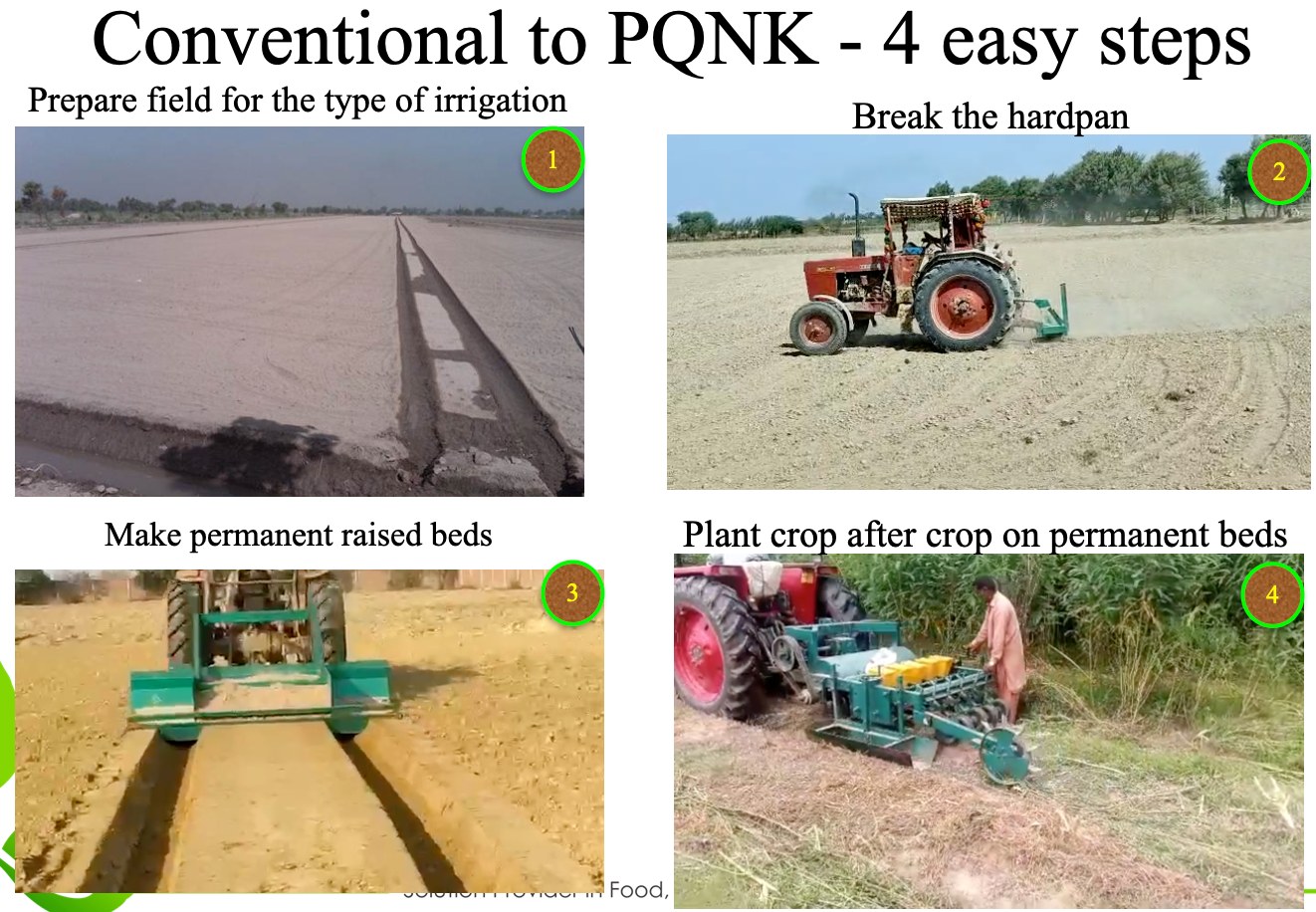
The prescribed four-step transitional method mirrors PQNK's broader hardpan protocol but is framed specifically around density correction: a one-time subsoiler pass to shatter the hardpan (never a plough, which inverts soil layers); a conditional chemistry correction, an 8 kg-per-acre sulfuric acid application with deep irrigation, triggered only if tested soil pH exceeds 8.0; construction of permanent raised beds with a dense Jantar (Sesbania) planting whose deep taproot permanently shatters remaining subsoil compaction; and, at flowering, chopping Jantar as the bed's first mulch layer while its roots decompose in place, after which no ploughing is ever again permitted and all future crop residue is retained as mulch.
Core operational principles reinforce that no external inputs of any kind, including farmyard manure, vermicompost, bio-preparations like Jeevamrit or Ghanjeevamrit, or mineral amendments like rock dust or lime, are permitted at any stage; soil organic matter comes solely from self-generated Jantar and crop-residue mulch. Irrigation systems like drip or flood are not used at all, with furrow irrigation along the raised beds reserved as, in the paper's words, 'an extremely rare measure for dire emergencies only,' since the permanent mulch layer is expected to regulate moisture by capturing rainwater, dew, and atmospheric humidity through the soil's own improved structure.
Full Paper
If you use “Listen”, the text of the page may be sent to your browser or operating system’s speech provider, such as Apple, Google or Microsoft, depending on the voice your device uses. Pedaver does not process, transmit or store any audio.
Subject: Principles and Practices for Achieving Optimal Soil Physical Health
1.0 Preamble: The PQNK Philosophy on Soil
Paedar Qudratti Nizam Kashatqari (PQNK) is a regenerative and sustainable Pristine Organic Farming System. It operates on the fundamental principle of a strictly closed-loop ecosystem. Nothing is added from outside the farm boundary after the initial transition. The system's vitality is driven by in-situ biological processes, self-generated organic matter, and the strategic sequencing of deep-rooted pioneer plants. This knowledge paper outlines the PQNK protocol for managing the critical physical property of soil density, which is foundational to crop root health, water dynamics, and overall system resilience.
2.0 Understanding Soil Density in the PQNK Context
In PQNK, soil is recognized not as an inert growing medium, but as a living, breathing ecosystem. Soil density provides a physical measure of the compactness or porosity of this living matrix, directly determining its capacity to support life.
• 2.1 Particle Density: This refers to the density of the solid soil particles alone (minerals and stable organic matter), excluding the pore spaces between them. It typically ranges from 2.6 to 2.75 g/cm³ and is relatively stable. PQNK does not focus on altering this metric directly. Instead, the system ensures these particles consist of a balanced, biologically-cycled blend of minerals and humified organic matter, achieved entirely through on-farm processes.
• 2.2 Bulk Density: This is the operationally critical measure for the farmer. It is the mass of dry soil including its pore spaces per unit volume. It is the definitive indicator of soil compaction, root zone aeration, and water movement. Managing bulk density biologically is a primary focus of the PQNK methodology.
3.0 PQNK's Ideal Soil Physical State
The PQNK system is designed to create a soil that is loose, well-aggregated, and biologically active—structurally akin to a sponge cake. This state ensures optimal movement of air, water, and roots.
• 3.1 Ideal Bulk Density Range: For most field crops (grains, vegetables, pulses), the target bulk density range for a loamy PQNK soil is between 1.0 to 1.3 g/cm³.
• Below 1.0 g/cm³: May indicate exceptionally high organic matter content, which is generally favorable for root growth.
• Above 1.4 g/cm³: Indicates the onset of compaction, where root growth for sensitive crops (e.g., carrots, tomatoes) becomes restricted.
• Above 1.6 g/cm³: Signifies severe compaction, creating a physical barrier that the roots of most crops cannot effectively penetrate.
• 3.2 Ideal Particle Density: A mature PQNK soil, enriched through years of in-situ organic matter cycling, will typically exhibit a particle density around 2.65 g/cm³. The significance lies not in the number itself, but in the origin and composition of those particles—a biologically-fabricated complex of minerals, silica, and stable humus.
4.0 The PQNK 4-Step Transitional Method to Permanently Correct Soil Density
PQNK prescribes a singular, non-repetitive transitional sequence to permanently remediate compacted soil and achieve the ideal physical state. This process is mandatory for system establishment.
Step 1: Break the Hardpan
A one-time mechanical intervention is permitted. A subsoiler (not a plough) is used to shatter the subsurface compacted layer (hardpan). This initial fracture enables the deep percolation of water and allows the entry of pioneer plant roots, setting the stage for biological takeover.
Step 2: Correct Soil Chemistry with Water and Acid (Conditional)
This step is activated only if the soil pH is tested and found to be above 8.0, indicating salt and mineral lock-up. A single, deep irrigation event is applied to leach soluble salts. In conjunction, 8 kg of sulfuric acid per acre is applied with this water. This one-time chemical correction within the closed-loop system actively lowers pH, liberates locked nutrients, and creates a soil environment hostile to parasitic weeds. If pH is below 8, proceed directly to Step 3.
Step 3: Build Permanent Raised Beds and Plant Jantar
Permanent raised beds are constructed immediately. On these beds, a dense stand of Jantar (Sesbania aculeata) is sown. The powerful, deep-penetrating taproot system of Jantar is PQNK's primary biological tool for permanently shattering subsoil compaction, creating stable bio-pores, and drawing subsurface minerals into the biomass. All inputs for this process are generated on the field.
Step 4: Retain, Mulch, and Plant with No-Till
At the flowering stage, the Jantar biomass is chopped and left as a thick mulch layer on the same bed. Its root system is left in-situ to decompose. This establishes the first permanent, spongy organic horizon. Henceforth, all ploughing is strictly prohibited. Every subsequent cash crop is sown directly into this mulch using a no-till planter. All crop residues from every cycle are retained as mulch on the same beds, perpetually enhancing soil porosity and lowering bulk density through biological activity.
5.0 Core PQNK Operational Principles for Sustaining Ideal Soil Density
• Principle of In-Situ Resource Generation: No external inputs—including FYM, vermicompost, bio-preparations (Jeevamrit, Ghanjeevamrit), or mineral amendments (rock dust, lime)—are permitted. Soil organic matter is solely the self-generated mulch from Jantar and successive crop residues.
• Principle of Permanent Soil Armor: The soil surface must never be exposed. A permanent mulch blanket, created from on-farm plant biomass, protects against crusting, compaction from raindrop impact, and moisture loss.
• Principle of Zero Soil Disturbance: After the one-time subsoiling in Step 1, the only tool permitted to interact with the soil is the no-till planter for seeding. This preserves the fungal networks and soil structure created by biology.
• Principle of Biological Mineral Cycling: No external mineral balancing is allowed. Nutrient availability is managed through the closed-loop cycle: deep-rooted plants (Jantar) mobilize subsoil minerals, and the continuous return of all plant residues to the same soil maintains the nutrient equilibrium.
• Principle of Autonomous Water Management: Irrigation systems (drip, flood) are not used. Soil moisture is regulated by the permanent mulch layer, which captures rainwater, dew, and atmospheric humidity. The biologically-improved soil structure maximizes infiltration and water-holding capacity. Furrow irrigation along the raised bed pathways is an extremely rare measure for dire emergencies only.
6.0 Impact on Crop Production
Adherence to this protocol transforms the soil into a resilient, low-bulk-density ecosystem:
• Unrestricted Root Exploration: Deep, stable bio-pores allow crop roots to access deep water and nutrients, building robust, stress-resistant plants.
• Optimized Water Dynamics: The soil acts as an effective reservoir, minimizing water dependency and maximizing rain-use efficiency.
• Vibrant Aerobic Habitat: Continuous pore space supports a thriving aerobic soil food web, essential for nutrient cycling and disease suppression.
• Self-Renewing Fertility: The in-situ cycle of growth, mulching, and decomposition perpetually liberates and recycles all necessary nutrients for sustained production.
7.0 Conclusion
PQNK provides a definitive, science-based, and closed-loop pathway to correct and maintain ideal soil density. By transitioning through the non-negotiable Four Steps and adhering to its core principles, the farmer creates a self-sustaining, porous soil ecosystem. This system produces abundant yields through intrinsic biological processes, freeing the farmer from external inputs and building lasting agricultural resilience.
Footnote: PQNK (pronounced 'picnic')—the regenerative & sustainable Pristine Organic Farming System—is grounded in Natural Ecosystem Science. This science employs perennial biodiversity, protects soil with organic mulch, and avoids practices like water inundation, tillage disturbance, and leaving soil bare.
PDF Knowledge papers: https://drive.google.com/drive/folders/ 1iadwV6mdUPyrUIpB3oRfNv6DLiackaUL?usp=sharing
About This Paper
- Crop
- Carrot · Tomato
- Problem
- Soil Compaction (General) · Weak / Shallow Root Establishment
- Science
- Soil
- Evidence
- Scientific Mechanism
- Authority
- Current / Approved PQNK Knowledge
Related PQNK Science
Key Takeaways
- PQNK's target bulk density for loamy field soil is 1.0-1.3 g/cm³; above 1.4 g/cm³ flags compaction onset for sensitive crops like carrots and tomatoes, and above 1.6 g/cm³ is severe, root-blocking compaction.
- Distinguishes bulk density (the farmer's real management target, including pore space) from particle density (the density of solid particles alone, roughly 2.6-2.75 g/cm³, which PQNK doesn't try to alter directly).
- The chemistry-correction step, 8 kg of sulfuric acid per acre with deep irrigation, is explicitly conditional, triggered only if soil pH tests above 8.0.
- No external inputs are permitted at any stage, including farmyard manure, vermicompost, Jeevamrit or Ghanjeevamrit bio-preparations, or mineral amendments like rock dust or lime.
- Irrigation systems like drip or flood are not used; furrow irrigation along raised beds is described as 'an extremely rare measure for dire emergencies only.'
- A mature PQNK loamy soil is expected to settle near 2.65 g/cm³ particle density, built from biologically-fabricated minerals, silica, and stable humus rather than imported material.
Related Knowledge
same problem
Deep Subsoil Remediation & Activation: Strategic Pathways for Compacted Soils
This paper lays out PQNK's two-track response to hardpan: a preferred one-time mechanical subsoiling where machinery is available, and a patient, plant-and-fungi-driven biological pathway for farms where it isn't, with mycorrhizal fungi cast as the ecosystem's 'stone breaker.'
same problem
Why PQNK Sugarcane Does Not Need Earthing Up
Earthing up is mandatory in conventional sugarcane: the set is placed in a furrow 6 to 8 inches deep between ridges 6 to 8 inches high, above a compacted hardpan, roots stay shallow, and the profile has to be reversed with soil piled around the stool. PQNK removes the cause instead: the hardpan is broken once, cane grows on permanent beds, roots go deep, the crown stays near the aerated surface and the full sugar-rich base can be harvested.
same problem
Deeper Understanding of PQNK: A Dialogue on Tillage, Soil Physics, and Biology with SRI Co-Founder Norman Uphoff
An email exchange between Asif Sharif and System of Rice Intensification co-originator Norman Uphoff that works through why disturbed soil is not actually better for root growth than undisturbed soil, reframing weeds as ecological repair agents and arguing that agriculture's overemphasis on soil chemistry has obscured the physics and biology that actually govern nutrient flow.
same problem
Root Retention Science
Industrial agriculture treats roots as exhausted residue once a crop is harvested, then destroys them through tillage. This paper argues roots are long-term ecological infrastructure whose value increases after the plant dies, and explains how retaining them in place builds permanent soil porosity, carbon storage, and hydraulic continuity that compounds season after season.