

KP-185 · Workforce & Practice Advisories
What Is This White and Green Growth Seen After Irrigation? A Farmer Q&A
Answers a farmer's question about white and green growth appearing on a Khapli wheat plot after a second irrigation, identifying it as beneficial fungal mycelium and early microbial/algal activity, not disease, and advising the farmer to leave it alone entirely.
Read or listen to the full paper ↓Farmer Question
“After a second irrigation, my furrows turned moist and cooled, and white and green growth appeared — is this a disease?”
— PQNK farmer question — field observation on a Khapli wheat plot. Preserved here as Pedaver’s own account of the question, not a verbatim quotation.
Pedaver’s Answer
Abstract
The advisory answers a specific field question: after a second irrigation on a Khapli wheat plot, moist and cooled furrows produced white and green growth, and the farmer asked whether this signaled a problem. The short answer given is that this is beneficial biological activity, not disease, identified as fungal mycelium (the white threads) and beneficial algae or early microbial colonies (the green tint), organisms that appear only when moisture, oxygen, and organic residues or minerals are simultaneously present, meaning the soil is alive and responding, and that a saffron discoloration noted alongside it indicates iron or mineral exposure rather than damage.
It explains why the growth appeared specifically at this point: the soil had previously been dry and biologically inactive, and irrigation restored the water-air balance needed to wake dormant soil life, with the paper noting the Khapli plot's likely low chemical toxicity as a contributing factor, and stating as a general principle that biology always responds before plants show any visible change.
On harm, the answer is unambiguous: the growth is beneficial, breaking minerals into plant-available form, improving soil aggregation, protecting the soil surface from crusting, and supporting root-microbe communication, all of which directly benefit root health. It explains this growth is rarely seen in conventional fields because repeated flooding removes oxygen, chemicals suppress fungi and microbes, and bare soil overheats and dries, meaning biology is either killed outright or never allowed to establish, which the paper argues leads farmers to mistake clean-looking soil for healthy soil when the opposite is often true.
Framed through the PQNK lens, the phenomenon is termed biological activation rather than infestation, following the principle that soil always shows signs of life before plants show improvement, biology first, yield later, a positive indicator rather than a warning sign. The farmer's prescribed response is explicitly to do nothing: not to spray anything, not to disturb the soil, and not to re-flood it, allowing the soil to dry naturally so the growth self-regulates.
A closing technical note distinguishes the two colors more precisely: white mycelium indicates aerobic fungal dominance and improved carbon-mineral exchange consistent with early-stage soil regeneration, while the green tint suggests algal or cyanobacterial presence contributing nitrogen at the soil surface under moist but oxygenated conditions, both of which are expected to disappear or stabilize naturally as the system balances itself.
Full Paper
If you use “Listen”, the text of the page may be sent to your browser or operating system’s speech provider, such as Apple, Google or Microsoft, depending on the voice your device uses. Pedaver does not process, transmit or store any audio.
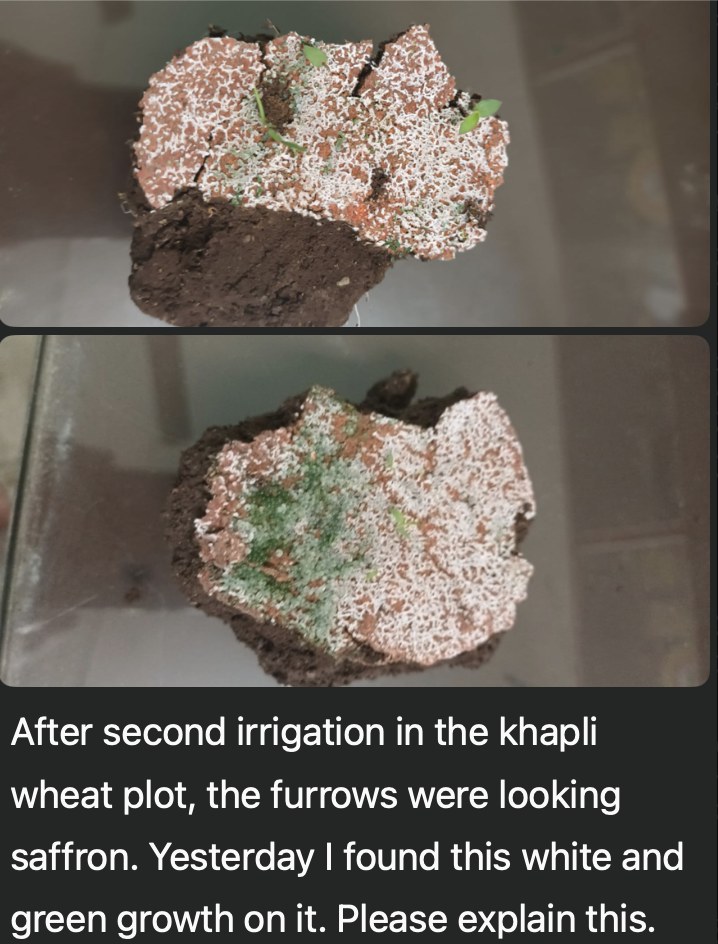
Fungal mycelium (white threads)
Beneficial algae / early microbial colonies (green tint)
These organisms appear only when three things are present:
Moisture
Oxygen
Organic residues or minerals
This means your soil is alive and responding.
Why did it appear now?
Because:
The soil was previously dry and inactive
Irrigation restored water–air balance
Khapli wheat plot likely has low chemical toxicity
The saffron colour indicates iron / mineral exposure, not damage
Biology always responds before plants show visible change.
Is this harmful to the crop?
❌ No. Absolutely not. ✔️ In fact, it is beneficial.
This biological growth:
Breaks minerals into plant-available form
Improves soil aggregation
Protects soil surface from crusting
Supports root–microbe communication
Roots benefit directly from this activity.
Why do we not see this in conventional fields?
Because in conventional systems:
Repeated flooding removes oxygen
Chemicals suppress fungi and microbes
Bare soil overheats and dries
Biology is either killed or never allowed to establish
So farmers assume clean soil = healthy soil, which is incorrect.
PQNK perspective (پقنک)
Under پقنک, this is called biological activation, not infestation.
👉 Soil always shows life before plants show improvement. 👉 Biology appears first, yield follows later.
This is a positive indicator, not a warning sign.
What should the farmer do now?
✅ Do nothing. ❌ Do NOT spray anything. ❌ Do NOT disturb the soil. ❌ Do NOT flood again.
Let:
Soil dry naturally
Biology stabilize
Roots interact freely
This growth will self-regulate.
One-line
یہ بیماری نہیں، یہ مٹی کی زندگی ہے۔ آبپاشی کے بعد فائدہ مند فنگس اور مائیکروب جاگ گئے ہیں۔ پقنک میں یہ اچھی علامت ہے، مسئلہ نہیں۔
यह बीमारी नहीं है, यह मिट्टी की जीवन शक्ति है।
सिंचाई के बाद लाभकारी फंगस और सूक्ष्मजीव सक्रिय हो गए हैं।
पقنक में यह एक अच्छी निशानी है, कोई समस्या नहीं।
(“This is not a disease, it is soil life. After irrigation, beneficial fungi and microbes have become active. Under پقنک, this is a good sign, not a problem.”)
Slightly deeper note
White mycelium indicates:
Aerobic fungal dominance
Improved carbon–mineral exchange
Early-stage soil regeneration
Green tint suggests:
Algal or cyanobacterial presence
Nitrogen contribution at soil surface
Moist but oxygenated conditions
Both disappear or stabilize naturally as the system balances.
Final reassurance
If soil shows life, crops will follow. If soil looks dead, crops only survive on injections.
——————————
Applying PQNK without understanding nature’s operating system will not deliver abundance, stability, or nutrient density.
PQNK (pronounced “picnic”)—the regenerative & sustainable Pristine Organic Farming System—is grounded in Natural Ecosystem Science. This science employs perennial biodiversity, protects soil with organic mulch, and avoids practices such as water inundation, tillage disturbance, and leaving soil bare.
It is the process that matters most. PQNK is a pristine production system designed not merely for yield, but for optimal, balanced output—where quality, sustainability, and ecological harmony emerge from a self‑regulated, zero‑external‑input methodology.
Connect & Resources Facebook: www.Facebook.Com/Pedaver YouTube (PQNK): https://www.youtube.com/@pedaverpqnk3167/videos YouTube: http://www.youtube.com/@aasifsharif PDF Knowledge Papers: https://drive.google.com/drive/folders/1iadwV6mdUPyrUIpB3oRfNv6DLiackaUL?usp=sharing Email: pedaver@gmail.com WhatsApp: +92 320 677 6666
About This Paper
- Crop
- Wheat
- Problem
- Farmer Uncertainty / Diagnostic Skill Gap
- Science
- Soil · Biodiversity · Plants
- Evidence
- Field Observation
- Authority
- Current / Approved PQNK Knowledge
Related PQNK Science
Key Takeaways
- Identifies the white growth as fungal mycelium and the green tint as beneficial algae or early microbial colonies, both requiring simultaneous moisture, oxygen, and organic residues or minerals to appear.
- States plainly that soil always shows biological activity before plants show visible improvement, biology first, yield later, framing the growth as a positive indicator rather than a warning sign.
- Explains this growth is rarely seen in conventional fields specifically because repeated flooding removes oxygen and chemical inputs suppress the fungi and microbes that would otherwise establish it.
- Prescribes explicit inaction: do not spray, do not disturb the soil, and do not re-irrigate; let the soil dry naturally and the growth self-regulate.
- Distinguishes the two colors technically: white mycelium signals aerobic fungal dominance and carbon-mineral exchange, while green tint signals algal/cyanobacterial nitrogen contribution at the soil surface.
Related Crops
Related Knowledge
same problem
What This Uprooted Wheat Plant Is Telling Us — Through the PQNK ("picnic") Lens
A single stray wheat plant, pulled from the ground and photographed, becomes a full diagnostic reading of soil health in this short field note. Root structure, tillering, leaf color, and soil cling are each read as evidence the plant is in energy surplus rather than survival mode.
same problem
Reading Roots, Sap, and Pest Risk: A Field Diagnostic Guide Through the PQNK Lens
A no-tools field guide for comparing PQNK-grown wheat roots against chemical-farmed roots, and for reading that difference forward into a pest-pressure forecast, on the premise that pests are scavengers of weak plants rather than indiscriminate attackers.
same problem
Smog, Haze, and the Unshakable Resilience of the PQNK Farm
Answering a Punjab farmer worried that weeks of smog and fog will starve his citrus, wheat, and rapeseed of light, this paper reframes low winter sunlight as a normal, non-threatening part of the plant's yearly rhythm rather than a crisis requiring intervention. It argues the correct response to smog is not a new input but strict adherence to the mulch-covered, closed-loop PQNK system already in place.
same problem
PQNK Knowledge Paper: The Role and Perspective of Supplemental Nutrition in the Perpetual Abundance System
This paper explains the real biochemical mechanism behind foliar feeding, stomatal and cuticular absorption pathways, and affirms it as scientifically valid, while insisting within PQNK it is only ever a brief safety net for a farm's first transitional crop, complete with exact spray and irrigation recipes and the specific signal, a fertilized plant showing no response, that tells a farmer supplementation is no longer needed.