

KP-170 · Water & Climate
When a Natural Climate Cycle Meets a Broken Planet: Understanding Super El Niño Through the PQNK Water Cycle Lens
An argument that Super El Niño's increasingly destructive impacts stem not from the oscillation itself, a natural pattern spanning millennia, but from industrial agriculture's prior destruction of Earth's land-based water storage and cooling capacity.
Read or listen to the full paper ↓Abstract
El Niño is described as a natural Pacific Ocean-atmosphere oscillation that has repeated for thousands of years without human intervention: trade winds weaken, warm water accumulates in the eastern Pacific, and weather systems shift globally, producing floods in some regions and drought in others. The paper's starting question is not why El Niño occurs but why its modern consequences have become so much more destructive than in the past.
The answer offered is that El Niño now develops on top of a land surface whose natural water-cycle function has already been dismantled by industrial agriculture: deep tillage, bare soil, heavy machinery, and deforestation have converted land that once absorbed rainfall into groundwater storage into surfaces that shed water as runoff, generate extensive heat islands from bare soil regularly exceeding 70°C, and increasingly displace water into the atmosphere as vapour rather than storing it underground.
The paper proposes, as a systems hypothesis rather than an established finding, that this altered atmospheric moisture balance reduces the ocean's capacity for evaporative cooling, allowing more heat to accumulate in sea surface waters, heat that a strong El Niño then transfers into the atmosphere more rapidly, amplifying global weather extremes. It is explicit that this mechanism complements rather than replaces established climate science and needs further investigation, and frames El Niño under these conditions as pouring fuel on an already overheated system rather than igniting a new one.
The prescribed response is land-based restoration rather than atmospheric intervention alone: breaking hardpan to reconnect surface and subsoil, building permanent raised beds, eliminating tillage, maintaining continuous mulch, and rebuilding soil biology and groundwater, interventions intended to restore infiltration, cooling, and local water storage rather than to prevent El Niño itself, which the paper treats as unpreventable but whose downstream severity it argues can be substantially reduced.
Full Paper
If you use “Listen”, the text of the page may be sent to your browser or operating system’s speech provider, such as Apple, Google or Microsoft, depending on the voice your device uses. Pedaver does not process, transmit or store any audio.
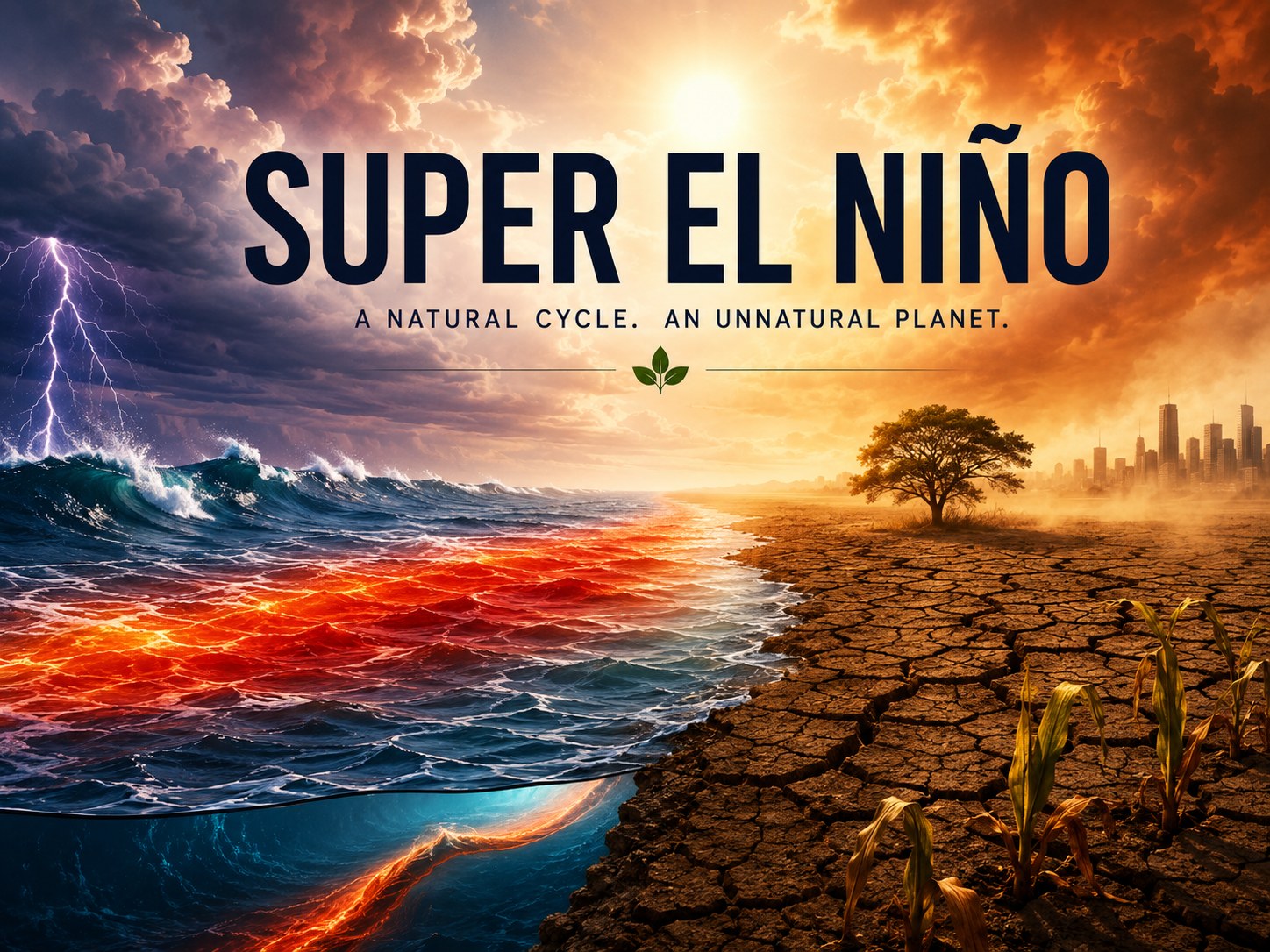
Understanding Super El Niño Through the PQNK Water Cycle Lens
ABSTRACT
Public discussion often portrays Super El Niño as the primary cause of global heatwaves, floods, droughts, and climate instability. This paper argues that El Niño is not the fundamental problem. It is a natural ocean-atmosphere oscillation that has existed for thousands of years. The unprecedented severity of its modern impacts arises because it now develops on a planet whose natural water cycle has already been profoundly disrupted by industrial agriculture. Massive heat islands created by bare soils, destruction of soil biology, widespread hardpan formation, groundwater depletion, and the collapse of local water storage have transformed the Earth's hydrological balance. Under these conditions, El Niño acts as an amplifier of an already unstable climate rather than its origin. Using the PQNK (Paedar Qudratti Nizam Kashatqari) framework, this paper explains how restoring living soils, permanent ground cover, and biological water storage addresses the root cause of increasing climate extremes.
1. Introduction
Every few years the world's attention turns toward the Pacific Ocean. Scientists begin monitoring sea surface temperatures, trade winds weaken, warm water migrates eastward, and headlines warn of an approaching El Niño. When temperatures continue rising, the phrase "Super El Niño" rapidly spreads across television, newspapers, and social media. Floods, droughts, crop failures, and heatwaves are then widely attributed to this single climatic event.
This explanation is incomplete.
El Niño is a natural oscillation that has occurred for millennia. Yet the damage associated with recent El Niño events appears increasingly severe. The critical question is therefore not why El Niño occurs, but why its consequences have become so destructive.
The answer, according to the PQNK framework, lies not in the Pacific Ocean alone, but in the condition of the land.
2. Understanding El Niño
Under normal conditions, strong trade winds push warm surface water westward across the tropical Pacific. Cooler, nutrient-rich water rises along the South American coast, while evaporation from the western Pacific drives rainfall over Asia and Australia. This circulation forms part of Earth's natural climate engine.
During El Niño, the trade winds weaken. Warm water accumulates in the eastern Pacific, ocean temperatures rise, and additional heat is transferred to the atmosphere. Weather systems around the world shift, producing floods in some regions and droughts in others.
This natural rhythm has repeated itself for thousands of years without human intervention.
The question therefore becomes:
Why are modern El Niño events producing unprecedented global consequences?
3. The Missing Half of the Climate Story
Most discussions focus almost exclusively on greenhouse gases.
PQNK identifies another equally important process.
For billions of years, Earth's land surface functioned as an immense biological water storage system. Rain infiltrated living soils, groundwater remained close to the surface, plants continuously transpired moisture, and evaporation provided powerful natural cooling.
Industrial agriculture dismantled this system.
The widespread adoption of deep tillage, bare soil, heavy machinery, deforestation, and synthetic-input agriculture fundamentally altered the movement of water across the land.
Instead of entering the soil, rainfall increasingly runs off the surface.
Instead of being stored underground, water rapidly leaves agricultural landscapes.
Instead of cooling the land through evaporation and transpiration, vast areas become intense heat islands.
This is the background condition upon which every modern El Niño now develops.
4. How Industrial Agriculture Destabilized the Water Cycle
The disruption follows a predictable sequence.
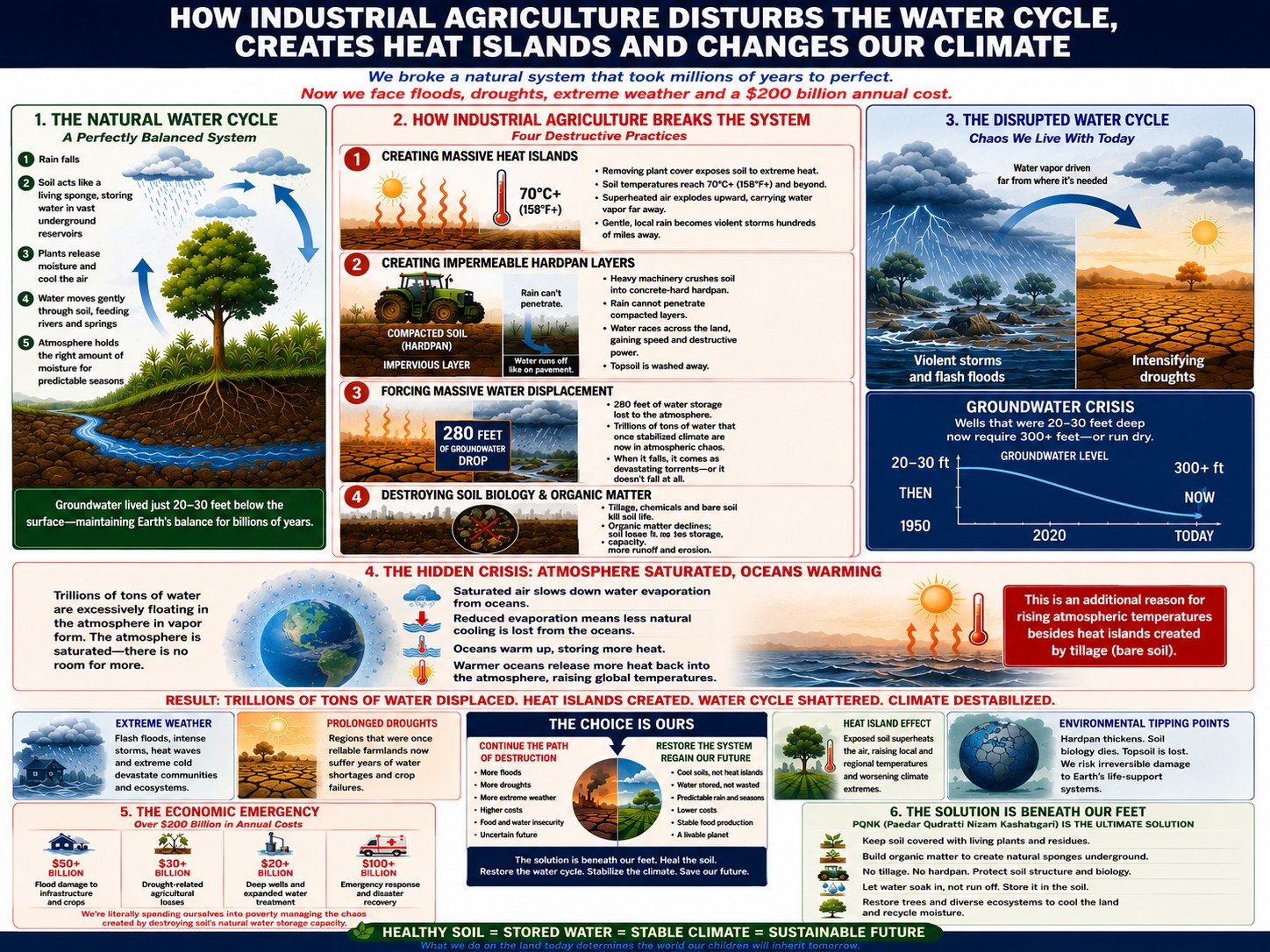
First, repeated tillage removes protective vegetation and organic mulch, exposing bare soil directly to solar radiation.
Second, heavy machinery creates impermeable hardpan layers that prevent rainfall from infiltrating the soil profile.
Third, the destruction of soil biology and organic matter eliminates the sponge-like structure that once stored enormous quantities of water underground.
Fourth, groundwater tables decline, springs disappear, and rivers increasingly depend on irregular rainfall rather than stable underground recharge.
The atmosphere gradually receives increasing amounts of water vapour displaced from the land.
The climate becomes progressively unstable.
5. The Hidden Heat Engine
Industrial agriculture creates two interconnected sources of warming.
The first is familiar.
Bare soils often exceed 70°C under direct sunlight, creating extensive continental heat islands.
The second is less widely recognized.
As shown in infographic placed below, trillions of tonnes of water that would normally be stored within healthy soils instead remain in the atmosphere as water vapour or are rapidly displaced through runoff and evaporation from exposed surfaces. This alters the timing and location of atmospheric moisture.
From the PQNK perspective, this has another consequence.
A moisture-laden atmosphere has less capacity to accept additional evaporation from the oceans under similar conditions. Reduced evaporative cooling allows more heat to remain in ocean surface waters, contributing to higher sea surface temperatures. When a strong El Niño develops, that stored oceanic heat can be transferred more rapidly into the atmosphere, intensifying global weather extremes.
This mechanism is presented here as a PQNK systems hypothesis linking degraded land hydrology with ocean-atmosphere energy exchange. It complements, rather than replaces, established climate science, and warrants further investigation.
6. Super El Niño Becomes an Amplifier
Under natural conditions,
El Niño adds heat to a stable climate.
Today,
El Niño adds heat to an already overheated climate.
It is comparable to pouring fuel onto an existing fire.
Every weather process becomes amplified.
Floods become larger.
Droughts become longer.
Heatwaves become hotter.
Storms become more destructive.
Agricultural losses become greater.
Food insecurity increases.
The natural event has not fundamentally changed.
The condition of the planet has.
7. Why Restoration Must Begin on the Land
Most climate discussions focus on reducing emissions.
PQNK agrees that emissions matter but argues that restoring Earth's biological water cycle is another essential part of climate stabilization.
This requires rebuilding the soil ecosystem rather than simply modifying atmospheric chemistry.
PQNK restores the natural water cycle by:
breaking hardpan to reconnect surface and subsoil,
constructing permanent raised beds,
eliminating tillage,
maintaining continuous organic mulch,
restoring soil biology,
maximizing infiltration,
rebuilding groundwater,
encouraging continuous transpiration,
reducing land-surface temperatures.
These interventions seek to restore the hydrological functions that healthy ecosystems performed long before industrial agriculture.
8. Conclusion
Super El Niño is not creating a new climate.
It is exposing the fragility of one already destabilized.
The Pacific Ocean remains a powerful natural climate regulator, but it now interacts with landscapes that have lost much of their capacity to store water, moderate temperature, and stabilize local weather.
The lesson is therefore not to fear El Niño itself.
The lesson is to repair the land.
A restored water cycle cannot prevent El Niño, but it can reduce the severity of its consequences by rebuilding Earth's natural capacity to absorb water, cool the surface, and regulate climate.
From the PQNK perspective, the long-term solution to increasing climate instability lies not only in the atmosphere or the oceans, but beneath our feet—in living soil, permanent ground cover, and the restoration of nature's original water cycle.
——————————
Applying PQNK without understanding nature’s operating system will not deliver abundance, stability, or nutrient density.
PQNK (pronounced “picnic”)—the regenerative & sustainable Pristine Organic Farming System—is grounded in Natural Ecosystem Science. This science employs perennial biodiversity, protects soil with organic mulch, and avoids practices such as water inundation, tillage disturbance, and leaving soil bare.
It is the process that matters most. PQNK is a pristine production system designed not merely for yield, but for optimal, balanced output—where quality, sustainability, and ecological harmony emerge from a self‑regulated, zero‑external‑input methodology.
Connect & Resources Facebook: www.Facebook.Com/Pedaver YouTube (PQNK): https://www.youtube.com/@pedaverpqnk3167/videos YouTube: http://www.youtube.com/@aasifsharif PDF Knowledge Papers: https://drive.google.com/drive/folders/1iadwV6mdUPyrUIpB3oRfNv6DLiackaUL?usp=sharing Email: pedaver@gmail.com WhatsApp: +92 320 677 6666
About This Paper
- Problem
- Flooding · Drought / Water Scarcity · Bare / Exposed Soil
- Science
- Climate · Water · Soil
- Evidence
- Philosophical/Framework Argument
- Authority
- Current / Approved PQNK Knowledge
Related PQNK Science
Key Takeaways
- El Niño is framed as a natural oscillation repeating for millennia; the paper's core claim is that its modern severity stems from land-based water-cycle degradation, not from any change in the oscillation itself.
- Industrial agriculture is described as converting land from a water-absorbing, cooling surface into one that sheds rainfall as runoff and generates heat islands, with bare soil regularly exceeding 70°C.
- The paper proposes, explicitly as an untested systems hypothesis, that degraded land hydrology reduces oceanic evaporative cooling capacity, allowing more heat to build in sea surface waters ahead of an El Niño event.
- The prescribed response is land restoration, not atmospheric intervention alone: breaking hardpan, permanent raised beds, eliminating tillage, continuous mulch, and rebuilt groundwater and soil biology.
- The paper's framing is that a restored water cycle cannot prevent El Niño but can substantially reduce the severity of its downstream flood, drought, and heatwave consequences.
Related Knowledge
same problem
Rain Where It Falls: Restoring the Soil Before Building More Water Storage
Rajendra Singh’s Rajasthan story shows that slowing runoff lets water enter the ground and restore wells and rivers. PQNK moves that principle upstream into the field itself: correct the hardpan, stop disturbing the soil, keep the surface covered, and let every acre receive and hold the rain where it falls, so that agricultural water demand stays within what the landscape renews.
same problem
Harvesting Without Irrigation
Crop water requirement is not the same as irrigation requirement. Three field clips show organic residue capturing humidity and dew and keeping the soil beneath it moist and soft, on a roller-compacted road and in the Cholistan Desert, while exposed soil beside it dries and hardens. Receive the rain, store it in the profile, protect it with cover and let roots reach it: on mature PQNK beds at 400 mm or more of annual rainfall, no irrigation is needed.
same problem
The PQNK Water System: Receive, Retain, Use
The PQNK water work in one account: break the hardpan once so the field receives the rain where it falls, retain it under permanent mulch in a living soil that also gathers dew and humidity, and use that water before adding any. Irrigation becomes a small furrow supplement, given only on the soil-ball test and never above a 4-inch (10 cm) head; a kilogram of wheat takes 154 litres of irrigation water under PQNK in transition against 1,175 under flood, and mature beds at 400 mm (16 inches) or more of rain need none.
same problem
The Hidden Crisis: How Industrial Agriculture Has Broken Earth's Water Cycle
A quantified case that industrial agriculture has driven global groundwater tables from 20-30 feet to over 300 feet deep, creating a roughly $200 billion annual crisis addressable through a costed $15 billion, 24-month PQNK rollout plan.