

KP-101 · Soil Science & PQNK System
Knowledge Paper: The Principle of Permanent Confinement – The Mechanical-Synchrony Foundation of PQNK Bed Geometry
PQNK bed and furrow dimensions are not chosen for tradition or aesthetics, they are derived mathematically from tractor wheel-track spacing and tire width so that machinery is permanently confined to the furrows and never crosses the growing bed. This paper sets out that engineering logic, the five-step establishment sequence that eliminates germination problems, and a recalculation table for adapting bed width to different tractors, soils, and rainfall zones.
Read or listen to the full paper ↓Abstract
Conventional field design starts by asking how wide a bed should be. PQNK inverts that question entirely: it starts by asking how machinery movement can be confined permanently outside the biological production zone, and treats bed width as a derived variable that follows from that answer rather than an arbitrary or traditional starting point. The paper's central claim is that PQNK's now-familiar 42-inch bed top and 18-inch furrow top are not universal dogma but one successful solution to a specific mechanical equation involving common 55-90HP two-wheel-drive tractors, their roughly 60-inch rear wheel-center spacing, and typical 13-inch rear tire width, so that a tractor's rear wheels naturally track the furrows on both sides of the bed without deviation.
The paper also corrects what it calls a previous drafting error: the assumption that PQNK beds face a 'germination difficulty' because moisture must travel from the furrow to a dry bed center. It replaces that assumption with a five-step establishment sequence, break the hardpan, water-wash the soil to settle particles and leach salts, wait for workable moisture, pulverize once with a single final tillage pass, then seed and form beds, either broadcasting onto pulverized moist soil before bed formation or forming beds first and planting into them. Because the entire bed volume is already moist at the moment of formation, seeds germinate in that residual moisture and roots are already developing by the time it depletes; there is no germination problem when the sequence is followed correctly, and this is the final tillage event the field ever undergoes.
After establishment, the paper describes a deliberately engineered gradient hydrology rather than uniform moisture: furrows serve as the water source, bed edges see high moisture and nutrient exchange, and the bed center holds moderate, dense moisture with high aeration where roots have already colonized. Roots are described as motile and exploratory rather than passive, bridging the gradient themselves, so the plant does not require uniform edge-to-edge moisture, only a connected root system and functional pore network, both of which the establishment sequence and any cover-crop rooting create.
A significant portion of the paper addresses adaptability: the standard 42-inch configuration is optimized for controlled irrigation and moderate rainfall, but in rain-fed areas with non-sandy soils, beds can widen to 48-60 inches or more provided tractor track spacing is recalculated to match. A worked recalculation table gives specific furrow and bed-top dimensions across five scenarios, from a narrow 33-inch hillside configuration to an 80-inch rain-fed wide-bed configuration, with the rule that furrow width should always exceed tire width by roughly 5 inches for guidance tolerance and sidewall clearance.
The furrow itself is framed as a multi-functional corridor serving five inseparable roles simultaneously: hydraulic conveyance, traffic guidance, compaction localization, machine alignment, and structural boundary protection for the undisturbed bed. The paper's conclusion states that once traffic lanes are fixed and the establishment sequence is complete, compaction becomes permanently localized to the furrow corridors while the raised bed accumulates organic matter, porosity, and biology undisturbed season after season, and calls for this confinement principle, not any specific measurement, to be treated as the permanent architectural logic of the PQNK Bed System.
Full Paper
If you use “Listen”, the text of the page may be sent to your browser or operating system’s speech provider, such as Apple, Google or Microsoft, depending on the voice your device uses. Pedaver does not process, transmit or store any audio.
1. Abstract
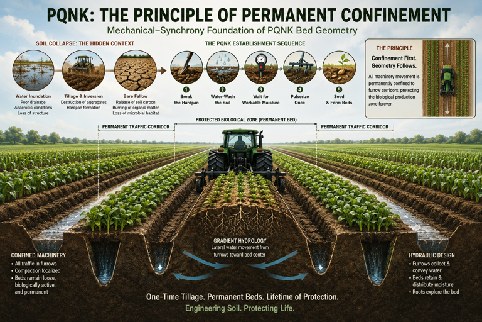
This paper establishes a core engineering principle that must become part of the permanent architectural logic of the PQNK Bed System section. Contrary to conventional agricultural design—which begins by asking “How wide should the bed be?”—PQNK originates from a different, ecologically prior question: “How can machinery movement be confined permanently outside the biological production zone?” The resulting bed and furrow dimensions are therefore not arbitrary, aesthetic, or traditional. They are mechanically synchronized with controlled traffic engineering, tractor wheel geometry, hydraulic organization, and biological protection.
This paper further integrates the complete PQNK establishment sequence. Most soils entering transition have already collapsed due to water inundation, tillage, soil inversion, and bare fallowing—practices that release soil carbon and burn organic matter. The PQNK method does not hope for germination. It engineers it through a deliberate sequence: break the hardpan, water-wash the soil, pulverize once at workable moisture, then seed and form beds. Because the entire bed is moist at establishment, seeds germinate without difficulty. Once roots develop, they reach out to required aeration and nutrient density, aided by lateral water movement gradients from furrows to bed center. This is not a problem to be solved. It is the designed hydrology of the system.
2. The Primacy of Confinement Over Dimension
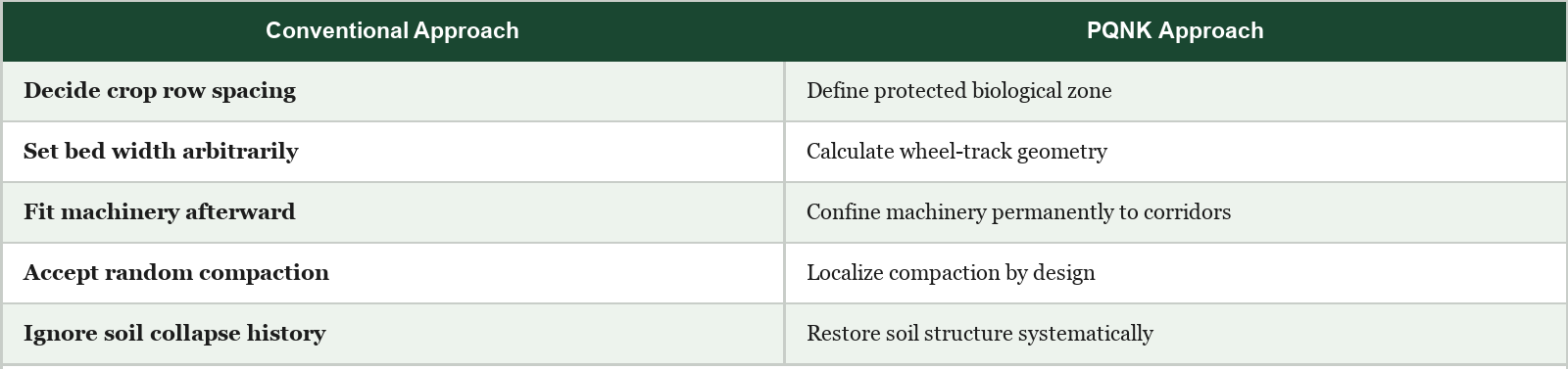
In standard farming, bed width is often the first variable. In PQNK, bed width is a derived variable. The design sequence is inverted:

| Cause | Effect |
|---|---|
| Water inundation | Anaerobic conditions, loss of soil structure |
| Tillage and soil inversion | Destruction of natural aggregates, hardpan formation |
| Keeping soil bare | Release of soil carbon, burning of organic matter, loss of microbial habitat |
| Conventional Approach | PQNK Approach |
|---|---|
| Decide crop row spacing | Define protected biological zone |
| Set bed width arbitrarily | Calculate wheel-track geometry |
| Fit machinery afterward | Confine machinery permanently to corridors |
| Accept random compaction | Localize compaction by design |
| Ignore soil collapse history | Restore soil structure systematically |
PQNK does not begin with geometry. It begins with confinement. Once confinement is achieved, geometry follows necessarily from mechanical and hydraulic constraints.
3. The Hidden Context: Soil Collapse and Hydrological Fragmentation
Most agricultural soils entering a PQNK transition are not healthy. They are collapsed due to three interrelated insults: As a result, water infiltration, seepage, and retention capacity differ dramatically by region, primarily driven by soil temperature regimes. Cold soils hold water differently than warm soils. Organic matter content varies. The same bed geometry cannot be assumed to perform identically everywhere. Therefore, the PQNK engineering principle must include a complete establishment sequence that prepares soil before permanent confinement geometry becomes fully operational.
4. The Complete PQNK Establishment Sequence (The Correct Method)
There is no "germination difficulty" in PQNK when the following sequence is followed exactly. The sequence is not optional. It is the mechanical-biological protocol that guarantees successful establishment.
Step 1: Break the Hardpan
Mechanical fracturing of the compacted layer to allow vertical water movement, root penetration, and deep infiltration.
Step 2: Water-Wash the Soil
Controlled irrigation or natural rainfall is applied to settle soil particles, leach salts, and initiate natural reconsolidation. This is not "irrigation for germination." It is hydraulic preparation of the soil matrix.
Step 3: Wait for Workable Moisture
The soil is allowed to dry to the precise moisture level at which it can be properly worked—neither too wet (smearing) nor too dry (dust formation). This is determined by field feel or quantitative moisture measurement.
Step 4: Pulverize with Tillage – Once, for the Last Time
In this well-worked, moist soil, a single tillage pass is performed to pulverize soil aggregates to seedbed consistency. This is the final tillage event in the life of that field under PQNK. After this moment, tillage never occurs again on the permanent bed. All subsequent operations are confined to furrow corridors.
Step 5: Seed and Form Beds (Two Permissible Orders)

| Option A | Option B |
|---|---|
| Broadcast seed onto the pulverized moist soil surface | Form beds first using the permanent geometry |
| Form permanent raised beds afterward | Plant seed using a planter (designed to place seed into moist soil) |
Both options work because the soil is already moist at the time of seeding. The seed is placed into a moist environment. Germination proceeds without difficulty.
5. Why There Is No Germination Problem
The conventional farmer's anxiety—"Will moisture reach the center of the bed?"—rests on an assumption that the bed is formed dry and then irrigated from furrows only. That is not the PQNK method. In PQNK establishment:
• The entire bed volume is already moist at the moment of bed formation.
• Seeds germinate in that residual moisture.
• By the time that residual moisture is depleted, roots have already developed.
Once roots are developed, they reach out to required aeration and the density of the water-nutrient solution within the soil matrix. The plant does not wait for water to come to it. The root system explores the bed.
6. The Gradient Hydrology of the Permanent Bed
After establishment, lateral water movement occurs naturally from the furrows toward the bed center. This is not a defect. It is a designed gradient.

| Zone | Hydrological Characteristic |
|---|---|
| Furrow (both sides) | Water source during irrigation or rainfall |
| Bed edge | High moisture, high nutrient exchange |
| Bed center | Moderate nutrients dense moisture, highly aerated zone, roots have already colonized |
Because roots are already present throughout the bed profile, they access water and nutrients across the gradient. The plant does not require uniform moisture from edge to edge. It requires a connected root system and functional pore networks. Both are established during the initial sequence.
7. The Root Principle Reaffirmed
Where water does not initially reach, roots reach out. This is not a statement of difficulty. It is a statement of biological design. Roots are motile, exploratory, and adaptive. A seed germinating in a uniformly moist bed does not face a moisture barrier. As the bed ages, roots create their own pathways. Cover crop roots (if included in the rotation) further open pores for infiltration, seepage, water retention, aeration, and soil life corridors. The issue is permanently resolved not by engineering alone, but by engineering plus biology.
8. The Standard Configuration as a Case Study
The widely adopted PQNK configuration—42-inch bed top + 18-inch furrow top—is not a universal dogma but a successful solution to a specific mechanical equation.
• Common 55–75 HP two-wheel-drive (TWD) tractors
• Standard rear wheel-center spacing: approximately 60 inches
• Typical rear tire width: 13 inches
Thus, the tractor’s rear wheels naturally track the furrows on both sides of the bed without deviation. This remains valid. In rain-fed contexts with wider beds, tractor track spacing must be adjusted accordingly.
9. The Furrow as a Multi-Functional Corridor
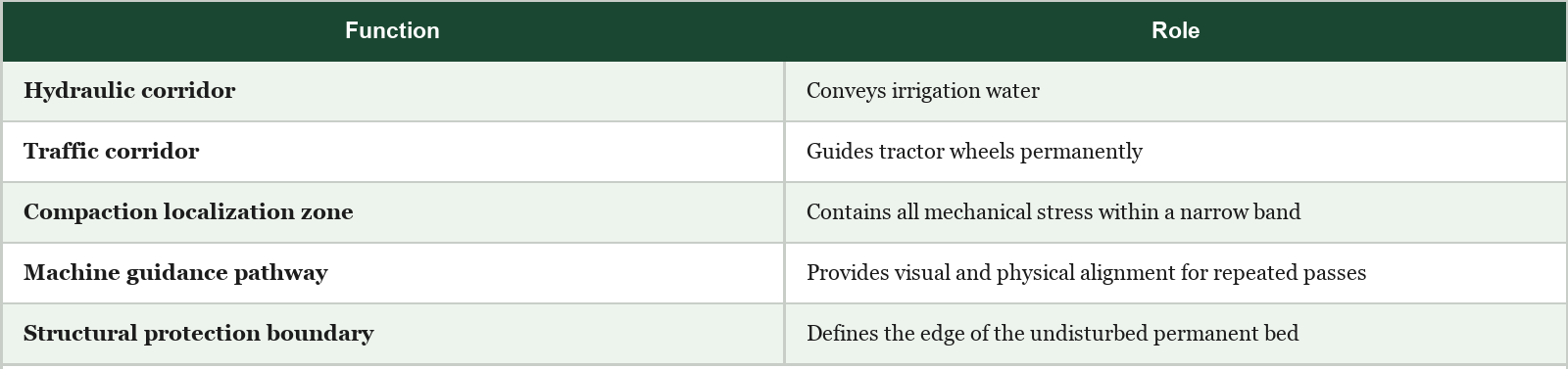
The furrow is not merely a water channel. In PQNK architectural logic, each furrow simultaneously serves five inseparable functions:
| Function | Role |
|---|---|
| Hydraulic corridor | Conveys irrigation water |
| Traffic corridor | Guides tractor wheels permanently |
| Compaction localization zone | Contains all mechanical stress within a narrow band |
| Machine guidance pathway | Provides visual and physical alignment for repeated passes |
| Structural protection boundary | Defines the edge of the undisturbed permanent bed |
Addendum on gradient hydrology: After establishment, furrows supply lateral water movement toward the bed center. This gradient does not need to be uniform. Roots bridge the gradient.
10. Biological Protection Through Mechanical Discipline
Once traffic lanes become fixed and the four establishment steps (hardpan break, water wash, final pulverization, seeding + bed form) are complete, the field undergoes a fundamental change in behavior:
• Compaction becomes localized within designated furrow corridors.
• The raised bed remains structurally protected season after season.
• Organic matter, porosity, and soil biology accumulate undisturbed in the bed zone.
• Roots from cash crops and cover crops create permanent biopores that transport water, air, and nutrients without tillage.
• Operational stress separates from ecological function.
Controlled alignment is therefore not a convenience—it is a hidden foundation of long-term soil stabilization under PQNK.
11. Rain-Fed Adaptability: Bed Width Is Not Fixed
The standard PQNK configuration is optimized for controlled irrigation and moderate rainfall. However, in rain-fed areas, if tractor track spacing allows—and tractor track spacing is always adjustable to meet row-to-row distance requirements—bed size can be made wider, provided the soil texture is not sandy.

| Soil Texture | Rain-Fed Bed Width Recommendation |
|---|---|
| Clay, clay loam, silt loam | Wider beds possible (e.g., 48–60 inches) |
| Sandy loam | Standard or narrower beds (42 inches) |
The engineering logic remains intact: tractor wheels must still track permanently within furrows. The confined traffic principle does not demand a specific number. It demands mechanical synchrony between furrow spacing and wheel geometry.
12. The Adaptive Principle: Dimensions Are Not Doctrinal
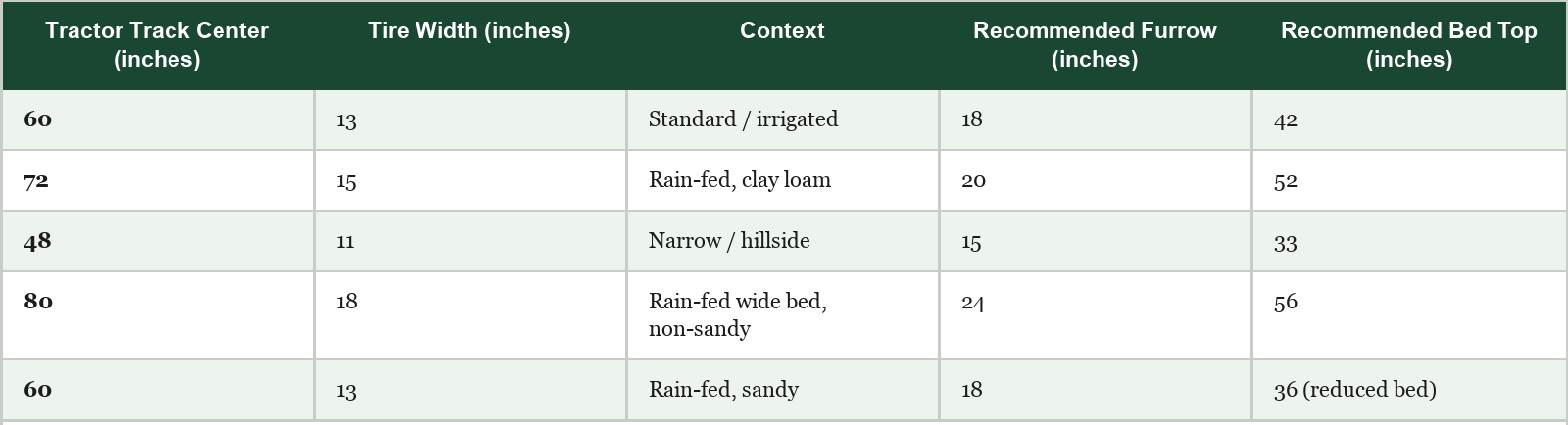
The most critical engineering clarification remains: The principle is universal; the measurements are adaptive. If tractor wheel-track spacing differs—due to region, brand, horsepower class, flotation requirements, or rain-fed bed width adjustments—then bed and furrow dimensions must be recalculated. The objective remains invariant: Tractor tires must travel permanently within the furrows on both sides of the bed while the intervening zone remains undisturbed as the permanent biological production platform.
Recalculation Examples
| Tractor Track Center (inches) | Tire Width (inches) | Context | Recommended Furrow (inches) | Recommended Bed Top (inches) |
|---|---|---|---|---|
| 60 | 13 | Standard / irrigated | 18 | 42 |
| 72 | 15 | Rain-fed, clay loam | 20 | 52 |
| 48 | 11 | Narrow / hillside | 15 | 33 |
| 80 | 18 | Rain-fed wide bed, non-sandy | 24 | 56 |
| 60 | 13 | Rain-fed, sandy | 18 | 36 (reduced bed) |
Note: Furrow width should always exceed tire width by ~5 inches minimum for guidance tolerance and sidewall clearance.
13. Integration into PQNK Documentation
This principle must now become structurally integrated into the upcoming chapters of the PQNK Bed System section. Specifically:
• Chapter: Soil Collapse & Readiness Assessment – Must include soil collapse history, temperature regime, and organic matter status before geometry is selected.
• Chapter: The PQNK Establishment Sequence – Must present the five-step sequence (break hardpan → water wash → workable moisture → final pulverization → seed + bed form) as non-negotiable. This chapter must explicitly state that there is no germination problem when this sequence is followed.
• Chapter: Bed Geometry Design – Must open with the question of confinement, not dimension, and include rain-fed width adaptation rules.
• Chapter: Gradient Hydrology – Must explain lateral water movement from furrows to bed center, and how roots bridge moisture gradients.
• Chapter: Controlled Traffic Integration – Must reference the furrow as a multi-functional corridor.
• Chapter: Root Biology – Must document that roots reach out to required aeration and water-nutrient density, and that this is a designed feature, not a remedial measure.
• Chapter: Regional Adaptation – Must provide recalculation method for different tractor systems, rainfall zones, and soil textures.
14. Conclusion
PQNK bed geometry is not based on aesthetic symmetry, historical row-spacing tradition, or arbitrary convenience. It is derived from ecological mechanics, hydraulic behavior, machinery alignment, and biological continuity functioning together as one integrated field architecture. Most soils enter the transition already collapsed from inundation, tillage, and bare fallowing. The PQNK establishment sequence addresses this directly: hardpan broken, soil water-washed, worked at correct moisture, pulverized once and for all, then seeded and formed into beds. Because the entire bed is moist at establishment, seeds germinate without difficulty. After roots develop, they reach out across the bed, accessing aeration and water-nutrient gradients created by lateral movement from furrows. In rain-fed areas with non-sandy soils, beds can be widened as tractor track spacing allows. This adaptive engineering flexibility will become increasingly important as PQNK expands across different countries, tractor systems, soil types, rainfall zones, and cropping systems. The principle of permanent confinement is therefore not a technical detail—it is the permanent architectural logic of the PQNK Bed System.
Document Status: Approved for structural integration into core PQNK technical chapters. Correction Acknowledged: The previous draft incorrectly suggested a germination difficulty. This draft removes that error and documents the correct establishment sequence.
Next Action: Revise all transition and hydrology chapters to reflect that PQNK begins with moist soil at seeding, not dry beds awaiting furrow irrigation.
Applying PQNK without understanding nature’s operating system will not deliver abundance, stability, or nutrient density.
PQNK (pronounced “picnic”)—the regenerative & sustainable Pristine Organic Farming System —is grounded in Natural Ecosystem Science. This science employs perennial biodiversity, protects soil with organic mulch, and avoids practices such as water inundation, tillage disturbance, and leaving soil bare.
It is the process that matters most. PQNK is a pristine production system designed not merely for yield, but for optimal, balanced output—where quality, sustainability, and ecological harmony emerge from a self‑regulated, zero‑external‑input methodology.
About This Paper
- Problem
- Soil Compaction (General) · Poor Germination / Emergence · Machinery / Field-Operation Decision Difficulty
- Science
- Soil · Production Architecture
- Evidence
- Scientific Mechanism
- Authority
- Current / Approved PQNK Knowledge
Related PQNK Science
Key Takeaways
- PQNK bed geometry is derived from tractor wheel-track spacing and tire width, not chosen arbitrarily: the standard 42-inch bed/18-inch furrow configuration is a mechanical solution for common 55-90HP tractors with ~60-inch rear wheel-center spacing and 13-inch tires.
- Corrects an earlier draft's error: there is no inherent 'germination difficulty' in PQNK beds. A five-step sequence, break hardpan, water-wash, reach workable moisture, pulverize once, then seed and form beds, leaves the whole bed moist at establishment so seeds germinate without difficulty.
- After establishment, lateral gradient hydrology moves water from furrow to bed center by design; roots are described as motile and exploratory, bridging the moisture gradient themselves rather than requiring uniform moisture.
- Bed width is adaptive, not fixed: rain-fed, non-sandy fields can run 48-60+ inch beds provided furrow spacing is recalculated to match the tractor's actual track geometry, with furrow width always exceeding tire width by roughly 5 inches.
- The furrow is framed as a multi-functional corridor performing five roles at once: hydraulic conveyance, traffic guidance, compaction localization, machine alignment, and structural boundary protection.
- The governing principle is permanent confinement of machinery to furrow corridors, not any specific dimension; once traffic lanes are fixed, compaction stays localized while the bed zone accumulates organic matter and biology undisturbed indefinitely.
Related Knowledge
same problem
Production Architecture: Engineering the Farm So the Living System Never Has to Be Rebuilt
Explains the physical engineering behind the four PQNK principles: permanent raised beds and furrows that separate destructive tractor traffic and irrigation from a protected biological zone, so a field accumulates biological function crop after crop instead of being torn down and rebuilt every season.
same problem
PQNK Farming in Practice: Site-Specific Solutions for Regenerative Agriculture — Questions & Detailed Answers
A practitioner's detailed field questions, on bed orientation, irrigation choice, land clearing, machine-hour budgets, and mulch selection, are answered directly, with the recurring caveat that most PQNK decisions are inherently site-specific and only become concrete once a farm's topography, water, climate, and objectives have been surveyed.
same problem
Optimizing Tractor Setup for Precision Planting and Bed-Furrow Health
A farmer choosing between two tractors and two tyre widths for a precision planter on 42-inch permanent beds gets a precise engineering answer here: 45-55 HP, with approximately 9 inches the ideal tyre width for this furrow geometry (9-13 inches the practical range, not exceeding 13 inches), and compaction strictly limited to the lower third of the furrow slope. The paper treats correct tractor setup as inseparable from PQNK soil-health outcomes, not a separate mechanical concern.
same problem
PQNK Factsheet: Production of HD Castor
A field factsheet for High-Density (HD) Castor grown as a 3-5 year perennial under PQNK, covering the mandatory land-preparation sequence, planting density, and the pruning schedule that keeps the crop productive across multiple harvest years.