

KP-001 · Plant Physiology & Production Systems
The Evolution of Seed Placement: Why the Seed Opener Was Left Behind
A century of planter engineering perfected the seed meter but never solved the seed opener, the part of the machine that actually places seed in the soil. This paper traces that history and explains the SIPP and VIPP no-till planters Pedaver engineered to close the gap.
Read or listen to the full paper ↓Abstract
Modern seed drills and planters owe their precision to a century of refinement in one component: the seed meter, the mechanism that singulates and doses seed at a controlled rate. Meanwhile the seed opener, the part of the machine that actually cuts into the soil and places that seed, has been left largely unchanged since the era of animal-drawn drills. This paper traces that uneven history and argues that seed placement, not seed metering, is the unresolved half of planter engineering.
Conventional openers place seed inside a single continuous slit or furrow, a geometry with no precedent in natural seed dispersal. No wild plant drops its seed into a straight, uninterrupted line; nature scatters seed into pockets of varying depth and spacing, shaped by wind, gravity and animal movement. PQNK's placement work starts from that observation, treating the continuous slit itself, rather than any input the crop is missing, as a root cause of uneven germination and weak early root architecture.
Pedaver's response was to design two purpose-built no-till planters rather than adapt an existing drill. SIPP, the Slit Insertion Precision Planter, opens a short, discrete two-inch by two-inch pocket for each seed rather than a running slit, cutting cleanly through thick surface mulch without dragging residue into the seed zone. VIPP, the Vertical Insertion Precision Planter, uses a cone-shaped insertion point to press seed straight down into an undisturbed soil profile, suited to crops and field conditions where a vertical placement outperforms a slit-style opener.
Both machines are built for the same underlying PQNK requirement: planting directly through a mulch layer, on permanent raised beds, without inverting or disturbing the soil beneath. The paper closes by walking through field-documented outcomes from SIPP and VIPP across multiple crops, and situates the seed-opener problem within the broader argument that PQNK's engineering, not just its biology, is what makes no-till mulch planting workable at commercial scale.
Full Paper
If you use “Listen”, the text of the page may be sent to your browser or operating system’s speech provider, such as Apple, Google or Microsoft, depending on the voice your device uses. Pedaver does not process, transmit or store any audio.
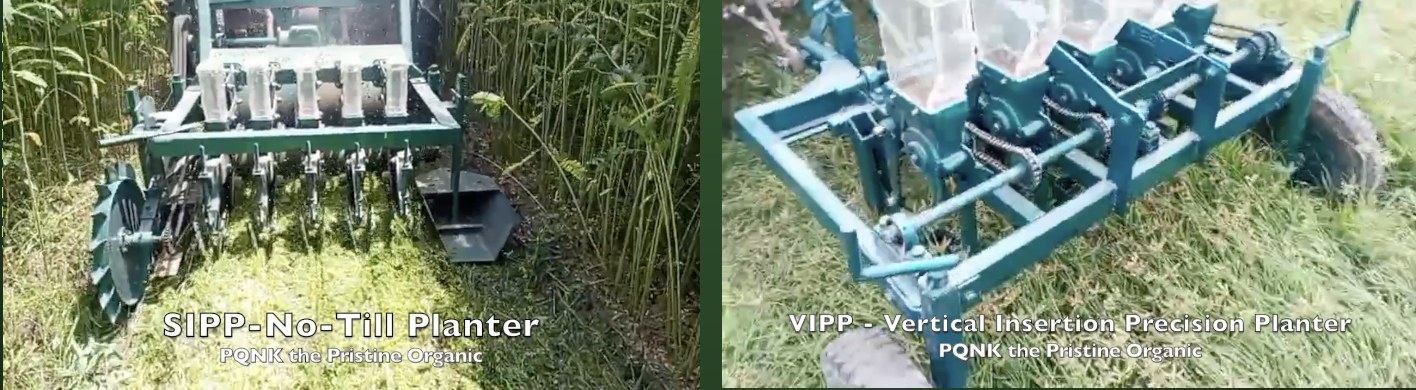
TABLE OF CONTENTS
Chapter 1. Every Seed Needs Two Machines
Chapter 2. Twelve Thousand Years of Opening the Soil
Chapter 3. Disturbed Soil Volume
Chapter 4. Engineering the Vertical Insertion Precision Planter
Chapter 5. Comparative Engineering Analysis of Seed Placement Systems
Chapter 6. Engineering for Manufacturability
Chapter 7. Design Requirements Specification (DRS) for the Vertical Insertion Precision Planter
Chapter 8. Kinematic and Dynamic Analysis of the Vertical Insertion Precision Planter
Chapter 9. Actuator Engineering for the Vertical Insertion Precision Planter
Chapter 10. Failure Modes and Engineering Challenges
Chapter 11. Prototype Development and Field Validation
Chapter 12. Future Development of the Vertical Insertion Principle
Chapter 13. Conclusion
CHAPTER 1
Every Seed Needs Two Machines
Every crop begins with a seed, and every seed must complete two separate journeys before it can become a plant. The first is from the seed hopper to its intended location in the field. The second is from the soil surface into the living root zone where moisture, oxygen and biological activity allow germination to begin. These two journeys are performed by two entirely different systems within every planter ever built: the seed distribution mechanism, or seed meter, which selects individual seeds and delivers each to its planting point, and the seed opener, which creates space within the soil for the seed before the soil closes around it.
Mechanically these two systems are assembled into a single machine. Biologically they are not equally important. The seed meter determines how accurately seeds are spaced. The seed opener determines how much of the living soil ecosystem must be disturbed in order to place those seeds.
For thousands of years this distinction went unrecognised, because every crop was preceded by tillage. The soil had already been ploughed, pulverised and levelled before the planter entered the field, so the additional disturbance caused by the opener was of little consequence. Under the PQNK system this assumption no longer holds. The field entering the planting season is not a loose seedbed waiting to be cultivated; it is a mature biological ecosystem of permanent raised beds, living roots, earthworm channels, fungal networks and protective mulch. The objective of planting is no longer to prepare the soil for a crop. It is to introduce a new crop into a living ecosystem without destroying the biological system that already exists.
Seed metering has its own long history of refinement. Broadcasting, the oldest method, scatters seed across the surface with almost no control over plant population, forcing much higher seed rates to compensate for uneven distribution and competition among crowded seedlings. The seed drill improved on this by delivering seed into rows, though spacing within each row remained essentially random. The plate planter introduced true singulation, using a rotating plate of individually sized cells to release one seed at a time, at the cost of requiring carefully graded, uniform seed. The vacuum planter refined singulation further, using controlled air pressure rather than mechanical cells, and remains among the most accurate metering systems available today, again provided the seed is well graded. Seed rollers occupy a similar niche for smaller-seeded crops. Across all of these systems, one pattern holds: once a seed is accurately singulated, the problem of seed distribution is essentially solved. Germination afterward depends not on the sophistication of the metering device but on the biological environment the seed is placed into.
This is the paradox at the centre of a century of planter engineering. Enormous effort went into placing seed more accurately, while comparatively little went into reducing the biological cost of opening the soil to receive it. Whether the opener is a shoe, a hoe, a disc or a tine, nearly every modern planter still relies on the same principle that has governed planting implements for centuries: create a continuous opening through the soil, place the seed within it, and close it again. The dimensions and mechanism vary; the biological consequence, a continuous wound running the length of every row, does not.
This paper begins from the opposite direction. The engineering question is no longer “How accurately can we place the seed?” that problem has already been solved. It has become “How little living soil must we disturb to place it?”
The answer led to two distinct planting systems within PQNK. The first was the Slit Insertion Precision Planter (SIPP), which greatly reduced soil disturbance by replacing conventional furrows with a narrow continuous slit. The second, and more significant step, was the Vertical Insertion Precision Planter (VIPP), which abandoned the continuous slit altogether and replaced it with an individual vertical insertion point for each seed. That seemingly simple change represents a fundamental shift in the philosophy of agricultural engineering from designing machines to work the soil, toward designing machines that protect it.
CHAPTER 2
Twelve Thousand Years of Opening the Soil
The history of agriculture is often told as the history of improving seeds, fertilizers, irrigation and machinery. It could equally be told as the history of how humans have opened the soil to place a seed. Every civilization has faced the same challenge: a seed must be placed beneath the surface where moisture and warmth allow germination to begin. The materials used to create that opening have evolved from sharpened sticks to forged steel, from animal power to hydraulic systems, from hand tools to electronically controlled planters. Beneath this extraordinary technological progress, however, lies a remarkable continuity: almost every seed opener ever invented has relied on the same principle: move horizontally through the soil while continuously creating an opening. The dimensions of that opening have changed. Its precision has changed. Its biological consequence has changed very little.
The Planting Stick
The earliest farmers possessed no machinery. Their seed opener was a sharpened wooden stick pushed vertically into the ground by hand, creating a small hole into which one or more seeds were dropped before the opening was closed with the foot. Biologically this was an elegant solution: disturbance was confined almost entirely to the immediate location of each seed, while the soil between neighbouring plants remained untouched. Its limitation was not biological but one of productivity, no individual farmer could plant fast enough to support an expanding population.
The Hoe
The next development replaced individual planting holes with continuous furrows. A hoe pulled through the soil created an open trench into which seed could be placed before being covered again. This greatly increased planting efficiency: one continuous movement now planted many seeds. But for the first time, the soil between neighbouring seeds was disturbed even though no seed occupied that space. The continuous furrow became the standard method of planting, a principle that would dominate agriculture for thousands of years.
Animal-Drawn Ploughs
As civilizations expanded, animal power replaced human labour. Wooden and later iron ploughs created longer, deeper furrows and cultivated far larger areas. These implements were never designed primarily as seed openers; they prepared the entire field before planting began. But they reinforced the same philosophy, before a seed could enter the soil, the soil itself had to be completely reconstructed. Every crop began by destroying the previous biological system, and this survived almost unchanged for millennia.
Mechanical Seed Drills
The Industrial Revolution combined seed metering and seed opening into a single machine. Mechanical seed drills delivered seed continuously while shoe or hoe openers created narrow furrows ahead of the seed tube, placing seed at relatively uniform depth in orderly rows. Crop establishment improved dramatically, but the biological principle remained unchanged: the opener still produced one continuous disturbance extending along the entire planted row. Engineering had improved precision. It had not reduced biological interruption.
Shoe, Hoe, Disc, Tine and Rotary Openers
Later generations of drill openers refined this same principle without abandoning it. The shoe opener, a wedge-shaped body that forced soil aside, performed well in finely prepared seedbeds but depended on prior tillage and could not tolerate mulch or residue. The hoe opener, a stronger variant, penetrated harder soils and tolerated somewhat heavier residue, but still displaced soil continuously along the row. Rotating discs reduced draft and improved residue flow, slicing rather than pushing, and became the preferred choice for many no-till drills, yet the disc still produced a continuous cut from one end of the field to the other; the engineering had become more refined, but the geometry had not fundamentally changed. Tine openers combined deep penetration with better residue flow but generated greater lateral disturbance in the process. Rotary openers, the most aggressive of all, actively cultivate the planting zone immediately ahead of seed placement, pulverising aggregates and severing roots, solving a mechanical problem by recreating the very disturbance permanent agriculture seeks to eliminate.
Despite their differences in appearance, every one of these openers shares one defining characteristic: each creates a continuous opening while travelling horizontally through the soil. Some are wider, some narrower; some move soil, others slice it; some rotate, others slide. But every one of them treats the planted row as one uninterrupted engineering operation, disturbing the space between seeds exactly as thoroughly as the space the seed itself occupies. Nature never follows this principle, a naturally dispersed seed disturbs only the small volume of soil immediately surrounding its own germination site. Twelve thousand years of agricultural engineering had moved progressively farther from that natural model.
The First Departure: SIPP
The Slit Insertion Precision Planter marked the first deliberate attempt to redesign the seed opener on biological rather than purely mechanical terms, replacing the conventional furrow with a narrow continuous slit that dramatically reduced disturbed soil volume while allowing accurate planting directly through mulch. For the first time, a planter had been engineered to preserve rather than reconstruct the soil. Yet one characteristic remained: the slit was still continuous, connecting every seed along the row through one uninterrupted opening.
The Final Step: VIPP
The next question was inevitable: if the continuous slit itself could be eliminated, could planting approach the biological efficiency of nature? The answer became the Vertical Insertion Precision Planter, which replaces continuous movement through the soil with a series of independent vertical insertions, each seed placed within its own isolated cavity, with the soil between planting points left almost entirely undisturbed. For the first time since agriculture began, the geometry of planting returned close to the geometry by which nature itself establishes new plants. The remaining chapters of this book examine why that geometry matters, and how it was engineered.
CHAPTER 3
Disturbed Soil Volume
The Engineering Parameter That Was Never Measured
Throughout the evolution of agricultural machinery, engineers have measured almost every characteristic of a planter, draft force, field capacity, plant spacing, depth uniformity, manufacturing cost. One parameter, however, has remained almost entirely absent from agricultural engineering: how much living soil does the planter disturb in order to place each seed?
The omission is understandable. Before planting, fields were routinely ploughed, cultivated, harrowed and levelled, so the biological architecture had already been dismantled long before the planter itself entered the field. Measuring the disturbance caused by the opener seemed unnecessary because it represented only a small fraction of the disturbance already imposed by tillage.
Permanent biological agriculture changes this completely. In a mature PQNK field, the planter is the only machine that penetrates the biological bed after its one-time establishment. Earthworms, fungal networks and root channels from previous crops continue functioning uninterrupted throughout the year, and the mulch protects the surface while microorganisms recycle organic residues into plant nutrients. Within such a system, every movement of steel through the soil becomes biologically significant, and the more appropriate engineering question becomes how little soil the planter needs to disturb before successful germination can occur.
This is Disturbed Soil Volume: the three-dimensional quantity of soil whose natural structure, its aggregates, its pore spaces, its fungal continuity, is altered during planting. From the standpoint of the seed, only a remarkably small volume of soil is actually required: enough to establish intimate contact with moist soil while maintaining access to oxygen during germination. Everything beyond that volume is engineering excess inherited from centuries of cultivation rather than the biological requirements of the plant itself.
Consider a crop planted at nine-inch spacing, roughly sixty-two thousand plants per acre. Each seed requires only a small volume of undisturbed soil in which to germinate; the soil between neighbouring seeds has no biological reason to be opened, because no seed will occupy that space. Conventional seed openers disturb it anyway, simply because the opener remains in continuous contact with the ground while the machine advances. Across an entire field this produces an enormous multiplication of disturbance: instead of opening only the individual locations where seeds will germinate, the machine opens an uninterrupted strip extending for kilometres, the majority of which never receives a seed.
Once this parameter is made explicit, seed openers can be classified not by their mechanical construction but by their biological behaviour, and three categories emerge.
Continuous-disturbance openers, shoe, hoe, disc, tine and most conventional no-till openers, create an uninterrupted opening extending the full length of the planted row. Every centimetre travelled produces another centimetre of disturbed soil, regardless of mechanism.
Reduced-continuity openers reduce the cross-section of that disturbance dramatically without eliminating it. The Slit Insertion Precision Planter belongs to this category: by replacing a wide furrow with a narrow slit approximately two inches wide and two inches deep, it cut disturbed soil volume to a fraction of that produced by conventional drills, while permitting accurate planting directly through heavy mulch without prior cultivation. The surrounding biological system remained substantially more intact, a major engineering achievement. But the slit was still continuous. Between one seed and the next, where no biological purpose existed for disturbing the soil, the slit nevertheless remained open.
Discrete-placement openers eliminate the continuous opening altogether, creating isolated planting cavities that exist only where individual seeds are placed. The Vertical Insertion Precision Planter is the first practical implementation of this category. Its planting beak enters the soil vertically to produce a small conical cavity, roughly one inch wide at the surface, tapering to less than half an inch at its base, and about one and a half inches deep, before withdrawing and allowing the surrounding soil to relax naturally toward its original position. Between two neighbouring seeds, the planter does nothing: no slit is extended, no furrow is continued, no additional soil is disturbed.
The cone shape is deliberate rather than incidental. Narrow at the bottom, it concentrates the seed at one exact depth in firm contact with moist soil rather than loose fill. Wide at the top, it gives mulch and residue room to pass without jamming the mechanism. And because it is a poke rather than a cut, fibrous, non-brittle residue never has a continuous edge to drag against or resist. A cylindrical hole would require unnecessary displacement of soil throughout its depth; because the cavity narrows toward its base, the surrounding soil experiences less displacement and retains greater structural stability, and after withdrawal the soil's own elasticity encourages partial closure without additional mechanical action.
This geometry has a natural precedent. Across forests, grasslands, wetlands and deserts, billions of seeds germinate every year without any continuous opening in the soil. Whether carried by wind, water, birds or animals, or released directly from the parent plant, every seed begins its life as an individual event; the soil around it remains exactly as it was before the seed arrived. Nature has had more than four hundred million years to optimise plant establishment, and no plant, insect, bird or mammal has ever needed to prepare a continuous trench before a new plant could grow. Only the seed requires accommodation. The soil between neighbouring plants continues performing functions transporting water and nutrients through fungal hyphae, maintaining air and water channels through earthworm galleries, protecting organic carbon within stable aggregates, that contribute nothing to placing a seed but everything to establishing a healthy plant. Disturbing them unnecessarily imposes a biological cost without an equivalent biological benefit.
Across an entire field, the difference between a continuous slit and discrete insertion is the difference between one uninterrupted zone of disturbance and a sequence of isolated planting sites separated by completely undisturbed living soil. Fungal networks remain connected between planting points. Earthworm galleries remain intact. Moisture stays protected beneath the mulch, and oxidation is confined almost entirely to the small cavity immediately surrounding each seed. For perhaps the first time since the earliest farmers planted with a sharpened stick, the geometry of mechanised planting once again approaches the geometry by which nature establishes new plants.
This is the principle upon which the VIPP has been engineered. It is not merely another seed opener with a different shape; it represents a different philosophy of agricultural engineering. For more than a century, engineers pursued the question of how efficiently steel could move through the soil. The Vertical Insertion Principle asks a different question: how little does the soil need to be disturbed before nature can complete the rest of the work? That distinction, between machinery designed to move soil efficiently and machinery designed to disturb it as little as possible, separates industrial agriculture from permanent biological agriculture, and it is the foundation for everything that follows in this book.
CHAPTER 4
Engineering the Vertical Insertion Precision Planter
The Vertical Insertion Precision Planter does not begin its design with the seed meter or the seed opener. It begins with the permanent biological bed itself: a structure whose geometry remains unchanged for years, carrying a continuous layer of living vegetation, dead mulch or both, and containing stable aggregates, earthworm channels, fungal networks and root systems from previous crops that should not be disturbed unless absolutely necessary for seed establishment. The planter therefore performs only one operation, it introduces a seed into the biological bed, with no cultivation, no furrow preparation, no soil inversion and no bed reshaping.
This requirement establishes the first engineering objective: the planting mechanism must operate independently of forward motion. Every conventional opener derives its planting action from horizontal movement through the soil, the faster the planter travels, the longer the furrow becomes. The VIPP separates these two motions completely. The tractor provides only forward movement; the planter provides only vertical insertion. Forward travel determines the distance between successive planting positions. Vertical movement determines seed placement. Neither motion depends on the other.
The insertion mechanism functions as a precisely timed actuator. At predetermined intervals it accelerates the planting beak vertically into the soil, pauses momentarily while the seed is released, and withdraws before the machine advances to the next position. Because insertion occurs vertically rather than horizontally, the forces acting on the mechanism differ substantially from those in conventional openers: horizontal drag becomes almost negligible, and the principal requirement becomes sufficient downward force to penetrate the mulch layer and upper soil horizon without enlarging the opening unnecessarily.
The geometry of the planting beak follows from this. Unlike a conventional tine, whose purpose is to separate soil continuously while moving forward, the VIPP beak is a temporary displacement tool: it enters cleanly, produces the smallest possible cavity, and withdraws without dragging soil upward. Smooth surfaces reduce friction, and a gradual taper encourages the surrounding soil to relax naturally after withdrawal, producing a shallow cone rather than a cylindrical hole. The insertion depth of roughly one and a half inches reflects biological rather than mechanical considerations: because permanent mulch conserves surface moisture and moderates soil temperature, seeds no longer need placement beneath thick layers of loose cultivated soil to avoid desiccation. They require intimate contact with biologically active moist soil immediately beneath the mulch, and no more.
Timing between insertion and seed release is equally important. The seed must not begin falling until the cavity has reached full depth. Premature release causes the seed to strike the cavity wall, while delayed release risks partial closure before the seed arrives. The reliable sequence consists of four events: the beak enters the mulch and soil; it reaches full depth and momentarily stabilises; the seed is released into the base of the cavity; and the beak withdraws vertically, allowing the surrounding soil to recover. The whole sequence takes a fraction of a second, yet determines the quality of every planting event.
Residue handling follows the same logic. Conventional residue managers often clear a strip ahead of the opener because a continuous furrow requires unobstructed passage; the VIPP has no such requirement, since the planting beak penetrates the residue layer only at the insertion point and leaves the residue between planting points untouched. Many no-till drills reduce soil disturbance successfully yet still remove or displace residue along the planted row, the VIPP leaves almost the entire mulch blanket intact.
Because the insertion mechanism operates independently of forward motion, seed spacing is determined entirely by synchronisation between ground speed and insertion frequency, and the actuator technology used to achieve that synchronisation, mechanical, hydraulic, electric or electromagnetic, becomes a matter of engineering refinement rather than biological principle. The Vertical Insertion Principle should never become dependent on one particular mechanism; the principle is permanent, while the actuator technology may continue to evolve. In engineering terms, the VIPP performs less work than any previous production planter. In biological terms, it achieves more, and that apparent contradiction is the essence of the design.
CHAPTER 5
Comparative Engineering Analysis of Seed Placement Systems
Agricultural engineering has traditionally compared planting machines by field capacity, planting accuracy, draft requirement and manufacturing cost. These remain important, but they no longer provide a complete evaluation for machines intended to operate within permanent biological agriculture, where a planter that achieves excellent spacing while destroying soil structure cannot be regarded as equally successful as one that achieves the same spacing while preserving the living ecosystem.
This chapter compares the principal seed placement systems using a broader set of engineering criteria: seed handling (singulation accuracy, dependence on graded seed, tolerance of inert material), soil interaction (disturbed area, disturbance to mulch, total disturbed soil volume, preservation of existing biological structure), and engineering efficiency (draft, energy consumption, preservation of permanent bed geometry, crop adaptability, compatibility with future automation).
Applied systematically, these criteria make the historical pattern already traced in Chapter 1 explicit. Broadcasting tolerates seed mixtures well but compensates for poor placement accuracy with much higher seed rates and typically requires secondary tillage to incorporate the seed, producing widespread surface disturbance. The random drill and, later, the plate, vacuum and roller planters progressively solved the problem of seed singulation, each an improvement in metering accuracy, while leaving the opener beneath them fundamentally unchanged: a continuous furrow or slit disturbing the entire planted row regardless of where individual seeds actually fall.
The Slit Insertion Precision Planter was the first system to treat the opener, and not only the meter, as a genuine engineering problem. Its narrow slit, approximately two inches wide and two inches deep, cut disturbed soil volume substantially, kept surface residue largely intact, and allowed direct planting into permanent raised beds without prior cultivation. But the slit remained continuous: every centimetre between neighbouring seeds still experienced disturbance, regardless of whether a seed occupied that space.
The Vertical Insertion Precision Planter completes the second stage of this evolution. Rather than narrowing a continuous opening further, it eliminates continuity altogether, disturbing soil only at individual planting positions while retaining the singulation accuracy of any modern seed meter placed above it. Disturbed soil volume approaches the theoretical minimum required for germination. Mulch remains almost completely undisturbed. Permanent bed geometry is preserved season to season. Existing fungal networks, earthworm galleries and root channels remain connected between neighbouring planting positions, and draft requirements fall because continuous horizontal soil displacement has been eliminated in favour of intermittent penetration.
Because the Vertical Insertion Principle is independent of the method used to meter seed, plate, vacuum, belt, or future electronic singulation systems can all operate above the insertion mechanism, the two systems may now evolve independently, each toward its own optimum: the seed meter toward greater precision, the insertion mechanism toward lower biological disturbance. Neither objective limits the other. The historical progression of planting machinery therefore reveals two distinct phases: a first phase, over more than a century, concentrated on the accurate distribution of seed; and a second phase, now beginning, concentrated on the preservation of the living soil into which that seed is placed. The VIPP does not replace the achievements of modern precision planting. It gives them a biological foundation.
Comparative Engineering Summary
Table 1: Comparative Engineering Analysis of Seed Placement Systems
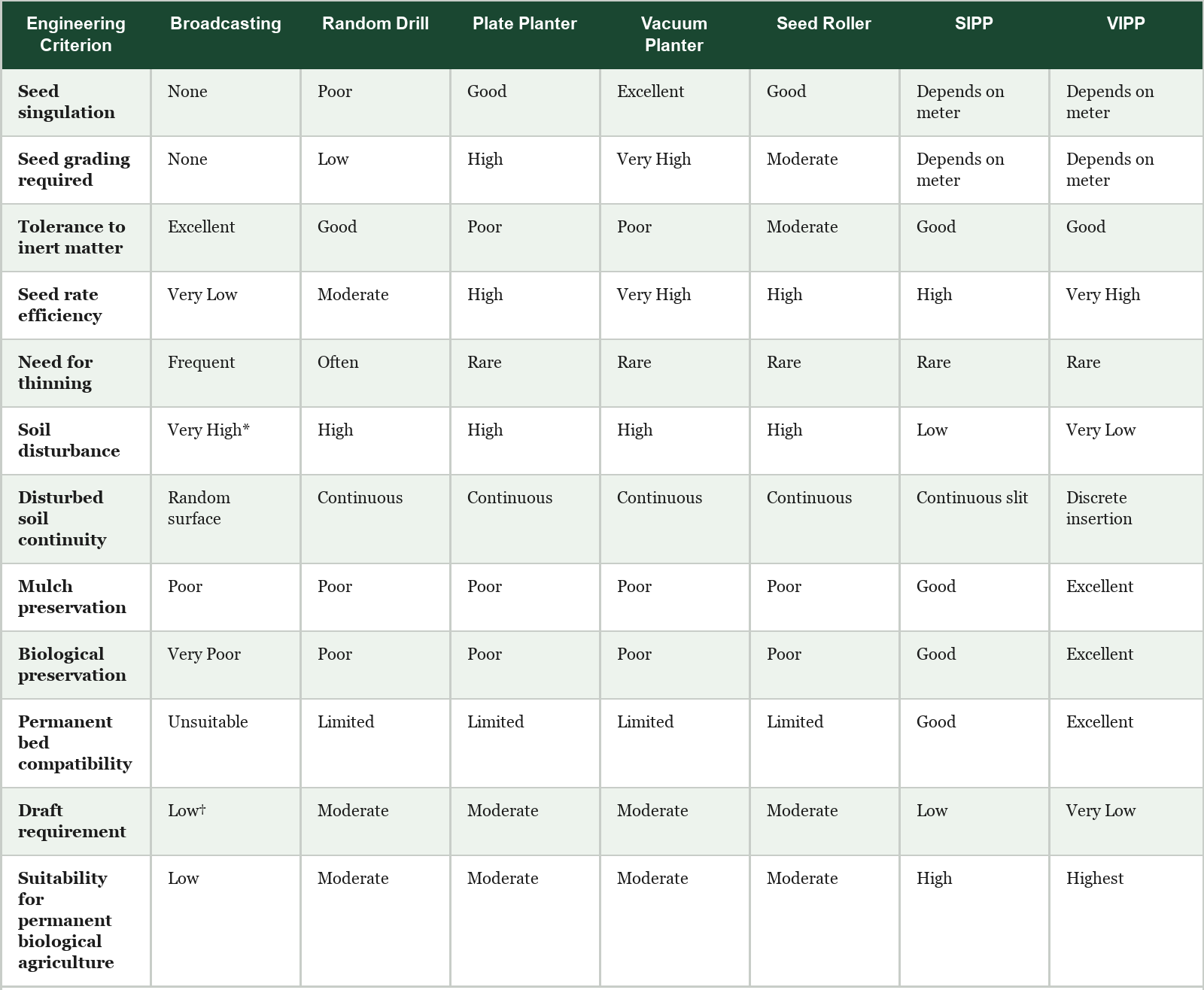
| Engineering Criterion | Broadcasting | Random Drill | Plate Planter | Vacuum Planter | Seed Roller | SIPP | VIPP |
|---|---|---|---|---|---|---|---|
| Seed singulation | None | Poor | Good | Excellent | Good | Depends on meter | Depends on meter |
| Seed grading required | None | Low | High | Very High | Moderate | Depends on meter | Depends on meter |
| Tolerance to inert matter | Excellent | Good | Poor | Poor | Moderate | Good | Good |
| Seed rate efficiency | Very Low | Moderate | High | Very High | High | High | Very High |
| Need for thinning | Frequent | Often | Rare | Rare | Rare | Rare | Rare |
| Soil disturbance | Very High* | High | High | High | High | Low | Very Low |
| Disturbed soil continuity | Random surface | Continuous | Continuous | Continuous | Continuous | Continuous slit | Discrete insertion |
| Mulch preservation | Poor | Poor | Poor | Poor | Poor | Good | Excellent |
| Biological preservation | Very Poor | Poor | Poor | Poor | Poor | Good | Excellent |
| Permanent bed compatibility | Unsuitable | Limited | Limited | Limited | Limited | Good | Excellent |
| Draft requirement | Low† | Moderate | Moderate | Moderate | Moderate | Low | Very Low |
| Suitability for permanent biological agriculture | Low | Moderate | Moderate | Moderate | Moderate | High | Highest |
* Broadcasting itself disturbs little soil, but successful establishment in conventional systems generally requires secondary incorporation through harrowing or cultivation, resulting in high overall disturbance.
† The act of broadcasting has little draft requirement, but the complete establishment system usually requires additional tillage passes.
This comparison illustrates that the most significant advance introduced by the VIPP is not a new seed meter. It is the replacement of continuous soil disturbance with discrete biological insertion, while remaining compatible with any future advance in precision seed metering.
CHAPTER 6
Engineering for Manufacturability
Throughout the history of agricultural machinery, many technically sound inventions have failed because they were too complicated to manufacture, too expensive to purchase, or too difficult to maintain under farm conditions. Agricultural engineering ultimately succeeds only when technical excellence is matched by practical simplicity.
The Vertical Insertion Precision Planter was conceived with this principle from the beginning.
Its objective is not to become the most sophisticated planter ever built.
Its objective is to become the least disturbing planter that can be manufactured economically, operated reliably, and maintained easily by ordinary farmers and local workshops.
This distinction influences every engineering decision.
Unlike laboratory equipment, agricultural machinery operates under some of the harshest mechanical environments encountered by any industry. Dust, abrasive soil particles, crop residues, moisture, vibration, temperature fluctuations and operator misuse are routine rather than exceptional. Components that perform perfectly inside a workshop often fail rapidly after several planting seasons unless simplicity is treated as an engineering requirement rather than an afterthought.
The VIPP therefore follows a philosophy of functional simplicity.
Every moving component should perform a necessary function. Components that exist only because of unnecessary mechanical complexity should be eliminated whenever possible. The most reliable mechanism is generally the one containing the fewest parts capable of accomplishing the required task.
This philosophy becomes particularly important within the insertion mechanism.
Unlike continuous openers, which remain under nearly constant loading while travelling through the soil, the insertion mechanism operates intermittently. Every planting cycle consists of acceleration, penetration, seed release, withdrawal and recovery before the next cycle begins. The durability of the planter therefore depends not only upon material strength but also upon the reduction of unnecessary moving mass.
The lighter the reciprocating assembly becomes, the lower the inertial forces acting upon bearings, pivots, guide systems and actuators.
Consequently, the insertion assembly should contain only those components that must move vertically. Heavy structural members should remain fixed to the frame whenever possible, allowing only the planting beak and its immediate support mechanism to reciprocate.
This principle improves reliability while simultaneously reducing power consumption.
Material selection follows the same philosophy.
The structural frame should utilise conventional steel sections that are readily available throughout agricultural manufacturing industries. Farmers should never become dependent upon proprietary structural materials that cannot be repaired locally. Standard fabrication techniques such as cutting, welding, drilling and machining should remain sufficient for construction and maintenance.
Only the components directly exposed to repeated soil penetration require specialised materials.
The planting beak experiences continuous abrasive wear from mineral particles and therefore should be manufactured from hardened wear-resistant steel or fitted with replaceable wear inserts. Since the beak represents only a small proportion of the machine's total mass, the use of premium wear materials becomes economically justified while keeping the remainder of the planter inexpensive.
This modular philosophy extends throughout the entire machine.
Wear components should be replaceable independently of the supporting structure.
Bearings should be standard industrial sizes available through multiple suppliers.
Fasteners should conform to internationally recognised standards.
Bushings, springs and seals should likewise remain interchangeable wherever practical.
Such standardisation reduces manufacturing cost while ensuring long-term serviceability.
An equally important consideration concerns manufacturing tolerance.
Conventional precision planters frequently require extremely close tolerances within seed metering components because singulation depends upon accurate interaction between moving parts and individual seeds. The Vertical Insertion Principle deliberately separates seed metering from soil insertion. Consequently, the insertion mechanism itself does not require micron-level manufacturing accuracy. It requires robustness, repeatability and timing rather than exceptionally fine dimensional control.
This separation creates an important commercial advantage.
Manufacturers may continue employing proven seed metering systems while developing progressively improved insertion mechanisms. Neither system constrains the evolution of the other.
Production flexibility increases accordingly.
A manufacturer serving vegetable growers may install one type of precision meter.
A manufacturer specialising in cereals may install another.
Future electronic singulation systems may be incorporated without redesigning the insertion mechanism.
The Vertical Insertion Principle therefore functions as an engineering platform rather than as a proprietary seed metering system.
This modularity also encourages international adaptation.
Different regions cultivate different crops under different planting densities, residue conditions and field sizes. A rigid machine designed for only one agricultural environment inevitably limits adoption. The VIPP should therefore be viewed as a family of machines sharing one common insertion principle while differing in row number, frame width, toolbar configuration and metering equipment.
The smallest manually operated unit may serve market gardeners cultivating permanent raised beds.
Medium-width tractor-mounted versions may serve diversified farms.
Large folding toolbar configurations may eventually serve extensive commercial operations.
Despite these differences, the biological principle remains identical.
Each seed is inserted individually.
The living soil between neighbouring seeds remains undisturbed.
The manufacturing philosophy therefore encourages scalability without sacrificing biological correctness.
Future development may proceed in several independent directions.
Higher operating speeds.
Improved actuation systems.
Greater planting precision.
Electronic monitoring.
Autonomous operation.
Variable-rate planting.
None of these advances requires abandonment of the Vertical Insertion Principle.
Instead, they build upon it.
This characteristic distinguishes a genuine engineering platform from a single machine design.
The importance of manufacturability extends beyond economics.
It determines accessibility.
Agricultural innovation achieves its greatest value when it can be adopted by farms of widely differing sizes and financial resources. A planter that can be manufactured only within highly specialised factories may remain technologically impressive while contributing little to global food production.
Conversely, a biologically advanced planter that can also be fabricated, repaired and maintained within ordinary agricultural engineering workshops possesses the potential for worldwide adoption.
The success of the Vertical Insertion Precision Planter should therefore never be measured solely by the sophistication of its engineering.
It should also be measured by the ease with which that engineering can be reproduced.
The highest achievement of agricultural engineering is not the creation of a machine that only one manufacturer can build.
It is the creation of an engineering principle that many manufacturers can improve while preserving its biological foundation.
The Vertical Insertion Principle was conceived with precisely that objective.
Its purpose is not to define a single planter.
Its purpose is to establish a new family of planting machines whose future evolution remains limited only by engineering imagination while remaining permanently guided by biological correctness.
CHAPTER 7
Design Requirements Specification (DRS) for the Vertical Insertion Precision Planter
14.1 Purpose
Engineering progresses most rapidly when innovation is guided by clearly defined functional requirements rather than by copying existing designs. Throughout industrial history, successful technologies have been governed by performance specifications that define what a system must accomplish while leaving engineers free to develop improved mechanical solutions.
The Vertical Insertion Precision Planter should be viewed in the same manner.
The purpose of this Design Requirements Specification is not to describe one particular prototype. It is to define the minimum engineering and biological requirements that any planting machine must satisfy before it can legitimately be classified as a Vertical Insertion Precision Planter.
These requirements are based upon biological principles rather than mechanical preference.
As engineering advances, actuators, materials, electronics and manufacturing methods will inevitably evolve. These developments are welcomed. They represent progress.
The biological objectives, however, remain unchanged.
14.2 Fundamental Functional Requirements
Every Vertical Insertion Precision Planter shall satisfy the following primary functional requirements.
Requirement 1: Individual Seed Insertion
The machine shall insert each seed independently.
No continuous trench, furrow or slit shall be created between adjacent planting positions.
Each planting event shall begin and end before the next insertion occurs.
The seed shall occupy an isolated planting cavity rather than a continuous opening.
Requirement 2: Minimum Soil Disturbance
The machine shall disturb only the quantity of soil required for successful germination.
No additional soil displacement shall occur solely because the planter is moving forward.
The disturbed soil volume shall approach the theoretical minimum compatible with reliable seed establishment.
Requirement 3: Biological Preservation
The planting process shall preserve the biological integrity of the permanent bed.
Earthworm channels, fungal networks, root channels and stable soil aggregates located between planting positions shall remain substantially undisturbed.
The planter shall be designed to cooperate with the existing biological system rather than reconstruct it.
Requirement 4: Permanent Bed Compatibility
The planter shall operate on permanent biological beds without altering their geometry.
It shall not reshape, flatten, cultivate or otherwise modify the permanent bed profile.
Repeated seasonal use shall not progressively destroy the permanent traffic-control architecture of the PQNK system.
Requirement 5: Continuous Soil Cover
The planting operation shall preserve the protective mulch layer.
Live mulch, dead mulch and mixed mulch shall remain substantially intact after planting.
Residue management shall occur only where absolutely necessary for insertion.
The majority of the soil surface shall remain continuously covered.
14.3 Mechanical Requirements
The biological objectives establish corresponding engineering requirements.
Requirement 6: Independent Vertical Motion
Insertion shall occur by controlled vertical movement.
Forward travel shall determine only the spacing between planting positions.
The insertion motion shall remain mechanically independent of forward movement.
Requirement 7: Controlled Seed Placement
Seed release shall occur only after the insertion cavity reaches its intended depth.
The seed shall be deposited accurately within the planting cavity.
Seed placement shall not depend upon rebound, random fall or secondary soil movement.
Requirement 8: Positive Withdrawal
Following seed release, the insertion mechanism shall withdraw without enlarging the cavity.
Withdrawal shall minimise upward displacement of soil.
The surrounding soil shall be allowed to recover naturally.
Requirement 9: Adjustable Operating Parameters
The planter shall permit adjustment of: planting depth insertion frequency seed spacing row spacing operating speed without compromising the Vertical Insertion Principle.
14.4 Seed Meter Compatibility
One of the most important engineering principles established in this book is the separation of seed metering from seed insertion. Accordingly,
Requirement 10
The insertion mechanism shall remain independent of the seed metering mechanism. The planter may employ: mechanical plate meters, vacuum meters, belt meters, finger pickup systems, pneumatic systems, electronic singulation, or future technologies, provided that the biological objectives remain satisfied.
The Vertical Insertion Principle shall never become dependent upon a particular seed meter.
14.5 Actuator Independence
Requirement 11
The Vertical Insertion Principle shall remain independent of the actuator technology. Insertion may be produced by: crank mechanisms, cams, hydraulic cylinders, pneumatic cylinders, electromagnetic linear actuators, servo-electric actuators, robotic manipulators, or future engineering systems.
Only the resulting planting action is mandatory.
The mechanism used to achieve that action is not.
14.6 Crop Independence
Requirement 12
The planter shall be adaptable for a wide range of crops.
Crop adaptation shall be achieved through adjustment of spacing, seed metering and insertion timing rather than by altering the biological operating principle.
The same engineering philosophy shall remain applicable to cereals, legumes, oilseeds, vegetables, fibre crops and future crop systems.
14.7 Scalability
Requirement 13
The Vertical Insertion Principle shall be scalable. The engineering concept shall permit implementation as: hand-operated planters, animal-drawn planters, tractor-mounted planters, self-propelled planters, robotic planters, autonomous planting systems.
Machine size shall not alter the biological principle.
14.8 Automation Readiness
The planting system shall be compatible with future developments in: GPS guidance, machine vision, artificial intelligence, autonomous navigation, variable-rate planting, sensor-based depth control, cloud-connected farm management.
These technologies shall enhance the implementation of the Vertical Insertion Principle rather than replace it.
14.9 Serviceability
The planter shall be engineered for practical agricultural use.
Wear components shall be replaceable.
Routine maintenance shall require ordinary workshop tools.
The machine shall minimise dependence upon proprietary service procedures.
Repairability shall remain an engineering objective throughout the design process.
14.10 Biological Performance Requirements
Regardless of mechanical configuration, every Vertical Insertion Precision Planter shall demonstrate the following biological outcomes under field conditions: preservation of permanent bed geometry, preservation of mulch continuity, minimum disturbed soil volume, minimum interruption of fungal continuity, preservation of soil pore structure, compatibility with permanent root systems, compatibility with living soil biology, reliable seed germination, accurate seed spacing, repeatable planting depth.
Failure to satisfy these biological requirements shall constitute failure of the Vertical Insertion Principle, irrespective of the sophistication of the mechanical design.
14.11 Conformance
A planting machine should not be classified as a Vertical Insertion Precision Planter merely because it employs a vertical motion or an innovative mechanism.
It shall satisfy the complete set of biological and engineering requirements established in this specification.
Compliance shall be determined by field performance rather than appearance.
Machines differing substantially in construction may all conform to this specification provided they achieve the same biological objectives.
Conversely, two machines may appear visually similar while only one satisfies the requirements of the Vertical Insertion Principle.
The identity of a VIPP therefore resides not in its mechanism, but in its measurable biological performance.
Concluding Statement
The Design Requirements Specification presented in this chapter establishes the Vertical Insertion Precision Planter as more than a machine. It defines a new engineering standard for biological planting systems. Future innovations may improve speed, precision, manufacturing efficiency and automation, yet they will remain members of the same engineering family only if they continue to honour the central principle upon which the specification is founded: The machine shall disturb no more of the living soil than is absolutely necessary to establish the next generation of plants.
CHAPTER 8
Kinematic and Dynamic Analysis of the Vertical Insertion Precision Planter
Every agricultural machine converts power into controlled mechanical motion. In a conventional planter, this motion is relatively simple. As the machine advances, the seed opener moves continuously through the soil while the seed-metering system releases seed at predetermined intervals. Because the opener never stops interacting with the soil, its motion can be analysed as continuous translation.
The Vertical Insertion Precision Planter operates according to a fundamentally different kinematic principle.
Its planting beak does not remain in continuous contact with the soil. Instead, it performs a sequence of discrete insertion cycles. Each cycle consists of penetration, seed release, withdrawal and recovery before the next insertion begins. The engineering challenge therefore changes from analysing continuous motion to analysing synchronised reciprocating motion.
The accuracy, reliability and field capacity of the planter depend entirely upon the correct relationship between these two independent movements.
One movement is horizontal.
The other is vertical.
Neither may interfere with the other.
15.1 The Two Independent Motions
The operation of the VIPP can be represented by two simultaneous but independent motions.
The first is the forward motion of the machine across the field. This motion determines only the distance between successive planting locations. It is produced by the tractor or propulsion system and is expressed as forward velocity.
The second is the vertical reciprocating motion of the insertion mechanism. This motion determines when and how the seed is placed. It is produced by the actuator and is expressed as insertion frequency.
Unlike conventional planters, neither motion defines the geometry of the other.
Forward motion determines spacing.
Vertical motion determines planting.
The engineering task is therefore to synchronize the two.
15.2 Synchronisation Between Speed and Seed Spacing
For every planting system, the required insertion frequency is determined by only two variables: forward speed and desired seed spacing, related by f = V ÷ S, where f is insertion frequency (insertions per second), V is forward velocity (metres per second), and S is seed spacing (metres). This equation governs every VIPP regardless of its mechanical construction.
For example, suppose the planter operates at 4 km/h (1.11 m/s) with a desired seed spacing of 150 mm (0.15 m). Then f = 1.11 ÷ 0.15 = 7.4, meaning the insertion mechanism must complete 7.4 complete planting cycles every second. Each row of the planter performs this frequency independently: a six-row planter therefore performs approximately 44 planting events every second, and an eight-row planter almost 60 insertions every second. These calculations illustrate that actuator performance rapidly becomes the limiting factor rather than seed metering.
15.3 Stroke Length
The insertion stroke determines both penetration depth and mechanical loading.
The VIPP prototype employs an adjustable stroke so that different crops and soil conditions can be accommodated. The recommended engineering range is: 150–250 mm (6–10 inches) The actual penetration into the soil remains approximately 38 mm (1.5 inches), while the additional travel provides acceleration, deceleration and mechanical clearance above the mulch layer.
This longer mechanical stroke reduces impact loading because acceleration can occur gradually rather than abruptly.
15.4 Motion Profile
The choice of motion profile has a profound influence on machine durability.
A simple crank mechanism produces sinusoidal motion.
Although mechanically simple, sinusoidal motion results in continuously changing velocity and acceleration, with maximum acceleration occurring near the ends of the stroke.
For higher planting speeds, more advanced motion profiles become advantageous. These include: modified harmonic motion, cycloidal motion, servo-generated motion, electronically programmed trajectories.
These profiles reduce peak acceleration while maintaining high planting frequency. Lower acceleration produces: lower vibration, reduced bearing loads, lower fatigue, improved durability.
Thus, motion law becomes an engineering optimisation rather than merely a mechanical consequence.
15.5 Velocity During Penetration
The insertion beak should not strike the soil violently. Excessive impact increases: soil fracture, vibration, wear, power consumption.
Conversely, very slow penetration may fail to pass cleanly through mulch and compacted surface layers.
The optimum motion therefore consists of: moderate approach velocity, controlled penetration, momentary dwell at maximum depth, controlled withdrawal.
This sequence minimises disturbance while maintaining accurate seed placement.
15.6 Dwell Time
Unlike conventional drills, the VIPP benefits from a short dwell period after reaching full insertion depth.
During this brief interval: the cavity becomes geometrically stable, vibration subsides, the seed is released, the seed reaches the bottom of the cavity before withdrawal begins.
Only after seed placement is complete should withdrawal commence.
Even a dwell of only a few milliseconds substantially improves placement consistency.
15.7 Dynamic Loading
The insertion mechanism experiences four principal dynamic loads. First, soil penetration resistance.
Second, inertia of the moving components.
Third, friction within guides and bearings.
Fourth, impact generated during acceleration reversal.
The total actuator force may therefore be expressed conceptually as F = Fs + ma + Ff, where Fs is soil penetration force, m is moving mass, a is acceleration, and Ff is mechanical friction.
This equation immediately reveals an important engineering objective.
Reducing moving mass reduces actuator force.
Reducing acceleration reduces actuator force.
Reducing friction reduces actuator force.
None of these reductions compromises planting quality. Consequently, lightweight reciprocating assemblies become one of the most important design objectives.
15.8 Energy Per Planting Event
Unlike continuous openers, the VIPP consumes energy only during insertion.
Between planting events, very little work is performed.
The theoretical energy required for one insertion equals Force × Penetration Distance plus small mechanical losses.
Consequently, energy consumption depends primarily upon: penetration resistance, insertion depth, actuator efficiency.
No energy is wasted dragging steel continuously through the soil.
This characteristic explains why the Vertical Insertion Principle has the potential to become the most energy-efficient precision planting system yet developed.
15.9 Throughput Limit
Every reciprocating mechanism possesses an upper operating frequency. Beyond this limit, vibration, inertia, timing errors, and wear increase rapidly.
The maximum practical planting speed therefore depends upon: stroke length, moving mass, actuator capability, desired seed spacing.
Unlike conventional drills, the limitation no longer lies in soil flow around the opener.
It lies in the dynamic capability of the insertion mechanism.
Future improvements in actuator technology will therefore directly increase planting capacity.
15.10 Mechanical Implications
The kinematic analysis leads to several important engineering conclusions. The insertion mechanism should be: as light as possible, as stiff as possible, dynamically balanced, accurately guided, precisely synchronized, capable of adjustable stroke, capable of adjustable insertion timing.
Every unnecessary gram added to the reciprocating assembly increases actuator requirements.
Every unnecessary millimetre of stroke increases inertial loading.
Every unnecessary impact reduces service life.
The engineering objective is therefore not simply successful planting.
It is the achievement of successful planting with the minimum possible moving mass, minimum acceleration, and minimum energy consumption.
15.11 Implications for Future Development
The equations developed in this chapter remain valid regardless of future mechanical implementation. Whether the insertion mechanism is driven by: a crankshaft, a cam, a hydraulic cylinder, a linear electric actuator, an electromagnetic actuator, or an autonomous robotic manipulator, the governing relationships remain unchanged.
Forward speed still determines spacing.
Insertion frequency still determines timing.
Dynamic loading still governs durability.
This universality is one of the strengths of the Vertical Insertion Principle. It separates the physics of planting from the technology used to achieve it.
CHAPTER 9
Actuator Engineering for the Vertical Insertion Precision Planter
The Vertical Insertion Principle establishes the biological objective of the planter but does not prescribe the mechanism by which the insertion motion is produced. This distinction is intentional. Throughout engineering history, successful principles have survived numerous generations of mechanical implementation. Steam power remained unchanged while engines evolved. Aircraft continued to obey the same aerodynamic principles while propulsion systems progressed from piston engines to turbofans.
The Vertical Insertion Principle should be viewed in the same manner.
The engineering requirement is not a particular linkage or actuator. The engineering requirement is the controlled insertion of each seed into the soil with minimum biological disturbance. How that motion is generated remains an engineering optimisation problem.
Selecting the most appropriate actuator therefore requires a systematic evaluation based upon measurable engineering criteria rather than familiarity with existing machinery.
16.1 Functional Requirements of the Actuator
Before comparing alternative mechanisms, the functional requirements should be established. The actuator shall: generate sufficient vertical force to penetrate mulch and soil; provide an adjustable stroke suitable for different crops and soil conditions; synchronise accurately with forward travel; maintain repeatable insertion depth; operate reliably at high planting frequencies; minimise vibration and impact loading; consume the least practical amount of energy; require minimal maintenance; permit economical manufacture; remain suitable for future automation.
These requirements become the benchmark against which every actuator is evaluated.
16.2 Crankshaft Mechanism
The crankshaft is one of the oldest and most widely used methods of converting rotary motion into reciprocating motion. Its popularity results from mechanical simplicity, robust construction and low manufacturing cost.
For agricultural machinery, these are important advantages. Components are readily available, fabrication techniques are well established and maintenance is familiar to mechanics throughout the world.
However, the crank mechanism possesses several inherent limitations.
The stroke is fixed by the crank radius. Changing the stroke requires replacement or modification of the crank assembly. The motion follows a sinusoidal path that cannot easily be altered. Velocity and acceleration are determined entirely by geometry, leaving little opportunity for optimisation. Peak acceleration occurs near the ends of the stroke, increasing vibration and inertial loading as planting frequency rises.
The crank mechanism therefore represents an excellent solution for early prototypes and moderate operating speeds, but its flexibility is limited.
16.3 Cam Mechanism
Cam systems provide considerably greater freedom in motion design.
The cam profile can be engineered to produce almost any desired displacement, velocity and acceleration curve. Smooth penetration, controlled dwell at planting depth and gentle withdrawal can all be incorporated within a single cam profile.
This flexibility makes cam mechanisms attractive where planting precision is more important than manufacturing simplicity.
The disadvantages are equally apparent.
Cam manufacture requires greater precision than crank systems. Wear between the cam and follower must be carefully managed. Modifying the motion law generally requires replacement of the cam itself.
Consequently, cams offer excellent mechanical performance but reduced adaptability after manufacture.
16.4 Scotch Yoke
The Scotch yoke converts rotary motion into perfectly linear reciprocating motion.
Its principal advantage lies in the elimination of angular side forces associated with conventional crank linkages.
The mechanism is compact and mechanically efficient.
However, the sliding contact between the crank pin and the yoke produces significant wear under dusty agricultural conditions unless carefully protected. Lubrication becomes more critical than with conventional crank systems, and abrasive soil particles may accelerate deterioration.
For high-cycle field machinery, these limitations reduce its practical attractiveness.
16.5 Hydraulic Actuation
Hydraulic cylinders provide very high force within relatively compact dimensions.
Stroke length is easily adjustable. Force can be varied continuously, allowing adaptation to changing soil resistance. Position control can be integrated with modern electro-hydraulic systems, making hydraulic actuation attractive for larger commercial machines.
The principal disadvantages arise from system complexity.
Hydraulic pumps, valves, hoses, filters and seals increase manufacturing cost and maintenance requirements. Leakage, contamination and temperature sensitivity must also be considered.
Hydraulic systems excel where high force is required but introduce additional infrastructure beyond the insertion mechanism itself.
16.6 Pneumatic Actuation
Pneumatic cylinders offer rapid movement with relatively simple construction.
Compressed air provides inherent cushioning during stroke reversal, reducing mechanical shock.
Nevertheless, air is compressible.
Consequently, precise control of insertion depth becomes more difficult than with hydraulic or electric systems. Energy efficiency is also comparatively low because significant power is consumed during air compression.
Pneumatic systems therefore remain attractive for light-duty applications but are less suitable where precise depth control is essential.
16.7 Linear Electric Actuators
Advances in electric motors and power electronics have made linear electric actuators increasingly attractive.
Servo-controlled systems permit independent adjustment of stroke length, insertion velocity, acceleration and timing through software rather than hardware.
The same actuator may therefore accommodate multiple crops without mechanical modification.
Position feedback further improves planting accuracy.
The disadvantages are principally economic.
Initial cost remains higher than conventional mechanical systems. Electronic components require environmental protection against dust and moisture. Reliable electrical power must be available throughout operation.
Despite these considerations, electric actuation represents one of the most promising directions for future development.
16.8 Electromagnetic Linear Actuation
Electromagnetic linear actuators deserve particular attention because they eliminate many intermediate mechanical transmission components.
Instead of converting rotary motion into reciprocating motion through linkages, electromagnetic systems generate linear motion directly. This characteristic offers several potential advantages: programmable stroke length; programmable insertion timing; rapid response; reduced mechanical wear; simplified transmission; compatibility with autonomous systems.
For the VIPP, this flexibility is especially attractive because seed spacing can be altered electronically by modifying insertion frequency rather than by replacing gears or sprockets.
Challenges remain.
Continuous operation at high frequencies generates heat within the coils. Energy management becomes critical. Electromagnetic force decreases rapidly with increasing air gap, requiring careful magnetic circuit design. Reliable operation under field conditions has yet to be demonstrated at large commercial scales.
Nevertheless, the technology aligns closely with the long-term objectives of biologically intelligent planting machinery.
16.9 Ball-Screw Servo Systems
Ball-screw mechanisms driven by servo motors combine excellent positional accuracy with high mechanical efficiency.
The rolling contact within the ball nut minimises friction, allowing precise control of insertion depth and timing.
However, ball screws are sensitive to contamination.
Agricultural environments containing dust, moisture and abrasive particles demand effective sealing. Long-term reliability therefore depends heavily upon environmental protection.
For research equipment and precision horticultural systems they offer significant advantages. For heavy field agriculture, further engineering development may be required.
16.10 Comparative Engineering Evaluation
The preceding analysis demonstrates that no actuator is universally superior.
Each possesses strengths suited to particular applications.
Mechanical systems offer simplicity and low cost.
Hydraulic systems provide high force.
Electric systems provide programmability.
Electromagnetic systems offer exceptional future potential.
Consequently, actuator selection should depend upon the intended operating environment rather than personal preference or manufacturing tradition.
Comparative Assessment of Candidate Actuators
Table 2: Comparative Assessment of Candidate Actuators
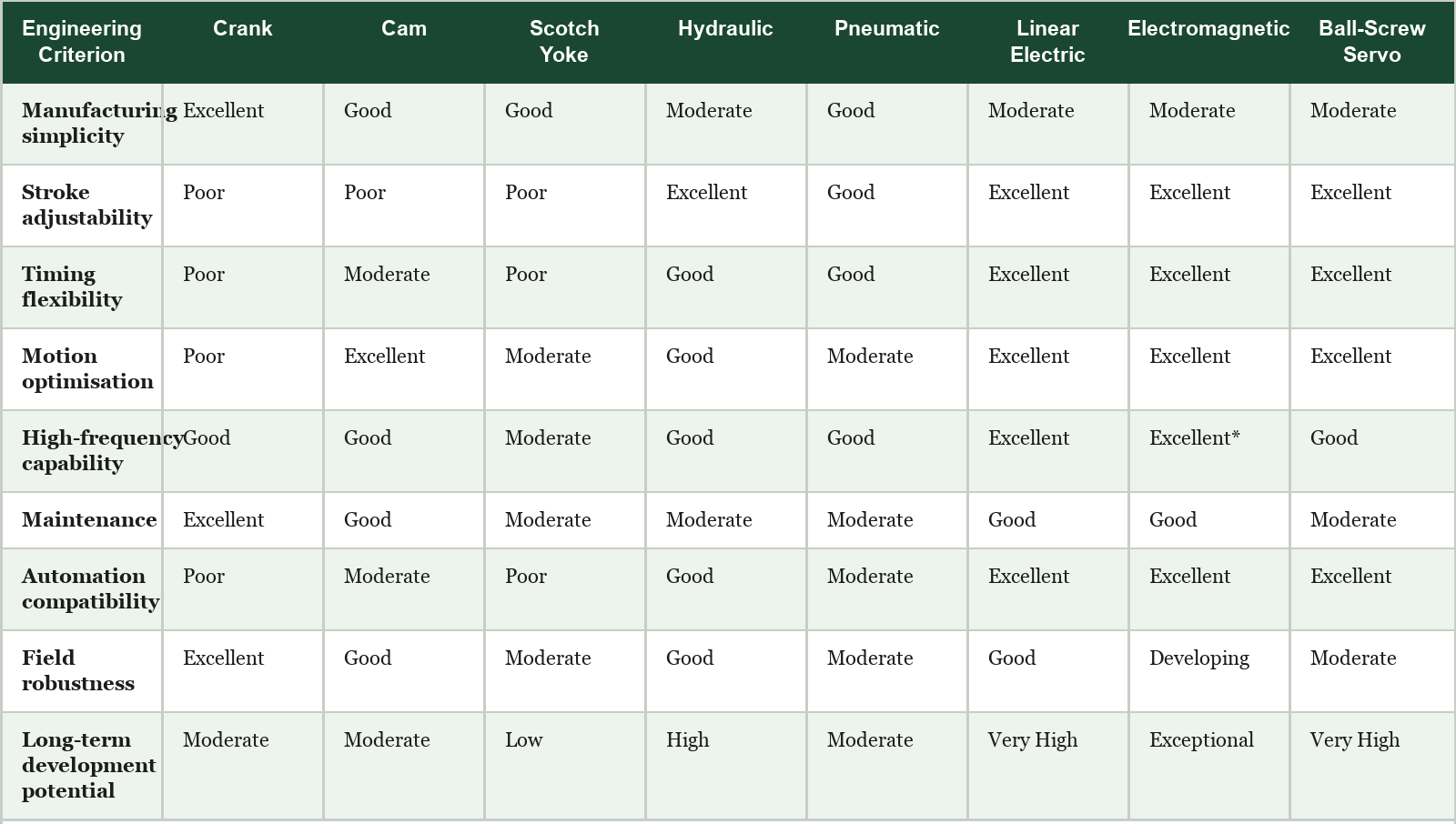
| Engineering Criterion | Crank | Cam | Scotch Yoke | Hydraulic | Pneumatic | Linear Electric | Electromagnetic | Ball-Screw Servo |
|---|---|---|---|---|---|---|---|---|
| Manufacturing simplicity | Excellent | Good | Good | Moderate | Good | Moderate | Moderate | Moderate |
| Stroke adjustability | Poor | Poor | Poor | Excellent | Good | Excellent | Excellent | Excellent |
| Timing flexibility | Poor | Moderate | Poor | Good | Good | Excellent | Excellent | Excellent |
| Motion optimisation | Poor | Excellent | Moderate | Good | Moderate | Excellent | Excellent | Excellent |
| High-frequency capability | Good | Good | Moderate | Good | Good | Excellent | Excellent* | Good |
| Maintenance | Excellent | Good | Moderate | Moderate | Moderate | Good | Good | Moderate |
| Automation compatibility | Poor | Moderate | Poor | Good | Moderate | Excellent | Excellent | Excellent |
| Field robustness | Excellent | Good | Moderate | Good | Moderate | Good | Developing | Moderate |
| Long-term development potential | Moderate | Moderate | Low | High | Moderate | Very High | Exceptional | Very High |
*Subject to thermal management and power electronics.
16.11 Engineering Conclusion
The history of agricultural machinery demonstrates that the most successful designs are those that combine biological effectiveness with engineering practicality.
For the immediate development of the Vertical Insertion Precision Planter, mechanically driven systems such as crank or cam mechanisms provide practical and economical pathways to field validation. They are robust, well understood and readily manufactured using existing agricultural engineering capabilities.
As the technology matures, electrically controlled linear actuators and electromagnetic systems offer a compelling path forward. Their ability to adjust stroke length, insertion timing and operating frequency through software rather than mechanical modification aligns closely with the flexibility demanded by future precision agriculture, autonomous machinery and crop-specific optimisation.
The key conclusion, however, extends beyond actuator selection.
No actuator defines the Vertical Insertion Principle.
The actuator is a means of generating motion.
The principle is defined by its biological objective: the precise insertion of each seed into a living soil ecosystem while disturbing no more of that ecosystem than is necessary for successful establishment.
As actuator technology evolves over the coming decades, the mechanisms described in this chapter will undoubtedly improve. New systems will emerge, and some current technologies may become obsolete. The Vertical Insertion Principle, however, will remain unchanged because it is founded not on a machine, but on the enduring relationship between engineering and biology.
CHAPTER 10
Failure Modes and Engineering Challenges
Every engineering innovation must eventually answer a simple question.
What can go wrong?
Machines rarely fail because their operating principle is incorrect. More often, failure results from an incomplete understanding of the conditions under which the principle is applied. Reliable engineering therefore requires systematic identification of potential failure modes before commercial development begins.
The Vertical Insertion Precision Planter is no exception.
Its biological objectives remain fundamentally different from those of conventional planting machinery, but it must still operate within the harsh realities of agricultural field conditions. Soil varies continuously. Crop residues differ between seasons. Weather changes daily. Operators make mistakes. Components wear. Every one of these factors influences machine performance.
Understanding these limitations is not a weakness of the design.
It is an essential part of its engineering maturity.
17.1 Penetration Failure
The first and most obvious failure mode occurs when the insertion beak cannot penetrate the soil to its intended depth. This may result from: severe surface compaction, wheel traffic outside designated furrows, insufficient hardpan removal during PQNK conversion, prolonged drying of the surface horizon, stones or buried obstacles.
Incomplete penetration prevents proper seed placement.
The seed may remain within mulch rather than entering the soil.
Alternatively, variable planting depth may produce uneven emergence.
Engineering Response
The machine should not be expected to correct poor field preparation.
Successful operation depends upon proper implementation of the PQNK system: permanent controlled traffic, one-time hardpan removal, protected soil structure, continuous biological activity.
Nevertheless, engineering safeguards remain desirable. Possible solutions include: adjustable insertion force, depth sensors, overload protection, automatic cycle interruption, operator warning systems.
The objective is not greater force.
The objective is reliable insertion without damaging the machine.
17.2 Residue Interference
Heavy residues occasionally bridge above the insertion point. Instead of penetrating cleanly, the beak may push flexible residues downward.
This phenomenon is particularly likely where: long cereal straw remains attached, vines are present, fresh green cover crops are excessively tall.
Engineering Response
The insertion geometry should slice through residues rather than pushing them. Possible improvements include: sharpened beak profiles, self-cleaning surfaces, residue-cutting leading edges, controlled penetration velocity.
Residue should never be removed unnecessarily.
Only the insertion point requires temporary separation.
17.3 Seed Delivery Failure
The insertion cavity alone does not guarantee correct planting.
The seed must actually reach the bottom of the cavity. Possible causes include: seed bounce, tube vibration, static electricity, delayed release, premature release, blockage, bridging within the seed tube.
Even highly accurate seed meters cannot compensate for poor delivery dynamics.
Engineering Response
Seed trajectory should be analysed using high-speed imaging. The seed tube should: minimise rebound, minimise friction, reduce static charge, shorten free-fall distance, align with the insertion axis.
Delivery should become a controlled engineering process rather than passive gravity alone.
17.4 Timing Error
The insertion mechanism and seed meter operate independently.
Incorrect synchronisation produces several possible failures. The seed may: arrive before the cavity forms, arrive during withdrawal, arrive after partial closure, miss the cavity entirely.
These failures increase as planting speed rises.
Engineering Response
The actuator and seed meter should share a common synchronisation reference.
Electronic timing control offers advantages over purely mechanical phasing because compensation can occur continuously with changing ground speed.
Ground-wheel slip should also be monitored where wheel-driven systems are used.
17.5 Dynamic Fatigue
The insertion mechanism performs thousands of cycles every hour. Repeated acceleration produces fatigue loading in: pivots, bearings, guide rails, springs, connecting rods, actuator mountings.
Even modest stress becomes significant after millions of cycles.
Engineering Response
Dynamic balancing becomes essential.
Moving mass should be minimised.
Stress concentrations should be eliminated.
Finite element analysis should verify fatigue life rather than relying solely upon static strength calculations.
Durability should be expressed in planting cycles rather than operating hours.
17.6 Wear of the Planting Beak
The insertion beak experiences the most severe abrasive environment within the machine. Repeated penetration through mineral soil gradually changes: tip geometry, taper, surface finish, dimensional accuracy.
As wear progresses, soil disturbance increases, while penetration quality decreases.
Engineering Response
The beak should be regarded as a consumable wear component. Possible engineering solutions include: hardened alloy steel, carbide inserts, ceramic coatings, replaceable tips, modular construction.
Replacement should require only minutes rather than hours.
17.7 Soil Adhesion
Certain clay soils adhere strongly to steel surfaces, particularly under wet conditions.
Accumulated soil may: enlarge the insertion cavity, alter seed trajectory, increase insertion force, reduce operating consistency.
Engineering Response
Surface engineering becomes important. Possible approaches include: polished surfaces, low-friction coatings, specialised geometries, vibration-assisted release, self-cleaning profiles.
The objective is continuous self-cleaning during normal operation.
17.8 High-Speed Operation
Increasing planting speed increases productivity. It also increases: acceleration, vibration, timing sensitivity, actuator loading, seed bounce, mechanical wear.
Eventually, precision decreases.
Engineering Response
Maximum operating speed should be determined experimentally rather than commercially.
Field capacity should never be increased at the expense of planting quality.
Future actuator improvements may raise this limit.
The biological principle remains unchanged.
17.9 Electronic Failure
Future VIPP systems may depend upon: sensors, controllers, GPS, software, electric actuators.
These introduce new failure modes unknown to purely mechanical machinery.
Engineering Response
Every electronically controlled VIPP should possess a fail-safe operating mode. Where practical, the machine should complete the current planting cycle safely before stopping.
Diagnostic software should identify faults clearly rather than simply shutting down.
17.10 Operator Error
Engineering cannot assume perfect operation. Incorrect adjustments may include: excessive depth, insufficient depth, incorrect timing, unsuitable speed, poor maintenance, damaged beaks, incorrect seed selection.
Many apparent machine failures originate from operator setup.
Engineering Response
Adjustment procedures should be intuitive.
Calibration should require the minimum number of steps.
Visual indicators should confirm correct settings.
Critical adjustments should be difficult to misconfigure.
Operator training remains part of engineering design.
17.11 System-Level Failure
Perhaps the greatest risk is not mechanical failure at all.
A machine may perform perfectly while being used in an unsuitable production system. The VIPP cannot compensate for: repeated tillage, removal of mulch, uncontrolled wheel traffic, soil compaction, flooded fields, destruction of biological activity.
These conditions violate the assumptions upon which the Vertical Insertion Principle is based.
Engineering Response
The planter should always be evaluated as one component of the complete PQNK production system.
Its performance depends upon the integrity of the biological environment into which it plants.
17.12 Engineering Risk Matrix
Failure analysis is most useful when risks are prioritised according to Severity (S), Occurrence (O), and Detectability (D). Multiplying these three factors produces a Risk Priority Number (RPN), allowing engineers to focus on the most critical issues first.
Table 3: Engineering Risk Matrix
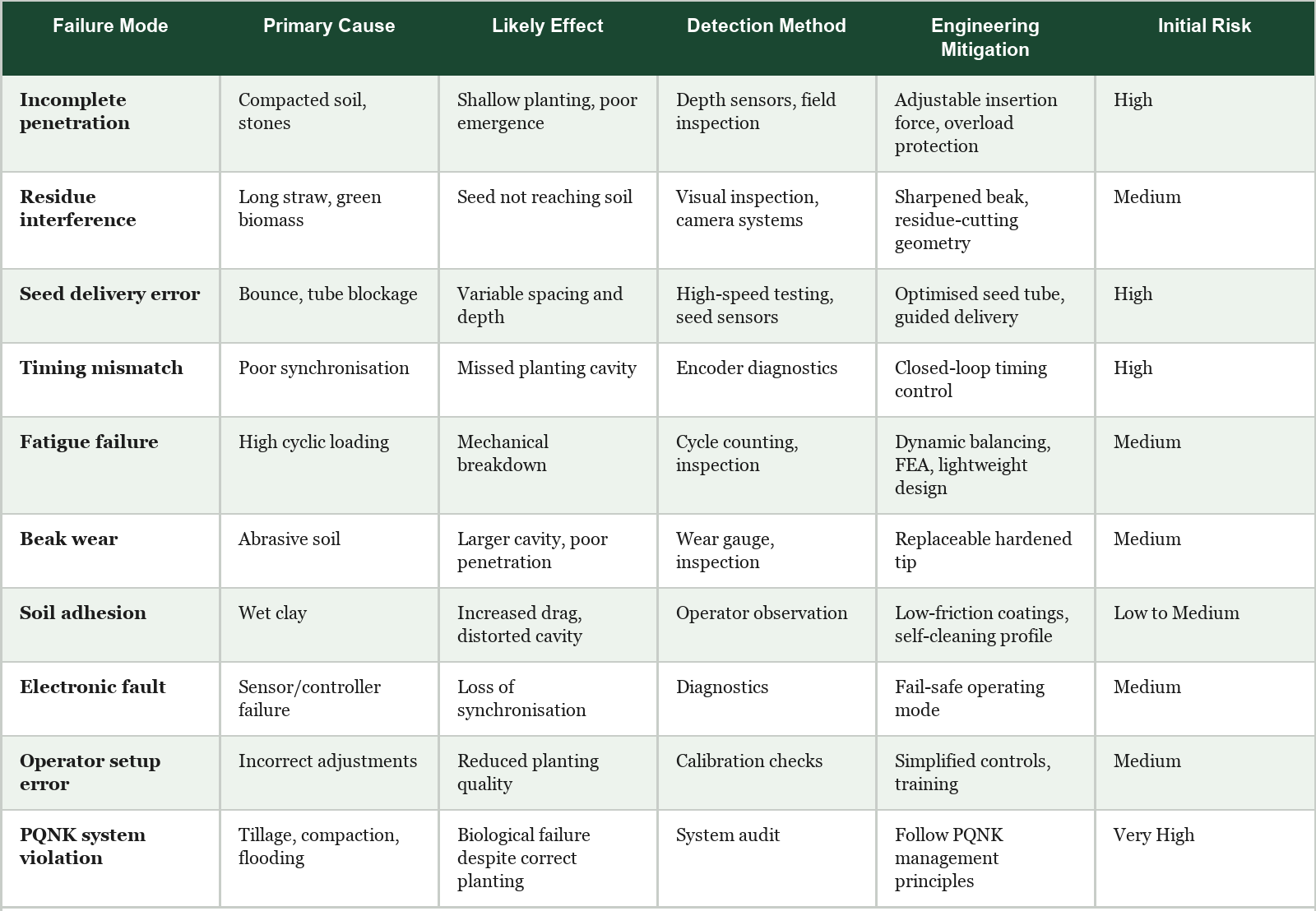
| Failure Mode | Primary Cause | Likely Effect | Detection Method | Engineering Mitigation | Initial Risk |
|---|---|---|---|---|---|
| Incomplete penetration | Compacted soil, stones | Shallow planting, poor emergence | Depth sensors, field inspection | Adjustable insertion force, overload protection | High |
| Residue interference | Long straw, green biomass | Seed not reaching soil | Visual inspection, camera systems | Sharpened beak, residue-cutting geometry | Medium |
| Seed delivery error | Bounce, tube blockage | Variable spacing and depth | High-speed testing, seed sensors | Optimised seed tube, guided delivery | High |
| Timing mismatch | Poor synchronisation | Missed planting cavity | Encoder diagnostics | Closed-loop timing control | High |
| Fatigue failure | High cyclic loading | Mechanical breakdown | Cycle counting, inspection | Dynamic balancing, FEA, lightweight design | Medium |
| Beak wear | Abrasive soil | Larger cavity, poor penetration | Wear gauge, inspection | Replaceable hardened tip | Medium |
| Soil adhesion | Wet clay | Increased drag, distorted cavity | Operator observation | Low-friction coatings, self-cleaning profile | Low to Medium |
| Electronic fault | Sensor/controller failure | Loss of synchronisation | Diagnostics | Fail-safe operating mode | Medium |
| Operator setup error | Incorrect adjustments | Reduced planting quality | Calibration checks | Simplified controls, training | Medium |
| PQNK system violation | Tillage, compaction, flooding | Biological failure despite correct planting | System audit | Follow PQNK management principles | Very High |
Concluding Remarks
Failure analysis does not weaken the Vertical Insertion Precision Planter.
It strengthens it.
By identifying limitations before widespread adoption, engineering transforms uncertainty into measurable design objectives. Every failure mode described in this chapter represents an opportunity for improvement rather than a reason for rejection.
The long-term success of the VIPP will depend not on claiming perfection, but on continuously refining the machine while remaining faithful to its central principle: Every engineering improvement must reduce biological disturbance without compromising reliable seed establishment.
CHAPTER 11
Prototype Development and Field Validation
Engineering ideas achieve practical value only after they are transformed into working machines and evaluated under realistic operating conditions. The Vertical Insertion Precision Planter is no exception. While the preceding chapters have established the scientific and engineering principles governing the Vertical Insertion Principle, those principles must ultimately be verified through systematic experimentation and field experience.
Prototype development should not be viewed as the construction of a single "final machine." Instead, it should be regarded as an iterative engineering process in which successive generations of prototypes progressively approach the biological and mechanical objectives established by the Design Requirements Specification. Each prototype should answer specific engineering questions, while simultaneously revealing new opportunities for refinement.
The first generation of prototypes should emphasize simplicity. Mechanical crank or cam-driven mechanisms provide a practical platform for validating the Vertical Insertion Principle because they are economical, robust and readily manufactured using conventional agricultural engineering techniques. Their purpose is not to optimise every aspect of the machine, but to confirm that discrete vertical insertion can reliably establish crops while preserving the biological integrity of permanent beds.
Once the fundamental principle has been validated, subsequent prototype generations should address increasingly sophisticated engineering objectives. These include optimisation of insertion geometry, reduction of moving mass, improvement of dynamic balance, refinement of seed delivery, enhancement of operating speed and evaluation of alternative actuator technologies.
Validation should proceed in three progressively more demanding stages.
The first stage consists of controlled laboratory testing. Individual mechanisms should be evaluated for stroke accuracy, insertion timing, seed delivery consistency, actuator performance and durability. High-speed video recording should be employed to observe insertion dynamics, seed trajectory and withdrawal behaviour. Laboratory testing permits controlled experimentation without the variability inherent in field conditions.
The second stage involves soil-bin testing. Artificial soil beds with controlled physical properties permit systematic investigation of penetration force, cavity geometry, residue interaction and seed placement under repeatable conditions. Variables such as soil moisture, compaction and residue type may be altered independently to determine their influence on machine performance.
The final stage consists of full-scale field evaluation under commercial farming conditions. Controlled comparisons with conventional precision planters and the Slit Insertion Precision Planter should be conducted using identical agronomic management wherever possible. Field evaluation should include engineering measurements such as: seed spacing accuracy, planting depth uniformity, insertion frequency, field capacity, fuel consumption, draft requirement, actuator power consumption, component wear, reliability over extended operating periods.
Equally important are biological measurements, including: percentage germination, emergence uniformity, early root development, preservation of mulch cover, soil aggregate stability, earthworm activity, continuity of fungal networks, moisture retention, long-term bed integrity.
Manufacturing cost, maintenance requirements, operating cost, serviceability and overall cost of ownership are essential considerations in determining commercial feasibility. Biological superiority alone is insufficient if the technology cannot be adopted economically by farmers.
Finally, validation should extend beyond engineering performance. The ultimate objective is not merely the successful operation of a machine, but the successful operation of a complete production system. The planter should therefore be evaluated as an integral component of the PQNK permanent biological farming system rather than as an isolated implement.
Successful validation will demonstrate not only that the Vertical Insertion Principle functions mechanically, but that it contributes meaningfully to the long-term preservation and productivity of living agricultural ecosystems.
CHAPTER 12
Future Development of the Vertical Insertion Principle
The Vertical Insertion Precision Planter should not be regarded as the final stage in planter development. It represents the beginning of a new engineering direction in which machinery increasingly complements biological processes rather than replacing them.
Future development will almost certainly focus on improving the efficiency, precision and adaptability of the insertion mechanism. Advances in materials science will permit lighter reciprocating assemblies and more durable wear components. Improvements in sensing technology will enable real-time monitoring of insertion depth, soil resistance and seed delivery. Intelligent control systems will continuously optimise insertion timing according to forward speed and changing field conditions.
Electromagnetic linear actuators represent one particularly promising avenue for future development. By eliminating many intermediate mechanical components, they offer the possibility of programmable stroke length, electronically adjustable timing and simplified integration with autonomous machinery. Although significant engineering challenges remain, continued progress in power electronics, magnetic materials and energy management suggests that such systems may become increasingly practical.
Autonomous agricultural vehicles provide another important opportunity. Because the Vertical Insertion Principle separates forward movement from insertion, it is inherently compatible with robotic platforms capable of operating continuously at relatively low ground speeds with exceptional positional accuracy. Swarms of lightweight autonomous planters may ultimately reduce soil compaction while increasing operational flexibility.
Artificial intelligence may further enhance planter performance through adaptive control algorithms capable of responding to changing soil conditions in real time. Machine vision, force sensing and predictive control could permit each insertion event to be optimised individually rather than relying upon fixed operating parameters.
Despite these technological advances, the central biological principle established throughout this book remains unchanged.
Future machines may differ completely in appearance from today's prototypes.
Their electronics may become more sophisticated.
Their actuators may become more efficient.
Their productivity may increase substantially.
Yet they will continue to belong to the same engineering family only if they preserve the essential characteristic of the Vertical Insertion Principle: the discrete introduction of individual seeds into a living soil ecosystem with minimum biological disturbance.
CHAPTER 13
Conclusion
The history of agricultural engineering has been characterised by a continuous search for greater efficiency, higher productivity and improved precision. Remarkable advances have been achieved in power, automation and seed metering. Yet one fundamental assumption remained largely unquestioned: that successful planting required continuous disturbance of the soil along the entire planted row.
This book has challenged that assumption.
By examining planting from the perspective of the living soil rather than the machinery alone, it has demonstrated that the essential engineering problem is not merely the accurate placement of seed, but the preservation of the biological system into which the seed is placed.
The Vertical Insertion Principle provides a practical engineering response to that challenge.
Its significance does not lie solely in the development of a new planter, but in the establishment of a new engineering philosophy. It recognises that machinery should perform only those functions that biology cannot, while allowing natural processes to continue uninterrupted wherever possible.
This philosophy extends beyond agriculture.
It illustrates a broader principle applicable to engineering as a whole: the highest achievement of technology is not the replacement of nature, but intelligent cooperation with it.
The Vertical Insertion Precision Planter therefore represents more than a machine. It represents a transition from the engineering of soil disturbance to the engineering of biological preservation.
Future generations of agricultural machinery will undoubtedly differ in their mechanisms, materials and control systems. Their success, however, should ultimately be measured by a simple question: How effectively do they establish the next crop while preserving the living ecosystem upon which all future crops depend?
If agricultural engineering adopts this question as its guiding principle, the Vertical Insertion Principle will have achieved its true purpose, not merely by introducing a new planter, but by helping define a new direction for the science of planting itself.
Applying PQNK without understanding nature’s operating system will not deliver abundance, stability, or nutrient density.
PQNK (pronounced “picnic”), the regenerative & sustainable Pristine Organic Farming System, is grounded in Natural Ecosystem Science. This science employs perennial biodiversity, protects soil with organic mulch, and avoids practices such as water inundation, tillage disturbance, and leaving soil bare.
It is the process that matters most. PQNK is a pristine production system designed not merely for yield, but for optimal, balanced output, where quality, sustainability, and ecological harmony emerge from a self‑regulated, zero‑external‑input methodology.
PQNK: Paedar Qudratti Nizam Kashatqari
Connect & Resources
Facebook: www.Facebook.Com/Pedaver
YouTube (PQNK): https://www.youtube.com/@pedaverpqnk3167/videos
YouTube: http://www.youtube.com/@aasifsharif
PDF Knowledge Papers: Google Drive folder
Email: pedaver@gmail.com
WhatsApp: +92 320 677 6666
About This Paper
- Problem
- Poor Germination / Emergence · Weak / Shallow Root Establishment · Residue Mismanagement
- Science
- Production Architecture · Plants
- Evidence
- Scientific Mechanism
- Authority
- Current / Approved PQNK Knowledge
Related PQNK Science
Key Takeaways
- The seed meter (dosing and singulating seed) has been engineered for a century; the seed opener (placing that seed in the soil) has not kept pace.
- A continuous planting slit has no equivalent in natural seed dispersal, and PQNK treats that mismatch as a cause of poor germination, not a detail to work around.
- SIPP (Slit Insertion Precision Planter) opens a discrete 2"×2" pocket per seed, built to cut through thick mulch without dragging residue into the seed zone.
- VIPP (Vertical Insertion Precision Planter) uses a cone-shaped opener to press seed vertically into undisturbed soil.
- Both planters exist to make PQNK's no-till, permanent-bed, mulch-planting system mechanically possible at commercial scale.
Related Knowledge
same problem
Advisory for One Acre Prosperity (OAP) in Vegetable Production: A PQNK Guide for the Smallholder
A hands-on smallholder guide built around one core discipline, using every square inch of soil for every passing minute of the year, that details a specific 36-block nursery system for raising transplants without seed waste or transplant shock, alongside a homemade 'dribble board' tool for direct seeding through mulch.
same problem
The PQNK Raised Bed System: Engineering Optimal Root Zone Environments for Vigorous Plant Production
This paper details the precise trapezoidal geometry, 42-inch top width and 8-inch height, and dual-zone irrigation strategy behind PQNK raised beds, showing how the system intentionally separates a lateral 'hydraulic' water reservoir from a central 'nutrient-aeration' zone so plants can draw independently on each as needed.
same problem
Why PQNK Sugarcane Does Not Need Earthing Up
Earthing up is mandatory in conventional sugarcane: the set is placed in a furrow 6 to 8 inches deep between ridges 6 to 8 inches high, above a compacted hardpan, roots stay shallow, and the profile has to be reversed with soil piled around the stool. PQNK removes the cause instead: the hardpan is broken once, cane grows on permanent beds, roots go deep, the crown stays near the aerated surface and the full sugar-rich base can be harvested.
same problem
Understanding Mulch: Types, Functions, and Selection
A practical selection guide to PQNK's three mulch types, live, dead/organic, and plastic, setting out the priority order for choosing between them, the seed-specific adjustments (broadleaf vs narrowleaf, small vs large seed) that determine mulch texture and depth, and the narrow, deliberately transitional case for plastic mulch.