

KP-032 · Soil Science & PQNK System
The Breathing Soil: A PQNK Dialogue on Humidity and Soil Structure
Responding to a Rajasthani PQNK farmer's questions, this dialogue explains why relative humidity around the crop canopy is a direct readout of raised-bed hydraulic function, and pins down the exact aggregate-size range, 1-10mm with roughly a fifth to a third in the 2-5mm band, that PQNK beds are engineered to build and hold.
Read or listen to the full paper ↓Farmer Question
“Why does relative humidity matter around my crop in PQNK production?”
— Mr. Rakesh, a practicing PQNK farmer from Rajasthan — asked in a PQNK WhatsApp learning group. Preserved here as Pedaver’s own account of the question, not a verbatim quotation.
Pedaver’s Answer
Abstract
Mr. Rakesh, a practicing PQNK farmer from Rajasthan, raised a set of questions in a PQNK WhatsApp learning group, and this paper works through them as a direct dialogue. The first question asks why relative humidity (RH) matters in PQNK crop production; the answer reframes RH not as an external weather condition but as a direct output of the engineered raised-bed root zone. A vigorously growing PQNK bed acts as a 'moisture battery,' storing capillary water in micropores while macropores drain freely, and a healthy plant in that environment transpires freely, creating a positive feedback loop: optimal soil moisture drives a vigorous plant, which drives high transpiration, which elevates local RH around the canopy, particularly in early morning hours.
This elevated local RH is framed as a bio-indicator of a functioning 'hydraulic bridge' between soil and atmosphere, the raised bed's capacity to wick moisture upward via capillary action to match the plant's transpirational pull. If canopy-level RH stays consistently low even under dry atmospheric conditions, the paper reads that as a signal the bridge is broken, likely from poor aggregation or compromised microbial activity, rather than treating RH as an external challenge to counter with more irrigation, the conventional response.
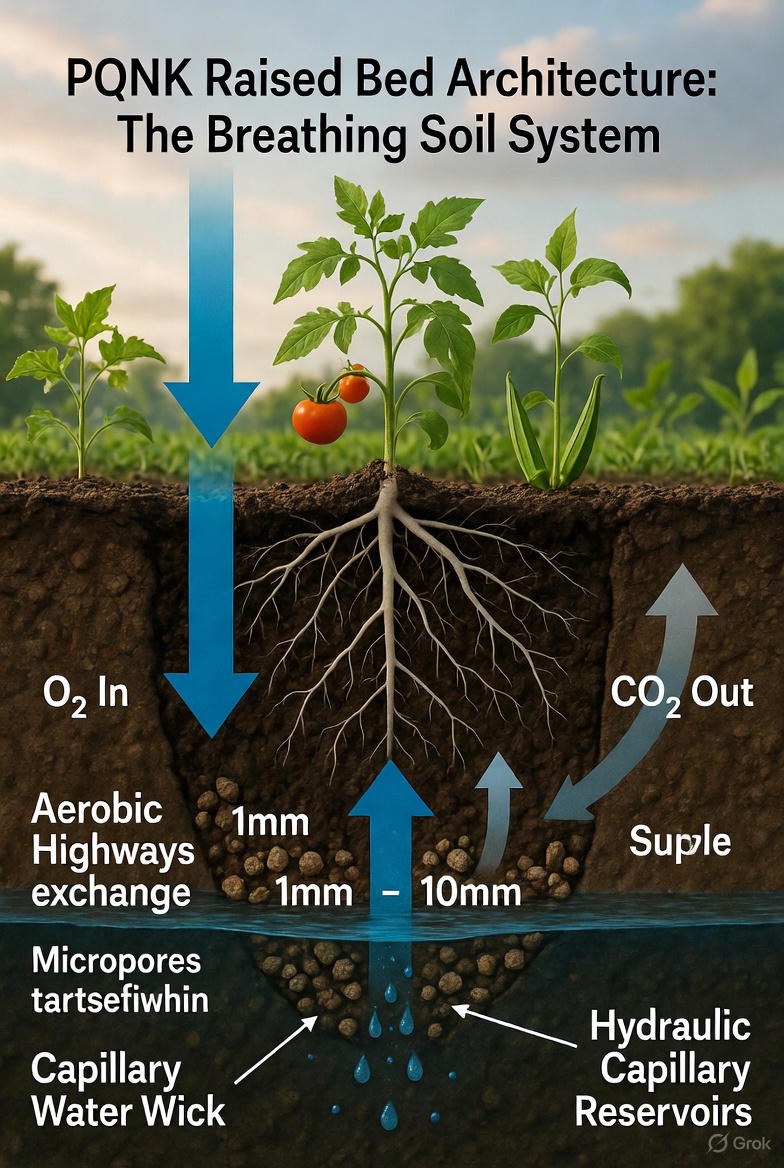
The second and third questions ask whether soil aggregate size affects crop production and what the best sizes are. The paper answers that aggregate size and stability sit at the absolute core of the raised bed's design, building a diverse pore network: macropores between larger aggregates act as 'aerobic highways' for gas exchange (oxygen in, CO2 out), while micropores within and between smaller aggregates act as 'hydraulic capillary reservoirs' holding water against gravity.
The ideal is defined as a stable 'crumb structure' spanning 1mm to 10mm, since aggregates finer than 1mm risk compaction and aggregates coarser than 10mm break capillary continuity and root-soil contact. Within that range, the paper specifies an engineering target of roughly 20-30% of aggregates falling in the 2-5mm band as the ideal building blocks, alongside a diversity of other sizes across the full 1-10mm spectrum to keep the pore network well connected at multiple scales.
The paper's final point is that aggregate stability in water matters more than dry size, formalized as the Slake Test: a stable PQNK aggregate, bound by fungal hyphae and microbial glue, holds its shape when immersed in water, while an unstable aggregate dissolves immediately, signaling weak biology and a hydraulic structure that will collapse under irrigation or rain.
Full Paper
If you use “Listen”, the text of the page may be sent to your browser or operating system’s speech provider, such as Apple, Google or Microsoft, depending on the voice your device uses. Pedaver does not process, transmit or store any audio.
Mr. Rakesh, a practicing PQNK farmer from Rajasthan, India, raised some questions in one of our PQNK learning groups on WhatsApp. These questions are being addressed for him and other farmers.
Question 1: Importance of Relative Humidity in Crop Production in PQNK Farming
Based on the hydraulic architecture of the PQNK raised bed system, Relative Humidity (RH) is not merely an external weather condition but a direct result and key indicator of the engineered root-zone environment. Its importance is understood through its intimate connection to soil moisture and plant transpiration.
The Feedback Loop of Plant Transpiration: In the PQNK system, the porous, aggregated structure of the raised bed acts as a "moisture battery." It stores capillary water in the micropores while macropores ensure free movement of air and water. A vigorously growing plant in this ideal environment freely transpires, releasing water vapor into the immediate canopy atmosphere. This creates a positive feedback loop:
Optimal Soil Moisture → Vigorous Plant → High Transpiration → Elevated Local RH around Canopy.
This elevated local RH, particularly during early morning hours, is a bio-indicator of a fully functional system. It shows that the plant is not under hydraulic stress and is actively "collaborating" with the soil ecosystem to regulate its microclimate.
The Hydraulic Bridge Between Soil and Atmosphere: The PQNK raised bed is engineered to wick moisture upwards via capillary action, countering gravity. This constant supply of moisture to the root zone is matched by the plant's transpiration, which pulls this water up and releases it as vapor. Therefore, the RH around the crop canopy is a real-time measure of the efficiency of this "Hydraulic Bridge." If the RH is consistently low at the canopy level, it signals a break in this bridge—likely due to poor soil structure, lack of aggregation, or compromised microbial activity that sustains this wicking potential.
A Managed Parameter, Not an Imposed One: Conventional farming sees RH as an external challenge to be countered with irrigation. In PQNK, the raised bed system is designed to engineer and moderate the RH itself. A properly constructed bed ensures that even during dry atmospheric conditions, the root zone remains hydraulically connected, allowing the plant to maintain transpiration and create its own protective humidity shield, thereby reducing abiotic stress.
In summary from the PQNK paper's lens: Relative Humidity is the visible breath of the living soil-plant system. A healthy PQNK raised bed, with its optimal hydraulic architecture, will naturally manifest a favorable RH regime around its plants, which is a key driver of vigorous and sustained production.
Question 2 & 3: Does the size of soil aggregates affect crop production? What are the best soil aggregate sizes?
The PQNK knowledge paper places soil aggregate size and stability at the absolute core of the system's design. It is the fundamental physical determinant of the Aerobic and Hydraulic Architecture of the raised bed.
1. The Non-Negotiable Role of Soil Aggregates:
Yes, aggregate size is paramount. The PQNK raised bed is not a simple pile of soil; it is a consciously engineered structure whose functionality depends on the creation of a diverse pore space network. This network is built by soil aggregates of varying sizes.
Macropores (between larger aggregates): These are the "Aerobic Highways" responsible for vital gas exchange. This is the process of "O<sub>2</sub> in, CO<sub>2</sub> out." Think of it as the soil breathing: the roots need fresh oxygen (O<sub>2</sub>) to come in so they can stay healthy and absorb nutrients, and they need to push out the used air, carbon dioxide (CO<sub>2</sub>), so they don't suffocate.
Micropores (within and between smaller aggregates): These are the "Hydraulic Capillary Reservoirs" that hold water tightly against gravity, making it available for plant and microbial use.
2. The Best Soil Aggregate Sizes for the PQNK Raised Bed:
The paper defines the ideal not as a single size, but as a spectrum of aggregation that creates the optimal balance between the Aerobic and Hydraulic domains.
The Goldilocks Zone: The Crumb Structure: The target is a stable "crumb structure" where the majority of aggregates fall within the 1 mm to 10 mm range. This specific range is critical because:
Aggregates smaller than 1 mm (a fine powder) risk compaction, reducing aeration and stopping the soil's breath.
Unstructured clods larger than 10 mm create overly large pores that can break capillary continuity and provide poor root-soil contact.
The Engineering Specification: Within this crumb structure, we aim for a mix:
~20-30% of aggregates in the 2-5 mm range: These are the ideal building blocks, creating stable pores that support both root penetration and capillary water movement.
A diversity of other sizes between 1mm and 10mm: This ensures a well-connected, multi-scale pore network.
3. The Ultimate Quality Test: Stability in Water:
As per PQNK principles, the stability of these aggregates is more important than their dry size. The Slake Test is our quality control protocol. A stable PQNK aggregate, bound by fungal hyphae and microbial glue, will hold its shape when immersed in water for a significant period. An unstable aggregate will immediately dissolve, signaling a lack of biological life and a doomed hydraulic structure that will collapse upon irrigation or rain.
In summary from the PQNK paper's lens: The best soil aggregate sizes are a stable, diverse crumb structure between 1mm and 10mm. This is the very material from which we engineer the PQNK raised bed. It is this specific physical architecture that creates the synergistic environment where water, air, and roots can coexist perfectly, leading to the vigorous plant production the system is known for.
—————————
Footnote: Any Production Process That Inundates Soil With Water, Disturbs Soil Through Tillage, Or Leaves Soil Bare Without Organic Mulch Cover Does Not Qualify As Natural Ecosystem Science For Production Agriculture.
PQNK, to be pronounced as 'picnic', which stands for Paedar Qudratti Nizam Kashatqari, and means: the regenerative & sustainable Pristine Organic Farming System.
www.Facebook.Com/Pedaver
https://www.youtube.com/@pedaverpqnk3167/videos
pedaver@gmail.com
WhatsApp +92 320 677 6666
About This Paper
- Problem
- Excess Vegetative Growth (at expense of yield/flowering) · Poor Soil Structure / Aggregation
- Science
- Soil · Water · Climate
- Evidence
- Scientific Mechanism
- Authority
- Current / Approved PQNK Knowledge
Related PQNK Science
Key Takeaways
- Relative humidity around the canopy is treated as a real-time bioindicator of the raised bed's 'hydraulic bridge,' not just ambient weather.
- A positive feedback loop drives canopy RH: optimal soil moisture leads to a vigorous plant, which drives high transpiration, which elevates local humidity, especially in early morning hours.
- Consistently low canopy RH under dry conditions signals a broken hydraulic bridge, usually from poor aggregation or weak microbial activity, not a need for more irrigation.
- The ideal PQNK aggregate spans a 1mm to 10mm 'crumb structure,' with roughly 20-30% concentrated in the 2-5mm range as the core building blocks.
- Macropores act as aerobic gas-exchange highways; micropores act as hydraulic capillary reservoirs; both are needed together for the bed to function.
- The Slake Test is the quality-control protocol: a stable, fungal-bound aggregate holds its shape underwater, while an unstable one dissolves, exposing a soil structure that will collapse under irrigation.
Related Knowledge
same problem
Production Architecture: Engineering the Farm So the Living System Never Has to Be Rebuilt
Explains the physical engineering behind the four PQNK principles: permanent raised beds and furrows that separate destructive tractor traffic and irrigation from a protected biological zone, so a field accumulates biological function crop after crop instead of being torn down and rebuilt every season.
same problem
Why Only 4 kg of NP During PQNK Transition?
Answers a transitioning farmer's question, why is PQNK's transitional dose only about 4 kg of NP per acre, by tracing how a plant actually feeds through a water-based soil solution shaped by transpiration, mass flow and diffusion rather than by counting fertilizer bags, and by drawing a precise distinction between over-irrigation and waterlogging that explains why excess soluble nitrogen produces lush, delayed, insect-prone growth.
same problem
The Underground Network We Have Been Farming Against
New 3D synchrotron imaging (Braunmiller et al., New Phytologist 2026) shows mycorrhizal hyphae spanning air-filled pores, bridging soil particles and growing along roots in intact soil. This paper separates what the research shows from what it means for PQNK: soil architecture is part of the root-fungal partnership, conventional farming dismantles it after every harvest, and a moist but aerated, undisturbed root zone protects it.
same problem
Soil Moisture Management in PQNK Organic Farming: The 30/70 Rule
Explains PQNK's core moisture condition, roughly 30% water-filled and 70% air-filled soil pore space, as the sustained balance of a healthy, functioning PQNK soil, and the yield, input-cost, and produce-quality consequences of over-irrigating past it.