

KP-166 · Soil Science & PQNK System
Subsoil Compaction Under No-Till Farming vs. PQNK-Based Regenerative Systems: A Critical Analysis
A critique of a PNAS article on subsoil compaction risk under no-till farming, arguing that its machinery-focused solutions treat a symptom of the Ancient Conventional Industrial framework rather than adopting the full four-step PQNK correction the article's own findings point toward.
Read or listen to the full paper ↓Abstract
The PNAS article under review found that nearly 40 percent of global no-till land is at high risk of subsoil compaction from heavy machinery despite the absence of tillage, with recovery times running years to decades, longer than the typical interval between compaction events, and identified this as a driver of persistent yield losses in crops such as maize, worsened in wet climates and moist soils.
This analysis argues the article's proposed fixes, lightweight autonomous machinery, controlled traffic farming, and scaling machinery to soil strength limits, are technological adjustments within the existing large-scale, input-dependent farming model rather than a systemic redesign, since the article does not address permanent soil cover, deep-rooted cover crops, or the soil microbial networks that determine whether compaction recurs regardless of machinery weight.
The paper maps the article's own findings directly onto the four PQNK steps as the missing prescription: breaking the hardpan addresses the exact subsoil compaction the article warns about; correcting soil chemistry resolves the pH and nutrient lock-up that compounds compaction; permanent raised beds combined with Jantar's deep roots create a compaction-resistant zone that biologically fractures subsoil over time; and permanent mulch under true no-till maintains the structure and moisture the article's no-till systems lack.
The conclusion frames the PNAS article as a valuable diagnosis of a broken system rather than a workable prescription, and cautions policymakers against treating no-till alone as synonymous with regenerative agriculture; the paper's position is that true sustainability requires all four PQNK steps operating together to integrate soil physics, chemistry, and biology into a closed-loop system.
Full Paper
If you use “Listen”, the text of the page may be sent to your browser or operating system’s speech provider, such as Apple, Google or Microsoft, depending on the voice your device uses. Pedaver does not process, transmit or store any audio.
Introduction
The attached PNAS article, “The invisible subsoil compaction risk under no-till farming,” highlights a significant concern in modern conservation agriculture: the gradual degradation of subsoil due to heavy machinery, even under no-till (NT) systems. While the article is scientifically rigorous and policy-relevant, it reflects a narrow view of conservation agriculture—one that is still embedded in the Ancient Conventional Industrial (ACI) framework. This analysis contrasts the article’s findings with the PQNK (Natural Ecosystem Science) approach, which emphasizes holistic soil regeneration through four sequential steps, not merely the absence of tillage.
Key Findings of the PNAS Article
1. Risk of Subsoil Compaction:
• NT systems, despite avoiding tillage, remain vulnerable to subsoil compaction from heavy machinery (e.g., harvesters).
• Nearly 40% of global NT land is at high risk, especially in mechanized regions like the USA, Canada, and Brazil.
• Soil recovery times (years to decades) often exceed the frequency of compaction events, leading to gradual degradation.
2. Impact on Crop Yields:
• Persistent yield losses in crops like maize are linked to subsoil compaction.
• Wet climates and moist soils exacerbate compaction risks.
3. Proposed Solutions:
• Lightweight autonomous machinery.
• Controlled traffic farming.
• Scaling machinery to soil strength limits.
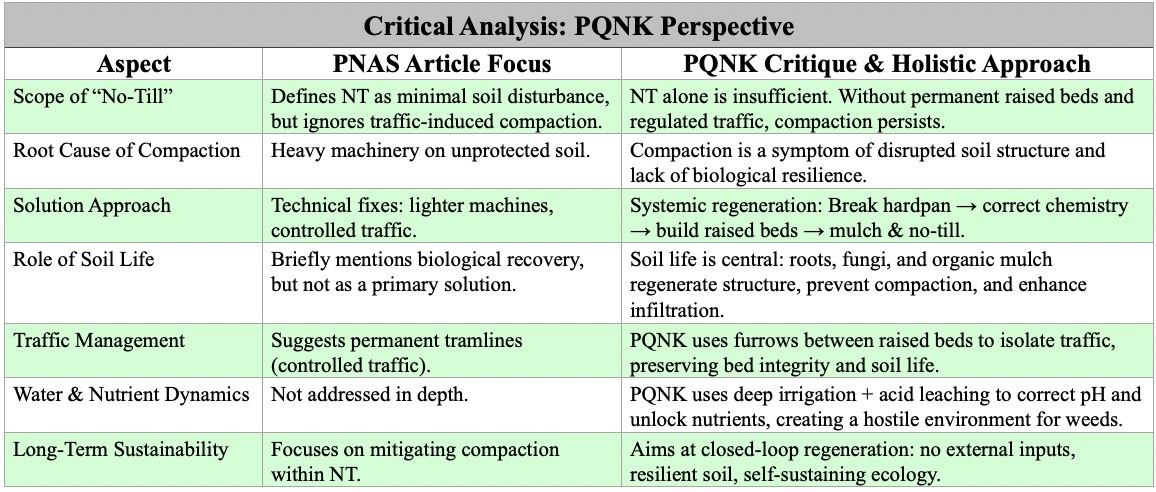
| Aspect | PNAS Article Focus | PQNK Critique & Holistic Approach |
|---|---|---|
| Scope of “No-Till” | Defines NT as minimal soil disturbance, but ignores traffic-induced compaction. | NT alone is insufficient. Without permanent raised beds and regulated traffic, compaction persists. |
| Root Cause of Compaction | Heavy machinery on unprotected soil. | Compaction is a symptom of disrupted soil structure and lack of biological resilience. |
| Solution Approach | Technical fixes: lighter machines, controlled traffic. | Systemic regeneration: Break hardpan → correct chemistry → build raised beds → mulch & no-till. |
| Role of Soil Life | Briefly mentions biological recovery, but not as a primary solution. | Soil life is central: roots, fungi, and organic mulch regenerate structure, prevent compaction, and enhance infiltration. |
| Traffic Management | Suggests permanent tramlines (controlled traffic). | PQNK uses furrows between raised beds to isolate traffic, preserving bed integrity and soil life. |
| Water & Nutrient Dynamics | Not addressed in depth. | PQNK uses deep irrigation + acid leaching to correct pH and unlock nutrients, creating a hostile environment for weeds. |
| Long-Term Sustainability | Focuses on mitigating compaction within NT. | Aims at closed-loop regeneration: no external inputs, resilient soil, self-sustaining ecology. |
Why the PNAS Article is Limited from a Regenerative Perspective
1. ACI Legacy:
• The article operates within the ACI paradigm—large-scale, input-dependent, machinery-focused farming.
• It does not challenge the monoculture, heavy machinery, and chemical dependency that underpin modern NT systems.
2. Missing Ecosystem Principles:
• No mention of permanent soil cover with mulch, deep-rooted cover crops, or soil microbial networks.
• Ignores the synergy between soil physics, chemistry, and biology.
3. Partial Solution Set:
• Lightweight robots and controlled traffic are technological tweaks, not systemic redesigns.
• Fails to integrate water management, pH correction, and biological tillage as seen in PQNK’s Jantar phase.
4. Policy Implications:
• The article could mislead policymakers into promoting NT alone as sustainable, without mandating complementary regenerative practices.
PQNK as the Regenerative Alternative
The PNAS article’s findings actually validate the need for PQNK:
• Step 1 (Break Hardpan): Addresses the very subsoil compaction the article warns against.
• Step 2 (Correct Chemistry): Solves nutrient lock-up and pH issues, which exacerbate compaction.
• Step 3 (Raised Beds + Jantar): Creates a compaction-resistant growing zone and uses deep roots to naturally fracture subsoil.
• Step 4 (Mulch + No-Till): Maintains soil structure, moisture, and life—true NT within a regenerated system.
Conclusion
While the PNAS article provides a valuable warning about subsoil compaction in NT systems, it remains trapped in the ACI mindset—treating symptoms rather than transforming the agricultural ecosystem. PQNK offers a scientifically grounded, holistic alternative that not only prevents compaction but also regenerates soil health, enhances water dynamics, and builds resilient, low-input farming systems. For policymakers, the lesson is clear: Do not equate no-till with regenerative agriculture. True sustainability requires all four PQNK steps—integrating soil physics, chemistry, and biology into a closed-loop, life-centered system.
Final Note
The PNAS article is a diagnosis of a broken system, not a prescription for a living one. PQNK provides the blueprint for regeneration—where soil is not merely conserved, but revived.
Footnote: PQNK (pronounced 'picnic')—the regenerative & sustainable Pristine Organic Farming System—is grounded in Natural Ecosystem Science. This science employs perennial biodiversity, protects soil with organic mulch, and avoids practices like water inundation, tillage disturbance, and leaving soil bare.
About This Paper
- Crop
- Maize (Corn)
- Problem
- Soil Compaction (General) · Hardpan · Locked / Unavailable Soil Minerals
- Science
- Soil · Production Architecture
- Evidence
- External Scientific Evidence
- Authority
- Current / Approved PQNK Knowledge
Related PQNK Science
Key Takeaways
- The PNAS article found nearly 40 percent of global no-till land at high risk of subsoil compaction from heavy machinery, with recovery times of years to decades exceeding the interval between compaction events.
- The article's proposed solutions (lightweight autonomous machinery, controlled traffic farming) are described as technological tweaks within the existing industrial farming model, not a systemic redesign.
- The analysis maps the article's findings directly onto the four PQNK steps: hardpan breaking, chemistry correction, raised beds with Jantar's deep roots, and permanent mulch under true no-till.
- The central policy caution is that no-till alone should not be equated with regenerative agriculture; without complementary soil chemistry and biology corrections, no-till systems remain vulnerable to the same compaction the article documents.
Related Knowledge
same problem
Deep Subsoil Remediation & Activation: Strategic Pathways for Compacted Soils
This paper lays out PQNK's two-track response to hardpan: a preferred one-time mechanical subsoiling where machinery is available, and a patient, plant-and-fungi-driven biological pathway for farms where it isn't, with mycorrhizal fungi cast as the ecosystem's 'stone breaker.'
same problem
When 13 Inches of Rain Falls in Eight Hours
After 13 inches of rain in eight hours, the PQNK orchard beds of Jaskaran Singh in Fazilka district, Indian Punjab, had taken the water into the soil and could be walked on in slippers, while neighbouring conventional orchards and fields stood under water, and so did a strip of his own orchard where the hardpan had not been broken. The paper explains why hardpan is a water barrier as well as a root barrier, and why the soil is the first reservoir.
same problem
Production Architecture: Engineering the Farm So the Living System Never Has to Be Rebuilt
Explains the physical engineering behind the four PQNK principles: permanent raised beds and furrows that separate destructive tractor traffic and irrigation from a protected biological zone, so a field accumulates biological function crop after crop instead of being torn down and rebuilt every season.
same problem
Why PQNK Sugarcane Does Not Need Earthing Up
Earthing up is mandatory in conventional sugarcane: the set is placed in a furrow 6 to 8 inches deep between ridges 6 to 8 inches high, above a compacted hardpan, roots stay shallow, and the profile has to be reversed with soil piled around the stool. PQNK removes the cause instead: the hardpan is broken once, cane grows on permanent beds, roots go deep, the crown stays near the aerated surface and the full sugar-rich base can be harvested.