

KP-046 · Soil Science & PQNK System
Role of Soil Colloids in Determining the Physical and Chemical Properties of Soil
Responding to a detailed farmer question about clay mineralogy, this paper explains why PQNK treats soil colloids, clay minerals and humus alike, as the soil's 'operating system,' and works through a PQNK-specific management approach for each major clay type from montmorillonite to vermiculite.
Read or listen to the full paper ↓Abstract
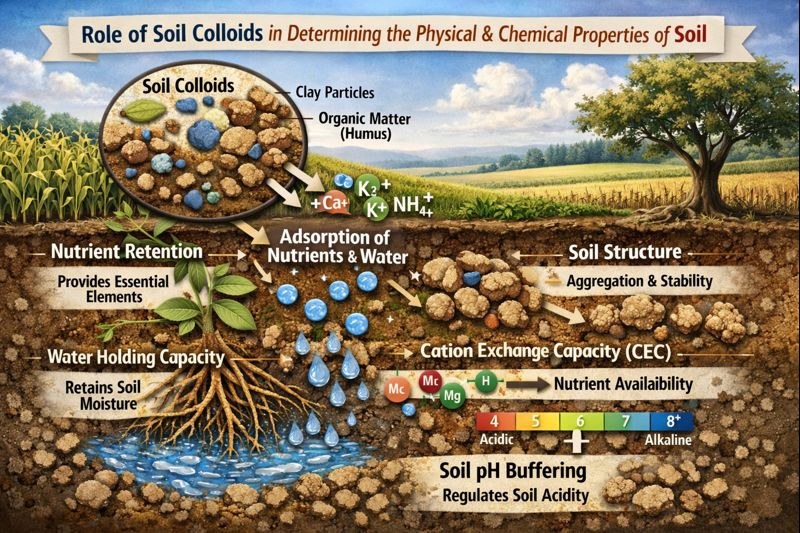
Answering a farmer's question about soil colloids and how PQNK balances them, the paper opens by defining colloids, the finest particles in soil, invisible to the eye but responsible for nutrient-holding capacity (CEC), water retention, aggregation, pH buffering, and biological activity, comprising both clay minerals and organic colloids like humus. It calls colloids the 'operating system' of soil: without balanced colloids, soil becomes either hard and compacted or loose but nutritionally empty.
On physical properties, colloids are said to determine soil structure (aggregation versus compaction, porosity, pore continuity), water behavior (infiltration, retention, drainage), and root penetration (oxygen availability, mechanical resistance). On chemical properties, colloids control cation exchange capacity for retaining calcium, magnesium, potassium, and ammonium; pH buffering against sudden shifts; and gradual, demand-driven nutrient availability rather than forced release.
PQNK's method is to never add colloids artificially, but to create the conditions under which existing colloids function correctly, through five practices: hardpan breaking (restoring vertical water movement and clay-humus interaction), deep water-based detoxification (leaching excess sodium and salts, rebalancing exchange sites toward calcium-magnesium dominance), permanent raised beds (preventing re-compaction for long-term colloidal balance), living roots and no-till (continuous carbon flow producing microbial glue that stabilizes clay-humus complexes), and mulch and biomass retention (building organic colloids while protecting clay surfaces from oxidation).
The paper then works through PQNK's function-based approach to five major clay minerals: montmorillonite (high swelling, water-sensitive, very high CEC) is stabilized with organic matter and improved calcium dominance to prevent waterlogging and cracking; kaolinite (low CEC, non-expanding) has its limited CEC compensated biologically through increased humus and nutrient cycling; illite (moderate CEC, potassium-holding) is managed by encouraging microbial potassium release while avoiding disturbance; chlorite (stable, low reactivity) is activated biologically through roots and organic coatings; and vermiculite (very high CEC, strong potassium fixation) is managed through balanced cropping and living roots that regulate potassium release and avoid 'potassium shock.'
The paper elevates humus above every clay mineral as the 'supreme colloid' in PQNK, citing its highest CEC among all colloids, its pH-buffering capacity, its role feeding microbes, and its function bonding clay particles into stable aggregates. Its summary principle: 'clay gives capacity, humus gives stability, biology gives intelligence,' and without biology, clay becomes inert, nutrients lock up, and soil becomes dead, regardless of the underlying mineral type.
Full Paper
If you use “Listen”, the text of the page may be sent to your browser or operating system’s speech provider, such as Apple, Google or Microsoft, depending on the voice your device uses. Pedaver does not process, transmit or store any audio.
Question raised by Mr. Rakesh Rajistan India in PQNK farmers
“Sir, what role do soil colloids play in determining the physical and chemical properties of soil? How does PQNK balance soil colloids to improve the physical and chemical properties of the soil? From what perspective does PQNK view montmorillonite, kaolinite, illite, chlorite, vermiculite, and humus?”
PQNK answers:
Thank you for this very important question. Yes, soil colloids are the foundation of soil fertility, structure, and resilience, and PQNK is, at its core, a system designed to restore and balance soil colloids naturally. Let us understand this step by step.
1. What Are Soil Colloids? (PQNK View)
Soil colloids are the finest particles in soil, invisible to the eye, but responsible for almost everything that matters in soil:
• Nutrient holding capacity (CEC)
• Water retention
• Soil aggregation
• Buffering of pH
• Biological activity
They include:
• Clay minerals
• Organic colloids (humus)
PQNK considers soil colloids as the “operating system” of soil.
2. Role of Soil Colloids in Physical Properties
Soil colloids determine:
• Soil structure
• Aggregation vs compaction
• Porosity and pore continuity
• Water behavior
• Infiltration
• Retention
• Root penetration
• Oxygen availability
• Mechanical resistance
Without balanced colloids, soil becomes either:
• Hard and compacted or
• Loose but nutritionally empty
PQNK aims for structured, breathing soil.
3. Role of Soil Colloids in Chemical Properties
Colloids control:
• Cation Exchange Capacity (CEC)
• Ca²⁺, Mg²⁺, K⁺, NH₄⁺ retention
• Prevention of nutrient leaching
• pH buffering
• Resistance to sudden acidity or alkalinity
• Nutrient availability
• Gradual, demand-driven release
PQNK avoids forcing nutrients into soil and instead builds the soil’s ability to hold and supply nutrients.
4. How PQNK Balances Soil Colloids (Very Important)
PQNK does not add colloids artificially. It creates conditions in which colloids function correctly.
Key PQNK practices: 4.1 Hardpan Breaking
• Restores vertical water movement
• Reactivates clay–humus interaction
• Prevents clay plate compression
4.2 Deep Water-Based Detoxification
• Leaches excess sodium and salts
• Rebalances exchange sites
• Improves Ca–Mg dominance
4.3 Permanent Raised Beds
• Zero re-compaction
• Stable aggregation
• Long-term colloidal balance
4.4 Living Roots & No-Till
• Continuous carbon flow
• Microbial glue (polysaccharides)
• Stable clay–humus complexes
4.5 Mulch & Biomass Retention
• Builds organic colloids (humus)
• Protects clay surfaces
• Prevents oxidation
5. PQNK Perspective on Major Clay Minerals
PQNK does not classify soils as “good” or “bad” based on clay type. It focuses on function, not mineral identity.
5.1 Montmorillonite (Smectite Group)
• High swelling
• Very high CEC
• Water-sensitive
PQNK approach:
• Stabilize with organic matter
• Improve calcium dominance
• Prevent waterlogging and cracking
5.2 Kaolinite
• Low CEC
• Non-expanding
• Structurally stable
PQNK approach:
• Increase humus content
• Enhance biological nutrient cycling
• Compensate low CEC biologically
5.3 Illite
• Moderate CEC
• Potassium-holding capacity
PQNK approach:
• Encourage microbial K release
• Avoid disturbance
• Maintain slow nutrient cycling
5.4 Chlorite
• Stable but low reactivity
PQNK approach:
• Biological activation through roots
• Organic coatings for improved function
5.5 Vermiculite
• Very high CEC
• Strong K fixation
PQNK approach:
• Balanced cropping
• Avoid potassium shock
• Use living roots to regulate K release
6. Humus: The Supreme Colloid in PQNK
PQNK places humus above all clay minerals. Why?
• Highest CEC of all colloids
• Buffers pH
• Feeds microbes
• Bonds clay particles into stable aggregates
• Prevents nutrient loss
PQNK’s goal is:
Clay + Humus + Biology = Living Soil
7. PQNK Summary Principle (Very Important)
Clay gives capacity Humus gives stability Biology gives intelligence Without biology:
• Clay becomes inert
• Nutrients become locked
• Soil becomes dead
PQNK restores all three together.
8. Why PQNK Outperforms Input-Based Systems
Chemical agriculture:
• Fills exchange sites temporarily
• Ignores colloidal balance
• Collapses structure over time
PQNK:
• Builds colloidal capacity
• Maintains exchange equilibrium
• Produces resilient, self-regulating soil
9. Final PQNK Statement
Soil colloids do not need correction. They need respect, space, water, and biology. When soil colloids are balanced:
• Roots go deeper
• Water lasts longer
• Nutrients stay available
• Yields stabilize naturally
That is the essence of PQNK.
Footnote
PQNK (pronounced “picnic”)—the regenerative & sustainable Pristine Organic Farming System —is grounded in Natural Ecosystem Science. This science employs perennial biodiversity, protects soil with organic mulch, and avoids practices such as water inundation, tillage disturbance, and leaving soil bare.
It is the process that matters most. PQNK is a pristine production system designed not merely for yield, but for optimal, balanced output—where quality, sustainability, and ecological harmony emerge from a self‑regulated, zero‑external‑input methodology.
About This Paper
- Problem
- Sandy / Low-Fertility Soil Texture · Locked / Unavailable Soil Minerals
- Science
- Soil
- Evidence
- Scientific Mechanism
- Authority
- Current / Approved PQNK Knowledge
Related PQNK Science
Key Takeaways
- PQNK treats soil colloids, clay minerals plus humus, as the soil's 'operating system,' directly governing CEC, water retention, aggregation, and pH buffering.
- Colloids are never added artificially; PQNK instead creates the conditions (hardpan breaking, salt-leaching detox irrigation, permanent beds, living roots, mulch) for existing colloids to function correctly.
- Each major clay mineral gets a distinct, function-based approach: montmorillonite is stabilized with organic matter and calcium dominance to control swelling, kaolinite's low CEC is compensated biologically with humus, and vermiculite's strong potassium fixation is managed by avoiding 'potassium shock' via living roots.
- Humus is named the 'supreme colloid,' ranked above all clay minerals for its CEC, pH buffering, and role bonding clay particles into stable aggregates.
- Summary principle: 'clay gives capacity, humus gives stability, biology gives intelligence' — without biology, clay is inert and nutrients stay locked regardless of mineral type.
- Argues chemical agriculture fills exchange sites temporarily while collapsing colloidal structure over time, whereas PQNK builds colloidal capacity and maintains exchange equilibrium.
Related Knowledge
same problem
Subsoiler Line Spacing and Stony-Land Conversion: A Farmer Q&A
A Nigerian farmer's questions on subsoiler line spacing, converting gravelly land, integrating cocoa into an alley system, and diagnosing nitrogen lock-up, answered with the PQNK conversion protocol step by step.
same problem
Subsoil Compaction Under No-Till Farming vs. PQNK-Based Regenerative Systems: A Critical Analysis
A critique of a PNAS article on subsoil compaction risk under no-till farming, arguing that its machinery-focused solutions treat a symptom of the Ancient Conventional Industrial framework rather than adopting the full four-step PQNK correction the article's own findings point toward.
same problem
Beyond Sand, Silt, and Clay: The PQNK Guide to Creating Productive Soil
Answering a farmer's question about whether soil texture or structure matters more for production, this guide draws a sharp line between the two, texture is your soil's fixed 'DNA,' structure is a living condition biology builds, and shows in practical terms how PQNK transforms both sandy and hard clay soils into functional loam without changing the underlying texture at all.
same problem
Agriculture in Sandy Soil: A PQNK Lecture Transcript
A transcribed lecture explaining why sandy soils fail to retain water and nutrients, and demonstrating, with live experiments, the PQNK clay-slurry treatment that seals the upper root zone of a raised bed so sandy soil can hold moisture and support crops without imported topsoil.