

KP-142 · Soil Science & PQNK System
Knowledge Paper: Returning Dairy Waste to the Land, A PQNK Perspective for Dairy Farmers
Addressed directly to dairy farmers who assume manure and biogas slurry are automatically 'valuable fertilizer,' this paper argues the same waste can help, stall, or actively poison a field depending entirely on which soil state within PQNK's transition, degenerative, regenerative (following the initial Corrective Intervention), or the Sustained Closed Loop State, it's applied to, and sets out a decision framework for matching waste form to soil condition.
Read or listen to the full paper ↓Abstract
The paper opens by naming a common dairy-farmer experience directly: waste is applied as 'valuable fertilizer' as advised, yet the soil doesn't feel the same as it once did and crops stop responding the way they should. Its explanation rests on matching waste to soil state within PQNK's transition, degenerative, regenerative (after Corrective Intervention), or the Sustained Closed Loop State, and the central claim that a farmer cannot simply 'apply waste' and expect improvement without first knowing which state the land is actually in, since the same material produces entirely different outcomes depending on the soil's condition.
In the PQNK 'sustained state,' the paper argues, plants are the employers of their own nutrient supply chain, running a self-sufficient food-production system encoded in every seed's DNA, exactly as land functioned before human intervention. Reaching this state from a degenerative starting point requires the four-step PQNK Regeneration Protocol used across the paper series (hardpan correction, chemistry correction, permanent bed and traffic discipline, and permanent mulch under no-till management) before waste application becomes appropriate at all.
Four scenarios illustrate the stakes of getting the sequencing wrong: applying waste to degenerative soil functions as a temporary crutch for a broken system that never actually heals; applying it to regenerative soil in transition is a disruption that stalls the healing process before it completes; applying raw waste to already-sustained soil is described as a poison that begins undoing the regeneration achieved; only properly processed waste, applied sparingly to fully sustained soil as habitat rather than feed, can be absorbed without disruption. Biogas slurry specifically is classified as intermediate material, not a finished product, regardless of how it is commonly marketed to dairy farmers.
The paper's practical center is the PQNK Waste Processing Protocol, transforming raw waste until, by its own stated indicator, the material no longer smells like waste but smells like earth, dark, crumbly, and alive, at which point it is ready for sparing application under strict guidelines matched to the soil's current state. The broader lesson offered is systemic: the only true solution to waste management is designing the farm so waste does not accumulate in the first place, reframing the farmer's job as maintaining the conditions under which plants can run their own nutrient economy, rather than continually feeding them.
Full Paper
If you use “Listen”, the text of the page may be sent to your browser or operating system’s speech provider, such as Apple, Google or Microsoft, depending on the voice your device uses. Pedaver does not process, transmit or store any audio.
A PQNK Perspective for Dairy FarmersPQNK - Sustained State
To the Dairy Farmer Reading This
You have a problem. Every day, your animals produce waste. Perhaps you have a biogas plant, and now you have slurry to manage. You have been told this waste is "valuable fertilizer." You have been told to spread it on your fields. Perhaps you already do.
But something troubles you. The soil does not feel the same as it once did. The crops are not responding the way they should. You are doing everything "right," and yet...
Let us look at this problem through a different lens.
Part One: The Three States of Soil
Before we discuss what to do with waste, we must first understand where your soil currently stands on its journey. There are three states, and they are not the same:
What Each Step Accomplishes in the Journey
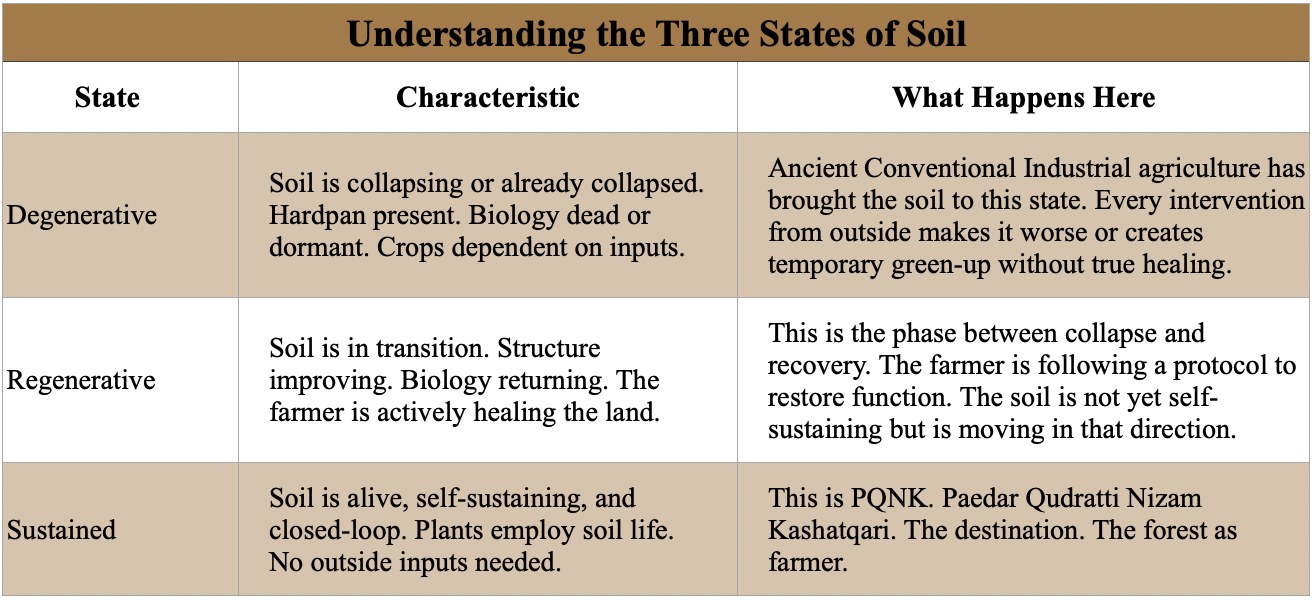
| State | Characteristic | What Happens Here |
|---|---|---|
| Degenerative | Soil is collapsing or already collapsed. Hardpan present. Biology dead or dormant. Crops dependent on inputs. | Ancient Conventional Industrial agriculture has brought the soil to this state. Every intervention from outside makes it worse or creates temporary green-up without true healing. |
| Regenerative | Soil is in transition. Structure improving. Biology returning. The farmer is actively healing the land. | This is the phase between collapse and recovery. The farmer is following a protocol to restore function. The soil is not yet self-sustaining but is moving in that direction. |
| Sustained | Soil is alive, self-sustaining, and closed-loop. Plants employ soil life. No outside inputs needed. | This is PQNK. Paedar Qudratti Nizam Kashatqari. The destination. The forest as farmer. |
Part Two: What Your Soil Should Be — The PQNK Sustained State
To understand what is wrong, you must first understand what is right.
In a sustained state soil—a PQNK soil—the plants are the employers. They do not wait for you to feed them. They have been designing and running their own food factory for millions of years, long before humans existed. The DNA inside every seed carries a complete production plan:
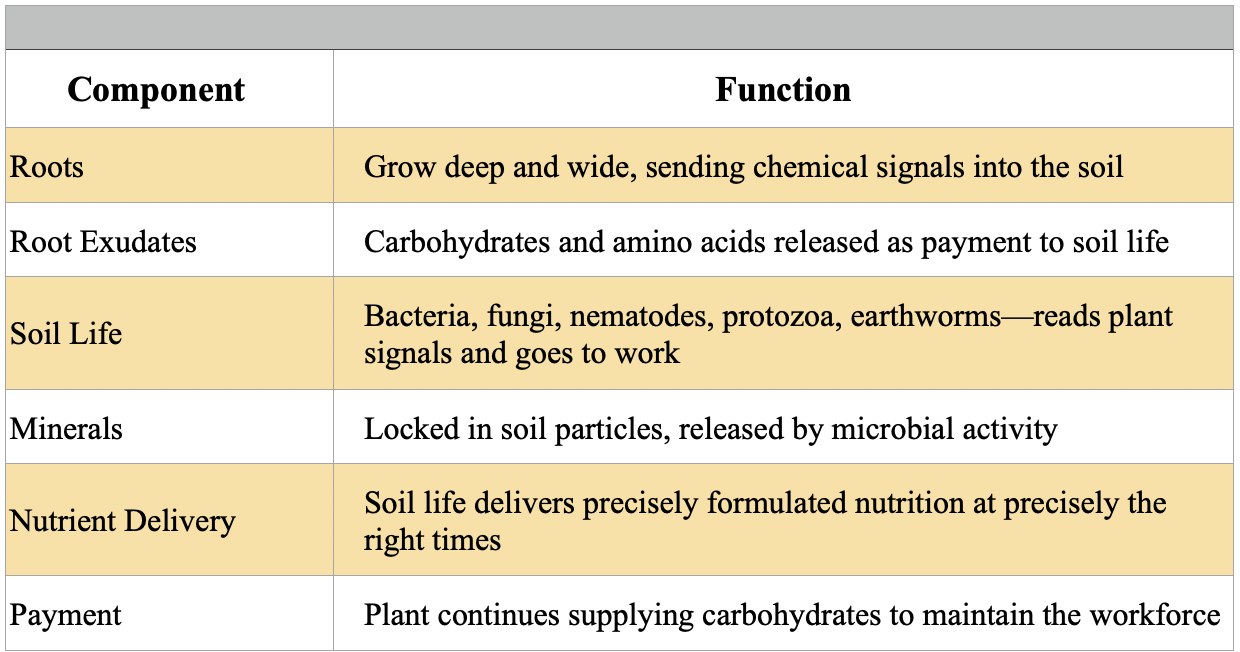
| Component | Function |
|---|---|
| Roots | Grow deep and wide, sending chemical signals into the soil |
| Root Exudates | Carbohydrates and amino acids released as payment to soil life |
| Soil Life | Bacteria, fungi, nematodes, protozoa, earthworms—reads plant signals and goes to work |
| Minerals | Locked in soil particles, released by microbial activity |
| Nutrient Delivery | Soil life delivers precisely formulated nutrition at precisely the right times |
| Payment | Plant continues supplying carbohydrates to maintain the workforce |
This is not theory. This is how every piece of land on earth functioned before humans began farming. This is the destination.
Part Three: The Journey from Degenerative to Sustained
If your soil is not in the sustained state, you cannot simply "apply waste" and expect things to improve. You must first follow the PQNK Regeneration Protocol to move your land through the regenerative transition.
These are the four steps, based on natural ecosystem science:
The PQNK Regeneration Protocol
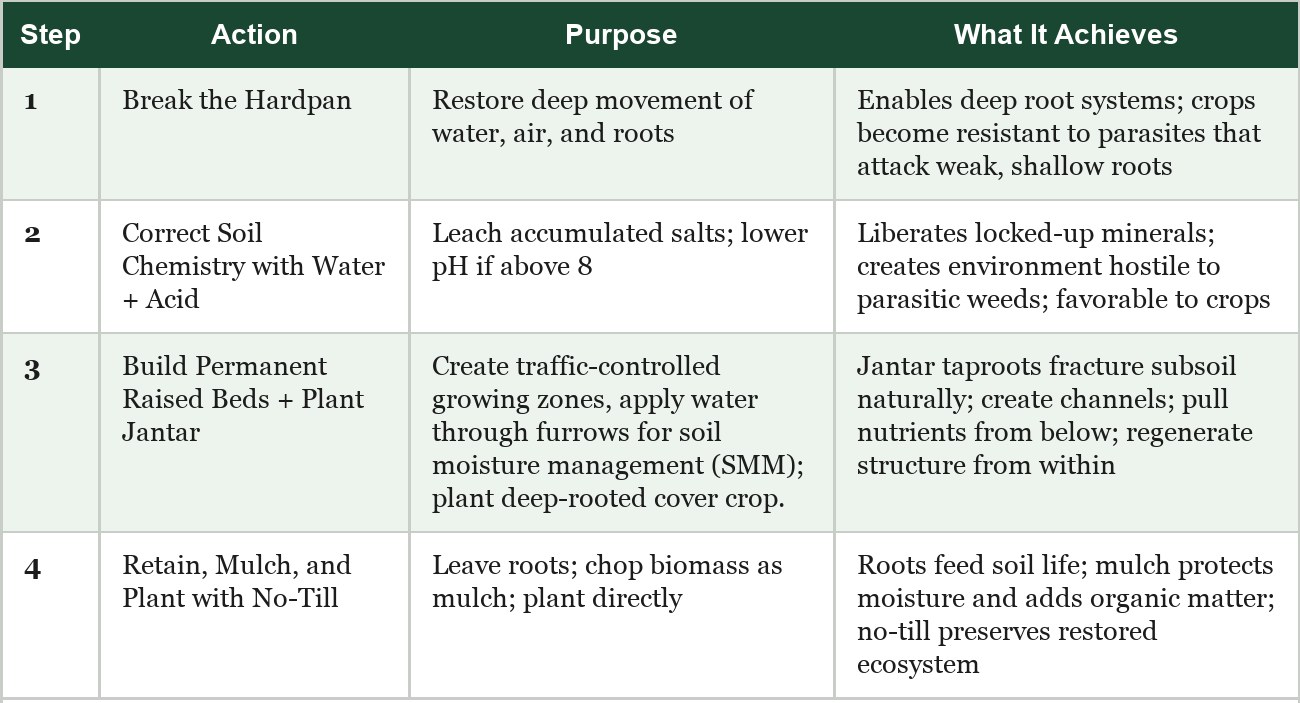
| Step | Action | Purpose | What It Achieves |
|---|---|---|---|
| 1 | Break the Hardpan | Restore deep movement of water, air, and roots | Enables deep root systems; crops become resistant to parasites that attack weak, shallow roots |
| 2 | Correct Soil Chemistry with Water + Acid | Leach accumulated salts; lower pH if above 8 | Liberates locked-up minerals; creates environment hostile to parasitic weeds; favorable to crops |
| 3 | Build Permanent Raised Beds + Plant Jantar | Create traffic-controlled growing zones, apply water through furrows for soil moisture management (SMM); plant deep-rooted cover crop. | Jantar taproots fracture subsoil naturally; create channels; pull nutrients from below; regenerate structure from within |
| 4 | Retain, Mulch, and Plant with No-Till | Leave roots; chop biomass as mulch; plant directly | Roots feed soil life; mulch protects moisture and adds organic matter; no-till preserves restored ecosystem |
What Each Step Accomplishes in the Journey
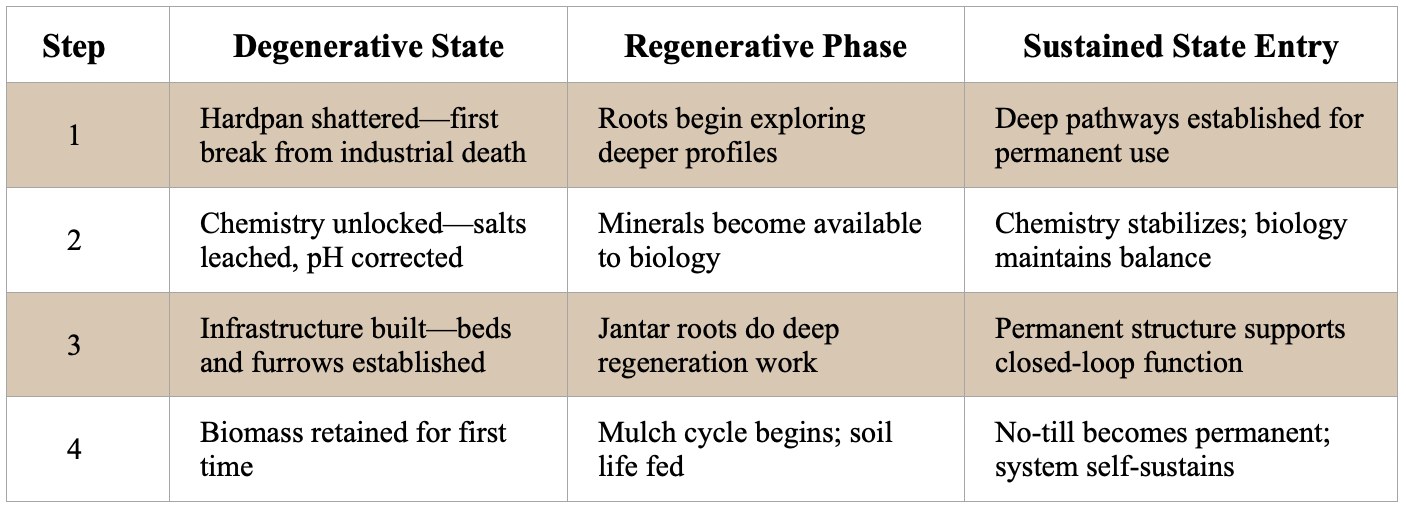
| Step | Degenerative State | Regenerative Phase | Sustained State Entry |
|---|---|---|---|
| 1 | Hardpan shattered—first break from industrial death | Roots begin exploring deeper profiles | Deep pathways established for permanent use |
| 2 | Chemistry unlocked—salts leached, pH corrected | Minerals become available to biology | Chemistry stabilizes; biology maintains balance |
| 3 | Infrastructure built—beds and furrows established | Jantar roots do deep regeneration work | Permanent structure supports closed-loop function |
| 4 | Biomass retained for first time | Mulch cycle begins; soil life fed | No-till becomes permanent; system self-sustains |
Part Four: Three Soils, Three Different Stories
Now let us examine what happens when dairy waste is applied to soil in each of these three states.
Scenario A: Applying Waste to Degenerative Soil
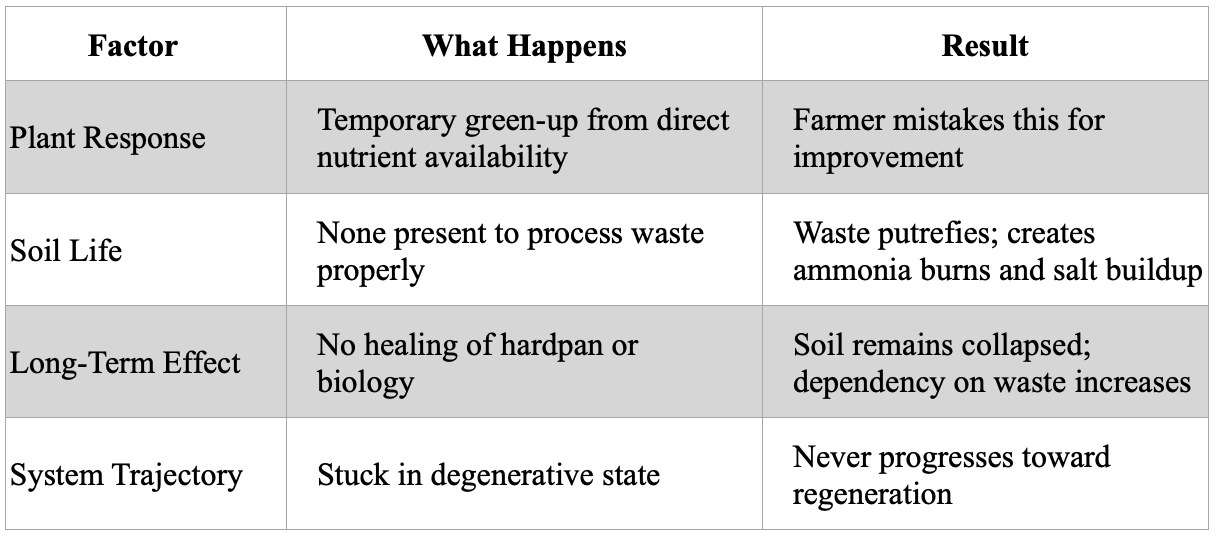
| Factor | What Happens | Result |
|---|---|---|
| Plant Response | Temporary green-up from direct nutrient availability | Farmer mistakes this for improvement |
| Soil Life | None present to process waste properly | Waste putrefies; creates ammonia burns and salt buildup |
| Long-Term Effect | No healing of hardpan or biology | Soil remains collapsed; dependency on waste increases |
| System Trajectory | Stuck in degenerative state | Never progresses toward regeneration |
In degenerative soil, waste is a crutch—a temporary support for a broken system that never heals.
Scenario B: Applying Waste to Regenerative Soil
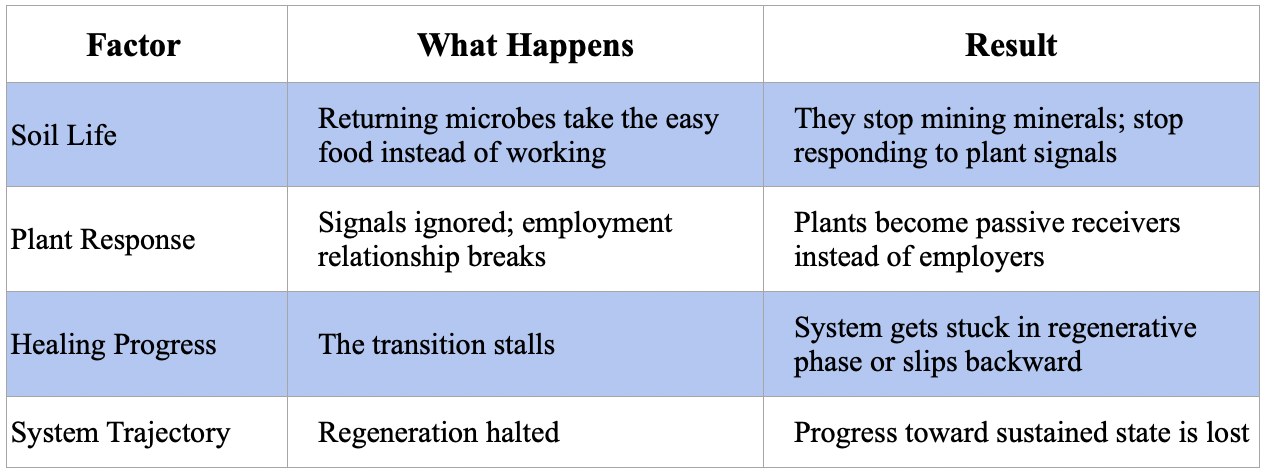
| Factor | What Happens | Result |
|---|---|---|
| Soil Life | Returning microbes take the easy food instead of working | They stop mining minerals; stop responding to plant signals |
| Plant Response | Signals ignored; employment relationship breaks | Plants become passive receivers instead of employers |
| Healing Progress | The transition stalls | System gets stuck in regenerative phase or slips backward |
| System Trajectory | Regeneration halted | Progress toward sustained state is lost |
In regenerative soil, waste is a disruption—it stalls the healing process and prevents the system from reaching the sustained state.
Scenario C: Applying Raw Waste to Sustained Soil
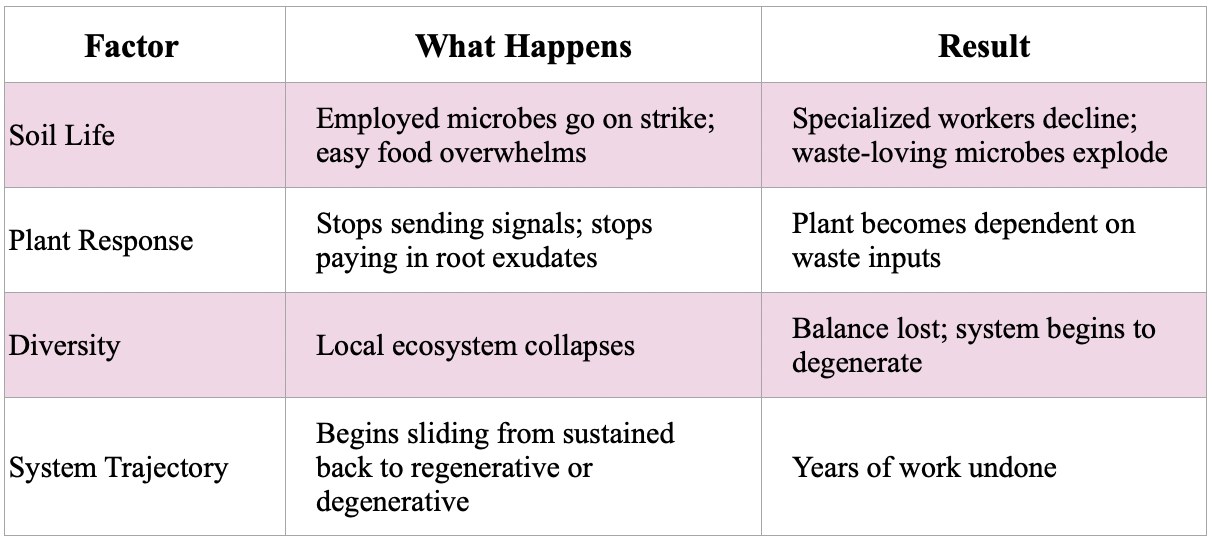
| Factor | What Happens | Result |
|---|---|---|
| Soil Life | Employed microbes go on strike; easy food overwhelms | Specialized workers decline; waste-loving microbes explode |
| Plant Response | Stops sending signals; stops paying in root exudates | Plant becomes dependent on waste inputs |
| Diversity | Local ecosystem collapses | Balance lost; system begins to degenerate |
| System Trajectory | Begins sliding from sustained back to regenerative or degenerative | Years of work undone |
In sustained soil, raw waste is a poison—it begins the process of degeneration and undoes everything you have built.
Scenario D: Applying Properly Processed Waste to Sustained Soil
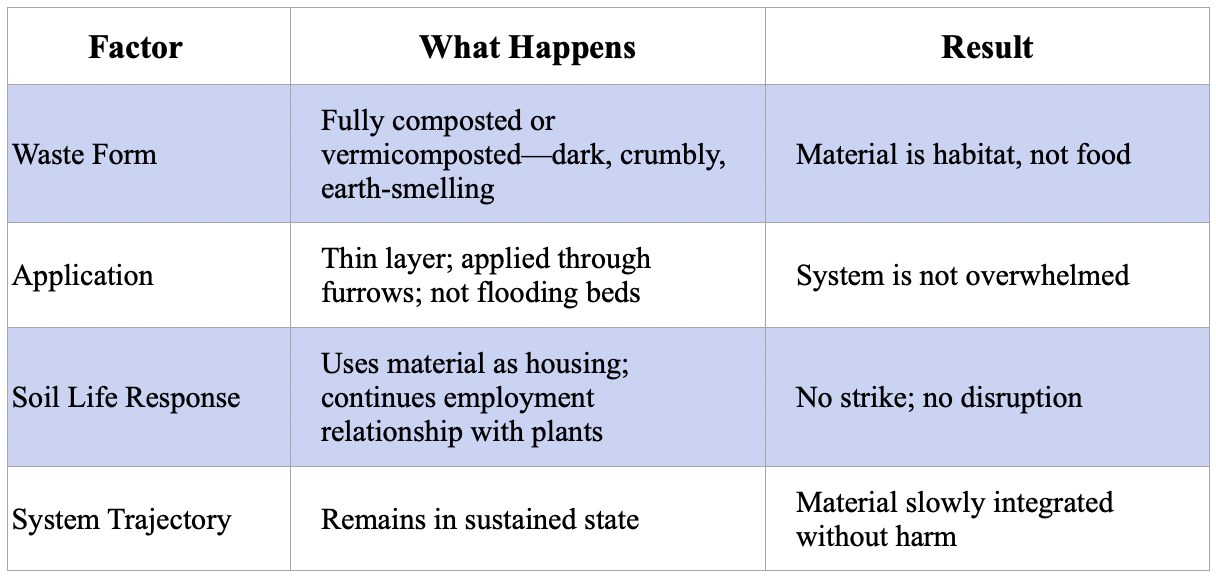
| Factor | What Happens | Result |
|---|---|---|
| Waste Form | Fully composted or vermicomposted—dark, crumbly, earth-smelling | Material is habitat, not food |
| Application | Thin layer; applied through furrows; not flooding beds | System is not overwhelmed |
| Soil Life Response | Uses material as housing; continues employment relationship with plants | No strike; no disruption |
| System Trajectory | Remains in sustained state | Material slowly integrated without harm |
In sustained soil, properly processed waste applied as habitat can be absorbed without disruption—but only if applied sparingly and only after complete transformation.
Part Five: The Critical Insight — A Summary Table
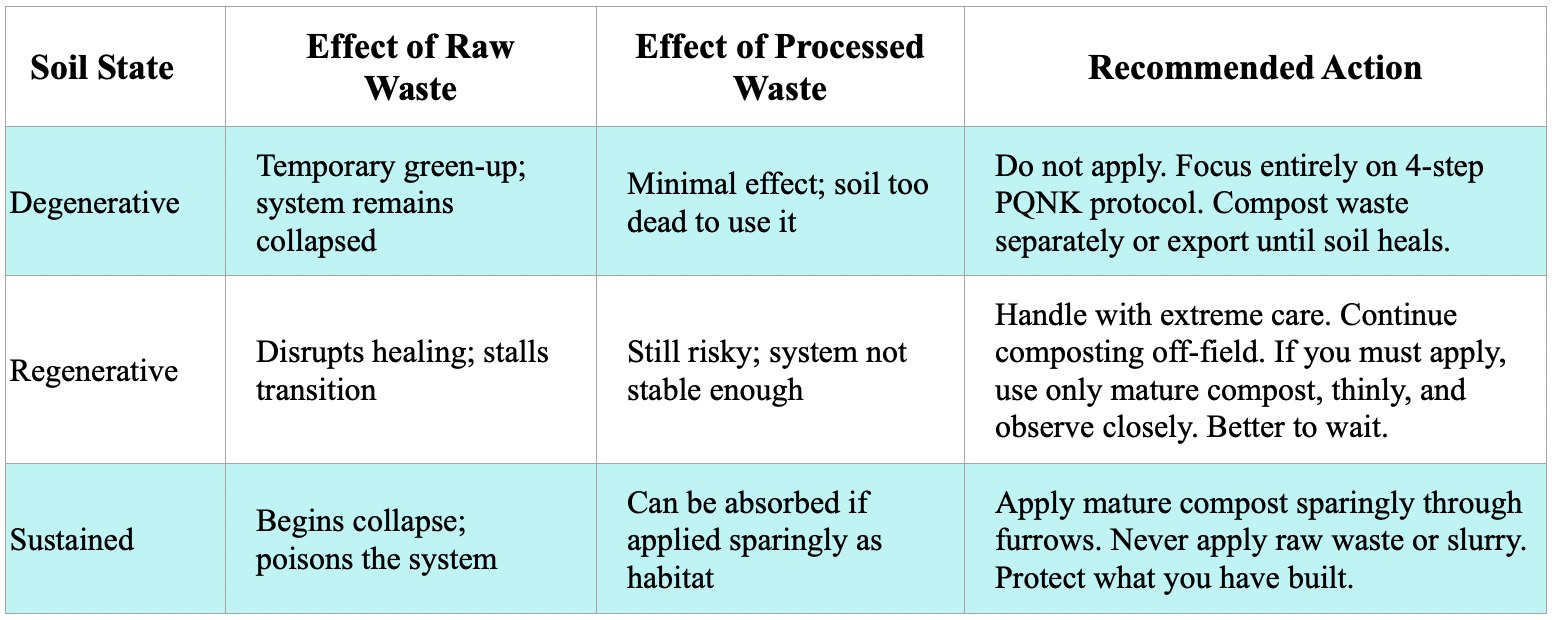
| Soil State | Effect of Raw Waste | Effect of Processed Waste | Recommended Action |
|---|---|---|---|
| Degenerative | Temporary green-up; system remains collapsed | Minimal effect; soil too dead to use it | Do not apply. Focus entirely on 4-step PQNK protocol. Compost waste separately or export until soil heals. |
| Regenerative | Disrupts healing; stalls transition | Still risky; system not stable enough | Handle with extreme care. Continue composting off-field. If you must apply, use only mature compost, thinly, and observe closely. Better to wait. |
| Sustained | Begins collapse; poisons the system | Can be absorbed if applied sparingly as habitat | Apply mature compost sparingly through furrows. Never apply raw waste or slurry. Protect what you have built. |
Part Six: The Biogas Plant Question
Many dairy farmers have biogas plants. The slurry produced is often seen as a valuable byproduct.
Through the PQNK lens, we must see it differently:
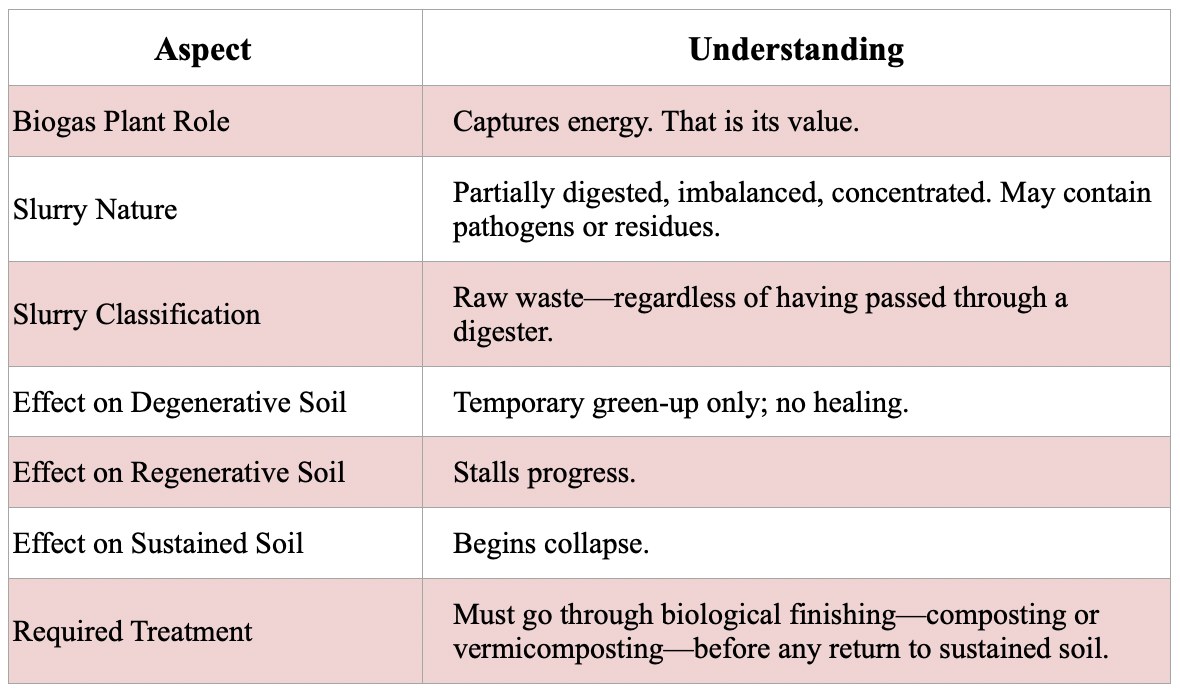
| Aspect | Understanding |
|---|---|
| Biogas Plant Role | Captures energy. That is its value. |
| Slurry Nature | Partially digested, imbalanced, concentrated. May contain pathogens or residues. |
| Slurry Classification | Raw waste—regardless of having passed through a digester. |
| Effect on Degenerative Soil | Temporary green-up only; no healing. |
| Effect on Regenerative Soil | Stalls progress. |
| Effect on Sustained Soil | Begins collapse. |
| Required Treatment | Must go through biological finishing—composting or vermicomposting—before any return to sustained soil. |
Biogas slurry is intermediate material. It is not finished product.
Part Seven: The PQNK Waste Processing Protocol
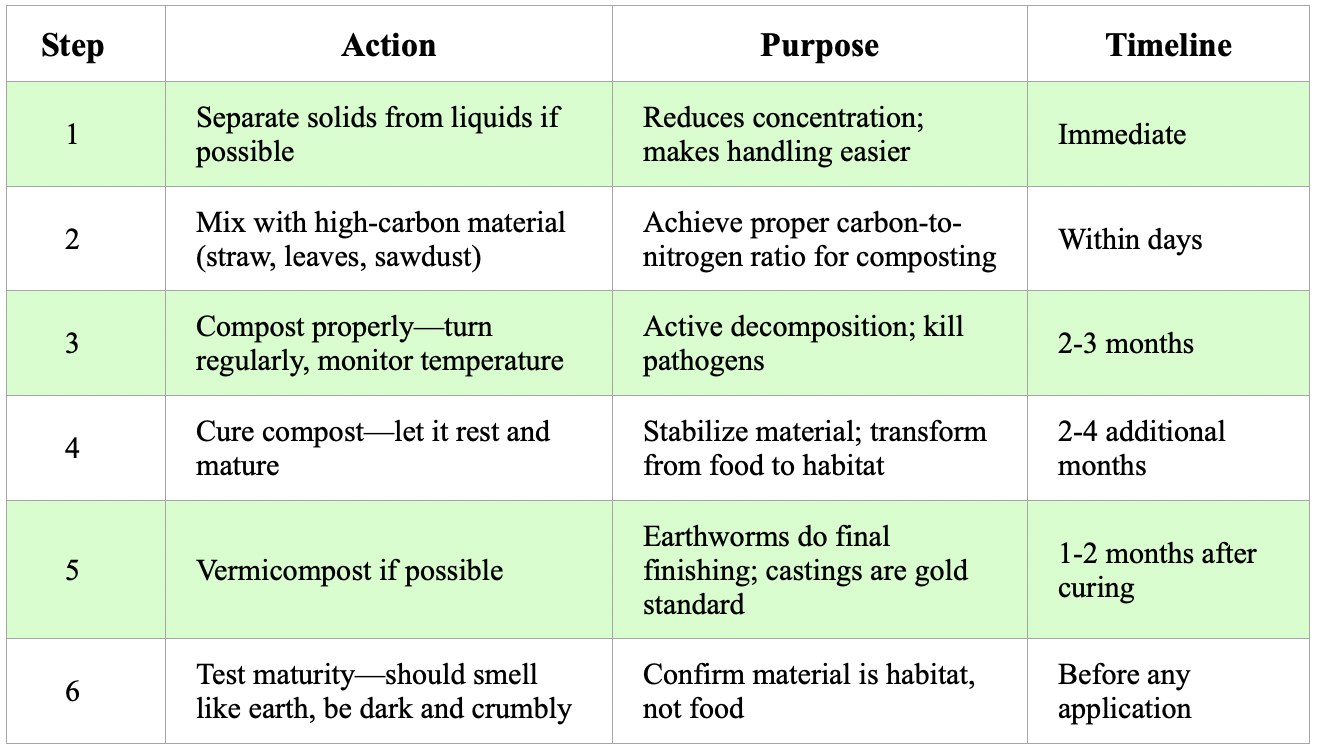
| Step | Action | Purpose | Timeline |
|---|---|---|---|
| 1 | Separate solids from liquids if possible | Reduces concentration; makes handling easier | Immediate |
| 2 | Mix with high-carbon material (straw, leaves, sawdust) | Achieve proper carbon-to-nitrogen ratio for composting | Within days |
| 3 | Compost properly—turn regularly, monitor temperature | Active decomposition; kill pathogens | 2-3 months |
| Cure compost—let it rest and mature | Stabilize material; transform from food to habitat | 2-4 additional months | |
| 5 | Vermicompost if possible | Earthworms do final finishing; castings are gold standard | 1-2 months after curing |
| 6 | Test maturity—should smell like earth, be dark and crumbly | Confirm material is habitat, not food | Before any application |
For farmers who must manage dairy waste, here is the protocol for transforming it into something that can safely return to the land:
The key indicator: When the material no longer smells like waste, when it smells like earth, when it is dark and crumbly and alive—then it is ready.
Part Eight: Application Guidelines for Sustained Soil
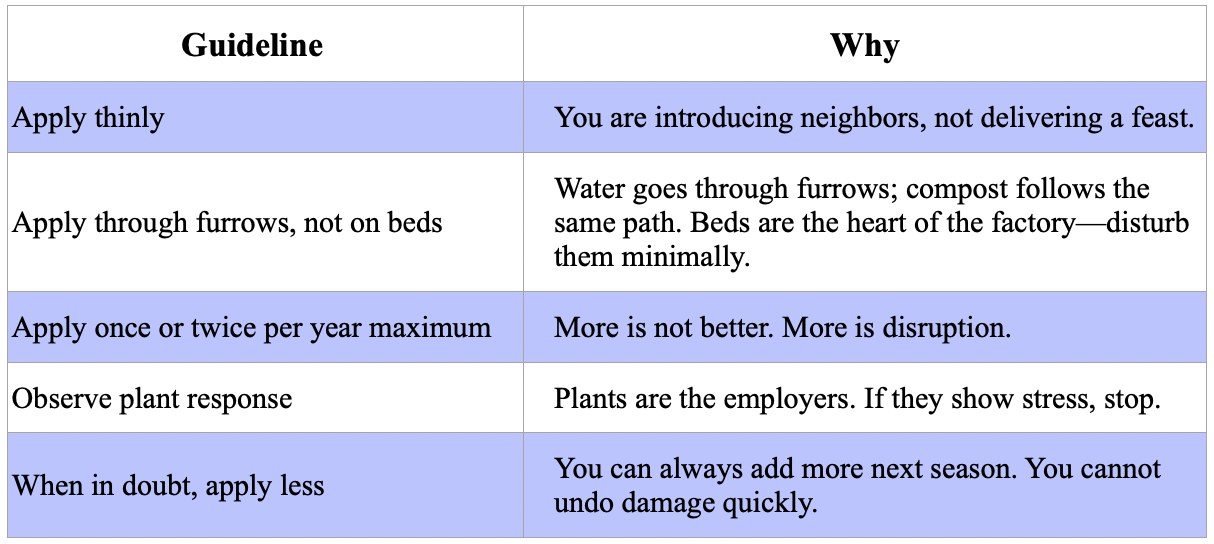
| Guideline | Why |
|---|---|
| Apply thinly | You are introducing neighbors, not delivering a feast. |
| Apply through furrows, not on beds | Water goes through furrows; compost follows the same path. Beds are the heart of the factory—disturb them minimally. |
| Apply once or twice per year maximum | More is not better. More is disruption. |
| Observe plant response | Plants are the employers. If they show stress, stop. |
| When in doubt, apply less | You can always add more next season. You cannot undo damage quickly. |
If your soil has reached the sustained state and you have properly processed waste, follow these guidelines:
Part Nine: The Deeper Lesson
There is a principle here that extends beyond waste management:
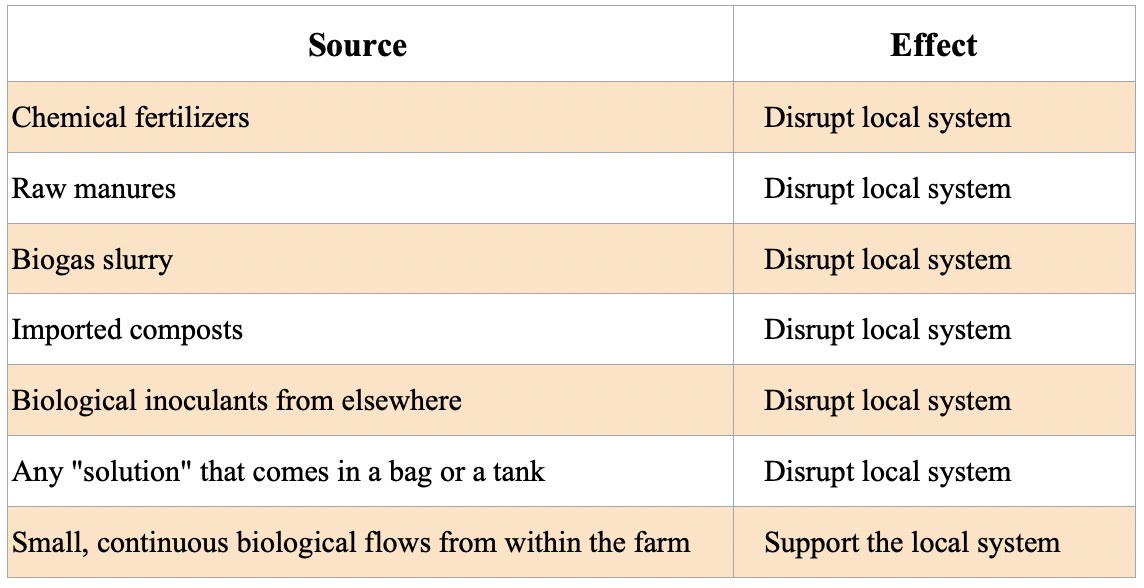
| Source | Effect |
|---|---|
| Chemical fertilizers | Disrupt local system |
| Raw manures | Disrupt local system |
| Biogas slurry | Disrupt local system |
| Imported composts | Disrupt local system |
| Biological inoculants from elsewhere | Disrupt local system |
| Any "solution" that comes in a bag or a tank | Disrupt local system |
| Small, continuous biological flows from within the farm | Support the local system |
The only true solution is to design your farm so that waste does not accumulate in the first place.
Part Ten: A Complete Decision Framework for the Farmer
Step 1: Assess Your Soil State
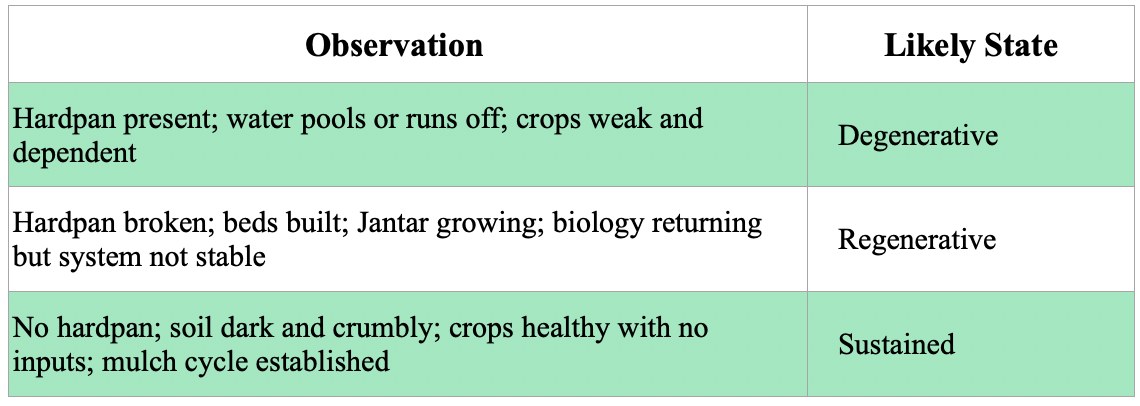
| Observation | Likely State |
|---|---|
| Hardpan present; water pools or runs off; crops weak and dependent | Degenerative |
| Hardpan broken; beds built; Jantar growing; biology returning but system not stable | Regenerative |
| No hardpan; soil dark and crumbly; crops healthy with no inputs; mulch cycle established | Sustained |
Step 2: Follow the Appropriate Path
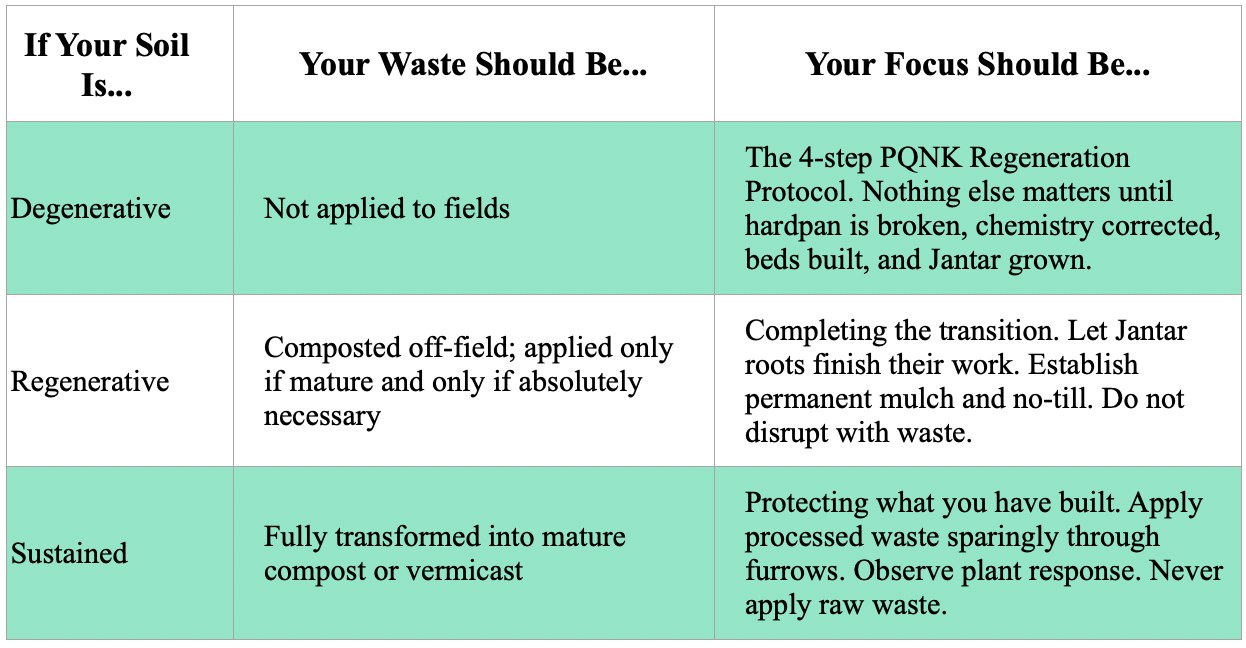
| If Your Soil IS... | Your Waste Should Be... | Your Focus Should Be... |
|---|---|---|
| Degenerative | Not applied to fields | The 4-step PQNK Regeneration Protocol. Nothing else matters until hardpan is broken, chemistry corrected, beds built, and Jantar grown. |
| Regenerative | Composted off-field; applied only if mature and only if absolutely necessary | Completing the transition. Let Jantar roots finish their work. Establish permanent mulch and no-till. Do not disrupt with waste. |
| Sustained | Fully transformed into mature compost or vermicast | Protecting what you have built. Apply processed waste sparingly through furrows. Observe plant response. Never apply raw waste. |
Step 3: Match Waste Form to Soil State
A Final Thought
The plants in your field are not helpless. They are not waiting for you to feed them. They are the employers, the managers, the CEOs of a food production system that has functioned perfectly for millions of years.
Your job, as a farmer, is not to feed the plants.
Your job is to maintain the conditions in which the plants can employ their workforce effectively.
When you understand this, everything changes. Waste is no longer something to "dispose of." It is a material that must be carefully, patiently, biologically transformed so that it can re-enter the cycle without breaking the employment contract between plant and soil.
And most importantly: You must know what state your soil is in. The same waste that seems to help degenerative soil will poison sustained soil. The same waste that gives temporary green-up to a dead field will destroy a living farm.
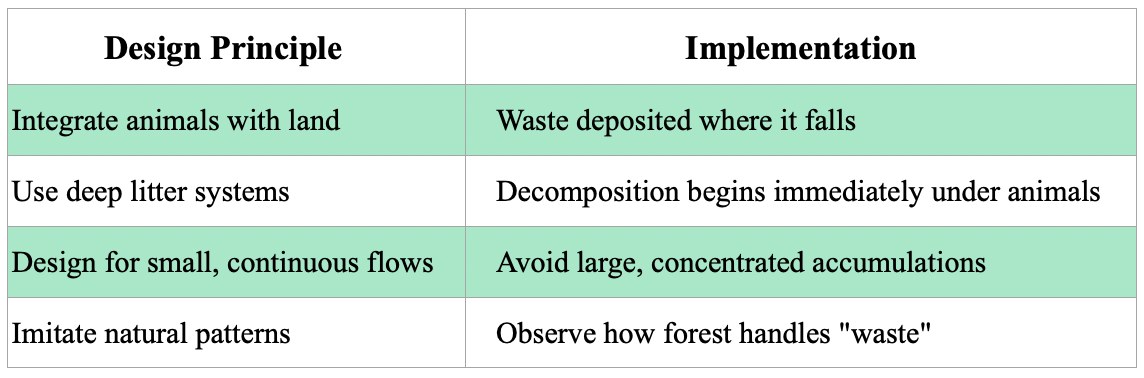
| Design Principle | Implementation |
|---|---|
| Integrate animals with land | Waste deposited where it falls |
| Use deep litter systems | Decomposition begins immediately under animals |
| Design for small, continuous flows | Avoid large, concentrated accumulations |
| Imitate natural patterns | Observe how forest handles "waste" |
Know your soil. Follow the protocol. Protect the living system. And let the plants do their job.
Quick Reference Card
This is the PQNK way.
This is Paedar Qudratti Nizam Kashatqari.
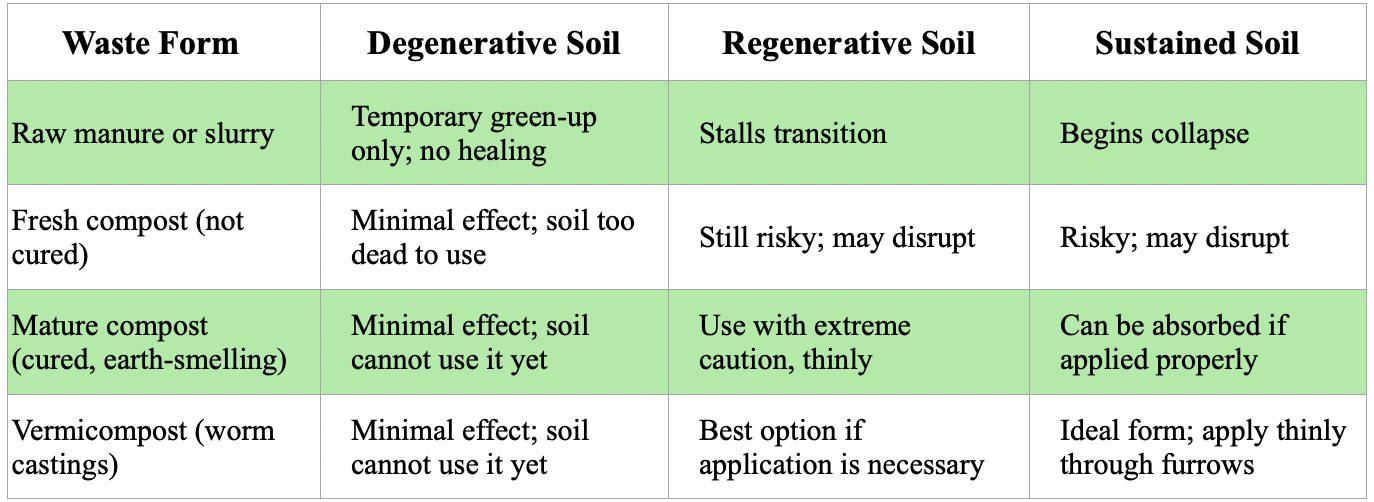
| Waste Form | Degenerative Soil | Regenerative Soil | Sustained Soil |
|---|---|---|---|
| Raw manure or slurry | Temporary green-up only; no healing | Stalls transition | Begins collapse |
| Fresh compost (not cured) | Minimal effect; soil too dead to use | Still risky; may disrupt | Risky; may disrupt |
| Mature compost (cured, earth-smelling) | Minimal effect; soil cannot use it yet | Use with extreme caution, thinly | Can be absorbed if applied properly |
| Vermicompost (worm castings) | Minimal effect; soil cannot use it yet | Best option if application is necessary | Ideal form; apply thinly through furrows |
This knowledge paper is part of an ongoing series developed through observation of natural ecosystem science. It is offered to farmers not as instruction, but as invitation—to observe, to question, and to rediscover the intelligence already present in their land.
——————————
Applying PQNK without understanding nature’s operating system will not deliver abundance, stability, or nutrient density.
PQNK (pronounced “picnic”)—the regenerative & sustainable Pristine Organic Farming System—is grounded in Natural Ecosystem Science. This science employs perennial biodiversity, protects soil with organic mulch, and avoids practices such as water inundation, tillage disturbance, and leaving soil bare.
It is the process that matters most. PQNK is a pristine production system designed not merely for yield, but for optimal, balanced output—where quality, sustainability, and ecological harmony emerge from a self‑regulated, zero‑external‑input methodology.
Connect & Resources Facebook: www.Facebook.Com/Pedaver YouTube (PQNK): https://www.youtube.com/@pedaverpqnk3167/videos YouTube: http://www.youtube.com/@aasifsharif PDF Knowledge Papers: https://drive.google.com/drive/folders/1iadwV6mdUPyrUIpB3oRfNv6DLiackaUL?usp=sharing Email: pedaver@gmail.com WhatsApp: +92 320 677 6666
About This Paper
- Problem
- General Soil Fertility / Land Degradation · Waste Accumulation / Disposal
- Science
- Soil · Transition · Nutrition
- Evidence
- Philosophical/Framework Argument
- Authority
- Current / Approved PQNK Knowledge
Related PQNK Science
Key Takeaways
- The paper's core model treats soil as existing in one of three states within PQNK's transition, degenerative, regenerative (after Corrective Intervention), or the Sustained Closed Loop State, with the same waste material producing entirely different (helpful, disruptive, or harmful) outcomes depending on which state it enters.
- Applying waste to degenerative soil acts as a temporary crutch that never lets the system heal; applying it to soil already in regenerative transition actively stalls that healing.
- Applying raw waste to already-sustained soil is described as a poison that begins reversing the regeneration already achieved; only properly processed waste, applied sparingly, is safe there.
- Biogas slurry is explicitly classified as intermediate material rather than a finished, ready-to-apply product, regardless of common marketing to dairy farmers.
- The processing protocol's readiness indicator is sensory and simple: material is ready when it no longer smells like waste but smells like earth, dark, crumbly, and alive.
- The paper's systemic recommendation is to design the farm so waste does not accumulate in the first place, rather than treating waste disposal as an ongoing input-management problem.
Related Knowledge
same problem
Chemical Fertiliser Dependency Through the PQNK Lens
An evidence-qualified review of the article “Chemical Fertilizer Industry”. It keeps the article's warning about soil degradation, nutrient pollution and biological decline, disciplines its headline numbers, and argues that fertiliser dependency is a symptom of a damaged production system (tillage, flooding, bare soil and simplified biology) that PQNK removes by restoring aerated, covered, living soil, reaching zero purchased fertiliser and pesticide at maturity.
same problem
The Global Cost of Agricultural Degradation & the PQNK Restoration Dividend
The visible price of food does not represent its full cost. Earlier versions of this Knowledge Paper attempted to combine several external estimates into a single $1.9 trillion annual cost and a $2.8 trillion restoration opportunity; source verification showed those figures combined studies with different scopes and could not be defended as one additive model, so Pedaver withdraws that composite calculation. The corrected analysis uses independently sourced estimates, FAO's ~$12 trillion/year hidden agrifood-system costs, UNCCD's ~$878 billion/year cost of inaction on land degradation, FAO's ~$400 billion/year soil-loss figure, within their own stated boundaries, and explicitly does not add them together.
same problem
The PQNK Framework: From Degenerative Systems to Regenerative Process to Sustainable State
A short framework note that corrects what it calls a common misconception, that 'regenerative' and 'sustainable' are interchangeable or parallel labels, by defining them as sequential stages: a defined four-step Corrective Intervention that a degraded farm passes through once, followed by a Regenerative Phase of biological rebuilding and then a permanent Sustained Closed Loop State requiring only seed placement and harvesting.
same problem
Factsheet: Commercial Bamboo Plantation Under PQNK
Bamboo behaves as a 'soil engine' under PQNK: a no-till, hardpan-broken planting of 726 plants per acre that needs no synthetic inputs, sequesters carbon, and stays productive for 60-100 years once established. This factsheet lays out species selection, the four-phase establishment protocol, and the water, nutrient, and weed management rules that keep the system self-sustaining.