

KP-031 · Soil Science & PQNK System
Monitoring Soil Life in the PQNK System: A Farmer's Guide
This farmer's guide sets out five simple, tool-free field tests for judging whether PQNK soil biology is actually taking hold: an earthworm census, a soil smell test, a water infiltration test, a mulch decomposition check, and a root architecture inspection. Each comes with concrete benchmarks separating degraded, good, and thriving soil, turning soil health from a guess into a measurement.
Read or listen to the full paper ↓Abstract
In the PQNK system, soil is treated as a living organism rather than a substrate, and this guide's premise is that the shift from sterile, conventional soil to a teeming, living one is measurable through simple, field-based observations any farmer can run without a lab. It lays out five tests, each with a clear tool, timing, method, and benchmark, so a farmer can move from guessing about soil health to knowing it.
The first two tests are the quickest checks. The earthworm census digs a 1-foot cubic block of soil and counts every earthworm found: 0-5 per cubic foot signals conventional or degraded soil, 10-15 signals good PQNK soil, and 25 or more signals a thriving, high-functioning system. The soil smell test asks the farmer to simply smell soil a few inches below the surface after a light rain; a sterile soil smells metallic or sour, while a living PQNK soil carries a rich, sweet, earthy aroma from geosmin, a compound produced by beneficial bacteria like Streptomyces.
The water infiltration test pushes an open-ended can two inches into the soil, pours a liter of water in, and times how long it takes to disappear: conventional soil can take 10-30 minutes or pool on the surface, while PQNK soil typically absorbs a liter in under two minutes, acting like a sponge. The mulch decomposition rate is a purely visual, ongoing check: in low-life soil, applied wood chips or straw sit largely unchanged for a year or more, while in active PQNK soil the mulch layer visibly breaks down into dark, crumbly humus laced with white fungal hyphae within 3-6 months, requiring regular topping up.
The final and most decisive test is plant vigor and root structure. Above ground, the farmer looks for deep green color and vigorous growth without fertilizer; below ground, gently uprooting a plant reveals the real signature of soil health. Conventional soil typically produces shallow, brown roots showing rot or nematode damage, while PQNK soil produces an extensive, dense, white or cream-colored root system with a fuzzy appearance from its intimate mycorrhizal association, the visible sign of a plant fully supported by the soil food web.
The guide closes by framing these five tests as a shift in the farmer's relationship to the land: by using them regularly, a PQNK farmer moves from guessing to knowing, treating earthworm counts, soil aroma, infiltration speed, mulch breakdown, and root architecture as the vital signs of a system that is, or isn't, actually alive.
Full Paper
If you use “Listen”, the text of the page may be sent to your browser or operating system’s speech provider, such as Apple, Google or Microsoft, depending on the voice your device uses. Pedaver does not process, transmit or store any audio.
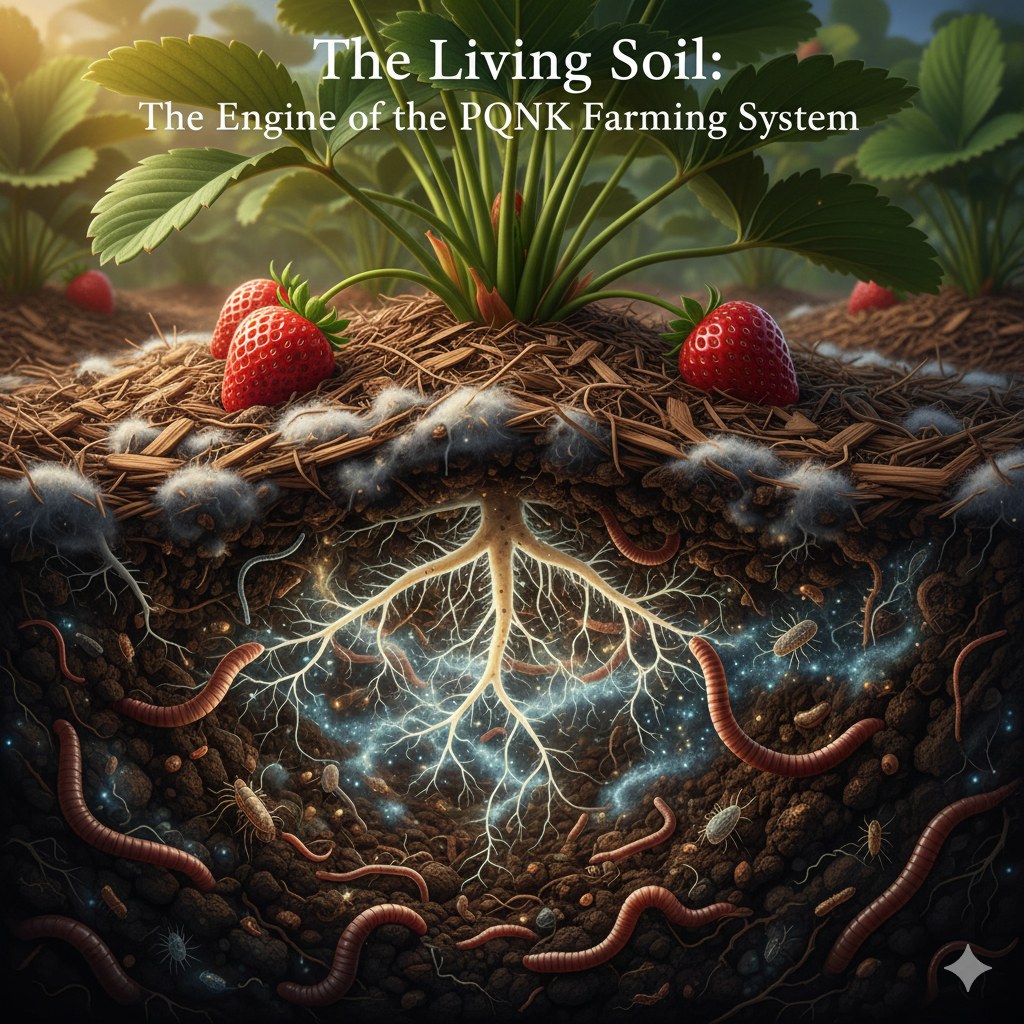
In the PQNK system, soil is not a substrate but a living organism. Its health is your primary asset. The shift from a sterile, conventional soil to a teeming, living one is measurable through simple, field-based observations and tests.
1. The Simple Earthworm Census (The Key Indicator Species)
Why: Earthworms are "ecosystem engineers." Their presence directly correlates with improved aeration, nutrient cycling, and soil structure. They thrive only in stable, well-mulched, aerobic, and chemically-free environments.
How to Check:
Tool: A spade.
When: During bed preparation and periodically (e.g., seasonally) in the furrows or at the edge of a bed.
Method:
Dig a 1-foot x 1-foot x 1-foot (30x30x30 cm) block of soil.
Gently break the soil apart on a plastic sheet or tarpaulin.
Count all earthworms found (adults and juveniles).
Benchmark:
Conventional/Degenerated Soil: 0-5 earthworms per cubic foot.
Good PQNK Soil: 10-15 earthworms per cubic foot.
Thriving PQNK Soil: 25+ earthworms per cubic foot. This is a clear sign of a high-functioning system.
2. The "Soil Smell" Test
Why: A sterile or anaerobic soil smells like concrete, clay, or sometimes sour/rotten. A living, aerobic soil has a vibrant, complex microbial community that produces distinct, pleasant odors.
How to Check:
Tool: Your nose.
When: After digging a small hole or lifting the mulch layer, especially after a light rain.
Method: Smell the soil from a few inches below the surface.
Benchmark:
Conventional Soil: Odorless, metallic, or sour.
PQNK Soil: A rich, sweet, earthy aroma. This is the smell of Geosmin, a compound produced by beneficial soil bacteria like Streptomyces. This is the smell of a healthy, living soil.
3. The Water Infiltration Test
Why: Soil life, particularly fungi and earthworms, creates stable pores and aggregates. This dramatically improves the soil's ability to absorb and hold water, eliminating runoff and inundation.
How to Check:
Tool: A empty can (like a coffee can) with both ends removed, a ruler, and a timer.
When: When the soil is moderately moist.
Method:
Push the can about 2 inches (5 cm) into the soil in a furrow or a representative spot.
Pour a known volume of water (e.g., 1 liter) into the can and start the timer.
Measure how long it takes for the water to fully infiltrate.
Benchmark:
Conventional Soil: Slow infiltration (e.g., 10-30 minutes for a liter or more). Water may pool on the surface.
PQNK Soil: Very rapid infiltration (e.g., a liter disappears in under 2 minutes). The soil acts like a sponge, accepting water instantly.
4. The Mulch Decomposition Rate
Why: The decomposition of organic mulch is the "engine" of the PQNK system, driven entirely by soil microbes (fungi and bacteria). The speed at which mulch breaks down is a direct measure of microbial activity.
How to Check:
Tool: Visual observation.
When: Continuously.
Method: Observe how quickly the thick layer of wood chips or straw you applied becomes a dark, crumbly humus, intertwined with white fungal hyphae (mycelium).
Benchmark:
Conventional/Low-Life Soil: Mulch remains largely unchanged for a year or more.
PQNK Soil: You will notice significant breakdown and incorporation of the mulch into the topsoil within 3-6 months, requiring regular topping up. This is a visible sign of a hungry, active microbial workforce.
5. The Plant Vigor & Root Structure Analysis
Why: A plant in a living soil forms a symbiotic relationship with mycorrhizal fungi and other microbes. This fundamentally changes its architecture and health.
How to Check:
Tool: Your eyes and a spade.
When: During the growing season.
Method:
Above Ground: Observe the plants. Are they a deep, lush green? Is growth vigorous even without fertilizer?
Below Ground (The Ultimate Test): Gently uproot a plant (or observe one at the end of a season).
Benchmark:
Conventional Soil: Roots are often shallow, brown, and may show signs of rot or nematode damage.
PQNK Soil: The root system will be extensive, dense, and white or cream-colored, often with a fuzzy appearance due to the intimate association with mycorrhizal fungi. This is the signature of a plant fully supported by the soil food web.
By regularly using these simple tests, a PQNK farmer moves from guessing to knowing. You are not just growing crops; you are cultivating life itself, and these are the vital signs of your success.
—————————
Footnote: Any Production Process That Inundates Soil With Water, Disturbs Soil Through Tillage, Or Leaves Soil Bare Without Organic Mulch Cover Does Not Qualify As Natural Ecosystem Science For Production Agriculture.
PQNK, to be pronounced as 'picnic', which stands for Paedar Qudratti Nizam Kashatqari, and means: the regenerative & sustainable Pristine Organic Farming System.
www.Facebook.Com/Pedaver
https://www.youtube.com/@pedaverpqnk3167/videos
pedaver@gmail.com
WhatsApp +92 320 677 6666
About This Paper
- Problem
- Farmer Uncertainty / Diagnostic Skill Gap · Soil Biology / Microbiome Decline · Poor Water Infiltration · Fungal / Bacterial Disease
- Science
- Soil
- Evidence
- Field Observation
- Authority
- Current / Approved PQNK Knowledge
Related PQNK Science
Key Takeaways
- Earthworm counts benchmark soil life directly: 0-5 per cubic foot signals degraded soil, 10-15 signals good PQNK soil, and 25+ signals a thriving system.
- A living PQNK soil smells rich, sweet, and earthy from geosmin, a compound produced by beneficial bacteria, versus the metallic or sour smell of sterile soil.
- The water infiltration test benchmark: a liter of water disappears in under 2 minutes in healthy PQNK soil versus 10-30 minutes (or surface pooling) in conventional soil.
- Applied mulch visibly breaks down into dark, crumbly humus within 3-6 months under active PQNK biology, versus remaining largely unchanged for a year or more in low-life soil.
- The ultimate test is root architecture: PQNK roots are extensive, white or cream-colored, and fuzzy with mycorrhizal association, versus shallow, brown, rot-prone conventional roots.
- None of the five tests require lab equipment; a spade, a nose, a can, a ruler, and a timer are enough to move a farmer from guessing about soil health to measuring it.
Related Knowledge
same problem
Reading Roots, Sap, and Pest Risk: A Field Diagnostic Guide Through the PQNK Lens
A no-tools field guide for comparing PQNK-grown wheat roots against chemical-farmed roots, and for reading that difference forward into a pest-pressure forecast, on the premise that pests are scavengers of weak plants rather than indiscriminate attackers.
same problem
When a Tree Bleeds Gum: The Plant Is Signalling a Problem, Not Asking for a Chemical, Understanding Gummosis Through the PQNK Living-Soil System
A farmer asked a simple question: what is the gum coming from this citrus trunk, and what is the remedy? Conventional plant protection moves from symptom to disease name to treatment; this paper argues PQNK should begin one step earlier by asking why the plant reached a condition in which tissue was injured at all. Gummosis is a symptom, not a single disease, and Phytophthora, an important and well-documented cause, is itself driven by moisture, drainage and trunk wetting, exactly the water-and-aeration balance PQNK's Soil Moisture Management is built to correct. The paper is explicit that this does not make PQNK a cure for gum, and that an already-diseased tree still needs direct diagnosis: the goal is a production environment in which the conditions that repeatedly cause the injury are no longer routinely created.
same problem
Earth to Food: Reclaiming Our Agricultural Future
A wide-ranging presentation tracing Earth's 400-million-year rock-to-dirt-to-soil-to-life cycle, diagnosing the 62 years since 1958 as a brief, damaging industrial experiment against that record, and closing with distinct, differentiated calls to action for farmers, food-chain actors, environmentalists, and consumers.
same problem
PQNK Foundational Document, Topic 1: The Organismic Paradigm — Quantum-Reading the Farm as a Unified Biological Field
The first in a foundational PQNK topic series proposes reading a farm not as an assembly of parts but as a coherent biological field, and trains the farmer to diagnose that field's coherence through five specific observable expressions, from leaf light reflection to predator-prey response lag, rather than through conventional soil chemistry alone.