

KP-169 · Water & Climate
Flood Irrigation and Jaggery-Water Microbes: A Farmer Q&A
A farmer's question on the apparent contradiction between PQNK's warning against flooding fields and organic-farming advice to multiply microbes in jaggery water, resolved by distinguishing permanent soil microbes from temporary liquid-culture microbes.
Read or listen to the full paper ↓Abstract
The farmer's question captures a real tension: PQNK teaches that flooding a field drowns aerobic soil microbes within 24-48 hours by cutting off oxygen, yet organic-farming trainers and universities recommend multiplying microbial cultures in jaggery water. The answer resolves this by distinguishing two entirely different environments rather than treating the practices as contradictory: soil pores as a permanent home versus a jaggery-water tank as a temporary, actively aerated vessel.
Soil microbes are described as permanent residents requiring continuous oxygen in the spaces between soil particles; flooding fills those spaces with water, cuts off oxygen, and kills the aerobic population within one to two days, which is why PQNK's raised-bed furrow irrigation never submerges the growing bed itself. By contrast, liquid-culture microbes multiplied in jaggery water are typically facultative anaerobes or fermenting organisms tolerant of variable oxygen, and the water in that vessel is described as a transport vehicle, not a habitat, with vigorous stirring several times a day serving specifically to maintain aerobic conditions during multiplication.
The paper affirms that the university/organic-training method is correct as far as it goes, but identifies a missing link: microbes do not live in water, their permanent home is organic matter in the soil, so spraying a liquid culture onto bare, mulch-free, chemically degraded soil leaves the delivered microbes with no food or shelter, and they die within hours of application regardless of how well the culture itself was prepared.
The resulting protocol sequences the two practices rather than treating them as alternatives: build the permanent habitat first, organic matter, mulch, retained roots, so that microbes can establish and multiply on their own, then use liquid cultures like Jeevamrit only during the transition period from conventional to PQNK soil, always aerated, used within 48-72 hours, and applied to already-mulched ground rather than bare soil.
Full Paper
If you use “Listen”, the text of the page may be sent to your browser or operating system’s speech provider, such as Apple, Google or Microsoft, depending on the voice your device uses. Pedaver does not process, transmit or store any audio.
"Dr. Saab, I have a question. Dr. Saab, you often say that when we flood the entire field with water, the essential microorganisms (microbes) drown and die because they don't know how to swim, and they also die due to lack of oxygen. But here, in our region, most of the people who teach organic farming tell us to develop microbes in water mixed with jaggery. Even in different universities, we get cultures, and they also say to multiply them in water. Is this possible? Is this method correct?"
🌱 PQNK ('Picnic') Answer
You have raised a very deep and scientific question. This is a question that almost every farmer thinks about when transitioning from conventional to natural farming. Let me clarify this apparent contradiction using the lens of Paedar Qudratti Nizam Kashtqari (PQNK) —the Pristine Organic Farming System.
🔬 Understanding the Two Different Worlds: Soil vs. Liquid
This is an excellent observation, and you are right to be confused. On the surface, it seems like a contradiction. But in reality, these are two completely different environments. Let me explain with a simple analogy:

| Environment | Analogy | What Happens? |
|---|---|---|
| Flooded Field | Like a city submerged under water for days | All houses (soil pores) fill with water. No air supply. Residents (aerobic microbes) cannot breathe |
| Liquid Culture (Jaggery Water) | Like a kitchen where you are cooking food | You are actively feeding and aerating the broth. It is a controlled, temporary environment. |
🧪 The PQNK Explanation: Two Different Types of Microbes
The key to understanding this lies in knowing that not all microbes are the same. They have different homes and different needs.
1. Soil Microbes (The Permanent Residents)
In your soil, the vast majority of beneficial microbes are aerobic—they need oxygen to live. They live in the spaces between soil particles, like fish living in water. If you flood the field for a long time:
• The water fills all the air spaces.
• Oxygen is cut off.
• Within 24-48 hours, these aerobic microbes begin to suffocate and die.
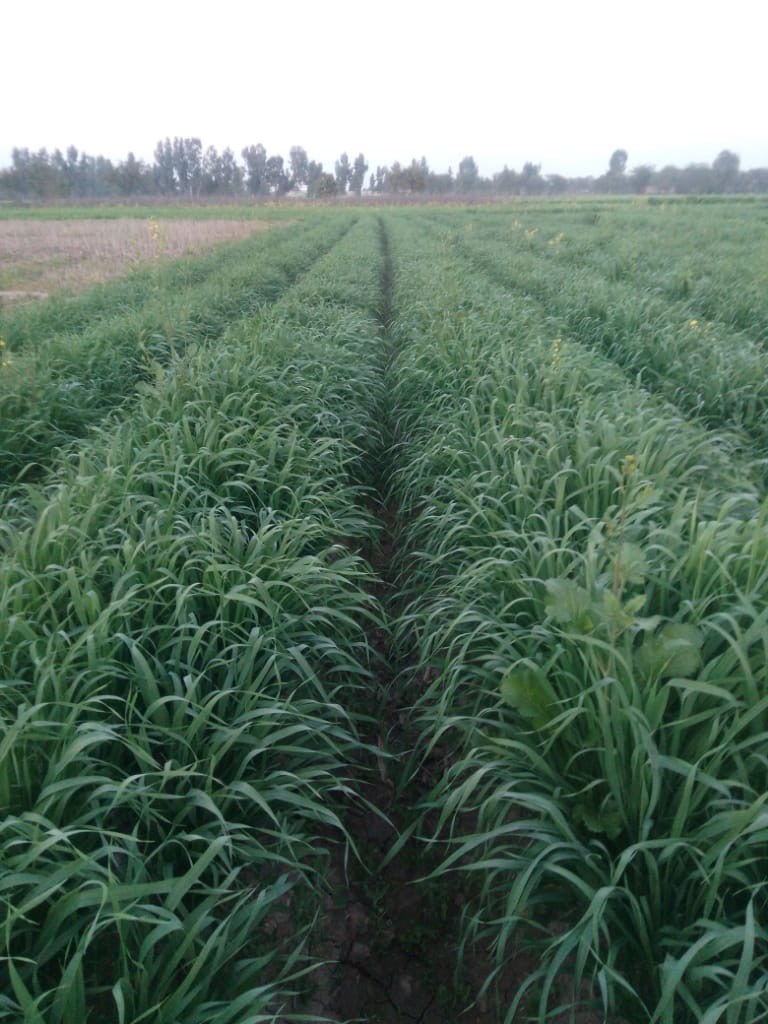
• This is why PQNK strongly discourages flooding. Raised beds use furrow irrigation, never leaving the field submerged. PQNK’s bed-furrow system forms a gradient; the edges of beds (close to furrows) have more water in the soil pores, as it moves towards the center, nutrients are dissolved by the water movement and in the centre of the beds there is low moisture but with higher dissolved nutrients and more air. This provides an ideal condition for plants and the life in the soil; they can pick and choose as per the requirement. This is why plants in the centre rows are bigger and more thriving (see the picture).
2. Liquid Culture Microbes (The Temporary Guests)
When you mix jaggery in water and add a microbial culture (like Jeevamrit, lab culture, or desi inoculum), you are creating a temporary, controlled fermentation tank.
• These are not the same microbes. The microbes that multiply in liquid are typically facultative anaerobes or fermenting microbes—they can survive with or without oxygen.
• The water is a vehicle, not a home. Think of it like this: when you put seeds in a truck to go to the field, the truck is not their permanent home. Similarly, water with jaggery is just a medium to carry the microbes and give them a quick "snack" before they enter the soil.
• Aeration is key. When making Jeevamrit or liquid cultures, we stir it vigorously multiple times a day. Why? To add oxygen! Even in water, we are trying to create aerobic conditions.
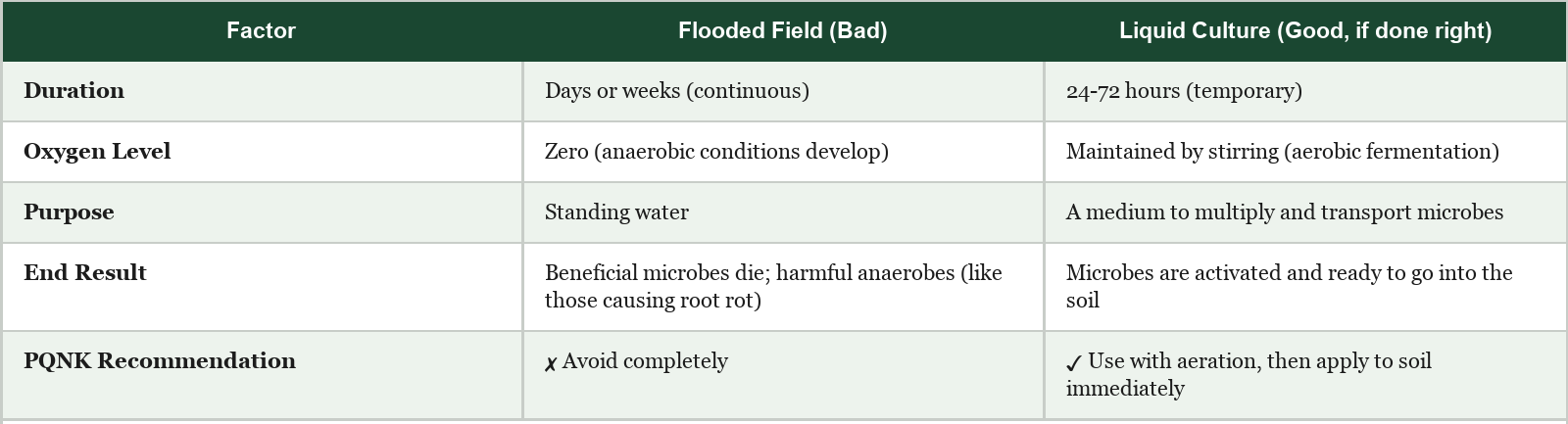
📊 Comparison Table: Flooded Field vs. Liquid Culture
| Factor | Flooded Field (Bad) | Liquid Culture (Good, if done right) |
|---|---|---|
| Duration | Days or weeks (continuous) | 24-72 hours (temporary) |
| Oxygen Level | Zero (anaerobic conditions develop) | Maintained by stirring (aerobic fermentation) |
| Purpose | Standing water | A medium to multiply and transport microbes |
| End Result | Beneficial microbes die; harmful anaerobes (like those causing root rot) | Microbes are activated and ready to go into the soil |
| PQNK Recommendation | ❌ Avoid completely | ✅ Use with aeration, then apply to soil immediately |
🌿 So, Is the University Method Correct?
Yes, it is correct—but only if you understand the science behind it. The universities and organic farming trainers are not wrong. The liquid culture method (water + jaggery + culture) is a proven way to multiply beneficial microbes. However, there is a missing piece that PQNK emphasizes: The Missing Link: Where Do Microbes Live Permanently? Microbes do not live in water. Water is just a bus. Their permanent home is organic matter in the soil. If you take this liquid culture and spray it on bare, dead, chemical-filled soil:
• The microbes will arrive in the field.
• They will look for food and shelter.
• If they find none (no organic matter, no mulch, no crop residue), they will die within hours.
This is why PQNK teaches:
1. First, prepare the home. Build organic matter, apply mulch, and leave roots in the soil. Microbes arrive on their own, without needing to be injected—just as birds will come to a place where food and safe shelter are available.
2. Then, invite the guests. Apply liquid cultures like Jeevamrit, only during the transition period, when soil is being converted from a conventional system to PQNK ( the Pristine Organic system).
3. The guests will stay and multiply because you have given them a permanent home.
✅ The PQNK Summary: Correct Method Checklist
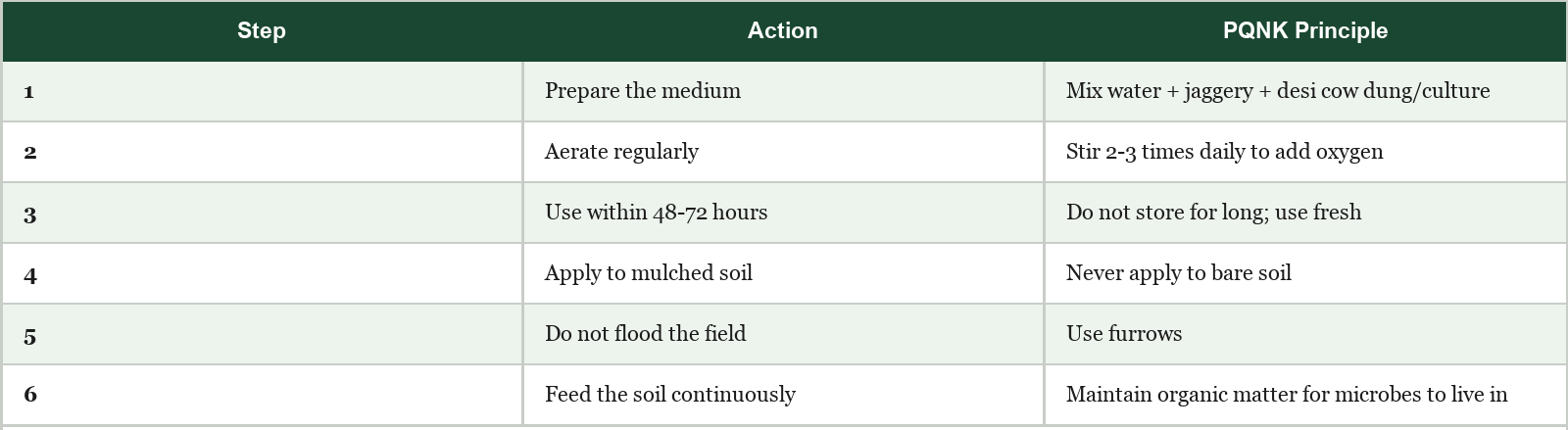
If you want to use liquid cultures correctly, follow these steps:
| Step | Action | PQNK Principle |
|---|---|---|
| 1 | Prepare the medium | Mix water + jaggery + desi cow dung/culture |
| 2 | Aerate regularly | Stir 2-3 times daily to add oxygen |
| 3 | Use within 48-72 hours | Do not store for long; use fresh |
| 4 | Apply to mulched soil | Never apply to bare soil |
| 5 | Do not flood the field | Use furrows |
| 6 | Feed the soil continuously | Maintain organic matter for microbes to live in |
💚 Final Words
Your question shows that you are thinking deeply. This is the sign of a true farmer-scientist. Both statements are true:
✅
1. Flooding the field kills soil microbes.
2. ✅ Growing microbes in water is possible and beneficial.
The difference is:
• Flooding = drowning the residents in their home for a long time.
• Liquid culture = giving a temporary energy drink to travelers before they go to their new home.
In PQNK, we say: Respect the soil as a living organism. Give it air, give it food (organic matter), give it water (as little as possible), and it will give you everything.
Applying PQNK without understanding nature’s operating system will not deliver abundance, stability, or nutrient density.
PQNK (pronounced “picnic”)—the regenerative & sustainable Pristine Organic Farming System —is grounded in Natural Ecosystem Science. This science employs perennial biodiversity, protects soil with organic mulch, and avoids practices such as water inundation, tillage disturbance, and leaving soil bare.
It is the process that matters most. PQNK is a pristine production system designed not merely for yield, but for optimal, balanced output—where quality, sustainability, and ecological harmony emerge from a self‑regulated, zero‑external‑input methodology.
About This Paper
- Problem
- Terminology / Framework Confusion · Soil Biology / Microbiome Decline
- Science
- Soil · Biodiversity · Water · Transition
- Evidence
- Scientific Mechanism
- Authority
- Current / Approved PQNK Knowledge
Related PQNK Science
Key Takeaways
- Flooding a field kills aerobic soil microbes within 24-48 hours by displacing all oxygen from soil pores; this is why PQNK irrigation applies water only to furrows, never submerging the growing bed.
- Liquid cultures in jaggery water use different organisms (facultative anaerobes/fermenters) in a temporary, actively aerated vessel; stirring several times daily maintains the aerobic conditions those microbes need to multiply.
- Microbes' permanent home is organic matter in the soil, not water; a liquid culture sprayed onto bare, mulch-free soil will die within hours regardless of how well it was cultured.
- The correct sequence is to build the soil habitat first (organic matter, mulch, retained roots) so microbes establish on their own, then use liquid cultures only during the conventional-to-PQNK transition period.
- Liquid cultures should be used fresh within 48-72 hours of preparation and applied only to already-mulched soil, never to bare ground or standing floodwater.
Related Knowledge
same problem
Chemical Fertiliser Dependency Through the PQNK Lens
An evidence-qualified review of the article “Chemical Fertilizer Industry”. It keeps the article's warning about soil degradation, nutrient pollution and biological decline, disciplines its headline numbers, and argues that fertiliser dependency is a symptom of a damaged production system (tillage, flooding, bare soil and simplified biology) that PQNK removes by restoring aerated, covered, living soil, reaching zero purchased fertiliser and pesticide at maturity.
same problem
The Underground Network We Have Been Farming Against
New 3D synchrotron imaging (Braunmiller et al., New Phytologist 2026) shows mycorrhizal hyphae spanning air-filled pores, bridging soil particles and growing along roots in intact soil. This paper separates what the research shows from what it means for PQNK: soil architecture is part of the root-fungal partnership, conventional farming dismantles it after every harvest, and a moist but aerated, undisturbed root zone protects it.
same problem
Earth to Food: Reclaiming Our Agricultural Future
A wide-ranging presentation tracing Earth's 400-million-year rock-to-dirt-to-soil-to-life cycle, diagnosing the 62 years since 1958 as a brief, damaging industrial experiment against that record, and closing with distinct, differentiated calls to action for farmers, food-chain actors, environmentalists, and consumers.
same problem
Knowledge Paper: The Soil Biome & Water-Nutrient Dynamics in PQNK
Answers a chili farmer's specific dead-mulch irrigation plan by explaining why a living root system, not mulch alone, is what activates the soil's microbial nutrient-delivery machinery, and reconciles the 'sugar-in-water' dilution concern with how a functioning PQNK system actually regulates nutrient concentration.