

KP-003 · Crop-Specific Guides
Enhancing Wheat Crop Lifespan through the PQNK System
The short, rapidly warming spring of the Indian subcontinent forces wheat into premature ripening and shriveled grain under conventional management. This paper explains the soil-biology mechanisms by which PQNK extends the crop's productive lifespan, letting it fill grain longer and yield more even under heat stress.
Read or listen to the full paper ↓Abstract
The Indian subcontinent's short spring, with its rapid rise in temperature, routinely forces wheat into premature maturation. Conventional 'Ancient Conventional Industrial' (ACI) systems make this worse: repeated tillage and chemical-input dependence degrade soil structure and reduce its water-holding capacity, so as evaporation demand climbs, crops ripen early and grains shrivel before they fill out, costing yield at the exact moment the plant needs more time, not less.
PQNK counters this through a small set of interlocking soil conditions produced by its governing principles: no hardpan formation, so roots can expand freely; soil moisture held at roughly 30% of pore space to encourage roots to explore further; a permanent organic mulch cover that regulates soil temperature and slows evaporation; a thriving soil food web that drives nutrient cycling; and a proportionally balanced nutrient supply rather than the boom-bust dosing of synthetic fertilizer.
These principles compound into a physically larger root system. Eliminating hardpan lets roots penetrate deeper, moisture retained in soil pores gives them a reason to reach further, and mulch keeps soil temperatures below roughly 30°C, preventing root-level heat stress. The resulting root surface area lets the plant meet spiking evaporation demand during hot spells without wilting, while mulch-conserved soil moisture and stable microbial aggregates let the crop endure dry spells without triggering premature senescence.
The combined effect is a wheat plant that simply stays alive and functional longer: an extended ripening period translates directly into higher seed weight, reduced wilting and shriveling improves both grain quality and quantity, and resilience to temperature spikes stabilizes yield despite year-to-year climate variability. The paper cites yield increases of 15-25% under stress conditions in analogous regenerative systems, driven primarily by improved root health and water-use efficiency.
The paper closes with a practical transition sequence for farmers moving off ACI management: phase out deep tillage to stop hardpan formation, apply organic mulch immediately after sowing, build soil life through compost and diverse rotations while avoiding biocides, and monitor soil porosity and moisture to hold the 30% water-filled pore space that the whole system depends on.
Full Paper
If you use “Listen”, the text of the page may be sent to your browser or operating system’s speech provider, such as Apple, Google or Microsoft, depending on the voice your device uses. Pedaver does not process, transmit or store any audio.
Date: 16 December 2025
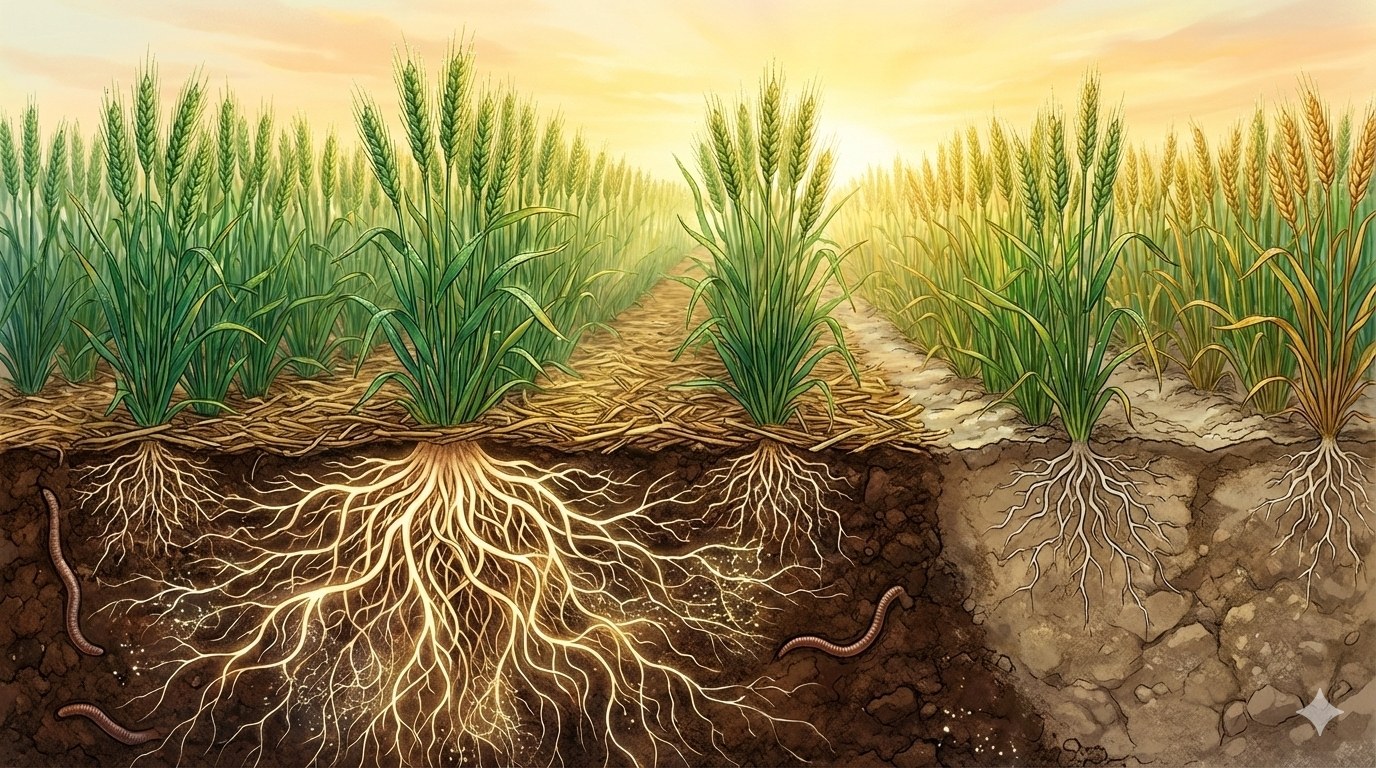
Subject: The regenerative and sustainable Pristine Organic Farming System (Paedar Qudratti Nizam Kashatqari, or PQNK) and its impact on wheat crop longevity and yield in the Indian subcontinent.Ancient Conventional IndustrialPQNK
1. Introduction
The Indian subcontinent experiences a short spring characterized by a rapid rise in temperature, which often forces crops, especially wheat, into premature maturation. This phenomenon is exacerbated under conventional agricultural systems, such as the Ancient Conventional Industrial (ACI) system, which fails to buffer crops against climatic stresses. In contrast, the PQNK system—a regenerative and sustainable farming approach—promotes extended crop lifespan, enhanced root development, and ultimately, higher yields. This paper explores the mechanisms through which PQNK mitigates environmental stresses and fosters resilient wheat production.
2. The Challenge: Short Spring and Premature Ripening
In regions with short springs, wheat crops face:
Rapid temperature increases, accelerating plant development.
Increased evaporation demand, leading to moisture stress.
Premature ripening and shriveled grains under conventional systems, resulting in yield loss.
The ACI system, with its reliance on tillage, chemical inputs, and inadequate soil management, exacerbates these issues by degrading soil structure and reducing its water-holding capacity.
3. PQNK: A Regenerative Solution
PQNK, pronounced “picnic,” stands for Paedar Qudratti Nizam Kashatqari—the regenerative & sustainable Pristine Organic Farming System. It emphasizes working with natural processes to build soil health, enhance biodiversity, and improve crop resilience.
3.1. Key Principles of PQNK
No hardpan formation: Preserves soil porosity, allowing roots to expand freely.
Optimal soil moisture: Maintains water in 30% of soil pores to encourage root exploration.
Organic mulch cover: Regulates soil temperature and reduces evaporation.
Thriving soil life: Supports nutrient cycling and plant resilience.
Balanced nutrient blend: Ensures proportional availability of essential elements.
4. How PQNK Extends Wheat Crop Lifespan
4.1. Enhanced Root Network Development
PQNK expands the root zone through:
Elimination of hardpans: Roots penetrate deeper and access more nutrients and water.
Increased catchment area: Water retained in soil pores encourages roots to “reach out.”
Temperature moderation: Organic mulch keeps soil temperatures below 30°C, preventing root stress.
Result: A larger root surface area improves absorption capacity, meeting the plant’s increased evaporation needs during high temperatures and preventing wilting.
4.2. Improved Soil Water Management
Mulch cover restricts capillary-driven evaporation, conserving soil moisture.
Living soil organisms create stable aggregates, enhancing infiltration and retention.
Result: Crops endure dry spells without premature senescence, allowing grains to fill fully.
4.3. Balanced Nutrition and Soil Health
Soil life (microbes, fungi, earthworms) mineralizes nutrients in sync with plant needs.
Proportionally balanced nutrients enhance plant resilience against abiotic stresses.
Result: Wheat plants remain healthy longer, translating into extended grain-filling periods and higher seed weight.
5. Yield Implications
PQNK directly addresses yield-limiting factors:
Longer lifespan → extended ripening period → higher seed weight.
Reduced wilting and shriveling → improved grain quality and quantity.
Resilience to temperature spikes → stable yields despite climatic variability.
Studies in analogous systems show yield increases of 15–25% under stress conditions, primarily due to improved root health and water-use efficiency.
6. Recommendations for Adoption
To transition from ACI to PQNK:
Phase out deep tillage to prevent hardpan formation.
Incorporate organic mulch post-sowing to moderate soil temperature and moisture.
Promote soil life through compost and avoidance of biocides.
Monitor soil porosity and moisture to maintain the 30% water-filled pore space ideal for root growth.
7. Conclusion
The PQNK system offers a scientifically grounded, ecologically harmonious approach to wheat cultivation in the challenging climate of the Indian subcontinent. By extending crop lifespan through enhanced root development, improved soil moisture management, and balanced nutrition, PQNK not only boosts yields but also builds long-term farm resilience. Embracing PQNK is a step toward sustainable food security and regenerative agriculture.
Prepared by: PQNK Regenerative Agriculture Research Group
"In nature, there is no waste; only cycles of renewal. PQNK aligns farming with these cycles."
—————————
Footnote: Any Production Process That Inundates Soil With Water, Disturbs Soil Through Tillage, Or Leaves Soil Bare Without Organic Mulch Cover Does Not Qualify As Natural Ecosystem Science For Production Agriculture.
PQNK, to be pronounced as 'picnic', which stands for Paedar Qudratti Nizam Kashatqari, and means: the regenerative & sustainable Pristine Organic Farming System.
www.Facebook.Com/Pedaver
https://www.youtube.com/@pedaverpqnk3167/videos
pedaver@gmail.com
WhatsApp +92 320 677 6666
About This Paper
- Crop
- Wheat
- Problem
- Harvest Timing Problems (Premature or Delayed) · Grain Quality Defects (Chalkiness, Breakage, Shriveling) · Heat Stress on Crop · Hardpan · Loss of Soil Water-Holding Capacity
- Science
- Soil · Plants · Water · Climate
- Evidence
- Scientific Mechanism
- Authority
- Current / Approved PQNK Knowledge
Related PQNK Science
Key Takeaways
- Short, fast-warming subcontinental springs push conventional wheat into premature ripening and shriveled grain; PQNK is framed as a direct countermeasure to this specific climate stress.
- Five interlocking soil conditions drive longer crop lifespan under PQNK: no hardpan, ~30% water-filled soil pores, organic mulch cover, active soil biology, and balanced nutrient supply — restoration outcomes of PQNK's four governing principles, not additional principles themselves.
- Mulch keeps soil temperature below roughly 30°C, preventing root-level heat stress during hot spells.
- A larger, deeper root network gives the plant the absorption capacity to meet spiking evaporation demand without wilting.
- Analogous regenerative systems show 15-25% yield gains under stress conditions, attributed to root health and water-use efficiency.
- Recommended transition steps: stop deep tillage, mulch immediately after sowing, build soil life via compost and rotation, and monitor pore-space moisture.
Related Crops
Related Knowledge
same problem
Comprehensive Guidance for Farmers Adapting to Man-Made Erratic Weather Using PQNK Principles
A farmer Q&A collection addressing a delayed, compressed winter season (monsoon arriving early, winter delayed 1-1.5 months) and its effect on wheat, alongside related questions on why weeds outperform crops under drought stress; the wheat section lays out a biology-based, soil-temperature-triggered sowing and pruning protocol built specifically to recover the lost growing time.
same problem
The PQNK Foundation: The Philosophy of the "Central Leader"
A farmer's questions about wheat tillering become the occasion for laying out a core PQNK principle: the plant as a 'Central Leader' system, like a tree, whose apical dominance must be surgically broken to redirect energy into uniform, productive tillers. The paper works through eleven practical questions, from exact pruning height to a full per-acre yield calculation, showing the principle in action.
same problem
Contour Line Farming through the PQNK (PICNIC) Lens
Large tracts of sloping, rainfed farmland already receive twice the water crops need, yet fail from runoff and erosion rather than drought. This paper applies PQNK's hardpan-breaking and mulch principles specifically to undulating terrain, using contour-aligned furrows as micro check-dams and citing practitioners who have farmed 7-8 consecutive years on rainfall alone.
same problem
Wheat Growing Checklist, Duly Vetted by Dr. Asif Sharif
A dense, numbered field checklist distilled from PQNK wheat lectures, covering land preparation, wheat spacing (revised to 5 rows on 42-inch beds at 8-inch spacing, about 62,000 hills per acre), tiller and grain-count benchmarks against conventional wheat, and a national-yield comparison projecting up to 136 maunds per acre against Pakistan's 28-maund average.