

KP-165 · Soil Science & PQNK System
Beyond the Nodule: How Underground Air Serves Every Crop in the PQNK System
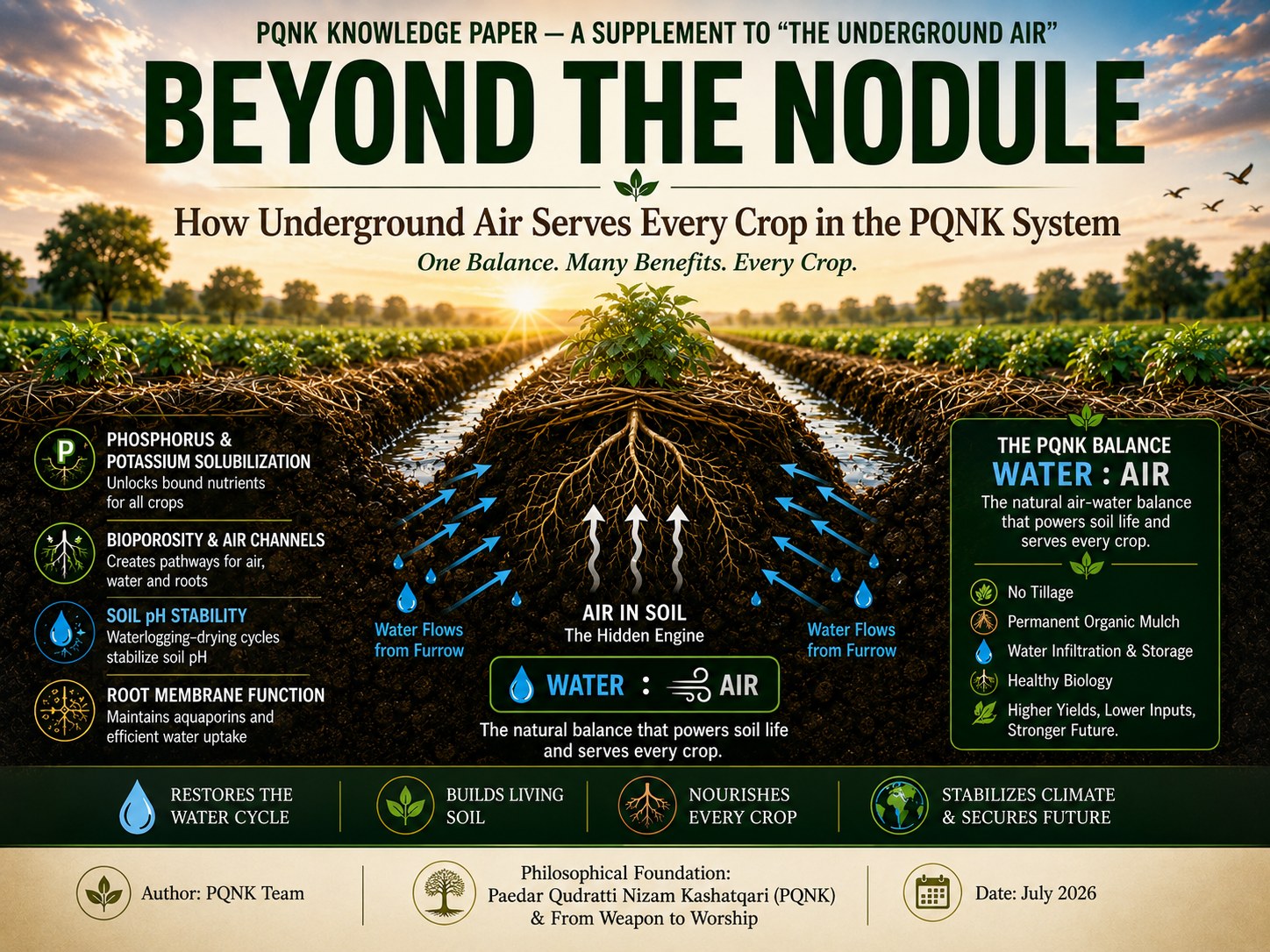
A technical follow-up paper, prompted by a direct response from Cornell's Professor Norman Uphoff, showing that the water:air soil balance central to nitrogen fixation governs four further services, phosphorus and potassium solubilization, soil bioporosity, pH stability, and root aquaporin function, that benefit every crop, not only legumes.
Read or listen to the full paper ↓External Knowledge — this paper is sourced from outside Pedaver/PQNK. It is presented as supporting evidence, not as PQNK's own approved doctrine.
Abstract
This paper is a direct response to Professor Norman Uphoff of Cornell, the researcher most responsible for the System of Rice Intensification's international recognition, who read the companion paper 'The Underground Air' and noted that its argument for legume nodulation left non-leguminous crops unaddressed, even though soil aeration builds a more diverse soil community serving phosphorus solubilization, pore-network construction, pH regulation, and root permeability across every crop. The paper takes up that request mechanism by mechanism.
On phosphorus and potassium, it argues that most soils, including Punjab's calcareous, alkaline profile, are not actually short of either element in absolute terms; a representative two-tonne-per-acre wheat yield removes only about 4.4 kg of phosphorus against roughly 800 kg held in the top six inches of a single acre, a bank-to-withdrawal ratio near 182 to 1 (potassium runs close to 1,167 to 1). Phosphate- and potassium-solubilizing bacteria unlock this existing reserve through organic-acid secretion and phosphatase enzymes, processes that, like nitrogenase, run best in the same moderate, well-aerated water:air band rather than at either extreme.
On soil structure, the paper credits earthworms and mycorrhizal fungi as the actual builders of the macropore network aeration depends on: a single earthworm can construct 1-2 metres of burrow, and worm populations displace over 100 kg of soil per square metre annually, an activity linked to yield increases of up to 25 percent, while fungal glomalin binds soil particles into aggregates that hold those pores open. On pH, matured PQNK beds measure roughly pH 8 in bulk soil but pH 7 inside the root net, a swing attributed to root-driven proton release and organic acid exudation consistent with published rhizosphere chemistry.
On root function, the paper extends the argument to the molecular level: aquaporins, the water-channel proteins that let water actually cross the root's endodermal membrane once past the Casparian strip, close within minutes under oxygen-deprivation-triggered cytosolic acidosis, a mechanism documented across crop species from sunflower to pearl millet. For the market, PQNK produce is validated by laboratory tests with the Punjab Agriculture, Food and Drug Authority, comparing it with conventionally grown produce for nutrition density and diversity.
Full Paper
If you use “Listen”, the text of the page may be sent to your browser or operating system’s speech provider, such as Apple, Google or Microsoft, depending on the voice your device uses. Pedaver does not process, transmit or store any audio.
1. INTRODUCTION: A SECOND QUESTION FROM THE SAME INSIGHT
“The Underground Air” began with a PQNK farmer's field observation: Jantar grown on raised beds seemed to carry larger, more numerous root nodules than the same crop on conventional flat beds. That observation led to an insight, that nitrogenfixing microbes use underground air rather than atmospheric air, and the paper explained that insight with the published science of nitrogenase, rhizobial nodules, freeliving diazotrophs, and the Casparian strip. Professor Uphoff's response, after reading that paper, raised a point the original argument had left unaddressed: “Your presentation nicely explains in scientific terms how soil aeration, active and passive, enhances particularly leguminous crops. I would be glad to see a little more attention to how it boosts non-leguminous crop, but making soil systems inhabited by more and more diverse soil organisms, micro to macro, which provide a lot of services to growing plants — P solubilization, creating air channels up and down and across in the soil, affecting soil pH, making soil more permeable for roots, etc. But this could be added easily.” The observation is exactly right, and it deserves its own paper rather than a footnote. Nitrogenase is the most dramatic example of an oxygen-sensitive soil process, but it is one example among several. Wheat, rice, maize, potato, and every other non-leguminous crop in a PQNK field has no nodule and fixes no nitrogen of its own, yet every one of them depends on a soil community whose other services, unlocking bound phosphorus and potassium, building and maintaining the pore network the root grows through, holding soil pH in a workable range, and keeping the root's own wateruptake machinery switched on, are governed by the identical water : air balance. This paper sets out that argument, service by service, then returns to the specific distinction Professor Uphoff draws between active and passive aeration and to a parallel he offered alongside it: that ragi (finger millet) farmers in Maharashtra had independently discovered, through an ox-drawn inter-row root-cutting implement, the same active-aeration principle his own SRI research established for rice. That a farmer's direct observation of Jantar nodulation and a Cornell professor's decades of rice research converge on the same underlying physical variable is, itself, a small demonstration of the paper's argument: attentive observation of soil, wherever it happens, keeps arriving at water : air.
2. ONE PRINCIPLE, NOT ONE ENZYME
“The Underground Air” already anticipated this paper's argument, briefly, in its Section 2.5. The oxygen paradox of nitrogen fixation was described there as “a specific, especially dramatic instance of a much more general rule: the balance of air and water in soil pore space, water : air, is the master variable that determines which microbial guild is active in any given pocket of soil, and how efficiently it works” (Tecon & Or, 2017). That section distinguished three conditions along one gradient, aerobic, microaerobic, and anaerobic, and noted that different microbial guilds, aerobic decomposers, nitrifiers, nitrogen-fixers, and anaerobic denitrifiers, each occupy their own band along it. This paper simply follows that gradient into the guilds the original paper did not have space to cover: the aerobic and facultative organisms responsible for phosphorus and potassium solubilization, the soil engineers, earthworms, fungi, and roots themselves, that build the pore network the gradient depends on, the chemistry that sets soil pH, and the plant's own root-cell water gates. None of these require a nodule. All of them require a soil that is neither waterlogged nor bone-dry, which is precisely what a raised bed's water : air balance is built to sustain.
3. ACTIVE AND PASSIVE AERATION, BEYOND RICE
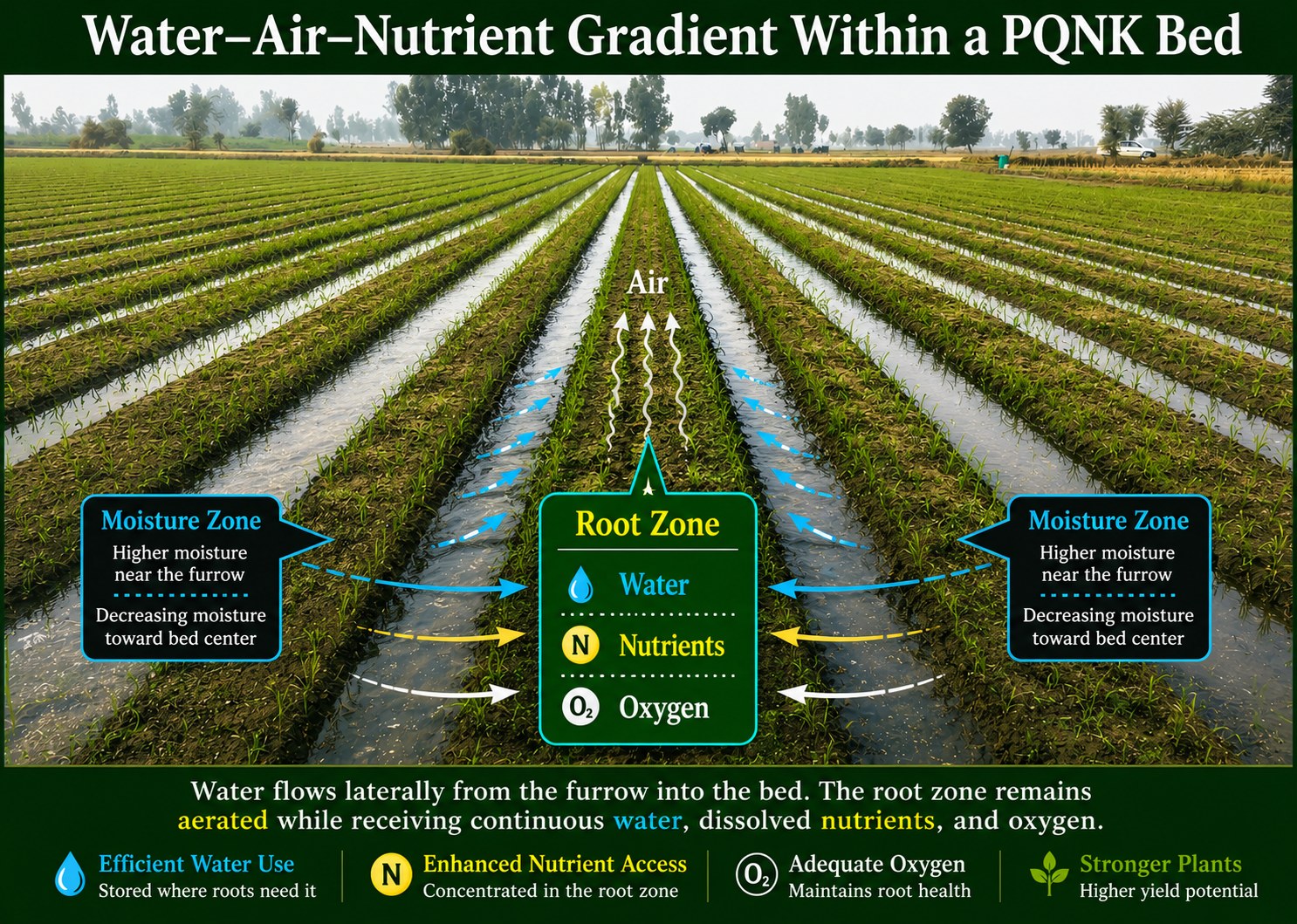
Professor Uphoff's own research draws a specific distinction between two routes to the same aerated soil condition. Passive soil aeration in the System of Rice Intensification comes from alternate wetting and drying, letting a paddy dry out, sometimes to the point of visible surface cracking, between irrigations rather than keeping it continuously flooded. Active soil aeration comes from the mechanical push-weeder SRI farmers use to control weeds between wide-spaced rows, which physically churns and opens the surface soil around each plant while it works. Research reviewing SRI's effect on rice-soil rhizospheres found that both routes raise populations of aerobic beneficial organisms together, not separately: free-living nitrogen-fixing bacteria and phosphate solubilizers both increased under SRI management, in some cases by close to seventy-five percent, alongside higher enzyme activity indicating greater nitrogen and phosphorus availability to the plant (Anas, Rupela, Thiyagarajan, & Uphoff, 2011). Rice is not a legume. This finding is therefore already direct evidence, from Professor Uphoff's own research programme, that soil aeration's benefit to phosphate-solubilizing organisms operates in a non-leguminous crop exactly as it does in Jantar. The Maharashtra ragi farmers Professor Uphoff describes had arrived at the active half of this same principle independently, through field observation rather than laboratory research, using an ox-drawn implement to cut the roots of weeds between eighteen-inch finger millet rows, disturbing the top five to ten centimetres of soil and boosting tillering and yield. The parallel to the PQNK farmer's Jantar observation that opened “The Underground Air” is direct: a working farmer, in a different country, on a different continent, on a crop with no nodule at all, noticed that disturbing the soil around the root zone in a specific, limited way made the crop perform better, years before either observation was connected to a documented physical mechanism. PQNK's raised-bed geometry already supplies the passive half of this pairing without requiring any separate aeration step. The permanent, undisturbed bed, its upper shoulders balanced between the saturated furrow and the well-aerated mound, is a standing passive-aeration structure rather than an intermittent one achieved through a wettingdrying cycle. PQNK does not add an activeaeration step: after conversion the soil is never disturbed again, and the permanent bed already supplies the aeration the crop needs.
4. PHOSPHORUS AND POTASSIUM SOLUBILIZATION: UNLOCKING WHAT IS ALREADY THERE
Most agricultural soils, including much of the calcareous, alkaline soil common across Punjab, are not actually short of phosphorus or potassium in absolute terms. What they are short of is available phosphorus and potassium: both elements readily form insoluble complexes, phosphorus with calcium, iron, and aluminium, potassium locked within the crystal lattice of clay minerals such as mica and feldspar, in forms a plant root cannot take up regardless of how much total P or K a soil test reports. Phosphate-solubilizing bacteria and fungi release that locked phosphorus mainly by secreting low-molecular-weight organic acids, gluconic, citric, oxalic, and several others, which lower the local pH and chelate the calcium, iron, or aluminium ions holding the phosphate in place, alongside phosphatase enzymes that mineralize organically bound phosphorus directly (Rodríguez & Fraga, 1999). Potassium-solubilizing bacteria use a closely related toolkit, organic acids and exopolysaccharides that dissolve or chelate the mineral lattice, releasing potassium into soil solution; a potassium-releasing strain of Bacillus edaphicus, for example, has been shown to directly improve potassium uptake and growth in cotton and rape (Sheng, 2005). The organisms carrying out both processes are predominantly aerobic or facultative heterotrophs. The metabolic pathways that generate their organic acids run most efficiently under oxygen-dependent respiration, the same energetic currency nitrogenase itself depends on, described in Section 2 of “The Underground Air.” This produces an instructive contrast rather than a contradiction: nitrogenase must be shielded from oxygen, while phosphate- and potassium-solubilizing organisms need enough of it to run their own chemistry, yet both are optimized by the same moderate, well-aerated-but-not-dry water : air band rather than by opposite extremes. A waterlogged soil starves both processes at once; the Anas et al. (2011) findings on rice already confirm this pattern operating in a single field, since both free-living nitrogen-fixers and phosphate solubilizers rose together under the same aeration regime. The practical stakes are concrete. Wheat, rice, maize, chickpea, lentil, canola, sesame, potato, tomato, and every other crop named in PQNK's current comparative nutrition testing programme with the Punjab Agriculture, Food and Drug Authority depends on available phosphorus for root development, energy transfer, and seed formation, and on available potassium for water regulation and disease resistance. A soil's water : air balance, not its total nutrient reserve, is what decides how much of that already-present phosphorus and potassium each of those crops can actually reach. PQNK's own field synthesis puts this scarcity-versus-access distinction in concrete, regional terms. For a representative two-tonne-per-acre wheat yield in the subcontinent, the top six inches of soil in a single acre holds an estimated 800 kilograms of total phosphorus, against a crop removal, in grain and straw combined, of only about 4.4 kilograms, a bank-to-withdrawal ratio of roughly 182 to 1. The same accounting for potassium runs closer to 1,167 to 1 (PQNK Knowledge Initiative, 2025). Two further reserves sit beneath the topsoil figure used in that ratio, a larger, slower-moving subsoil and weathered-bedrock tier, and a virtually limitless unweathered parent-rock tier below that, each a further store the topsoil bank draws on as it is depleted. Read alongside the organisms described above, the argument sharpens considerably: phosphate- and potassium-solubilizing bacteria are not manufacturing these elements from nothing, they are drawing down a reserve already present in the soil at a scale one to three orders of magnitude larger than a single season's crop demand. PQNK's own account of this process organizes it into three functional roles that map directly onto the biology already described: primary mineral weathering by lithotrophic bacteria and mycorrhizal fungi acting on parent rock, solubilization of the liberated but still-insoluble compounds by organic-acid-producing bacteria such as Pseudomonas, and transport of the solubilized nutrient to the root by the mycorrhizal hyphal network itself, a sequence triggered and paced by the plant's own root exudates rather than run on a fixed schedule (PQNK Knowledge Initiative, 2025). Every one of those three roles is carried out by an aerobic or facultative organism. The mineral reserve is, by this accounting, rarely the limiting factor; the water : air balance that keeps its aerobic workforce active is.
5. AIR CHANNELS AND THE LIVING ARCHITECTURE OF SOIL
Professor Uphoff's phrase, air channels up and down and across in the soil, describes a real and well-documented structure: soil macroporosity, built and maintained largely by the organisms living inside it rather than by any external tillage. Earthworms are the best-studied of these soil engineers. A single earthworm can construct one to two metres of burrow, and earthworm populations collectively displace more than one hundred kilograms of soil per square metre of ground each year, leaving behind a network of channels that serve as preferential pathways for water infiltration and gas exchange and that are readily reused by growing roots once formed (Blouin et al., 2013). Earthworm activity of this kind has been linked to specific crop yield increases of up to twenty-five percent. Fungal networks contribute a second, complementary structure. Arbuscular mycorrhizal fungi extend a web of extraradical hyphae far beyond the depletion zone immediately around a root, increasing the effective absorptive surface available for phosphorus and water uptake alike. These same fungi secrete glomalin, a glycoprotein that binds soil particles into stable aggregates, and hyphal length together with glomalin content has been shown to be a strong predictor of soil aggregate stability (Rillig, 2004; Smith & Read, 2008). Stable aggregates, in turn, are what hold macropores open against collapse and support continuous air and water movement between them. One honest qualification belongs here. Arbuscular mycorrhizal colonization is widespread but not universal: several crop families on PQNK's own representative list, canola and mustard among the Brassicaceae, and spinach among the Chenopodiaceae, are largely non-mycorrhizal and gain little from this specific fungal route. For these crops, the bacterial and bioturbation-based routes described in this paper, phosphate and potassium solubilization, earthworm channels, and pH regulation, remain fully operative and are, if anything, the more important pathway. PQNK's own no-till, permanent-bed management is what allows all of these channels, earthworm burrows, decayed root channels, and fungal hyphal networks alike, to persist and accumulate from one season to the next rather than being severed and reset by annual ploughing, exactly the mechanism “The Underground Air” already describes for Jantar's own deep taproots in Section 6.4. That description need not be limited to Jantar. Every deeprooted crop in a PQNK field leaves the same kind of reusable channel behind it, and the raised bed's undisturbed structure is what lets those channels compound from season to season rather than resetting with each crop, which is the literal mechanism behind the Regenerative Amplification Loop described in Section 7 of “The Underground Air,” now understood to apply to every crop on the bed and not only to Jantar.
6. SOIL PH: THE QUIET VARIABLE EVERY CROP DEPENDS ON
Availability of most essential plant nutrients, phosphorus, iron, zinc, manganese, and boron among them, the same mineral panel PQNK's comparative testing programme measures directly, is tightly bound to soil pH, with each nutrient reaching peak solubility within its own fairly narrow window. Soil pH is not a fixed background property; it is actively set and reset by the same microbial community this paper has been describing. Nitrification, the oxidation of ammonium to nitrate, releases hydrogen ions and acidifies the surrounding soil; organic acid secretion, by roots and by the phosphate- and potassium-solubilizing organisms of Section 4 alike, does the same locally and deliberately; and ordinary aerobic respiration releases carbon dioxide, which forms carbonic acid in soil water. Waterlogged, oxygen-depleted soil runs a different and less stable chemistry. Once oxygen is exhausted, microbial metabolism shifts to reduction reactions, iron and manganese oxides are reduced, and, at the extreme, sulfate is reduced to sulfide, each of these reactions consuming rather than releasing protons. The result is a soil pH that swings toward neutrality from whatever direction it started, an instability documented directly in oxygen and redox profiling of soil aggregates, where a saturated aggregate's anoxic core supports an entirely different, reduction-driven chemical regime from its aerated exterior only millimetres away (Sexstone, Revsbech, Parkin, & Tiedje, 1985). A soil held within the aerobic-to-microaerobic water : air band avoids this redox-driven churn and holds a more stable, moderate pH, one in which the mineral panel above stays within reach of the root. This is not a nitrogen-fixation-specific benefit; it applies equally to a wheat field, a tomato bed, or a stand of okra, and it is the same underlying reason PQNK's raised-bed architecture is designed to prevent waterlogging in the first place. PQNK's own field measurements show this stabilizing effect directly, and at a scale worth stating in full. On a matured PQNK bed, a soil sample drawn twelve inches from a plant measures a bulk pH of roughly 8, typical of Punjab's calcareous, alkaline soils; a sample drawn from inside that same plant's own root net, on the same bed, measures roughly 7, a full unit lower. This is not an anomaly requiring a special explanation. Root-induced pH change of exactly this kind is a well-documented rhizosphere effect, driven by the mechanisms already described above: the release of protons to balance an uptake of more cations than anions, sharpest where nitrogen is taken up as ammonium rather than nitrate, organic acid exudation by roots and their associated microbial community, and root and microbial respiration (Hinsinger, Plassard, Tang, & Jaillard, 2003). The magnitude PQNK measures is, if anything, conservative against the published literature. A controlled study of peach and nectarine grown in calcareous and alkaline soils under ammonium-based nitrogen supply measured rhizosphere pH running two to three full units below bulk soil pH, in the same direction and for the same underlying reason (Tagliavini, Masia, & Quartieri, 1995). A matured PQNK bed builds exactly the conditions that study's ammonium treatment did by design: permanent roots, an active associated microbial community, and nitrogen released through organic decomposition and biological fixation rather than nitrate-based fertigation. The one-unit swing PQNK measures from furrow-adjacent bulk soil to root net is the expected, and comparatively modest, signature of that same process.
7. ROOT PERMEABILITY: AQUAPORINS AND THE WATER-NUTRIENT GATEWAY FOR EVERY ROOT
“The Underground Air” described the Casparian strip as the gatekeeper that forces water and solutes out of the passive apoplastic pathway and through the living membrane of each endodermal cell. That description leaves one question open: once water is forced to cross the membrane, what does it actually cross through? The answer is aquaporins, water-channel proteins of the plasma-membrane intrinsic protein family, and they turn out to be governed by the same air-water balance as everything else in this paper. Research on plant water transport under low-oxygen conditions has shown that oxygen deprivation triggers cytosolic acidosis inside root cells, and that this drop in internal pH directly gates aquaporins shut, cutting a root's hydraulic conductivity within minutes of the onset of waterlogging (Tournaire-Roux et al., 2003). Because aquaporins, not the Casparian strip itself, are the specific channel through which water crosses the endodermal membrane, this closure acts downstream of the gatekeeper described in the original paper: even a fully intact, well-functioning Casparian strip cannot deliver water to the plant if the aquaporins on the other side of it have shut. The effect has since been confirmed across a range of crop species, from sunflower to pearl millet, and applies to any plant root, legume or otherwise. The practical consequence follows the same logic as every other section of this paper. A waterlogged soil does not just drown roots of oxygen; it actively switches off the specific molecular gate those roots use to take up water and, with it, whatever nutrients are moving in that water stream. A water : air-balanced raised bed keeps roots aerated enough that this gate stays open, in Jantar exactly as in wheat, maize, or any vegetable crop growing beside it.
8. SYNTHESIS: THE RAISED BED AS A UNIVERSAL PLATFORM
Five mechanisms, nitrogen fixation by freeliving and symbiotic bacteria and four further services, have been traced through this paper and its companion, and all five answer to the identical physical variable.
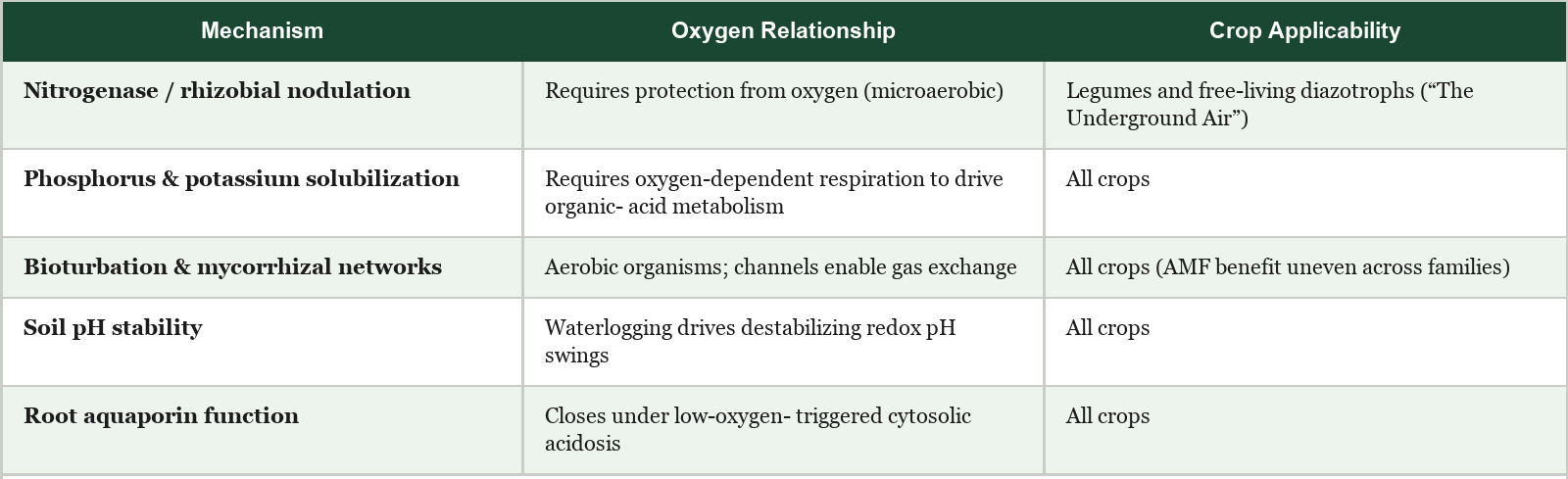
| Mechanism | Oxygen Relationship | Crop Applicability |
|---|---|---|
| Nitrogenase / rhizobial nodulation | Requires protection from oxygen (microaerobic) | Legumes and free-living diazotrophs (“The Underground Air”) |
| Phosphorus & potassium solubilization | Requires oxygen-dependent respiration to drive organic- acid metabolism | All crops |
| Bioturbation & mycorrhizal networks | Aerobic organisms; channels enable gas exchange | All crops (AMF benefit uneven across families) |
| Soil pH stability | Waterlogging drives destabilizing redox pH swings | All crops |
| Root aquaporin function | Closes under low-oxygen- triggered cytosolic acidosis | All crops |
PQNK's raised-bed water : air architecture was not designed as a nitrogen-fixation technology, and this paper's argument is that it should not be understood as one. It is a general soilbiology and plantphysiology platform, and every crop grown on PQNK beds, and every crop named on the sixteenitem representative list now entering PAFDAauthenticated testing, wheat, rice, maize, chickpea, mung bean, lentil, canola, sesame, cottonseed, potato, tomato, spinach, okra, kinnow, mango, and guava, draws on the same underlying mechanism, whether or not that crop carries a single nodule.
9. CONCLUSION: THE SAME AIR, EVERY ROOT
A PQNK farmer, watching Jantar roots on a raised bed, wondered whether the microbes around them were breathing a different air than the one above ground. A Cornell professor, reading the paper that grew from that wondering, pointed out that the same underground air the paper described so carefully for one crop and one enzyme is doing comparable work for every other crop in the field, through phosphate and potassium solubilizers, earthworms and fungal hyphae, the chemistry that sets soil pH, and the molecular gates that let a root drink at all. Neither insight came from a laboratory first. Both came from close, patient attention to a working field, which is where this paper, like its companion, ultimately rests its case: underground air was never only about nitrogen. It is the condition every root in a PQNK field depends on, whether or not that root ever forms a nodule.
KEY TAKEAWAYS
One Variable, Many Guilds: water : air is the physical variable that governs nitrogen fixation, phosphorus and potassium solubilization, soil bioporosity, pH stability, and root water uptake alike; nitrogenase is simply its most dramatic example, not its only one. Active and Passive Aeration Apply Beyond Rice: Professor Uphoff's own SRI research shows both aeration routes raising phosphate solubilizers and nitrogenfixers together in a nonleguminous crop, a finding independently echoed by Maharashtra ragi farmers using an oxdrawn activeaeration implement of their own design.
Phosphorus and Potassium Are Usually Present, Not Absent: most soils hold ample total P and K locked in insoluble forms; aerobic and facultative solubilizing bacteria, not fertiliser, are what make them available, and their metabolism runs best in the same well-aerated band nitrogenase needs. Soil Structure Is Biologically Built: earthworm burrows and mycorrhizal hyphal networks, not machinery, construct and maintain the macropores through which air, water, and roots move; PQNK's no-till management is what lets these structures persist and compound season over season. Aquaporins Are the Gate Behind the Gate: the Casparian strip forces water through the endodermal membrane; aquaporins are the channel it crosses, and they close within minutes under low-oxygen stress, in any crop's root, not only a legume's. Laboratory Validation: for marketing, PQNK field validation is supported by laboratory tests, run with the Punjab Agriculture, Food and Drug Authority, that compare PQNK produce with conventionally grown produce for nutrition density and diversity.
REFERENCES
Anas, I., Rupela, O. P., Thiyagarajan, T. M., & Uphoff, N. (2011). A review of studies on SRI effects on beneficial organisms in rice soil rhizospheres. Paddy and Water Environment, 9, 53–
64. Bais, H. P., Weir, T. L., Perry, L. G., Gilroy, S., & Vivanco, J. M. (2006). The role of root exudates in rhizosphere interactions with plants and other organisms. Annual Review of Plant Biology, 57, 233–266. Blouin, M., Hodson, M. E., Delgado, E. A., Baker, G., Brussaard, L., Butt, K. R., Dai, J., Dendooven, L., Peres, G., Tondoh, J. E., Cluzeau, D., & Brun, J.-J. (2013). A review of earthworm impact on soil function and ecosystem services. European Journal of Soil Science, 64(2), 161–182. Hinsinger, P., Plassard, C., Tang, C., & Jaillard, B. (2003). Origins of root-mediated pH changes in the rhizosphere and their responses to environmental constraints: A review. Plant and Soil, 248, 43-59. PQNK Knowledge Initiative. (2025). Knowledge Paper: The Perpetual Abundance Principle - Reconnecting Agriculture to the Geological Bank Through the PQNK System. PQNK Team. (2026). Engineering a Perpetual Abundance Machine. Rillig, M. C. (2004). Arbuscular mycorrhizae, glomalin, and soil aggregation. Canadian Journal of Soil Science, 84(4), 355–363. Rodríguez, H., & Fraga, R. (1999). Phosphate solubilizing bacteria and their role in plant growth promotion. Biotechnology Advances, 17(4–5), 319–339. Sexstone, A. J., Revsbech, N. P., Parkin, T. B., & Tiedje, J. M. (1985). Direct measurement of oxygen profiles and denitrification rates in soil aggregates. Soil Science Society of America Journal, 49(3), 645–651. Sheng, X. F. (2005). Growth promotion and increased potassium uptake of cotton and rape by a potassium releasing strain of Bacillus edaphicus. Soil Biology and Biochemistry, 37(10), 1918– 1922. Smith, S. E., & Read, D. J. (2008). Mycorrhizal Symbiosis (3rd ed.). Academic Press. Tagliavini, M., Masia, A., & Quartieri, M. (1995). Bulk soil pH and rhizosphere pH of peach trees in calcareous and alkaline soils as affected by the form of nitrogen fertilizers. Plant and Soil, 176, 263-271. Tecon, R., & Or, D. (2017). Biophysical processes supporting the diversity of microbial life in soil. FEMS Microbiology Reviews, 41(5), 599–623. Tournaire-Roux, C., Sutka, M., Javot, H., Gout, E., Gerbeau, P., Luu, D.-T., Bligny, R., & Maurel, C. (2003). Cytosolic pH regulates root water transport during anoxic stress through gating of aquaporins. Nature, 425, 393–397.
About This Paper
- Crop
- Wheat · Rice
- Problem
- Low Root-Zone Oxygen / Poor Aeration · Locked / Unavailable Soil Minerals · Soil Compaction (General) · Waterlogging
- Science
- Soil · Plants
- Evidence
- External Scientific Evidence
- Authority
- External Knowledge / Evidence
Related PQNK Science
Key Takeaways
- A representative wheat crop removes only about 4.4 kg of phosphorus per acre against roughly 800 kg already present in the topsoil, a 182:1 bank-to-withdrawal ratio (potassium runs near 1,167:1); scarcity is availability, not absence.
- A single earthworm builds 1-2 metres of burrow, and worm populations displace over 100 kg of soil per square metre per year, an activity linked to yield gains of up to 25 percent through the macropore networks it creates.
- Matured PQNK beds measure roughly pH 8 in bulk soil versus pH 7 inside the root net, a full-unit swing attributed to root-driven proton release and organic acid exudation.
- Root aquaporins, not the Casparian strip itself, are the specific channel water crosses to enter the plant, and they close within minutes under low-oxygen-triggered cytosolic acidosis, in any crop, not only legumes.
- Professor Uphoff's own SRI research found both active and passive soil aeration raise phosphate-solubilizing bacteria and nitrogen-fixers together in non-leguminous rice, by close to seventy-five percent in some cases.
- Laboratory validation: PQNK produce is compared with conventionally grown produce for nutrition density and diversity in tests with the Punjab Agriculture, Food and Drug Authority.
Related Knowledge
same problem
The Underground Network We Have Been Farming Against
New 3D synchrotron imaging (Braunmiller et al., New Phytologist 2026) shows mycorrhizal hyphae spanning air-filled pores, bridging soil particles and growing along roots in intact soil. This paper separates what the research shows from what it means for PQNK: soil architecture is part of the root-fungal partnership, conventional farming dismantles it after every harvest, and a moist but aerated, undisturbed root zone protects it.
same problem
The Weed-Indicator System
Instead of treating weeds as enemies to eliminate, PQNK reads them as diagnostic language the field uses to report its own underground condition. This paper works through three common indicator species, bindweed, nutsedge, and pigweed, explaining exactly which soil imbalance each one signals and why suppressing the weed without correcting that imbalance only produces temporary, repeating outbreaks.
same problem
The Farm You Only Have to Build Once: How PQNK Converts a Conventional Field into a Permanent, No-Till System
Most fields across Pakistan and northern India's irrigated plains are still laid out for nineteenth-century bullock-and-plough flood irrigation. This paper walks through the one-time engineering project, topography survey, field redesign, hardpan fracture, laser levelling, and permanent bed shaping, that converts such a field into a permanent PQNK system, citing published water-savings and yield data specific to Pakistani Punjab.
same problem
When a Tree Bleeds Gum: The Plant Is Signalling a Problem, Not Asking for a Chemical, Understanding Gummosis Through the PQNK Living-Soil System
A farmer asked a simple question: what is the gum coming from this citrus trunk, and what is the remedy? Conventional plant protection moves from symptom to disease name to treatment; this paper argues PQNK should begin one step earlier by asking why the plant reached a condition in which tissue was injured at all. Gummosis is a symptom, not a single disease, and Phytophthora, an important and well-documented cause, is itself driven by moisture, drainage and trunk wetting, exactly the water-and-aeration balance PQNK's Soil Moisture Management is built to correct. The paper is explicit that this does not make PQNK a cure for gum, and that an already-diseased tree still needs direct diagnosis: the goal is a production environment in which the conditions that repeatedly cause the injury are no longer routinely created.