

KP-013 · Crop-Specific Guides
Comprehensive Advisory on 'Batoor' Flower Management in Mango: Blending Traditional Wisdom with Scientific Insight
'Batoor', the stunted, non-productive mango inflorescences that worry farmers every spring, are traced in this advisory to hormonal imbalance and resource-stress abortion under conventional management. It contrasts the corrective pruning conventional orchards need with the rare, largely preventive role the same practice plays inside a mature PQNK ecosystem.
Read or listen to the full paper ↓Abstract
This advisory, issued by Jamil Shahzad and Asif Sharif, addresses a common source of farmer anxiety in mango cultivation: 'Batoor', stunted, crowded, or leaf-smothered inflorescences that appear in early spring but never progress to fruit set. It examines the phenomenon from two angles, conventional systems reliant on synthetic inputs and the PQNK ecosystem-based approach, and establishes upfront that while pruning these non-productive sprouts remains valid management in both systems, the frequency and underlying cause of Batoor formation differ dramatically between them.
In conventional orchards, Batoor is explained as a symptom of physiological stress and hormonal imbalance. Excessive gibberellic acid can permit floral emergence without allowing complete development, while a tree under resource stress aborts weak floral 'sinks' to redirect carbohydrates and nutrients toward stronger ones. That stress traces to identifiable causes: soil compaction and poor root health from intensive tillage, nutrient imbalance from excess nitrogen fertilizer promoting vegetative growth over reproduction, and biotic or environmental stress from pests, disease, or temperature and water fluctuation during the sensitive floral-initiation window.
The corrective practice itself is straightforward: pruning must happen immediately upon identifying Batoor growth, typically late February to early March, using a sharp, clean shear to cut the non-viable sprout to a 1-2 inch stub, encouraging a healthy new bud break from a node below the cut. The goal is selective removal, not denuding the tree. Its scientific benefit runs through three mechanisms: sink-strength manipulation redirects photosynthates toward remaining viable buds, hormonal rebalancing shifts the cytokinin-to-auxin ratio in favor of reproductive development, and improved canopy light and airflow reduces the humidity that encourages fungal disease.
PQNK's contribution is to treat Batoor as a symptom to be prevented rather than corrected. Breaking the hardpan enables deep water infiltration, root aeration, and unrestricted root proliferation; permanent raised beds add drainage and protection from compaction; no-tillage preserves the soil life habitats and thriving food web that convert minerals into plant-available nutrients at a steady, balanced rate; and this combination delivers balanced mineral nutrition without the boom-bust dosing of synthetic fertilizer.
Because a mature PQNK mango tree experiences continuous moisture access, balanced slow-release nutrition, a robust root system, and enhanced pest and disease resistance, it has little reason to abort a significant share of its flowers, and Batoor becomes rare. Pruning in this context shifts from a reactive, repeated corrective action into a proactive, supportive practice that optimizes an already healthy tree's production. The advisory's comparative summary frames the choice starkly: reactive intervention that treats a symptom of induced stress, versus a system design that prevents the underlying cause.
Full Paper
If you use “Listen”, the text of the page may be sent to your browser or operating system’s speech provider, such as Apple, Google or Microsoft, depending on the voice your device uses. Pedaver does not process, transmit or store any audio.
Date: August 21, 2025 Subject: Understanding and Managing “Batoor” Flowers in Mango Cultivation for Optimal Yield Issued by: Mr. Jamil Shahzad and Asif Sharif
1. Introduction and Overview
This advisory addresses a common concern in mango cultivation: the appearance of non-productive inflorescences, traditionally known as “Batoor” (false or diseased flowers). These floral structures fail to develop into fruit, causing significant anxiety and potential yield loss for farmers.
We will explore this phenomenon from two complementary perspectives: 1. The Conventional Farming Context: Examining the causes and solutions within systems relying on synthetic inputs. 2. The PQNK (Paidar Qudrat-e-Nizame Kashtkari) System: Understanding how an ecosystem-based approach minimizes such abnormalities by default.
The management strategy—pruning these non-productive sprouts—remains valid in both systems, but the frequency and underlying reasons for "Batoor" formation differ dramatically.
2. The “Batoor” Phenomenon: Scientific Explanation
2.1 What Are “Batoor” Flowers?
“Batoor” refers to underdeveloped or impaired inflorescences that emerge in early spring but fail to progress to successful fruit set. They are often visually identifiable as flower clusters that are stunted, crowded, or surrounded by excessive leafy growth.
2.2 Fundamental Scientific Reasons for “Batoor” Formation (In Conventional Systems)
In conventional farming, which often relies on synthetic inputs and can lead to soil degradation over time, the occurrence of "Batoor" flowers is typically a symptom of physiological stress and hormonal imbalance within the tree. The primary causes include:
Hormonal Imbalance: The development of fertile flowers is a delicately balanced process regulated by plant hormones. Excessive gibberellic acid (GA) levels are known to inhibit proper floral initiation and development. “Batoor” flowers may emerge from buds with intermediate GA concentrations that permit floral emergence but not complete, functional development.
Resource Allocation & Source-Sink Relationship: A tree under stress cannot support all its floral sinks. “Batoor” flowers represent weak sinks that the plant aborts to redirect scarce resources (carbohydrates, nutrients) to stronger, more viable flowers. This is often a consequence of: Soil Compaction and Poor Root Health: Conventional practices like intensive tillage can degrade soil structure over time, reducing aeration and hindering root development. This limits the root system's ability to uptake water and nutrients, putting the tree under stress.
Nutrient Imbalances: The use of synthetic fertilizers can lead to imbalances, such as excess nitrogen, which promotes vegetative growth at the expense of robust reproductive development.
Biotic and Environmental Stress: Damage from pests and diseases (e.g., mango hoppers, powdery mildew) during the critical floral initiation phase can directly damage tissues, leading to malformed inflorescences. Furthermore, temperature fluctuations or water stress during this sensitive period can disrupt the hormonal signals necessary for proper flower development.
3. The Practice: Pruning “Batoor” Sprouts
3.1 The Method
Timing: Pruning must be done immediately upon identifying the "Batoor" growth, typically in late February to early March when bud induction becomes visible.
Technique: Using a sharp, clean pruning shear, cut the identified non-productive sprout, leaving a 4-5 inch stub. This precise cut helps the plant compartmentalize the wound and may encourage a new, healthy bud break from a node below the cut.
Goal: The objective is selective removal, not denuding the tree. The aim is to eliminate only the clearly non-viable growth.
3.2 The Scientific Benefit of Removal
This traditional practice aligns with core horticultural principles: * Sink Strength Manipulation: Removing the weak, non-productive "Batoor" sinks forces the tree to redirect its photosynthates and nutrients toward the remaining, stronger floral buds. This improves the resource availability for the remaining fruits, enhancing potential fruit set, size, and quality. * Hormonal Rebalancing: Pruning can alter the balance of growth regulators. Eliminating a shoot that may be producing inhibitory hormones can promote a more favorable hormonal environment (e.g., higher cytokinin to auxin ratios) in the remaining buds, supporting reproductive development. * Canopy Management: Selective pruning improves light penetration and air circulation within the canopy. This creates a better microclimate for the remaining flowers and developing fruits, reducing humidity that can encourage fungal diseases.
4. The PQNK System: Preventing “Batoor” Through Ecosystem Balance
The PQNK system moves beyond treating symptoms to creating an environment where "Batoor" formation is minimized by default. It is a knowledge-intensive system that aims to regenerate the health of soils, ecosystems, and people.
4.1 Core PQNK Principles for Optimal Production
PQNK creates a resilient, self-regulating ecosystem that provides the plant with balanced resources, allowing it to express its full genetic potential without undue stress.
Breaking the Hardpan: The first conversion step is critical. Breaking the hardpan allows for: Deep Water Infiltration and Retention: Water can move deep into the soil profile, creating a reservoir for the tree to access during dry spells, preventing water stress.
Root Aeration: It saves soil life from drowning and allows oxygen to reach the root zone, which is critical for healthy root function and nutrient uptake.
Unrestricted Root Proliferation: Roots can grow deep and wide, accessing a larger volume of water and nutrients, making the tree more resilient and better nourished.
Permanent Raised Beds: These structures further ensure the above requirements. They provide rapid infiltration, preventing waterlogging that suffocates roots.
They facilitate soil aeration and can be designed to avoid compaction from machinery or foot traffic.
Combined with mulch, they create an ideal environment for both roots and soil life to thrive.
No-Tillage: This is fundamental to preserving the soil's natural structure. Preserving Soil Life Habitats: No-tillage prevents the destruction of the intricate natural habitats (pores, fungal networks) that soil microorganisms and earthworms need to flourish.
Unrestricted Duty of Soil Life: A thriving soil food web (decomposers, nutrient cyclers, symbiotic fungi) performs its duty without restraint, efficiently converting minerals into plant-available nutrients and building stable soil organic matter. This provides a steady, balanced nutrient supply to the tree.
Balanced Mineral Nutrition: PQNK focuses on providing a broad spectrum of minerals in a form that the soil life can process and make available to the plant. This avoids the imbalances common in conventional, synthetic-input systems and ensures the tree has all the necessary building blocks for healthy development.
4.2 Why “Batoor” is Rare in a PQNK System
In a mature PQNK system, the mango tree is not under significant stress. * Continuous Moisture Access (from deep infiltration) prevents water stress. * Balanced, Slow-Release Nutrition (from a thriving soil microbiome) prevents nutrient deficiencies or toxicities. * A Robust Root System supports the high energy demands of flowering and fruiting. * Enhanced Plant Health makes the tree more resistant to pests and diseases.
Therefore, the tree has no need to abort a significant number of its flowers. The plant's energy is focused on producing a high proportion of viable, productive inflorescences from the outset. Pruning in a PQNK system is thus less a corrective action and more a supportive practice to optimize an already healthy tree's production, similar to the ecological role played by animals in natural habitats.
5. Comparative Summary: Management Approach
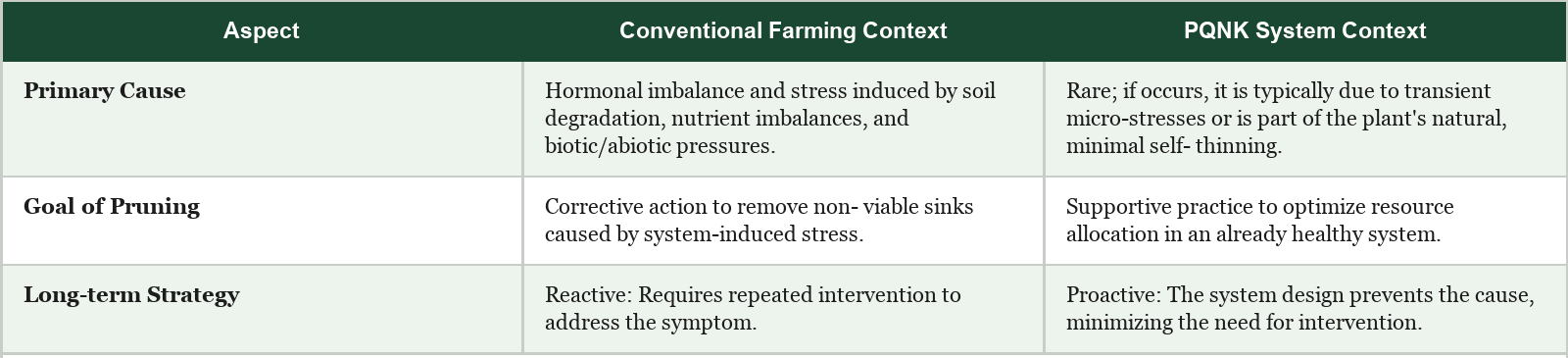
| Aspect | Conventional Farming Context | PQNK System Context |
|---|---|---|
| Primary Cause | Hormonal imbalance and stress induced by soil degradation, nutrient imbalances, and biotic/abiotic pressures. | Rare; if occurs, it is typically due to transient micro-stresses or is part of the plant's natural, minimal self- thinning. |
| Goal of Pruning | Corrective action to remove non- viable sinks caused by system-induced stress. | Supportive practice to optimize resource allocation in an already healthy system. |
| Long-term Strategy | Reactive: Requires repeated intervention to address the symptom. | Proactive: The system design prevents the cause, minimizing the need for intervention. |
6. Conclusion and Recommendation
The identification and pruning of "Batoor" flowers is a valid and scientifically sound practice that can help salvage yield in a stressed system. However, it addresses a symptom rather than the root cause.
For farmers experiencing significant “Batoor” issues, the long-term solution is to transition towards ecosystem-based principles like those outlined in the PQNK system: focus on building soil health by breaking hardpans, adopting no-till or minimum tillage, maintaining soil cover, and fostering a diverse soil microbiome. This creates the conditions for optimally functioning natural ecosystems that support consistent, high-quality mango production with fewer abnormalities.
By integrating traditional wisdom with a scientific understanding of plant physiology and soil ecology, farmers can move towards more sustainable, productive, and resilient mango cultivation.
Disclaimer: This advisory is based on general agronomic principles and reported practices. Local conditions may vary. It is recommended to observe and adapt these guidelines to your specific orchard context.
About This Paper
- Crop
- Mango
- Problem
- Poor Flowering / Fruit Set · Hormonal Growth Imbalance (Vegetative/Reproductive) · Soil Compaction (General) · Preventive/Prophylactic Over-Application of Inputs (Fertilizer/Nitrogen)
- Science
- Plants · Soil
- Evidence
- Scientific Mechanism
- Authority
- Current / Approved PQNK Knowledge
Related PQNK Science
Key Takeaways
- 'Batoor' flowers are hormonally aborted, non-viable mango inflorescences caused primarily by tree stress, not a natural floral defect or separate flower type.
- Excessive gibberellic acid and a stressed source-sink relationship drive the tree to abort weak floral sinks in favor of stronger ones.
- Conventional causes trace to soil compaction from tillage, nitrogen-heavy fertilization, and pest or disease damage during floral initiation.
- The corrective practice, pruning Batoor sprouts to a 1-2 inch stub in late February to early March, is valid in both systems but far less needed under PQNK.
- Breaking the hardpan, permanent raised beds, no-tillage, and balanced mineral nutrition keep a mature PQNK tree unstressed, making Batoor rare by default.
- Under PQNK, pruning becomes a supportive optimization of an already healthy tree rather than a reactive fix for a system-induced stress response.
Related Crops
Related Knowledge
same problem
The Weed-Indicator System
Instead of treating weeds as enemies to eliminate, PQNK reads them as diagnostic language the field uses to report its own underground condition. This paper works through three common indicator species, bindweed, nutsedge, and pigweed, explaining exactly which soil imbalance each one signals and why suppressing the weed without correcting that imbalance only produces temporary, repeating outbreaks.
same problem
Optimizing Mango Pruning Within a Self-Sustaining PQNK Ecosystem for Punjab
This advisory paper reframes mango pruning as an ecological signal rather than a mechanical operation, timed to Punjab's cold dormant winter to redirect the tree's stored energy from vegetative growth into flowering. It sets out the precise December pruning protocol and the no-irrigation, no-fertilization discipline that makes it work.
same problem
Potato Planting Depth vs Mulch-Based No-Till Planting: A Production, Economics, and Quality Analysis under the PQNK System
A scientific and economic comparison of conventional 6-inch deep seed burial against PQNK's surface-placement-plus-mulch method, showing that mulch delivers the same tuber-zone temperature control as deep burial while also enabling earlier sowing, denser planting, and a roughly 90% cut in per-acre production cost.
same problem
A Farmer's Guide to Establishing a Prosperous Olive Orchard
A practical planting guide for olive growers in Mediterranean-equivalent climates, laying out two distinct PQNK establishment paths, high-density irrigated beds versus a low-cost curved-furrow-and-borehole system for rain-fed sloping land, plus a year-by-year yield projection showing how consistent soil biology breaks the crop's typical biennial-bearing cycle.