

KP-150 · Soil Science & PQNK System
Breaking the Perennial Design: How Industrial Agriculture Sabotaged the Soil System and Broke the Production Cycle
Argues that industrial agriculture's foundational error is a deliberate break from the perennial, self-renewing design that soil systems have run on for 400 million years, and traces that break through tillage, bare soil, flood irrigation, and chemical substitution to its production consequences.
Read or listen to the full paper ↓Abstract
The paper opens by framing terrestrial soil systems as operating, for over 400 million years, on a perennial design: a continuous cycle of life, death, and rebirth in which soil functions as a living biological engine rather than a passive growing medium. It argues that Ancient Conventional Industrial (ACI) agriculture's core failure was not a technical misstep but a wholesale rejection of that design, substituting a linear, extractive process for a circular, self-fertilizing one.
This sabotage is broken into three deliberate acts. First, imposing periodicity on a naturally continuous system: tillage is described as severing fungal networks and burning soil carbon through oxidation, creating the hardpan that seals off the water cycle, while mandating bare soil between crops actively maintains a heat-damaged, eroding 'death state' (soil temperatures exceeding 70°C are cited). Second, breaking the hydrological cycle: bare soil becomes what the paper calls an 'evaporation engine' that pumps water vapor unproductively into the atmosphere, rainfall becomes destructive runoff rather than stored resource, and flood irrigation is framed as a compensating overcorrection that drowns aerobic soil life. Third, replacing biology with chemistry: broad-spectrum herbicides are compared to a chemical antibiotic sterilizing the medium, and soluble NPK fertilizers are described as force-feeding a narrow diet that bypasses the soil's own nutrient bank, producing what the paper calls 'dirt-based hydroponics,' where production depends on external input efficiency rather than land health.
Against this, the paper defines a non-negotiable PQNK Triad: no soil disturbance, no bare soil, and no soil inundation. Adherence to this triad is presented as what allows five interlocking cycles, soil, water, nutrient, climate, and life, to operate perpetually, with crop production treated as an emergent property of a functioning system rather than an extracted output of a broken one.
The paper closes by naming the three shifts it argues are required to restore the perennial design: from periodicity to perenniality (constant soil life and cover), from feeding plants to feeding the soil (recognizing that output depends on internal biological processes), and from chemical substitution to biological management (restoring the microbiome as fertility's primary engine).
Full Paper
If you use “Listen”, the text of the page may be sent to your browser or operating system’s speech provider, such as Apple, Google or Microsoft, depending on the voice your device uses. Pedaver does not process, transmit or store any audio.
Abstract: This paper argues that the foundational error of modern agriculture is its deliberate break from the perennial design of natural soil systems. Ancient Conventional Industrial (ACI) agriculture replaced a self-sustaining, perpetually cycling system with a periodical one reliant on constant human intervention. This sabotage of natural design has broken the production cycle at its core, transforming it from a net-positive ecological function into a degenerative extractive process. We contrast this with the principles of Paedar Qudratti Nizam Kashatqari (PQNK—pronounced “picnic”), a regenerative framework that aligns with nature's 400-million-year-old blueprint. By examining the consequences of breaking perenniality—from soil death to hydrological collapse—this paper contends that restoring the natural design is the only path to a viable agricultural future.
1. Introduction: The Perennial Blueprint
For over 400 million years, terrestrial ecosystems have operated on a perennial design: a continuous cycle of life, death, and rebirth where output is inextricably linked to internal self-renewal. In this design, soil is not a passive substrate but the living, beating heart of the system—a perpetual biological engine that drives the cycles of water, nutrients, and carbon.
ACI agriculture’s cardinal sin was not a mere misstep in technique; it was a fundamental rejection of this perennial blueprint. It swapped a circular, no-waste, self-fertilizing system for a linear, inefficient, and destructive one. This paper will detail how this break from natural design shattered the production cycle and how the PQNK framework provides the principles for its repair.
2. The Act of Sabotage: Deconstructing the Perennial Design
ACI agriculture is an exercise in systematically dismantling the perennial operating system of the land.
2.1. Imposing Periodicity on a Perennial System: The natural state of soil is one of constant activity. ACI forces it into a dormant, "death" phase.
The Tillage Fallacy: Ploughing is the initial violence—a deliberate shredding of the soil's structure. It severs the fungal networks (the ecosystem's internet), destroys habitat, and burns soil carbon through rapid oxidation. This creates a hardpan, a seal that breaks the water cycle.
The Bare Soil Mandate: Leaving soil bare is an anti-natural act. It makes the soil vulnerable, leading to extreme heating (baking biology at 70°C+), oxidation, and erosion. This is the active maintenance of a death state.
2.2. Breaking the Hydrological Cycle: A perpetually covered soil is a designed sponge. ACI breaks this design.
The Evaporation Engine: Bare soil becomes a machine for pumping water vapor unproductively into the atmosphere, contributing to erratic, humidified weather patterns and localized drought.
The Runoff Problem: Without structure and cover, water cannot infiltrate. Rainfall becomes a destructive force of runoff and erosion, not a resource to be stored.
The Flood-Irrigation Paradox: To compensate for the broken water cycle, ACI drowns the system. Flooding saturates pores, drowns aerobic life, and creates a pathological environment, further entrenching the need for external rescue.
2.3. Replacing Biology with Chemistry: The final stage of the sabotage is the replacement of the soil's innate intelligence with crude chemical substitutes.
The Glyphosate Sterilization: The application of broad-spectrum herbicides is the equivalent of administering a chemical antibiotic to kill the remaining life in the medium, ensuring a sterile starting point.
The NPK IV Drip: Soluble fertilizers force-feed plants a narrow diet, ignoring the vast "sustainable nutrient bank" that soil biology alone can access and regulate. This makes plants weak and addicted, breaking the nutrient cycle.
The Production Illusion: What follows is not true agriculture but "dirt-based hydroponics." The plant is grown in an inert matrix, its every need provided synthetically. The production cycle is no longer a function of the land's health but of external input efficiency. The system is broken, and production is merely mined.
3. The PQNK Framework: Aligning with the Perennial Design
Paedar Qudratti Nizam Kashatqari (PQNK) is not merely a set of practices; it is a commitment to working within the perennial design. It is the rejection of sabotage in favor of collaboration.
The PQNK Triad is the non-negotiable foundation for upholding the natural blueprint:
No Soil Disturbance: Respects the soil's physical structure and fungal architecture.
No Bare Soil: Maintains the organic armor that regulates temperature, conserves water, and fuels biology.
No Soil Inundation: Preserves aerobic conditions for the beneficial microbial life that powers the system.
Adherence to this triad allows the Five Cycles to function perpetually:
The Soil Cycle builds organic matter and fertility.
The Water Cycle infiltrates, stores, and regulates moisture.
The Nutrient Cycle efficiently recycles and makes available a full spectrum of minerals.
The Climate Cycle sequesters atmospheric carbon.
The Life Cycle promotes biodiversity and resilience.
Production in this system is an emergent property of a healthy system, not the extracted output of a broken one.Footnote: Any Production Process That Inundates Soil With Water, Disturbs Soil Through Tillage, Or Leaves Soil Bare Without Organic Mulch Cover Does Not Qualify As Natural Ecosystem Science For Production Agriculture.PQNK, to be pronounced as 'picnic', which stands for Paedar Qudratti Nizam Kashatqari, and means: the regenerative & sustainable Pristine Organic Farming System.
4. Comparative Analysis: A Broken System vs. A Functional One
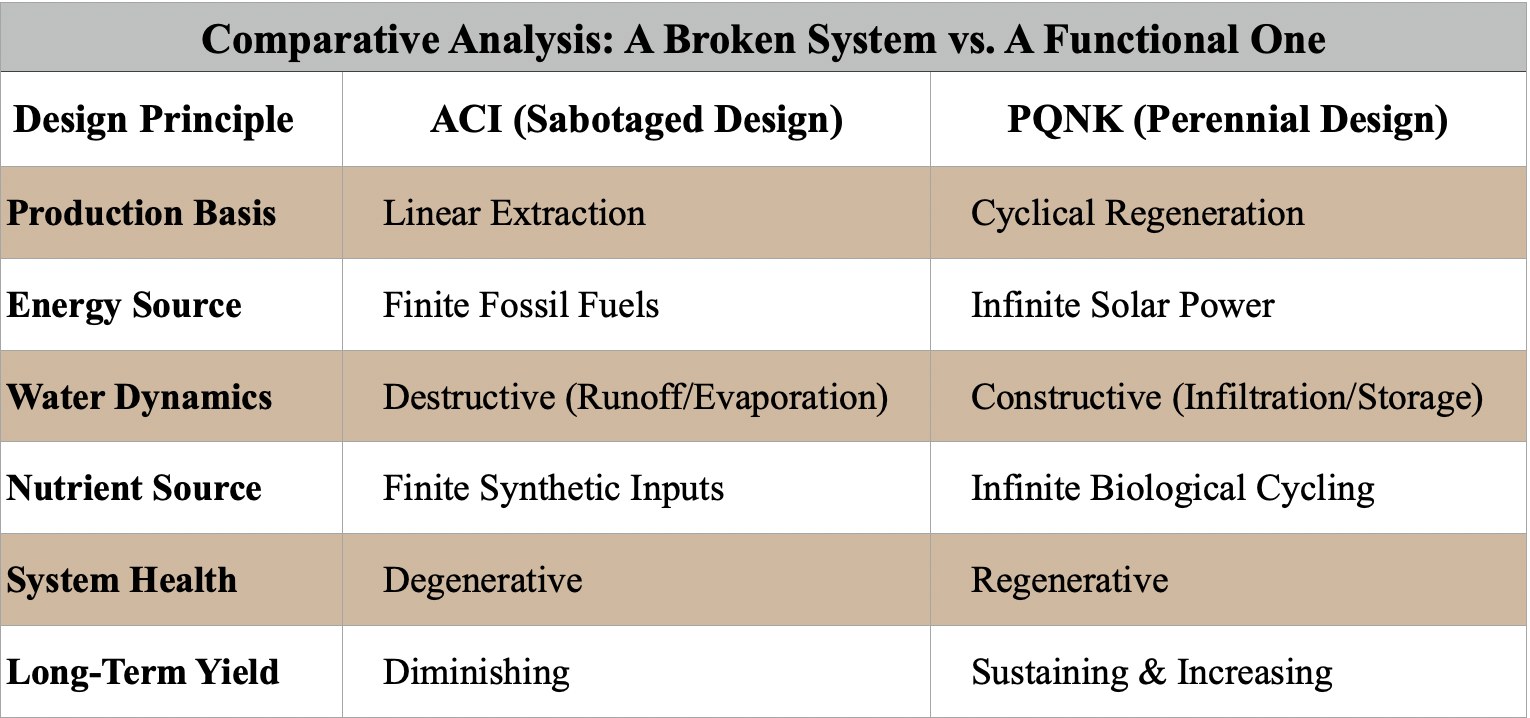
| Design Principle | ACI (Sabotaged Design) | PQNK (Perennial Design) |
|---|---|---|
| Production Basis | Linear Extraction | Cyclical Regeneration |
| Energy Source | Finite Fossil Fuels | Infinite Solar Power |
| Water Dynamics | Destructive (Runoff/Evaporation) | Constructive (Infiltration/Storage) |
| Nutrient Source | Finite Synthetic Inputs | Infinite Biological Cycling |
| System Health | Degenerative | Regenerative |
| Long-Term Yield | Diminishing | Sustaining & Increasing |
5. Conclusion: The Imperative to Restore the Design
The conclusion is undeniable: ACI agriculture broke a perfectly functional system. It replaced a sophisticated, solar-powered, self-renewing production cycle with a crude, fossil-fueled, extractive one. The results—soil degradation, nutritional poverty, water scarcity, and climate change—are not unforeseen accidents but the inevitable consequences of violating natural law.
The path forward is not to improve the sabotage but to end it. This requires a conscious shift:
From Periodicity to Perenniality: Embrace practices that maintain constant soil life and cover.
From Feeding Plants to Feeding the Soil: Recognize that healthy output depends on healthy internal processes.
From Chemical Substitution to Biological Management: Foster the soil microbiome as the primary engine of fertility.
Restoring the perennial design through the PQNK framework is not a nostalgic return to the past but the only intelligent path to a future where agriculture produces abundant, nutritious food while healing the planet. It is the decision to stop breaking the system and start working with it.
www.Facebook.Com/Pedaver
https://www.youtube.com/@pedaverpqnk3167/videos
pedaver@gmail.com
WhatsApp +92 320 677 6666
About This Paper
- Problem
- Hardpan · Bare / Exposed Soil · Runoff · External Input Dependency · Soil Organic Matter / Carbon Loss
- Science
- Soil · Water · Climate
- Evidence
- Philosophical/Framework Argument
- Authority
- Current / Approved PQNK Knowledge
Related PQNK Science
Key Takeaways
- Frames industrial agriculture's core error as breaking a 400-million-year-old perennial soil design, not merely using the wrong inputs or techniques.
- Identifies three acts of sabotage: imposing periodicity via tillage and bare soil (with bare soil able to exceed 70°C), breaking the hydrological cycle via evaporation and runoff, and replacing soil biology with herbicides and soluble NPK.
- Defines a non-negotiable PQNK Triad: no soil disturbance, no bare soil, no soil inundation, as the precondition for five interlocking cycles (soil, water, nutrient, climate, life) to run continuously.
- Describes conventional high-input production as 'dirt-based hydroponics,' where output depends on external input efficiency rather than the land's own biological health.
- Prescribes three paradigm shifts for restoration: periodicity to perenniality, feeding plants to feeding soil, and chemical substitution to biological management.
Related Knowledge
same problem
Rain Where It Falls: Restoring the Soil Before Building More Water Storage
Rajendra Singh’s Rajasthan story shows that slowing runoff lets water enter the ground and restore wells and rivers. PQNK moves that principle upstream into the field itself: correct the hardpan, stop disturbing the soil, keep the surface covered, and let every acre receive and hold the rain where it falls, so that agricultural water demand stays within what the landscape renews.
same problem
The Earth Has Not Stopped Working: A Production-Agriculture Response to Environmental Fatalism, and What PQNK Restores
A widely shared social-media message, built on Lovelock's Gaia Hypothesis, ends in resignation: the planet will correct a stressed system with floods and extinctions, and all we can do is await nature's revenge. This paper accepts that we are not separate from nature but rejects the fatalism. Drawing on more than fifty years in production agriculture, it argues the core error was redesigning natural systems before understanding them, that agriculture is the clearest case, and that a degraded field is a suppressed system rather than an extinguished one, so the answer is not to fear nature's revenge but to stop fighting nature and learn again to produce with it.
same problem
When 13 Inches of Rain Falls in Eight Hours
After 13 inches of rain in eight hours, the PQNK orchard beds of Jaskaran Singh in Fazilka district, Indian Punjab, had taken the water into the soil and could be walked on in slippers, while neighbouring conventional orchards and fields stood under water, and so did a strip of his own orchard where the hardpan had not been broken. The paper explains why hardpan is a water barrier as well as a root barrier, and why the soil is the first reservoir.
same problem
Harvesting Without Irrigation
Crop water requirement is not the same as irrigation requirement. Three field clips show organic residue capturing humidity and dew and keeping the soil beneath it moist and soft, on a roller-compacted road and in the Cholistan Desert, while exposed soil beside it dries and hardens. Receive the rain, store it in the profile, protect it with cover and let roots reach it: on mature PQNK beds at 400 mm or more of annual rainfall, no irrigation is needed.