

KP-063 · Plant Physiology & Production Systems
The Paradox of Resistance: Why Pests Adapt While Humans Degrade – A PQNK Scientific Perspective
A farmer asked why pests evolve immunity to pesticides while human diseases from the same chemicals keep rising. This paper explains both outcomes through the same mechanism operating at different biological scales, rapid population-level genetic selection in short-lived pests versus slow, cumulative, individual-level degeneration in humans, and argues PQNK escapes the trap entirely by removing the toxic pressure driving both.
Read or listen to the full paper ↓Farmer Question
“Why do pests evolve immunity to pesticides while human diseases from the same chemicals keep rising?”
— Asked in a PQNK WhatsApp learning group. Preserved here as Pedaver’s own account of the question, not a verbatim quotation.
Pedaver’s Answer
Abstract
The paper is framed as a direct response to a practitioner's question: how do pests develop resistance to lethal sprays while humans grow more susceptible to the same class of toxic residues, with disease rates rising rather than falling? It treats this as a systems-level insight rather than a simple curiosity, arguing the apparent paradox resolves once the different scale and timeframe of pest versus human exposure is accounted for.
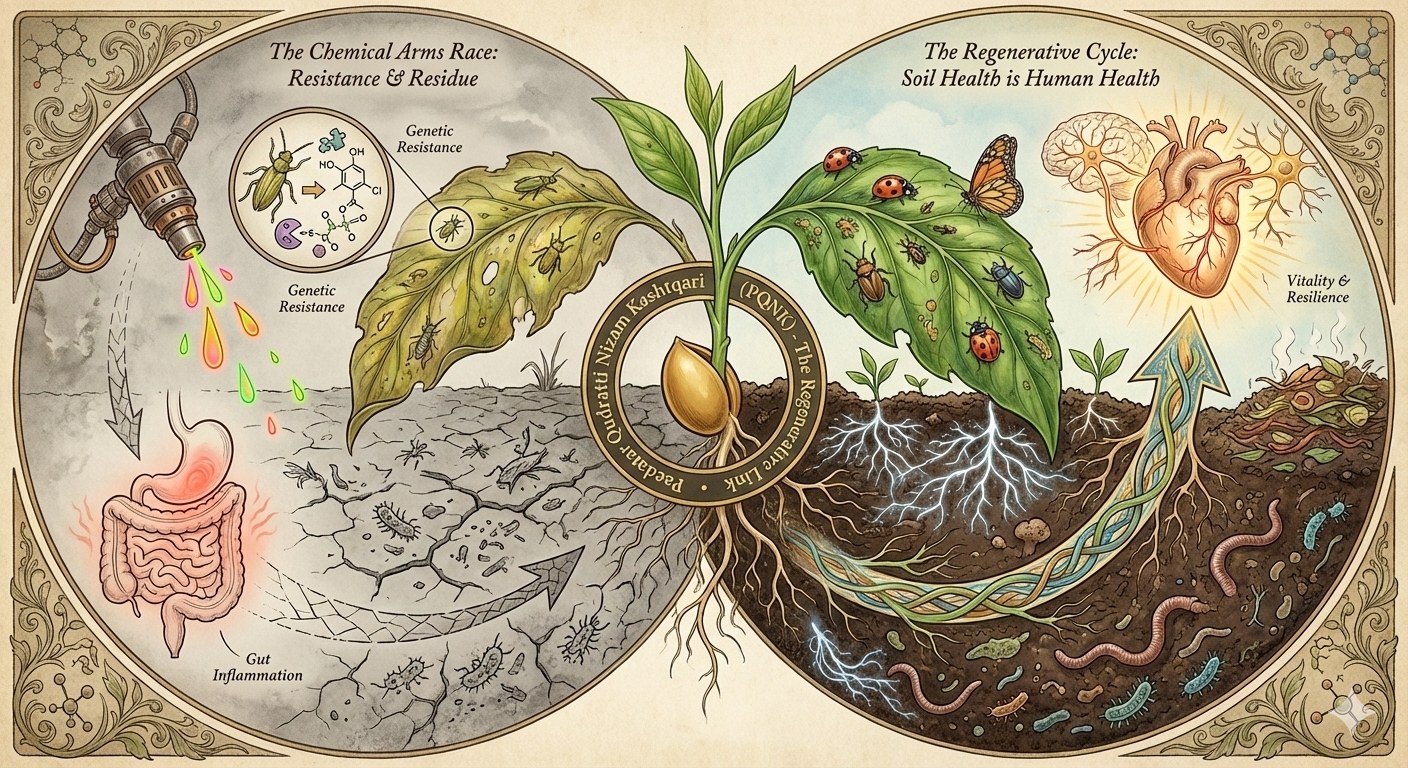
Pest resistance is explained through two reinforcing pathways: rare pre-existing genetic traits (a detoxifying enzyme, a modified nerve receptor) that let a small fraction of the population survive a lethal dose and pass the advantage to offspring, and sub-lethal exposure, where a much larger cohort survives an incomplete dose due to imperfect spray coverage or hiding, and that survival itself acts as a 'training stress' that upregulates detoxification pathways and selects for general tolerance. Each spray cycle, the paper argues, compounds both pathways, rapidly driving population-wide resistance, a narrow, desperate biochemical arms race rather than genuine health.
Human susceptibility is explained by a fundamentally different exposure profile: an insect weighing milligrams faces an acute, body-mass-overwhelming dose creating intense immediate evolutionary pressure across a generation measured in weeks, while a 70kg human accumulates a lifetime of chronic, low-level, multi-residue exposure that bio-accumulates in fatty tissue, compounds synergistically across chemical combinations, and drives endocrine disruption, gut microbiome destruction, and chronic inflammation linked to diabetes, heart disease, and autoimmune conditions. The paper adds a compounding factor: chemically farmed food from depleted soils simultaneously overloads the body with toxins while starving it of the minerals and phytonutrients needed for detoxification and repair.
This produces what the paper calls a great divergence: pests undergo rapid, population-level genetic adaptation, while humans suffer slow, individual-level systemic degeneration, the same underlying mechanism (chronic sub-lethal exposure) producing opposite-looking outcomes because it operates on organisms of radically different scale and lifespan.
PQNK's resolution is framed as systemic rather than chemical: a living soil food web renders synthetic toxins largely unnecessary by cycling nutrients and suppressing pathogens biologically; plants grown in that soil express full defensive phytonutrient potential, protecting the crop and nourishing the person who eats it; biodiversity re-establishes natural predator-prey checks that prevent any single organism from becoming a 'pest'; and the paper closes by drawing a direct 'soil-gut axis' parallel, arguing that microbial diversity in healthy soil mirrors the diversity needed in the human gut, so food grown this way actively fortifies human immunity rather than eroding it.
Full Paper
If you use “Listen”, the text of the page may be sent to your browser or operating system’s speech provider, such as Apple, Google or Microsoft, depending on the voice your device uses. Pedaver does not process, transmit or store any audio.
Question raised by a practicing PQNK farmer:
Sometimes I wonder small creatures like pests develop immunity against lethal sprays, meant to kill them. Why are we, humans so susceptible to toxic residues in the food that diseases are constantly on rise? Or is the mechanism at work but falls short? (Of course I don't mean to suggest any spraying.) Just a curiosity. DrSaab, your valuable guidance please. Deep regards Vasudha
PQNK Answer:
Preamble
A sharp-eyed PQNK practitioner recently posed a profound question:
“Small creatures like pests develop immunity against lethal sprays meant to kill them. Why are we humans so susceptible to toxic residues in food, with diseases constantly on the rise?”
This is not a mere technical query—it is a systems-level insight that cuts to the heart of industrial agriculture’s failure and illuminates the urgent logic of regenerative farming. Through the PQNK lens, we see this not as a paradox but as a predictable outcome of violating nature’s scale and interconnectedness.
I. The Illusion of Pest “Immunity” – A Story of Forced, Narrow Adaptation
Chemical pesticides do not achieve 100% lethal coverage. Survivors emerge through two reinforcing pathways:
1. Genetic Selection (The “Rare Trait”): A minuscule fraction of the pest population possesses pre-existing genetic traits— e.g., an enzyme that detoxifies the chemical or a modified nerve receptor. The spray annihilates the susceptible, leaving these rare individuals to reproduce. Their offspring inherit the advantage.
2. The Sub-Lethal Exposure (The Incomplete Kill): A larger cohort survives simply by not receiving a lethal dose—due to imperfect spray coverage, physical hiding, or rapid chemical breakdown.
• This sub-lethal dose acts as a “training stress,” upregulating the pest’s detox pathways.
• It selects for general robustness and avoidance behaviors, not just rare genes.
Result: Each spray cycle selects from a combined pool of genetic mutants and tolerant survivors, rapidly driving the entire population toward resistance. This is not true health; it is a desperate, narrow-scope biochemical arms race.
II. Human Susceptibility – A Story of Cumulative Systemic Failure
Humans face a fundamentally different exposure scenario, defined by scale, time, and complexity.
1. The Critical Factor of Biological Scale:
• An insect weighs milligrams and completes generations in weeks. A pesticide dose represents a massive challenge per unit of body mass, creating intense, immediate evolutionary pressure.
• A human weighs ~70 kg, with a lifespan of decades. Our per-event exposure is a minuscule fraction of body mass, but it accumulates relentlessly.
2. Chronic, Synergistic, and Insidious Assault: We are exposed to a low-level cocktail of multiple residues daily, over a lifetime. This leads to:
• Bio-accumulation in fatty tissues and organs.
• Synergistic toxicity where chemical combinations amplify harm.
• Systemic Disruption: Endocrine mimicry (cancers, infertility), Gut microbiome destruction (weakening 70% of our immunity), Chronic cellular inflammation (root of diabetes, heart disease, autoimmunity).
3. The Double Burden: Poison with Malnourishment: Chemically farmed food comes from depleted soils, lacking the full spectrum of minerals, vitamins, and phytonutrients needed for detoxification and repair. Our bodies are simultaneously overloaded with toxins and starved of building blocks for resilience.
Thus, the outcomes diverge radically:
Pests undergo rapid, population-level genetic adaptation. Humans suffer slow, individual-level systemic degeneration.
III. The PQNK Resolution: Shifting from War to Wholeness
PQNK recognizes that the pesticide-resistance trap is a symptom of fighting nature’s Qudratti Nizam (Natural System). Our response is not a better chemical, but a systemic transition to resilience.
1. Foundation: The Living Soil Food Web PQNK nurtures soil teeming with microbes, fungi, and earthworms—a biological buffer that cycles nutrients, suppresses pathogens, and renders synthetic toxins irrelevant.
2. Plant Health as Primary Defense Plants grown in such soil express their full genetic potential, producing robust arrays of defensive phytonutrients. These compounds protect the crop and become our nourishment and medicine.
3. Biodiversity as Natural Regulation By fostering habitats for beneficial insects, birds, and microbial diversity, PQNK re-establishes ecological checks and balances, preventing any organism from becoming a “pest.”
4. The Soil-Gut Axis: Completing the Cycle The microbial diversity in healthy soil mirrors the diversity required in the human gut. Food from a PQNK system thus inoculates and fortifies our inner ecosystem, building true, broad-spectrum immunity.
IV. Conclusion: The Practitioner’s Insight Confirms the Science
The practitioner’s observation reveals a cardinal truth: health cannot be built through poison.
Pests develop narrow resistance to acute threats; humans degenerate from chronic, low-dose assaults while starved of real nutrition.
PQNK resolves the paradox by restoring scale and connection. We reject the toxic arms race and choose instead to regenerate the system—from soil microbe to human cell. In this framework, the farmer is the ultimate ecologist and physician, cultivating life that sustains life.
Thus, we answer clearly:
The mechanisms are at work, but they operate on different scales. The solution lies not in winning a war against nature, but in aligning with its wisdom—nurturing the health of the whole system, of which we are an inseparable part.
In the service of science and sustainable life,
Asif Sharif Founder, PQNK | Lahore, Pakistan
Footnote: Any Production Process That Inundates Soil With Water, Disturbs Soil Through Tillage, Or Leaves Soil Bare Without Organic Mulch Cover Does Not Qualify As Natural Ecosystem Science For Production Agriculture.
PQNK, to be pronounced as 'picnic', which stands for Paedar Qudratti Nizam Kashatqari, and means: the regenerative & sustainable Pristine Organic Farming System.
About This Paper
- Problem
- Pesticide Resistance · Contamination / Residue / Food Safety Risk
- Science
- Crop Protection · Food Quality · Nutrition
- Evidence
- Scientific Mechanism
- Authority
- Current / Approved PQNK Knowledge
Related PQNK Science
Key Takeaways
- Resolves the apparent paradox by scale: pest resistance is rapid, population-level genetic adaptation over generations measured in weeks; human susceptibility is slow, individual-level degeneration accumulated over decades.
- Sub-lethal pesticide exposure acts as a 'training stress' that upregulates detoxification pathways in surviving pests, compounding with rare genetic resistance to drive population-wide resistance faster than genetics alone would predict.
- Humans face chronic, synergistic, multi-residue exposure that bio-accumulates and is linked to endocrine disruption, gut microbiome damage, and chronic inflammatory disease.
- Identifies a 'double burden': chemically farmed food from depleted soils delivers toxins while simultaneously lacking the minerals needed for the body's own detoxification and repair.
- Draws a direct 'soil-gut axis' parallel: the microbial diversity PQNK builds in soil is argued to mirror and support the diversity required for human gut and immune health.
- Frames the PQNK response as systemic (soil biology, plant nutrient density, biodiversity) rather than chemical, aiming to remove the evolutionary pressure that drives both pest resistance and human harm.
Related Knowledge
same problem
Two Pathways to "Pest Resistance": Genetic Selection, Sub-Lethal Dosing, and the Human Parallel
Answers a farmer's question about why pests develop resistance to sprays while humans grow more susceptible to residues, identifying a second, dosage-driven resistance pathway alongside classic genetic selection, and drawing a direct parallel to chronic low-dose human toxin exposure.
same problem
Chemical Fertiliser Dependency Through the PQNK Lens
An evidence-qualified review of the article “Chemical Fertilizer Industry”. It keeps the article's warning about soil degradation, nutrient pollution and biological decline, disciplines its headline numbers, and argues that fertiliser dependency is a symptom of a damaged production system (tillage, flooding, bare soil and simplified biology) that PQNK removes by restoring aerated, covered, living soil, reaching zero purchased fertiliser and pesticide at maturity.
same problem
Wheat Hybrid and Organic Wheat Through the PQNK Lens
A PQNK response to a widely circulated review comparing hybrid and organic wheat, arguing that hybrid describes genetics while organic describes a production standard, so the two are not opposite categories that can be compared directly. Applies PQNK's seed-is-potential, soil-is-the-production-system framework to modern wheat breeding, chemical dependence, organic certification, water management and the health claims made against modern wheat.
same problem
GMO Maize and the Question Pakistan Has Not Yet Asked: Before Engineering the Plant, Should We Restore the Biological System That Protects It?
Pakistan is weighing whether to commercialize GM maize while its domestic hybrid-seed industry warns that pollen-mediated gene flow could compromise non-GM seed stocks. This paper argues the debate is incomplete: before comparing GM maize against non-GM maize, Pakistan should test both against the same hybrid grown under a fully restored PQNK biological production system, since Bt itself began as a naturally occurring soil bacterium and no genetic trait can substitute for repairing the degraded ecosystem in which the plant must function.