

KP-077 · PQNK Philosophy, Framework & Economics
The Foundational Primacy of Agriculture Over Industry: A Knowledge Paper Through the PQNK Lens
This paper argues that agriculture, in its pristine PQNK form, is the non-negotiable, self-sufficient foundation of human civilization, while industry is a conditional, derivative superstructure that should serve the harvest rather than the other way around. It closes with a proposal for a national PQNK services entity that would deliver machinery, training, and market access without interfering with farming itself.
Read or listen to the full paper ↓Abstract
The paper opens by arguing that human civilization routinely conflates progress with industrialization while neglecting the foundation that makes all activity possible, and sets out to re-establish a hierarchy between agriculture and industry using PQNK as the evaluative benchmark. Its core thesis holds that pristine organic agriculture is the indispensable foundation for life, while industry is conditional and supplementary to it.
PQNK's key tenets are laid out as the basis for this hierarchy: nature provides an abundance of geological minerals that soil life processes into plant-available form; roughly 95% of a plant's mass derives from air and sunlight via photosynthesis, with soil providing only trace elements; water functions as a nutrient carrier analogous to blood rather than a primary input; and a correctly managed system requires zero external synthetic inputs.
From this the paper draws its central metaphor: agriculture is the trunk of the tree of life and economy, industry is a branch, and a branch cannot survive if the trunk is weakened. For Pakistan specifically, it argues the strategic imperative is to recognize agriculture's primacy, redirect policy and intellectual focus toward PQNK, and re-define industry's role as a subordinate service provider, one that does not feed the farm but serves the harvest through value addition, logistics, purpose-built machinery manufacturing, and market access, rather than supplying the farm's fertility.
To operationalize this, the paper proposes a national public or public-private PQNK Services System offering training and certification of production managers and machine operators, an 'agro-rental' network for custom-hire access to PQNK machinery, supply-chain aggregation and quality assurance connecting farms to markets, a 'sell-before-produce' hedging model to de-risk farming and secure incomes in advance, and the promotion of Crop Production Management Companies that manage production on a programmed, contractual basis to move farming from speculative to planned production.
It closes with a contrast between this model and extractive industries such as mining, which the paper argues require capital Pakistan often lacks and typically repatriate the bulk of benefits to foreign firms, whereas PQNK leverages resources that are already sovereign and national, sun, soil, and people, keeping value creation inside the country and building a genuinely self-reliant economy.
Full Paper
If you use “Listen”, the text of the page may be sent to your browser or operating system’s speech provider, such as Apple, Google or Microsoft, depending on the voice your device uses. Pedaver does not process, transmit or store any audio.
Preamble
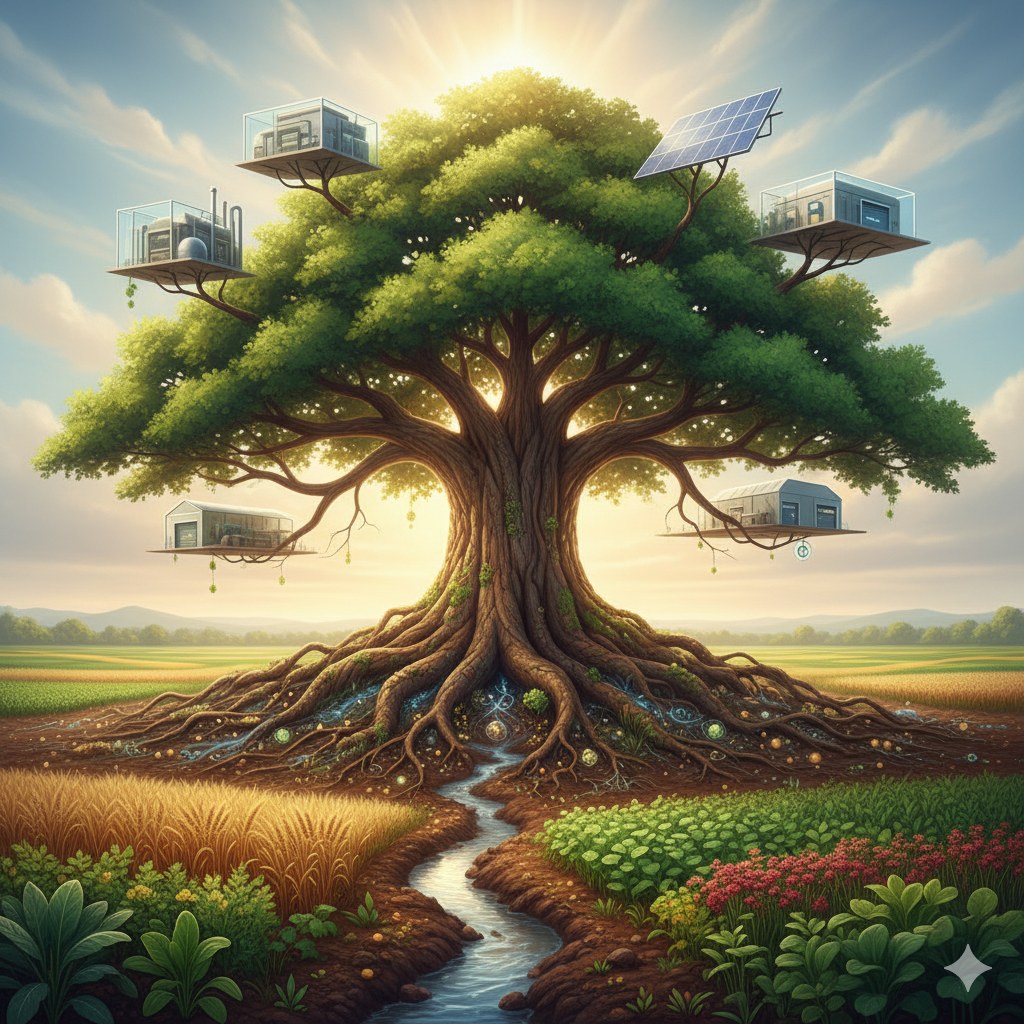
Human civilization stands at a crossroads, often conflating progress with industrialization while neglecting the very foundation that makes all life and activity possible. This paper seeks to re-establish the fundamental hierarchy of human needs and the systems that fulfill them. By evaluating Agriculture and Industry through the regenerative and sustainable paradigm of Paedar Qudratti Nizam Kashatqari (PQNK)—the Pristine Organic Farming System—we can clearly delineate the indispensable from the supplementary. The core thesis is that Agriculture, specifically in its pristine organic form, is the non-negotiable, self-sufficient foundation for life, while Industry is a conditional, derivative superstructure.
The Foundational Context: PQNK as the Benchmark
PQNK is not merely a farming technique; it is a philosophy and a practice that aligns with nature's inherent design. It operates on the principle that nature has already provided a complete, self-regulating, and abundant system for producing life's essentials. The system's key tenets are:
Abundance of Raw Materials: Nature provides all necessary geological minerals in the soil, which are processed by soil life into a perfectly balanced, plant-available form.
Atmospheric Primacy: 95% of a plant's mass is derived from air and sunlight (carbon, hydrogen, oxygen), processed through photosynthesis. The soil provides only trace elements to complete the recipe.
Water as a Nutrient Carrier: Water's role is analogous to blood, a medium for transporting nutrients, not a primary input in the industrial sense.
Zero External Inputs: When managed correctly, the system is regenerative and requires no synthetic fertilizers, pesticides, or external amendments.
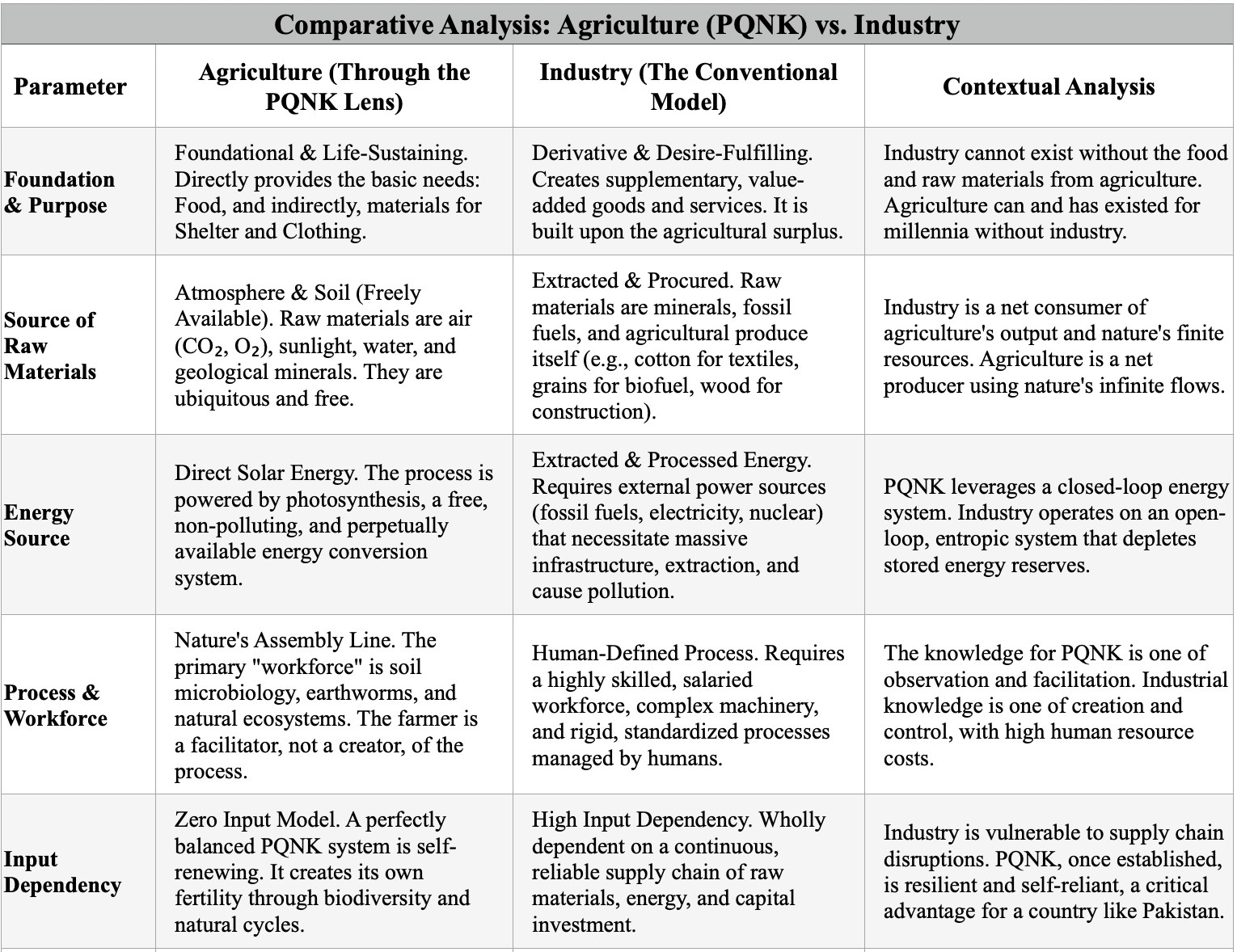
| Parameter | Agriculture (Through the PQNK Lens) | Industry (The Conventional Model) | Contextual Analysis |
|---|---|---|---|
| Foundation & Purpose | Foundational & Life-Sustaining. Directly provides the basic needs: Food, and indirectly, materials for Shelter and Clothing. | Derivative & Desire-Fulfilling. Creates supplementary, value-added goods and services. It is built upon the agricultural surplus. | Industry cannot exist without the food and raw materials from agriculture. Agriculture can and has existed for millennia without industry. |
| Source of Raw Materials | Atmosphere & Soil (Freely Available). Raw materials are air (CO₂, O₂), sunlight, water, and geological minerals. They are ubiquitous and free. | Extracted & Procured. Raw materials are minerals, fossil fuels, and agricultural produce itself (e.g., cotton for textiles, grains for biofuel, wood for construction). | Industry is a net consumer of agriculture's output and nature's finite resources. Agriculture is a net producer using nature's infinite flows. |
| Energy Source | Direct Solar Energy. The process is powered by photosynthesis, a free, non-polluting, and perpetually available energy conversion system. | Extracted & Processed Energy. Requires external power sources (fossil fuels, electricity, nuclear) that necessitate massive infrastructure, extraction, and cause pollution. | PQNK leverages a closed-loop energy system. Industry operates on an open-loop, entropic system that depletes stored energy reserves. |
| Process & Workforce | Nature's Assembly Line. The primary "workforce" is soil microbiology, earthworms, and natural ecosystems. The farmer is a facilitator, not a creator, of the process. | Human-Defined Process. Requires a highly skilled, salaried workforce, complex machinery, and rigid, standardized processes managed by humans. | The knowledge for PQNK is one of observation and facilitation. Industrial knowledge is one of creation and control, with high human resource costs. |
| Input Dependency | Zero Input Model. A perfectly balanced PQNK system is self-renewing. It creates its own fertility through biodiversity and natural cycles. | High Input Dependency. Wholly dependent on a continuous, reliable supply chain of raw materials, energy, and capital investment. | Industry is vulnerable to supply chain disruptions. PQNK, once established, is resilient and self-reliant, a critical advantage for a country like Pakistan. |
Using this lens, we compare the two systems.
Conclusion and Strategic Imperative for Pakistan
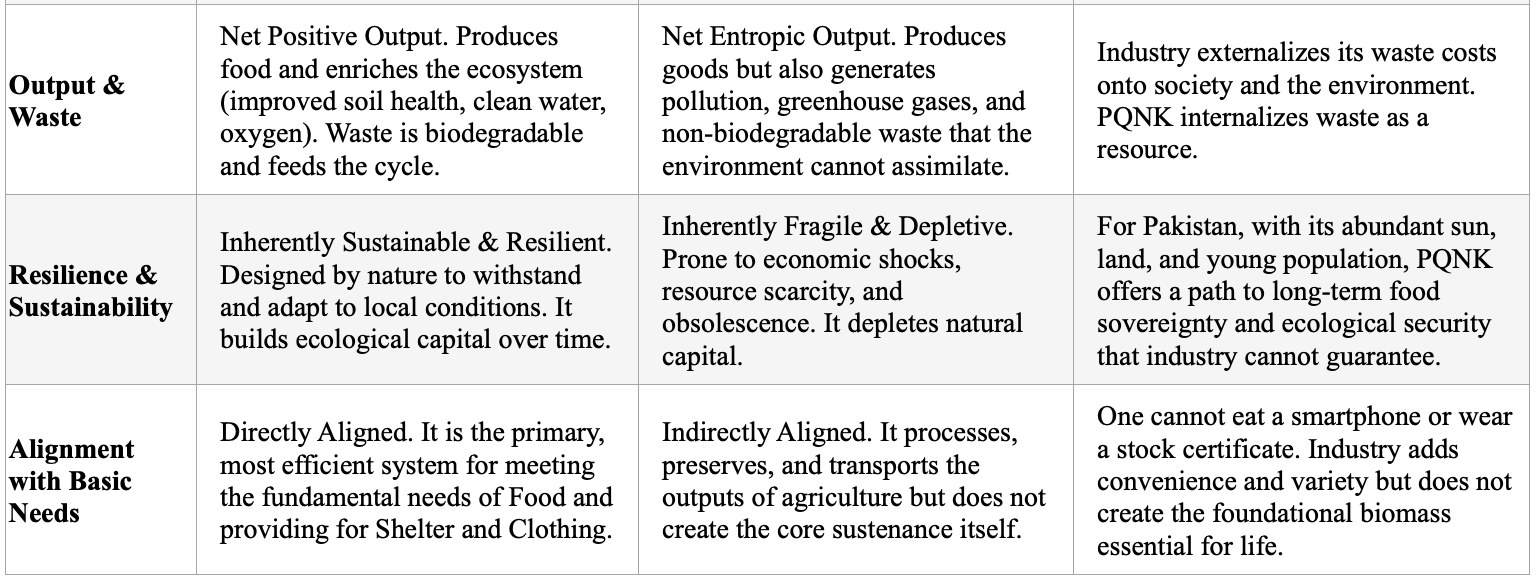
| Parameter | Agriculture (Through the PQNK Lens) | Industry (The Conventional Model) | Contextual Analysis |
|---|---|---|---|
| Output & Waste | Net Positive Output. Produces food and enriches the ecosystem (improved soil health, clean water, oxygen). Waste is biodegradable and feeds the cycle. | Net Entropic Output. Produces goods but also generates pollution, greenhouse gases, and non-biodegradable waste that the environment cannot assimilate. | Industry externalizes its waste costs onto society and the environment. PQNK internalizes waste as a resource. |
| Resilience & Sustainability | Inherently Sustainable & Resilient. Designed by nature to withstand and adapt to local conditions. It builds ecological capital over time. | Inherently Fragile & Depletive. Prone to economic shocks, resource scarcity, and obsolescence. It depletes natural capital. | For Pakistan, with its abundant sun, land, and young population, PQNK offers a path to long-term food sovereignty and ecological security that industry cannot guarantee. |
| Alignment with Basic Needs | Directly Aligned. It is the primary, most efficient system for meeting the fundamental needs of Food and providing for Shelter and Clothing. | Indirectly Aligned. It processes, preserves, and transports the outputs of agriculture but does not create the core sustenance itself. | One cannot eat a smartphone or wear a stock certificate. Industry adds convenience and variety but does not create the foundational biomass essential for life. |
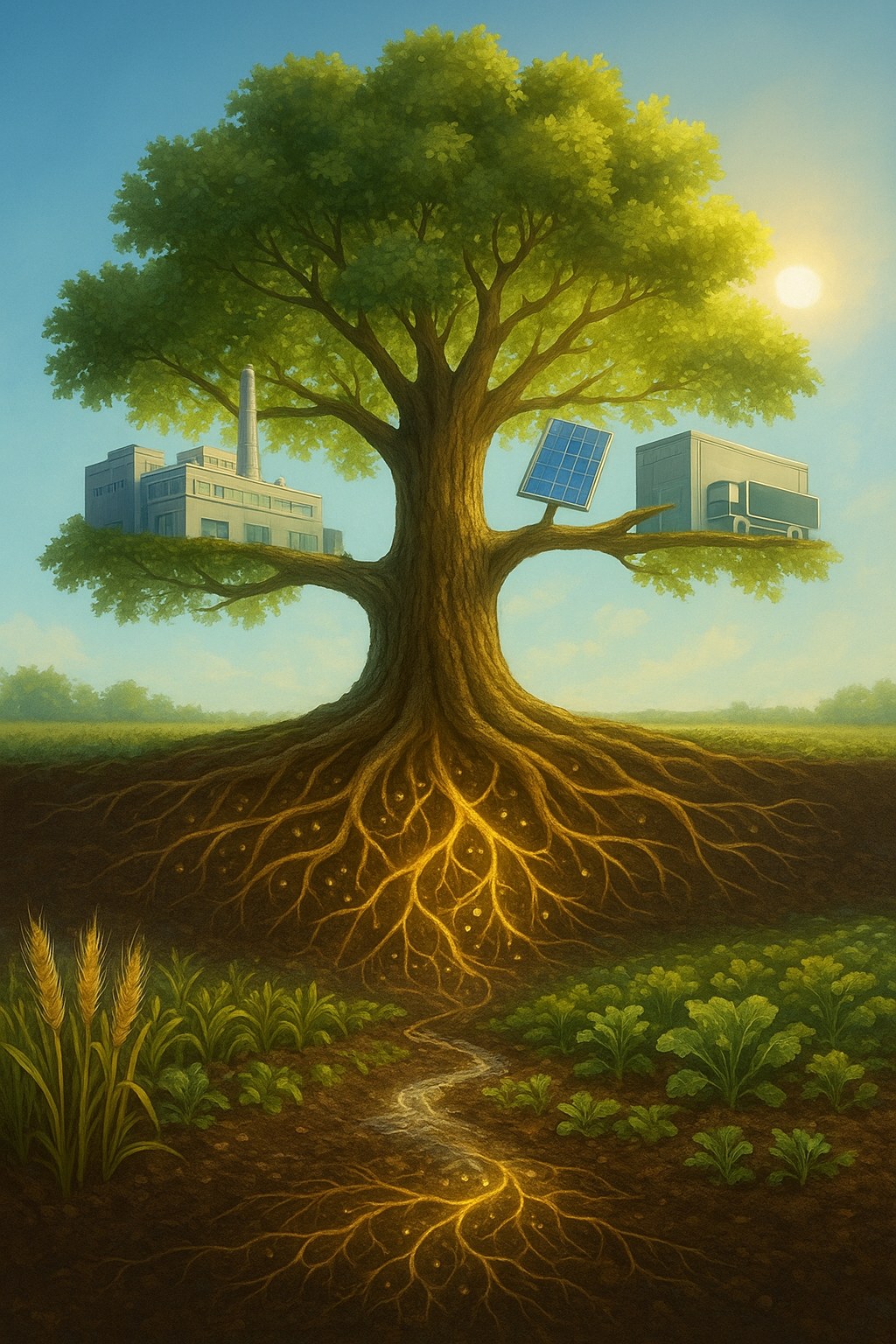
The comparison is not merely asymmetrical; it is hierarchical. Agriculture is the trunk of the tree of life and economy; industry is a branch. A branch, no matter how large, cannot survive if the trunk is weakened.
For Pakistan, an agricultural country blessed with abundant sunlight, fertile land, and a large rural population, the strategic imperative is clear:
Recognize Primacy: Acknowledge that a thriving, resilient agricultural sector based on PQNK principles is the nation's foremost priority and its greatest strategic asset.
Invest in the Foundation: Redirect policy and intellectual focus towards understanding, promoting, and implementing PQNK. This is not a return to the past but an evolution into a sustainable future based on bio-mimicry.
Re-define Industry's Role: A Subordinate Service Provider. Within the PQNK framework, the farming process itself requires no industrial inputs. Therefore, industry must be re-envisioned not as a replacement for agriculture, but as its subordinate service provider. Its role is not to feed the farm but to serve the harvest. PQNK provides the raw materials, and industry's functions are:
Value Addition & Logistics: Processing, packaging, storage, and transportation of the abundant raw produce.
Purpose-Built Machinery: Manufacturing and maintaining specific, non-invasive tools designed to enhance efficiency within the PQNK system without disrupting its ecological balance.
Market Access: Creating the supply chains to connect pristine organic produce to local and global markets.
The Implementation Vehicle: A National PQNK Services System
To operationalize this, a large-scale program should be launched through a nationwide public or public-private entity. This entity would not interfere with farming but would enable it at a national scale by providing:
Training & Capacity Building: A massive program for certifying Production Managers and Machine Operators in PQNK principles and practices.
Agro-Rental Services: Supporting custom hiring services (an "agro-rental" network) to ensure every farmer has access to purpose-built PQNK machinery.
Supply Chain Management: Collecting, aggregating, and quality-assuring the produce from PQNK farms and supplying it directly to wholesalers, retailers, exporters, and processors.
Financial Innovation & Risk Management: The entire operation should be based on a 'sell-before-produce' (hedging) model, securing prices and markets in advance to de-risk farming and ensure stable incomes for producers.
Promotion of Crop Production Management Companies (CPMC): Introduce and encourage CPMCs that manage production on a programmed, contractual basis. This ensures consistent quality, predictable volumes, and a seamlessly maintained supply chain, moving from speculative farming to planned production.
A Final Contrast: The PQNK Advantage over Extractives
This model stands in stark contrast to the extractive industrial model, such as mining for oils and minerals. Such ventures require immense technical and financial capital that Pakistan often lacks, leading to contracts where the bulk of the benefits are repatriated by the foreign exploration company. PQNK, however, leverages resources that are already sovereign and national—our sun, soil, and people—ensuring that the value created remains within the country, empowering rural communities, and building a truly self-reliant economy.
By embracing the PQNK system, Pakistan can achieve true self-reliance in food, regenerate its environment, and build an economy on the most solid foundation possible: the boundless, life-giving capacity of a pristine natural world.
Glossary:
PQNK (Paedar Qudratti Nizam Kashatqari): The Regenerative & Sustainable Pristine Organic Farming System. A knowledge system that facilitates nature's own production mechanisms without external inputs.
Entropic: A process that leads to increasing disorder and the dissipation of energy and resources, often producing waste.
CPMC (Crop Production Management Company): An entity that manages agricultural production on a programmed basis to ensure supply chain efficiency and quality control.
—————————
Footnote: Any Production Process That Inundates Soil With Water, Disturbs Soil Through Tillage, Or Leaves Soil Bare Without Organic Mulch Cover Does Not Qualify As Natural Ecosystem Science For Production Agriculture.
PQNK, to be pronounced as 'picnic', which stands for Paedar Qudratti Nizam Kashatqari, and means: the regenerative & sustainable Pristine Organic Farming System.
www.Facebook.Com/Pedaver
https://www.youtube.com/@pedaverpqnk3167/videos
pedaver@gmail.com
WhatsApp +92 320 677 6666
About This Paper
- Problem
- External Input Dependency · Farmer Uncertainty / Diagnostic Skill Gap · Macro / Policy-Level Externalities
- Science
- Plants · Economics · Production Architecture
- Evidence
- Philosophical/Framework Argument
- Authority
- Current / Approved PQNK Knowledge
Related PQNK Science
Key Takeaways
- Argues agriculture in its pristine (PQNK) form is civilization's non-negotiable foundation, while industry is a conditional, derivative superstructure, illustrated as the trunk versus a branch of the same tree.
- Cites the PQNK tenet that roughly 95% of a plant's mass derives from air and sunlight via photosynthesis, with soil supplying only trace elements, as grounding for agriculture's self-sufficiency.
- Re-defines industry's proper role as a 'subordinate service provider' to agriculture: value addition, logistics, and machinery manufacturing, not a supplier of fertility or an equal partner.
- Proposes a national PQNK Services System combining farmer/operator certification, an agro-rental machinery network, supply-chain aggregation, and a 'sell-before-produce' hedging model to de-risk farming.
- Promotes Crop Production Management Companies (CPMCs) as a vehicle for moving from speculative to planned, contractual agricultural production.
- Contrasts PQNK's use of sovereign national resources (sun, soil, people) with extractive industries like mining, which the paper argues require external capital and repatriate most benefits abroad.
Related Knowledge
same problem
Knowledge Paper: The PQNK Imperative — Re-Mothering Our Agriculture through the Pristine Organic System
This paper reframes a century of input-intensive farming as a severed relationship between plant and soil, using the metaphor of 'Soil as Mother' to argue that the Green Revolution orphaned crops by feeding them directly rather than nurturing the system that was designed to feed them. It closes with a policy agenda for 're-mothering' agriculture through machinery subsidies, farmer training, and GMO safeguards.
same problem
Five Decades of Agricultural Innovation: Interventions and Achievements in Chronological Order, 1973–2023
Asif Sharif's own year-by-year record of fifty years of hands-on agricultural intervention in Pakistan, from early machinery and seed distribution through the 2008 development of PQNK and its crop-by-crop expansion since, presented as the primary evidentiary record behind PQNK: a ground-up, farmer-verified track record rather than a journal citation.
same problem
Beyond the Traditional Cooperative
Argues that smallholders need a third structure between the traditional cooperative and the corporation: individual land ownership and accountability combined with professional production management, machinery services, risk protection, processing and collective market power. Draws on cooperative, machinery-service, land-reform and price-reform experience in Yugoslavia, Pakistan, India and Scandinavia to propose the farmer-owned Crop Production Management Company (CPMC) as the institutional vehicle for PQNK.
same problem
The Science Behind the Myth of Cow Dung and Urine
A knowledge paper separating ecological fact from belief-driven practice around cow dung and urine as farm inputs, explaining why the same material functions as recycling in a forest but as import-dependency on a conventional farm, and setting PQNK's boundaries on animal integration.